


Amazon on October 8, 2026 opened pre-orders for two Android tablets designed for children, priced from $229.99 and $329.99, each sold with a protective case, a one-year subscription to its Kids+ content service and parent-managed access to the Google Play store, according to a post on the company's news site.
In Short
Amazon is selling two new tablets for children that run Android and can download apps from Google Play, but only after a parent approves each download. The tablets matter to families choosing a first device, and also to app makers and advertisers, because the rules on collecting data from children apply to whatever runs on them. Orders are open now, deliveries start October 14 in four countries and October 19 in five more, and the announcement says little about how a new voice-driven story tool handles children's voice data.
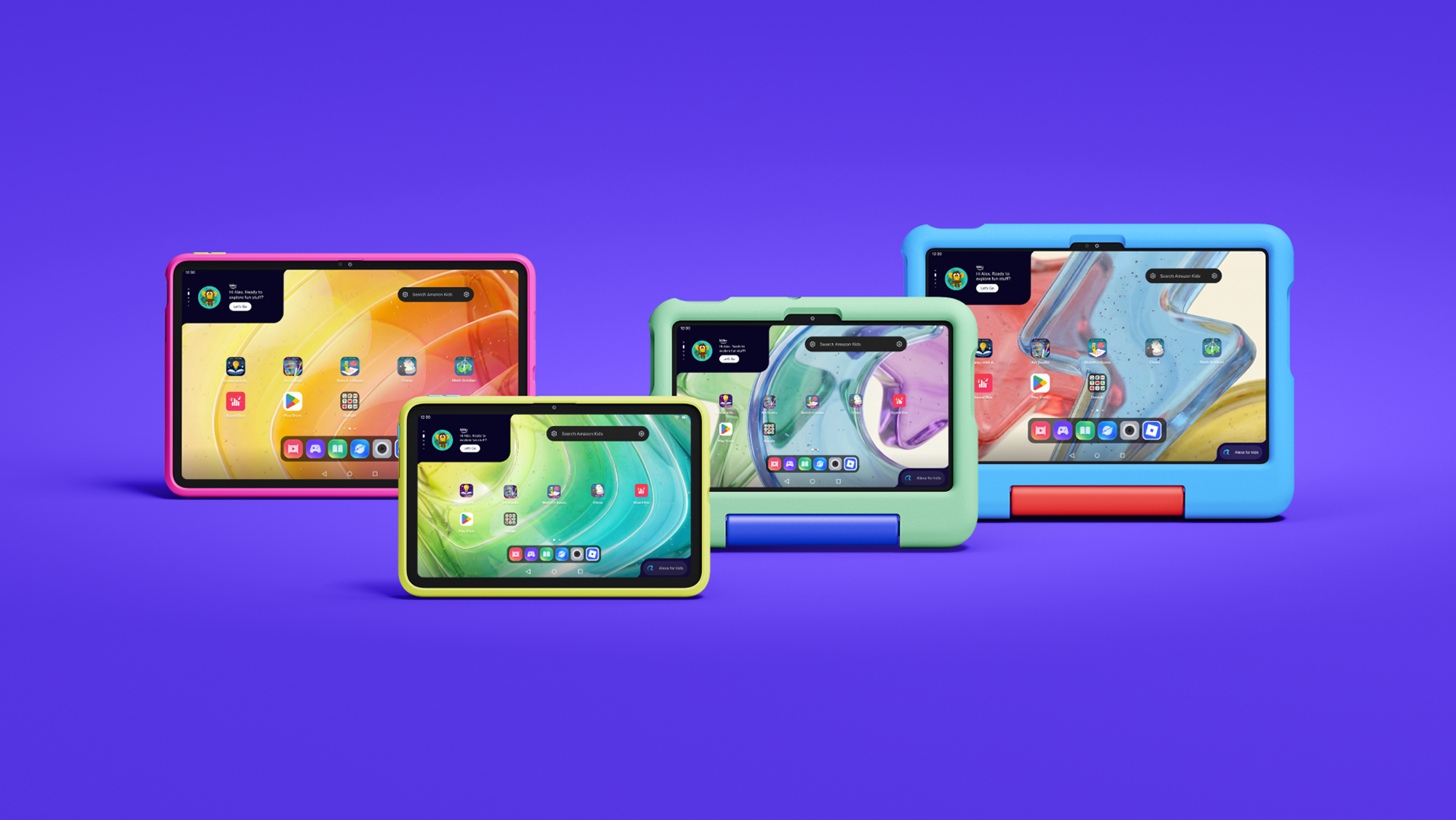
What Amazon published on October 8
Amazon posted the announcement on October 8, 2026, under the byline "Amazon Staff", with a stated reading time of four minutes. It describes two Android tablets, one with an 8.7-inch display and one with an 11-inch display, sold in versions for children aged 3 and over and for those aged 6 and over. According to Amazon, each unit ships with a case, a one-year Kids+ subscription, the Parent Dashboard control app pre-installed, and a one-year limited warranty.
The company frames the product line around a parental dilemma. "Few decisions feel trickier for parents than choosing the right device for their child," the post states, adding that parents "want devices and age-appropriate content that their kids will love and that they can trust." Amazon says its Kids devices were designed "to solve for both."
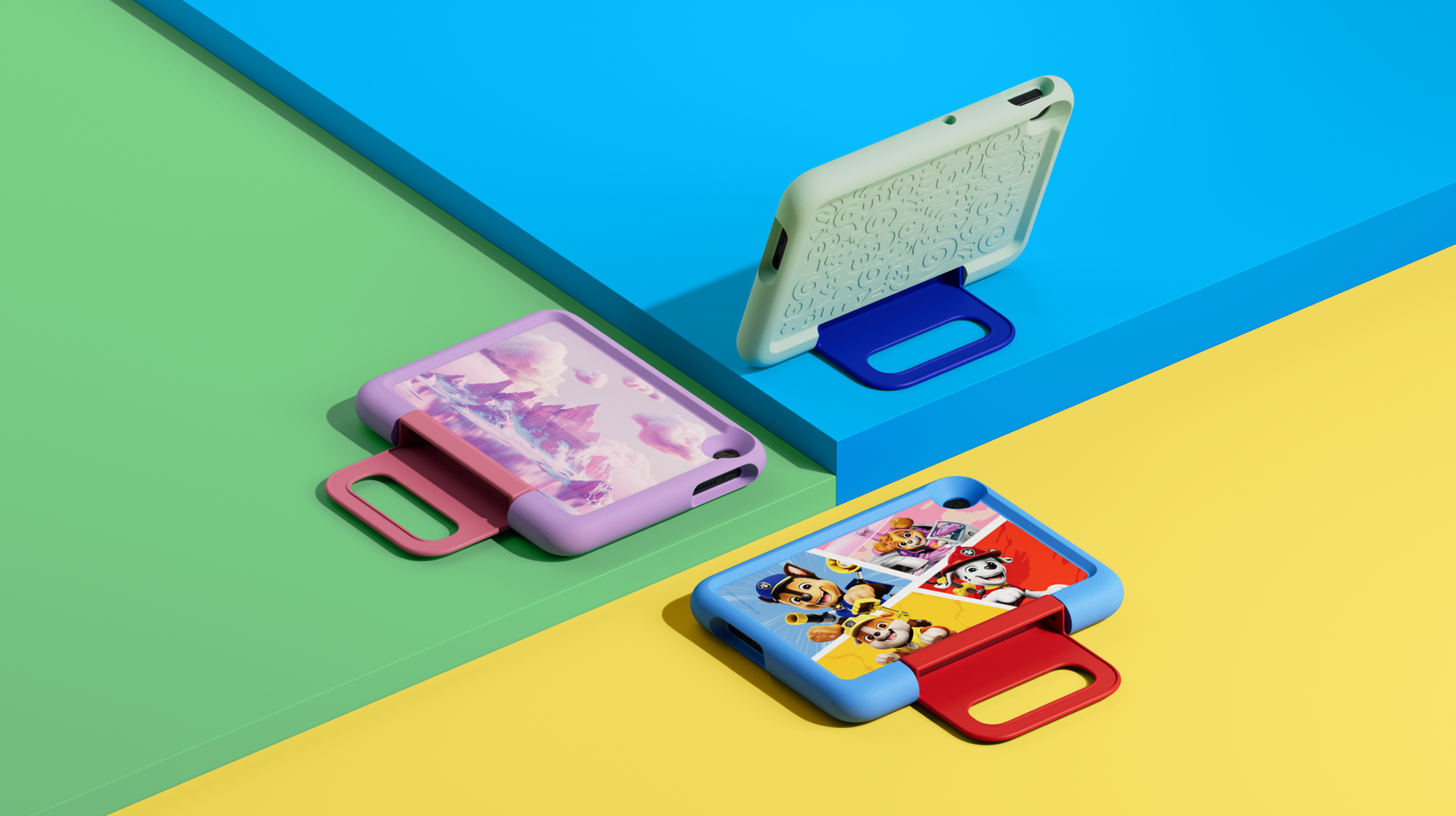
One detail needs care. The hardware section of the post calls the models "Amazon Kids Tablet 8.7-inch" and "Amazon Kids Tablet 11-inch", whereas the pricing section calls them "Amazon Kids Tablet 8" and "Amazon Kids Tablet 11". The two names appear to refer to the same products. The post also never says which screen size goes with which age band; it says only that the younger version comes with "a soft bumper" and the older with a "slim hard case", the latter in designs drawn from characters such as Paw Patrol, Barbie and SpongeBob SquarePants.
Hardware
The two sizes differ by more than screen area. The 8.7-inch model has a display Amazon describes as vivid, 14 hours of video playback and 64 GB of storage, which the company pitches at offline downloads of shows, games and books. The 11-inch model has a 2.5K display, 8 GB of RAM and stylus support, aimed at drawing and homework. "Kids want a real tablet, not a toy," the post says.
What the post omits is considerable. No processor is named, no battery capacity is given, and the Android version goes unstated. The smaller model has no RAM figure; the larger one has no storage figure.
Prices, dates and markets
Both tablets can be pre-ordered now and ship on October 14 in the United States, Mexico, Canada and Japan, according to Amazon. Five European markets follow on October 19: the UK, Germany, France, Italy and Spain. The Tablet 8 starts at $229.99 and the Tablet 11 at $329.99. Amazon.com is the direct channel, with select retail partners, including Best Buy and Target, also carrying the devices.
The word "starts" matters here, since the post does not explain what moves a price above the entry figure. Nor does it list prices in pounds, euros, yen or pesos for the nine countries, only in dollars.
Kids+ carries its own price once the bundled year ends. Amazon lists ongoing subscriptions from $7.99 a month for Prime members and $8.99 a month for non-Prime customers. Twelve months at those rates comes to $95.88 and $107.88 respectively. For comparison, Amazon renamed FreeTime Unlimited as Amazon Kids+ in September 2020, with monthly prices of $2.99 for Prime members and $4.99 for others and a catalogue of more than 20,000 books, movies, Audible books, games and Spanish-language content. The two price points are not like-for-like, because the 2026 post gives no title count or content scope.
Parent Dashboard, Google Play and the approval step
Parent Dashboard comes pre-installed on each tablet and also exists as a free app for iOS and Android. From it, according to the post, parents can set screen-time limits, monitor activity, find age-appropriate books, apps, games, videos and audiobooks, control web browsing, and pause or resume a child's device remotely. A "Learn First" setting lets parents prioritise Kids+ reading and educational apps ahead of entertainment. Profiles can be created for up to four children, and settings carry across compatible Amazon devices.
Google Play is the structural change. Amazon lists "parent-managed access to Google Play" as something the new tablets add to the existing kids lineup, and says that, because the devices run Android, parents can manage access to the full Google Play store and so add apps beyond the Kids+ catalogue. The approval step is stated plainly: "Every download goes through parental approval, so kids get more room to explore and parents stay in control."
Separately, the same page carries a teaser for a different range, Amazon Alexa Tablets with Alexa+ built in, which it says come with "full Google Play Store access". That range is not described further.
A download gate and a data practice are different things, though. Approval governs what lands on the device. What an installed app collects, which software development kits it embeds and what advertising it serves fall to the developer and, for services directed at children in the United States, to COPPA, the 1998 federal law requiring parental approval before children's personal data is collected. The post describes no screening of Play apps beyond the approval step.
The post also describes child profiles that parents create, not any method of estimating or verifying a child's age. That puts the design at some distance from the age assurance schemes now being debated in the UK, the EU, Australia and US states.
Storybuilder, voice input and the data question
Among the additions is Storybuilder, which Amazon places inside Kids+. It is described as "a new AI-powered creative experience where kids use their voice to dream up characters, plot twists, and entire worlds", with the output turned into picture books and comic books that children can share with their parents. Amazon adds that "every interactive feature is purpose-built for kids, with guardrails that keep the experience age-appropriate and give parents confidence that their children are exploring safely." Parent Dashboard also shows parents what children make in Stories with Alexa, Storybuilder and Art Studio.
Because Kids+ runs across Fire tablets, Kindle devices, Fire TV, Echo devices and adult Alexa-enabled tablets set up with a child profile, Storybuilder may not be limited to the new hardware. The post does not say.
Nor does it say how the voice input is processed. No AI model is named. There is no statement on whether recordings or transcripts are kept, for how long, or whether a parent can delete them. Those omissions carry weight given the company's history. In a blog post dated May 31, 2023, the FTC described a $25 million civil penalty over Amazon's handling of children's Alexa voice recordings. According to the FTC, Amazon kept those recordings indefinitely and, when parents asked for deletion, removed the files from some databases while retaining transcripts elsewhere, tied to persistent identifiers linked to the child's account.
The rules have tightened since. The amended children's privacy rule, in force since June 23, 2025, widens the definition of personal information to additional persistent identifiers and biometric data, with voice recognition among the examples cited. It requires separate verifiable parental consent before a child's data is disclosed to third parties, advertisers and data brokers included, and written retention policies with deletion timeframes set out in privacy notices. Full compliance for most provisions fell due on April 22, 2026, roughly six months before pre-orders for the tablets opened.
Where a parent's download approval sits relative to that separate consent is a question the post leaves untouched.

Why the advertising sector is watching children's devices
For marketers, the immediate fact is an absence. Kids+ is described as "handpicked, ad-free content", and Amazon calls it "the only subscription for kids that spans books, shows, games, apps, and audiobooks" - a claim made by the company itself. As a closed, curated catalogue, it works as a walled garden with no advertising inside it. The Google Play route is the opposite: an open catalogue of third-party apps, each with its own commercial model. The ad-free label is attached to Kids+ content. The post does not say whether it extends to apps added from Play, and it does not say whether the device itself carries advertising anywhere.
That sits within a wider reshaping of how children's audiences are reached. YouTube's compliance deadline of April 22, 2026 required every creator to state whether content is designed for children, with personalised ads switched off on made for kids content and civil penalties of up to $53,088 per violation in the background; Disney agreed to pay $10 million in September 2025 over failing to designate child-directed YouTube content as made for kids. On the supply side, Roblox named SuperAwesome its sole third-party partner for under-13 advertising worldwide on June 4, 2026, covering video billboards, branded portals, homepage ads and sponsored tiles, with targeting based on content classification, not on persistent identifiers or behavioural tracking. The approach is contextual advertising.
Enforcement has also grown heavier. On August 21, 2026, the US Department of Justice filed a consent motion in the TikTok case tied to a $400 million payment, split into $300 million immediately and $100 million after a court order vacating the 2019 consent decree, with a hearing set for September 21, 2026.
Taken together, these points describe an environment in which children's inventory is being organised around contextual signals and parental consent, while penalties for getting it wrong have reached nine figures. Amazon's tablets add a hardware-level channel to that picture, one whose advertising position is, for now, defined mostly by what the post does not say. How much of the Play store's app population carries advertising, and under which consent arrangements, will determine whether these devices matter to the media-buying side at all.
Timeline
- September 14, 2020: Amazon renames FreeTime and FreeTime Unlimited as Amazon Kids and Amazon Kids+, with Kids+ priced at $2.99 a month for Prime members and $4.99 for others
- May 31, 2023: FTC blog post describes a $25 million civil penalty over Amazon's handling of children's Alexa voice recordings
- April 22, 2025: amended COPPA rule published in the Federal Register
- June 23, 2025: amended COPPA rule takes effect
- September 2025: Disney agrees to pay $10 million over YouTube content not designated as made for kids
- April 22, 2026: compliance deadline for the 2025 COPPA amendments; YouTube publishes its audience-classification FAQ
- June 4, 2026: Roblox names SuperAwesome its sole third-party partner for under-13 advertising
- August 21, 2026: DOJ files a consent motion to vacate the 2019 TikTok COPPA decree alongside a $400 million payment
- September 21, 2026: hearing date set for the TikTok motion
- October 8, 2026: Amazon publishes the Kids Tablets post and opens pre-orders
- October 14, 2026: shipping begins in the US, Mexico, Canada and Japan
- October 19, 2026: shipping begins in the UK, Germany, France, Italy and Spain
Related PPC Land coverage
- Amazon creates Amazon Kids, an app with books, videos and games - September 2020 coverage of the FreeTime rebrand into Amazon Kids and Kids+, including the original monthly prices and catalogue size.
- New COPPA rules take effect June 23, 2025 with major advertising changes - covers separate parental consent for third-party disclosure, expanded personal information definitions and retention policy requirements.
- YouTube's COPPA deadline hits: what the audience setting rules really mean - explains the April 22, 2026 deadline, audience classification and per-violation penalties.
- SuperAwesome becomes Roblox's only under-13 ad partner globally - details the ad formats and contextual classification behind Roblox's under-13 advertising.
- TikTok pays $400 million as DOJ moves to vacate its 2019 COPPA decree - sets out the payment structure, the consent motion and the September 21, 2026 hearing date.
Summary
- Who: Amazon, which published the announcement under an "Amazon Staff" byline, with Google Play as the app store on the devices; the audience is parents of children aged 3 and over, plus app developers and advertisers active in children's media.
- What: Two Android Kids Tablets, an 8.7-inch Tablet 8 from $229.99 and an 11-inch Tablet 11 from $329.99, each bundled with a case, a one-year Kids+ subscription, Parent Dashboard controls, a one-year limited warranty and parent-approved access to the full Google Play store; Kids+ adds Storybuilder, a voice-driven AI story tool.
- When: Published and opened for pre-order on October 8, 2026; shipping begins October 14, 2026 in four countries and October 19, 2026 in five more.
- Where: The US, Mexico, Canada and Japan on October 14; the UK, Germany, France, Italy and Spain on October 19; sold through Amazon.com and select retailers including Best Buy and Target.
- Why: Amazon says the aim is to settle a hard purchasing choice for parents, noting, in its words, that "Few decisions feel trickier for parents than choosing the right device for their child." For the marketing and privacy community, the relevance lies in an ad-free subscription bundle sitting alongside an open app store, a voice-based AI feature with undisclosed data handling, and a children's data rulebook that tightened in 2025 and 2026.


Discussion