


Audible, the Amazon-owned audiobook service, on October 1, 2026 opened a limited beta in the United States and the United Kingdom for three AI-powered listening features, although only one of them, Character Guide, was in service on the first day.
In Short
Audible, the audiobook service owned by Amazon, added a tool to its Dracula production on October 1, 2026 that shows which performer is voicing each part as the story plays. Two more AI features, a chat with a story character and a set of maps and pictures timed to the narration, are due later, and all three are limited to a test group of customers in the United States and the United Kingdom. In practice, listeners in that group see name and photo cards for the cast now, while the chat is due this fall and the pictures are labelled only as coming soon.
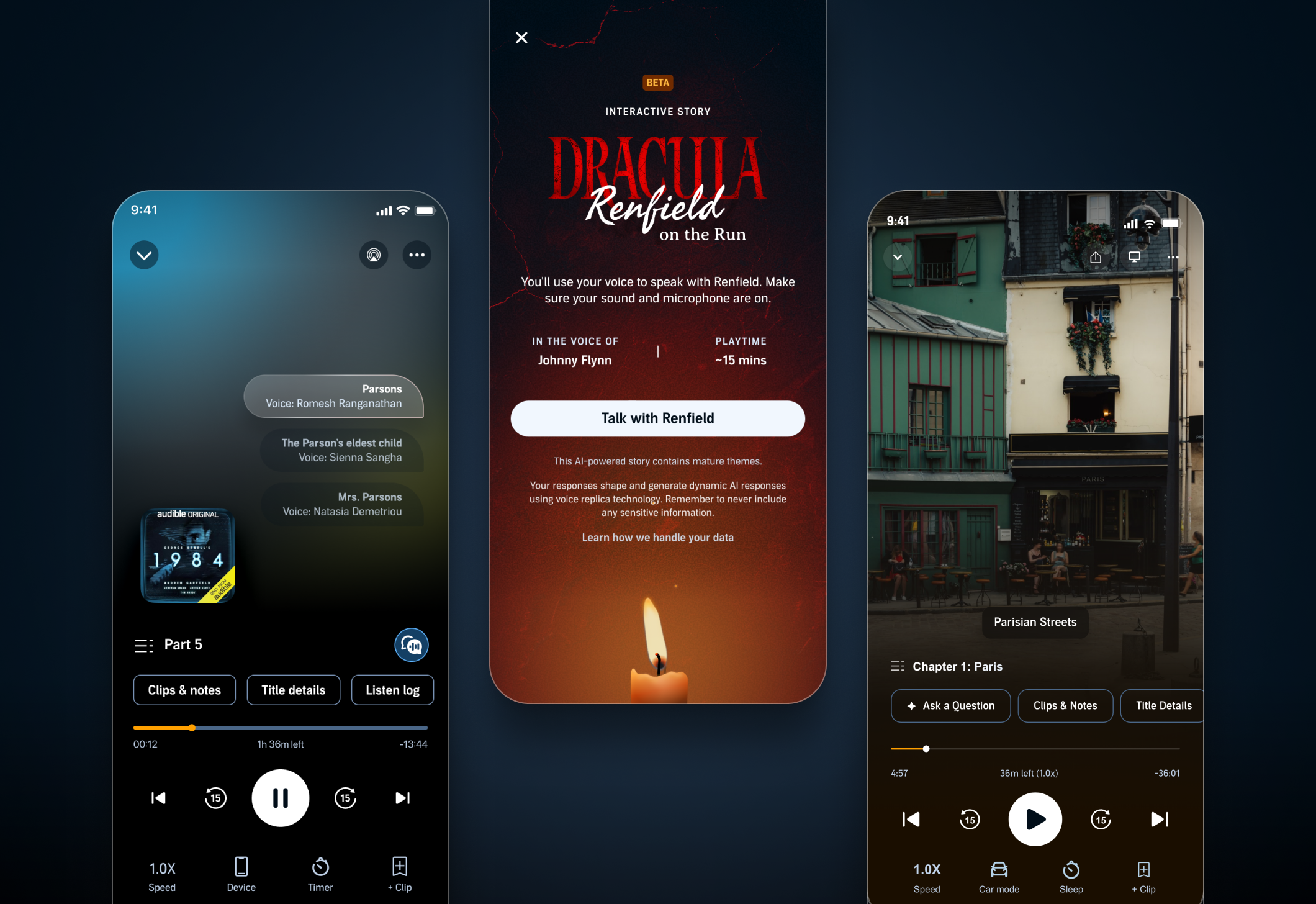
Three features at three stages
According to Audible, the company is adding three AI-powered features to its audiobook player: Character Guide, Interactive Stories and Visual Explorer. Materials dated Newark, New Jersey, October 1, 2026, say all three were built in close collaboration with creators and are rolling out in a limited beta for Audible customers in the United States and the United Kingdom. How limited the beta is, whether in users or in titles beyond those named, the company does not say.
The headline over Audible's materials lists all three features as launched. The text beneath it is more careful. Character Guide began on October 1. Interactive Stories is described as rolling out this fall, and Visual Explorer is marked coming soon, without a date. Taken at face value, the headline would overstate what a listener could use on the day.
The additions join a run of earlier product work that, according to Audible, includes Maven, an AI-powered conversational search tool, and personalized discovery features. The company said it is working with creators and publishers to bring the features to more stories, and that the beta will evolve with customer and creator feedback.
Character Guide, the one feature in service
Character Guide starts with Dracula, an Audible Original, and is also available in the Audible Original George Orwell's 1984, according to Audible. A third title, the Audible Original Exoplanet, is due to receive it on November 5. Exoplanet comes from the writer Benjamin Percy, whose credits include Wolverine and The Ninth Metal, with Andy Weir, author of The Martian and Project Hail Mary, as executive producer.
The problem it addresses is specific. According to Audible, listeners report that tracking an expansive cast is harder in audio than in print, where a visual reference is within reach. The feature responds by displaying the active character in real time on the player page, alongside character cards that steer clear of spoilers and spotlight the performer behind each voice through a narrator headshot and biography.
Behind that display sits a data problem. A live readout of the current voice requires each line of a full-cast recording to be tied, with timing, to a character, and each character to a named performer. Audible does not say whether those labels are written by production staff or inferred by software, or how the cards stay clear of spoilers as a story advances. The choice would shape how quickly the feature can spread beyond showcase titles.
Audible adds that the feature will soon allow listeners to put questions about the production to it while the story unfolds. No date accompanies that statement, and nothing describes where the answers would come from.
Interactive Stories, a character who speaks first
Rolling out this fall, Interactive Stories are billed by Audible as a bonus experience that sits beyond the original narrative. The listener holds a real-time conversation with a character brought to life through generative AI, conversational design and sound production. The character speaks first, assigns the listener a role, a goal and stakes, and reacts as the listener replies in their own words.
Authorship is split. According to Audible, creators define the opening scenes, the turning points and the character's persona, while the company's product design keeps each story faithful to the creator's vision. In other words, the skeleton is written by people and the connective dialogue is generated. The first example follows Renfield, Dracula's unpredictable and tormented servant, and is due this fall. A second, made with Percy and set in the world of Exoplanet, is due in November.
Andy Tsao, Audible's Chief Product and Analytics Officer, said "AI is allowing us to create new interactive experiences", and named younger audiences as a group craving them. He described the result as entry points into stories that are "still part of the authors' vision" yet "more personal and unique" for customers.
What the materials leave out is considerable. They do not name the model behind the conversations, say whether listeners speak or type, or state whether a character's voice is performed by an actor or synthesized. Session length, moderation, retention of conversations and any age restrictions go unmentioned, gaps that bear on the younger audiences Tsao cited. Nor do the materials describe what happens when a generated reply contradicts the story's facts or the persona a creator defined, the failure mode usually called hallucination. Whether Audible tolerates or blocks such drift is not stated.
Visual Explorer, maps and imagery at key moments
Visual Explorer, labelled coming soon, will surface maps and imagery at chosen points in a story. According to Audible, listeners could see where the action is unfolding, or tap an image tied to a pivotal moment, without losing their place in the narration. It is to start with The Cultural Tutor: A Modern Guide to History, Art, and Philosophy in 49 Short Chapters, which will carry imagery and bonus information about landmarks, figures and places in six European cities.
Sheehan Quirke, the book's author, said "I was able to shape what listeners see and when they see it". Creator involvement is the thread running through all three features in Audible's account, from Quirke's choice of images to the personas and turning points that authors set for Interactive Stories.
The audiobook market the features enter
Survey data
The Audio Publishers Association put 2025 US audiobook revenue at $2.43 billion, up 9%, with 157 million Americans having listened to an audiobook at least once and more than 750,000 active titles, in surveys it published on June 5, 2026. The same research carried a finding on AI. Consumer willingness to try AI-narrated audiobooks fell from 70% in 2025 to 61% in 2026, only 16% of listeners had actually heard one, and AI-narrated titles produced 0.03% of 2025 revenue.
Those figures concern synthetic narration, not AI-assisted listening tools, so they give no direct reading on how Character Guide, Interactive Stories or Visual Explorer will be received. The two would meet at a single point: whether an Interactive Stories voice is performed or synthesized, which Audible's materials leave open. A second result bears on Visual Explorer. An alternative to screen time ranked third among the reasons for listening, cited by 70% of those who had ever listened. Whether a tappable image layer cuts against that motive or complements it was not tested.
Spotify's moves
Competitors are building around the audiobook file as well. Spotify began rolling out AI-generated Audiobook Recaps in beta on November 13, 2025, short summaries of a title up to the listener's current position. Spotify said the feature does not use audiobook content for large language model training or voice generation. Audible's materials carry no comparable statement either way. Spotify also disclosed Page Match on February 5, 2026, a feature that carries a reader's place between print, e-book and audiobook.
Advertising at the storefront
Paid promotion sits at the storefront end of Audible's business. Amazon Ads opened Audible title identifiers to author advertisers in the United States on August 28, 2026. Vendors and publishers had already received access, with Sponsored Brands opening to Audible titles across nine markets in February 2024. The eligible formats are Sponsored Products and Sponsored Brands, which began as paid listings inside Amazon's own search results and product pages. Audible's materials mention no advertising or sponsorship inside Character Guide, Interactive Stories or Visual Explorer.
What the materials do not settle
Several commercial questions remain open. Audible gives no price for any feature and does not say whether they sit inside existing memberships or require an add-on. Neither the size of the beta nor the way participants are chosen is stated, and no usage targets or success measures appear.
Rachel Ghiazza, Audible's Chief Content Officer, tied the features to a "nearly 30-year journey" in audio storytelling and said "more time spent with stories benefits everyone who helps bring them to life". The materials do not say how that benefit reaches creators financially for bonus experiences such as Interactive Stories, nor whether creators review the generated dialogue beyond the scenes and personas they define.
Why this matters to the marketing community
For audio and publishing marketers, the release works less as a product to evaluate than as a set of signals. Audible's executives describe the features in terms of deeper engagement and more time spent with stories. Conversation and image taps would produce interaction data of a kind that passive listening does not, yet nothing in Audible's account says whether any of it will be reported to publishers or creators.
The competitive picture is moving on several fronts at once. Spotify has put a statement on training data and voice generation on the record for its AI feature, while Audible's materials carry no equivalent for its own features. The survey data adds a second point of comparison: with willingness to try AI narration falling by nine percentage points in a year, the way a company frames AI can matter as much as the feature. Audible's materials foreground creators and spotlight performers on the cards, though the voice question for Interactive Stories remains unanswered.
Timing limits what can be measured soon. One feature is live, in a beta of undisclosed size, in two markets, and Audible itself says the features will change as feedback arrives. Whether the experiments become a durable part of the product, or stay as showcase additions to a handful of Audible Originals, will depend on facts the company has not yet given.
Timeline
- February 2024 - Sponsored Brands opens to Audible titles for vendors and publishers across nine markets
- November 13, 2025 - Spotify begins rolling out AI-generated Audiobook Recaps in beta
- February 5, 2026 - Spotify discloses Page Match, syncing position across print, e-book and audiobook
- June 5, 2026 - Audio Publishers Association publishes surveys showing $2.43 billion in 2025 US audiobook revenue and a fall in willingness to try AI narration from 70% to 61%
- August 28, 2026 - Amazon Ads opens Audible title identifiers to author advertisers in the United States
- October 1, 2026 - Audible opens a limited beta for US and UK customers; Character Guide is in service in Dracula and George Orwell's 1984
- Fall 2026 (no date given) - Interactive Stories start with a Dracula story following Renfield
- November 5, 2026 - Character Guide due for Exoplanet
- November 2026 (no date given) - Interactive Stories experience set in the world of Exoplanet, made with Benjamin Percy, due
- No date given - Visual Explorer, labelled coming soon, to start with The Cultural Tutor
Related PPC Land coverage
- Audiobook sales hit $2.43 billion in 2025 as 157 million Americans tune in - Survey data on revenue, catalogue size, listener motives and the fall in willingness to try AI narration.
- Spotify launches AI-powered audiobook summaries to reduce listening friction - The November 2025 beta of AI-generated Audiobook Recaps and Spotify's position on training and voice generation.
- Spotify's Page Match lets readers jump between books and audiobooks instantly - The February 2026 feature that synchronises reading position across formats.
- Spotify's audiobook charts land in the U.S. and U.K. - and publishers are paying attention - The weekly audiobook rankings and the wider stack of Spotify audiobook features.
- Authors gain Amazon ad slots for Audible titles in the US - The August 2026 opening of Sponsored Products and Sponsored Brands to authors' audiobooks.
- Amazon Ads expands Sponsored Brands to include Audible titles - The vendor and publisher expansion across nine markets in 2024.
Summary
Who: Audible, the audiobook service owned by Amazon, with creators it says it worked with closely. Statements came from Rachel Ghiazza (Chief Content Officer), Andy Tsao (Chief Product and Analytics Officer) and Sheehan Quirke (author of The Cultural Tutor).
What: Three AI-powered listening features: Character Guide, which displays the active character and performer cards; Interactive Stories, a real-time conversation with a generated character; and Visual Explorer, which surfaces maps and imagery at key moments. Only Character Guide was in service at the start.
When: October 1, 2026, with Character Guide due for Exoplanet on November 5, Interactive Stories due this fall and in November, and Visual Explorer labelled coming soon.
Where: A limited beta for Audible customers in the United States and the United Kingdom.
Why: According to Audible, to deepen listeners' connections to stories, to ease the difficulty of tracking large casts in audio, and to build interactive experiences, with younger audiences cited as a group seeking them. Price, models, safeguards and creator compensation remain unstated.


Discussion