


Clear Channel Outdoor and OUTFRONT Media, two of the largest out-of-home advertising operators in the United States and direct competitors for the same advertiser budgets, today said they have partnered with the Million Mammograms Challenge, a breast cancer screening campaign benefiting the Cancer Research & Treatment Fund (CR&T). The announcement, distributed on PR Newswire from New York at 8:00 a.m. ET on October 23, 2026, says the campaign's creative runs across both companies' digital networks throughout October, Breast Cancer Awareness Month, and ties the effort to a goal of "one million mammograms by 2028."
In Short
Two big billboard companies that normally compete for advertisers are showing the same breast cancer screening ad on their digital screens across the US this month. The ad comes from a campaign started by an ad tech executive after her own double mastectomy, and it asks women to book a mammogram and share the date. The companies have not said how many screens, which cities or how they will know whether anyone booked an exam because of it.
What the companies disclosed
The release is short on operational detail. According to Clear Channel Outdoor, the campaign's creative "can be seen across thousands of digital billboards nationwide throughout October." It does not give a screen count, a list of markets, a split between the two operators' inventory, the start date of the flight, or impression estimates. Nor does it say whether the space is donated, discounted or paid for.
That timing matters. The announcement landed on October 23, with eight days of Breast Cancer Awareness Month left. The release describes the creative as running "throughout October," but does not say when the boards first went live.
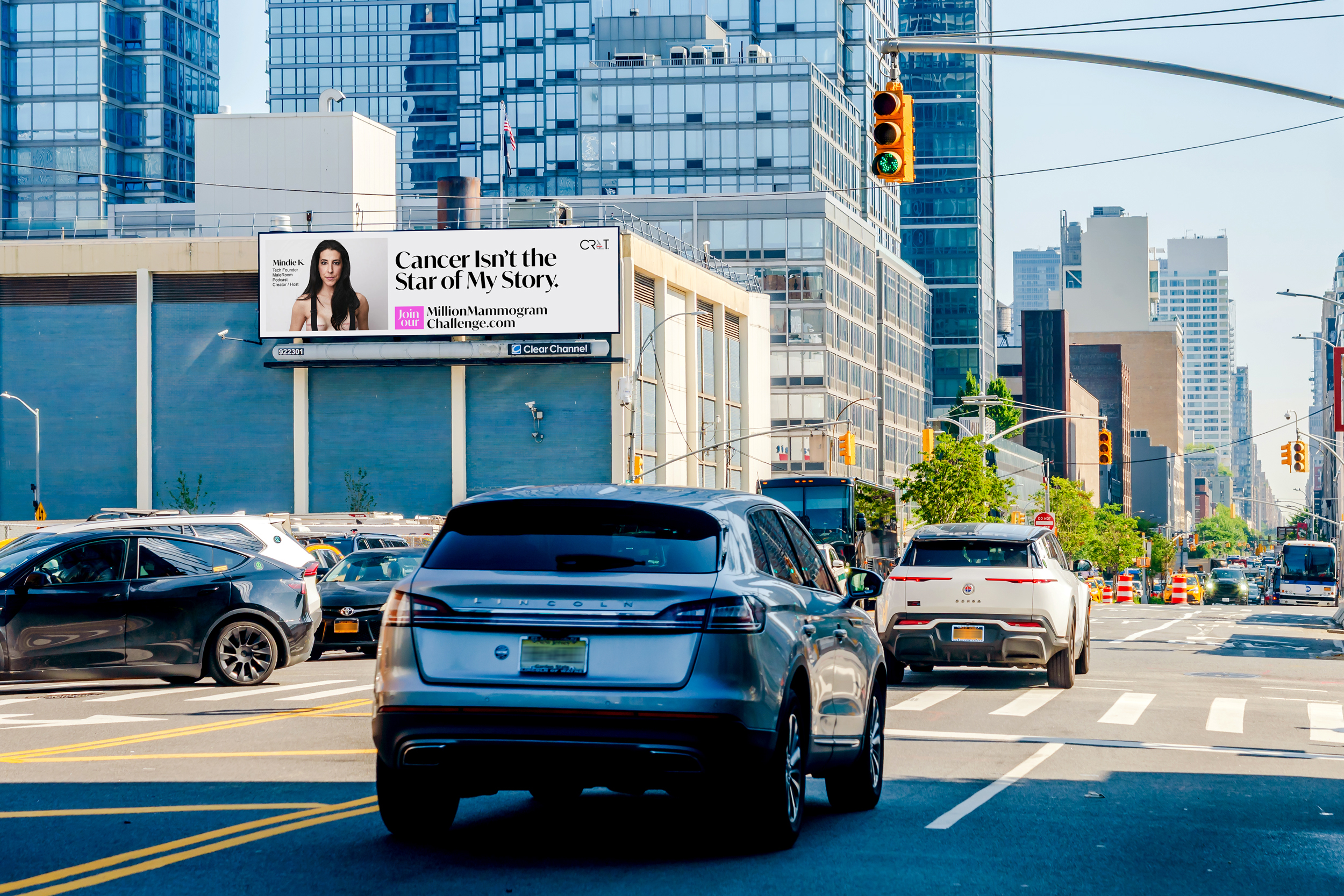
What the release does describe is the message. Million Mammograms, according to the announcement, "advocates for women to schedule and share their mammogram dates throughout October," and the creative carries "a clear, urgent call to action: encouraging women everywhere to schedule their screenings and take the important next step for their health." The slogan is "Cancer Isn't the Star of My Story."
The release cites the statistic that one in eight women in the United States will receive a breast cancer diagnosis in their lifetime. It does not name a source for the figure.
Who is behind the challenge
The Million Mammograms Challenge is now in its second year. According to the release, it was created by Mindie Kaplan, described as an advertising tech executive, "with the goal of changing narratives for women around shame, celebrating their femininity and early detection."
The billboard image is Kaplan herself. The photograph, taken by Tom Kubik, shows her six months after her double mastectomy, marking the halfway point of her surgeries. According to the release, she posted it on her personal Instagram, received what the companies call "an overwhelming number of responses," and then challenged followers to post their mammogram dates. That response, the release says, led her to launch the challenge nationally.
Kaplan described the reach the outdoor companies add. "Since the launch of the Million Mammograms Challenge, we have worked to reach millions of young women and advocate for them to take the next step in their health journeys by scheduling their mammogram dates," she said. "The support of Clear Channel Outdoor and OUTFRONT helps us reach them through billboards they come across in their daily lives and reduce the stigma around breast cancer and early screenings."
No figures from the first year appear in the release. It does not say how many mammogram dates were shared in 2025, how CR&T counts progress toward one million, or how much money the campaign has raised for the fund.
What the two marketing chiefs said
Both companies put their chief marketing officers on the record.
"Our joint partnership with the Million Mammograms Challenge reflects the industry's commitment to leveraging the reach and scale of our networks for good by helping to drive one million mammograms by 2028," said Dan Levi, EVP and CMO of Clear Channel Outdoor. "The campaign is a reminder of what out-of-home can do when combined with a meaningful cause that inspires real, measurable impact across the communities we serve."
Levi's phrase "real, measurable impact" is the claim the release does least to support. No measurement method, attribution design or reporting date is mentioned.
Stacy Minero, chief marketing officer of OUTFRONT, framed the effort around Kaplan. "Mindie started with an idea. Today, it's a movement with the power to change lives. We're proud to partner with Million Mammograms and Clear Channel Outdoor to help bring this important message to communities across the country," she said. "Together, we're using the scale of our networks to raise awareness, encourage early detection, and inspire people to take action."
Two competitors on one flight
The two operators compete for the same national buys. The release does not explain how the two networks coordinated the flight, or whether a single creative file was trafficked to both.
The scale of the companies involved is documented elsewhere. When OUTFRONT connected its inventory to VIOOH in March, PPC Land reported that more than 7,600 OUTFRONT digital screens generating about 18 billion monthly impressions were made available to programmatic buyers, roughly a quarter of the US digital out-of-home market, across more than 50 US cities and transit systems including New York's MTA and San Francisco's BART. Neither company says how much of that footprint, or of Clear Channel's, carries the mammogram creative.
Clear Channel's corporate position has also changed this year. In February, Mubadala Capital and TWG Global agreed a $6.2 billion all-cash take-private of Clear Channel Outdoor at $2.43 per share, with closing expected by the end of the third quarter of 2026. The October 23 release lists a stock ticker for OUTFRONT (NYSE: OUT) but none for Clear Channel, and the company's PR Newswire page lists a separate announcement of the completion of its acquisition by Mubadala Capital.
A pattern of cause campaigns on Clear Channel screens
The mammogram campaign is the latest in a run of public-interest flights on Clear Channel inventory that PPC Land has covered in 2026, several of which share the same gap between scale claims and measured outcomes.
Earlier this month, Clear Channel and the Afterschool Alliance put a 10th-grader's artwork on close to 2,000 digital billboards in 25 US markets for Lights On Afterschool, with donated space and a focal date of October 22. That article noted that the value of the donated space, impression figures and the names of the markets were not disclosed. The two campaigns overlap in October on the same company's digital network.
In July, Clear Channel's "Can You See Me?" anti-trafficking campaign ran in 25 markets during the FIFA World Cup, and partner data cited more than 600 signals to the National Human Trafficking Hotline from campaign cities. PPC Land's report pointed out that the figure was not tied to tracked billboard exposure and came without a baseline. In Arizona, Maricopa County estimated its 2025 heat messaging on Clear Channel boards was seen about 220 million times, and the 2026 flight ran from May 4 through the end of September. In June, Clear Channel worked with Los Angeles nonprofit Rainbow Labs on LGBTQ+ youth-designed Pride creative.
The mammogram release goes further than any of these on one point: it names a numeric goal. It is also thinner on inventory detail than the Afterschool announcement, which at least gave a screen count and market total.
Why the out-of-home market is relevant
For media buyers, the campaign is a small data point about how operators use unsold or flexible digital inventory. Digital screens let a creative swap in for a set share of loops without printing or posting, which is part of why cause flights can be scheduled at short notice.
The digital share of the market keeps growing. The OAAA reported that US out-of-home revenue reached $3.16 billion in the second quarter of 2026, up 10.7% year over year, the first quarter above $3 billion, with digital out-of-home up 18.5% and accounting for 38.4% of quarterly revenue. Guideline's forecast, reported in March, put full-year 2026 US out-of-home spend at about $4.0 billion, with digital growth of 14.5% described as healthy but decelerating.
Both companies also sell their digital screens through programmatic pipes, as the VIOOH deal shows. That raises a question the release does not address: whether the mammogram creative was booked directly into the companies' ad servers or delivered through the same automated channels advertisers use.
What remains unknown
Several facts a reader would need to judge the campaign's scale are missing from the release:
- the number of screens and markets, and how they divide between Clear Channel and OUTFRONT;
- the start date of the flight;
- whether the media is donated, and if so its estimated value;
- first-year results of the challenge;
- how CR&T or the challenge will count mammograms toward the 2028 goal, given that the call to action asks women to schedule and share dates rather than routing them through a tracked booking path.
The release offers no answers on these points. What it does establish is that two rival operators chose to run the same health message on their national digital networks in the final stretch of October, under a stated goal of one million mammograms by 2028.
Timeline
- 2025 - The Million Mammograms Challenge runs its first year, according to the release, which describes 2026 as its second year.
- February 2026 - Mubadala Capital and TWG Global agree a $6.2 billion take-private of Clear Channel Outdoor at $2.43 per share
- March 9, 2026 - OUTFRONT connects more than 7,600 digital screens to VIOOH's programmatic platform
- March 9, 2026 - Guideline forecasts US out-of-home spend of about $4.0 billion in 2026
- May 4, 2026 - Clear Channel and Maricopa County begin their third heat-relief billboard campaign
- June 15, 2026 - Clear Channel and Rainbow Labs present LGBTQ+ youth-designed Pride creative in Los Angeles
- July 22, 2026 - Clear Channel reports more than 600 hotline signals from its 25-market anti-trafficking campaign
- August 18, 2026 - OAAA reports Q2 2026 US out-of-home revenue of $3.16 billion, up 10.7%
- October 2026 - Clear Channel runs Afterschool Alliance creative on close to 2,000 digital billboards in 25 markets
- October 2026 - Million Mammograms creative runs on Clear Channel Outdoor and OUTFRONT digital networks throughout Breast Cancer Awareness Month, according to the release.
- October 23, 2026, 8:00 a.m. ET - Clear Channel Outdoor and OUTFRONT announce the partnership with the Million Mammograms Challenge, benefiting the Cancer Research & Treatment Fund.
- 2028 - Target year for one million mammograms, according to Clear Channel's Dan Levi.
Related PPC Land coverage
- Clear Channel puts a 15-year-old's art on nearly 2,000 digital billboards - Clear Channel's October 2026 Lights On Afterschool campaign with the Afterschool Alliance across 25 US markets.
- Anti-trafficking billboards ran in 25 markets during World Cup, 600 reports followed - Clear Channel's "Can You See Me?" campaign and the limits of the hotline data cited as its result.
- Clear Channel's Phoenix billboards hit 220M impressions fighting the heat - the third year of Clear Channel's heat-relief messaging with Maricopa County.
- Clear Channel lets LGBTQ+ youth design real Pride billboards in LA - a youth design program with Rainbow Labs for Pride Month 2026.
- Abu Dhabi sovereign fund bets $6.2 billion on America's billboards - the terms of the Mubadala Capital and TWG Global take-private of Clear Channel Outdoor.
- VIOOH and OUTFRONT just unlocked a quarter of the US DOOH market - OUTFRONT's programmatic deal covering more than 7,600 digital screens.
- US out-of-home revenue tops $3 billion for first time, up 10.7% - OAAA's second-quarter 2026 revenue figures by format.
- US out-of-home ad spend hits $4B in 2026 - but digital screens face a slowdown - Guideline's 2026 forecast for traditional and digital out-of-home spend.
Summary
Who: Clear Channel Outdoor and OUTFRONT Media, two US out-of-home advertising operators, with the Million Mammograms Challenge founded by advertising tech executive Mindie Kaplan, benefiting the Cancer Research & Treatment Fund. Clear Channel EVP and CMO Dan Levi and OUTFRONT CMO Stacy Minero were quoted.
What: A joint campaign running Million Mammograms creative, built around a photograph of Kaplan six months after her double mastectomy and the slogan "Cancer Isn't the Star of My Story," across thousands of digital billboards, encouraging women to schedule and share mammogram dates toward a goal of one million mammograms by 2028.
When: Announced today, October 23, 2026, at 8:00 a.m. ET, for a campaign running throughout October, Breast Cancer Awareness Month. The challenge is in its second year.
Where: Digital out-of-home networks across the United States. The release does not name markets.
Why: According to the companies, to promote early detection and reduce stigma around breast cancer screening. For the advertising industry, it shows two rival operators sharing a single cause flight on their digital networks, while leaving open the screen count, media value and how any effect on screenings will be measured.


Discussion