


Google today added documentation for the UGC Fresh Data Program, a dedicated pipeline through which approved forums and social platforms can send user-generated posts and interaction signals to the company, according to the Search Central changelog. The page sets out six eligibility criteria, rules out login-gated and paywalled content, and states that participation does not guarantee appearance in Search.
In Short
Google today published a page describing a program that lets approved forums and social networks send their newest posts, plus like and comment counts, straight to Google instead of waiting for Google's robots to find them. It matters to any site built on posts from its users, because discussion threads go stale quickly, and because Google states plainly that being in the program does not guarantee a post will show up in results. Sites that meet the listed requirements can apply through an online form, and Google says it will reply within 6 to 8 weeks, with technical instructions going only to those it accepts.

What the new page says
The entry in the Search Central changelog carries today's date and is brief. According to Google, the change "Added a new page about the UGC Fresh Data Program," and the stated reason is "To explain the purpose of the program and help prospective applicants understand the eligibility criteria and how to participate."
The documentation page itself is more specific. According to Google, the program is "an initiative designed to help platforms display fresh, high quality, and authentic user-generated content (UGC) across various features on Search." Approved platforms, the page says, "can use a dedicated data ingestion pipeline to send content and interaction signals to Google." The page describes the arrangement as "a specialized pipeline designed exclusively for trending UGC content" that is "independent of the Google Indexing API and traditional organic crawling for general web content."
Google defines user-generated content as "any digital material hosted and distributed by an online platform or aggregator, but created entirely by independent users rather than the platform itself." One sentence, set apart from the rest, limits the promise: "This program doesn't guarantee that content will appear in Search."
Where the program sits next to existing routes
Content usually reaches Search by a more passive path. Pages are discovered, fetched by Googlebot and then pass through indexing before they can be served. Timing data that Gary Illyes showed at Search Central Live Deep Dive Europe in Barcelona on October 2, relayed through an attendee recap, put typical discovery of a new URL at about 20 hours and a refresh of a known URL at about 30 days. Those figures did not come from a Google publication, and the recap gave no methodology.
A push alternative already exists, although within narrow limits. According to Google's Indexing API documentation, that interface can only be used to crawl pages carrying either JobPosting markup or a BroadcastEvent embedded in a VideoObject, and it comes with a default quota of 200 for onboarding and submission testing, with additional approval required beyond that. PPC Land covered the addition of live stream support to the API in December 2018.
The new program is a third path, aimed at a different kind of page and a tighter clock. According to the eligibility criteria, submitted content "must be as fresh as possible, ideally sent within minutes." What neither the page nor the form says is how quickly Google processes a submission once it arrives, so the minutes-level target applies to the sending side only.
The six eligibility criteria
Google says participation is "limited to platforms that meet specific content quality and volume guidelines." The page lists six requirements.
Content, audience and accessibility
The first criterion concerns what a platform hosts. According to the page, "The platform must primarily host UGC, social postings, or forum discussions," and that content "should be hosted on dedicated pages with stable URLs, not on profile or feed pages." A platform whose posts exist only inside an endless feed, without individual addresses, would fall outside that wording on a plain reading.
The second criterion, volume and audience, reads in full: "A high volume of UGC content and a significant user base." No figure is attached to either half of the sentence. The application form asks for monthly active users, but the documents give no minimum.
The third concerns accessibility. "Content must be on public web pages accessible to Googlebot and users; gated content (requiring a login or paywall to view) is ineligible," the page states, adding that "all UGC must be attributable to a creator with a public profile." Closed communities and paywalled forums are therefore excluded by the text, as are posts without an identifiable public author.
Technical readiness
The fourth criterion is the most demanding in engineering terms. According to Google, the platform owner "must possess the capacity to implement secure OAuth 2.0 API authentication and construct strictly validated JSON-LD payloads." A platform must also already use, or be ready to implement, structured data in the form of on-page schema.org markup across its URLs. The page offers an example: "SocialMediaPosting or DiscussionForumPosting with interactionStatistic sub-fields."
That vocabulary has recent history in Google's documentation. Google added support for DiscussionForumPosting and ProfilePage markup in November 2023, at the time tying marked-up forums to the Perspectives and Discussions and forums features. A March 24, 2026 changelog entry added more supported properties for Discussion Forum and QA Page markup, "For providing more clarity on comment thread structure to Google ingestion systems." On September 24, 2026, the changelog recorded a creator property and updated interactionStatistic types for VideoObject markup. The new program page does not name the Search features it feeds, so whether those two features are the ones meant remains unstated.
The payload specification itself is not public. According to Google, "We will share developer documents with more details once accepted into the program." Endpoint details, field definitions and rate limits, if any, therefore sit behind the application.
Moderation and freshness
The fifth criterion deals with content health: "The platform must not publish illegal content and must maintain active content moderation, including a user reporting mechanism." The sixth returns to speed. Beyond the minutes-level target for new posts, platforms "must be able to submit regular updates of engagement counters (within 72 hours of creation)." The page does not specify which counters are meant, though the schema example points to the interaction statistics that schema.org markup carries, such as likes and comments.
Creator identity has surfaced elsewhere in Google guidance this week. PPC Land reported on October 7 that Marie Haynes's reading of an edited quality rater guidelines page describes fabricated creator profiles as a form of deception, although the new wording had not been confirmed against a captured copy of the page. The UGC program, as written, requires the opposite: every item attributable to a creator with a public profile.
The application
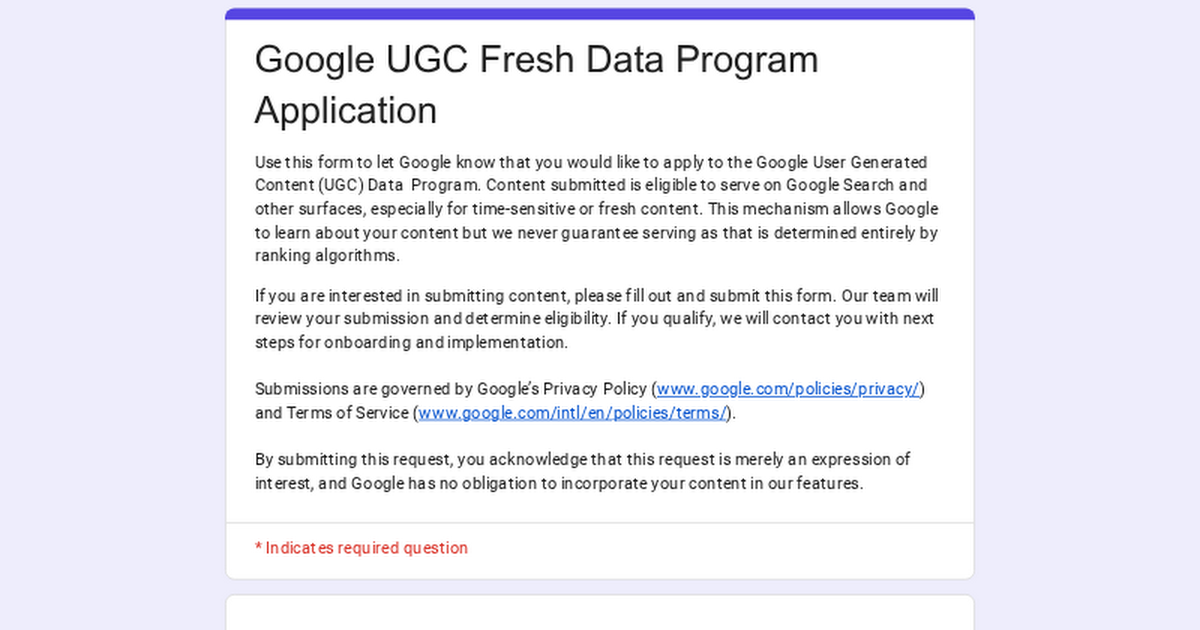
Interested platforms apply through a Google Form titled "Google UGC Fresh Data Program Application." Seven of its eight fields are mandatory: company name, service domain, 10 sample URLs, monthly active users, launch date, the Search Console owner email for the domain, and a contact email. Only the comments field is optional.
The sample URLs carry the most weight. Google asks for 10 recent examples from the domain that contain user-generated content, which "should follow the same format/structure that you intend to send to us." The request for a Search Console owner email indicates that domain ownership is tied to the application, although the form does not say how it is checked.
On timing, the documentation states: "We will get back to you within 6-8 weeks with a response on the status of your application." An application filed today would therefore receive an answer between November 19 and December 3, based on a count of days from today. The page adds that "Submitting an application doesn't guarantee participation in the program," and that selected platforms receive "detailed technical integration documentation and onboarding instructions."
The form is blunter still. It tells applicants that their request "is merely an expression of interest, and Google has no obligation to incorporate your content in our features." Elsewhere it says the mechanism "allows Google to learn about your content but we never guarantee serving as that is determined entirely by ranking algorithms." In other words, the program affects how quickly Google learns about a post, and the ranking systems decide what happens next.
What the documents leave open
Several gaps and one inconsistency stand out across the three source documents.
- Surfaces. The documentation page says the program supports display "across various features on Search." The form says submitted content "is eligible to serve on Google Search and other surfaces, especially for time-sensitive or fresh content." Neither document names the features or identifies the other surfaces.
- Program name. The page and the changelog use "UGC Fresh Data Program." The introductory text of the form refers to the "Google User Generated Content (UGC) Data Program," without the word "Fresh."
- Thresholds. Criteria such as "high volume" and "significant user base" have no stated numeric cutoffs.
- Reporting. The documents do not mention whether participants will see program submissions or their status in Search Console or any other report.
- Processing time. No service level is given for the interval between a platform sending content and Google processing it.
Why the program matters to marketers
The criteria address platform owners, not brands or individual creators. A brand that posts on a participating platform would not apply itself, and a publisher whose output is mainly editorial would not appear to meet the first criterion on its face, since the platform must "primarily host" user content. Whether content from brands and creators on admitted platforms would surface sooner is not addressed in either document.
For anyone who follows how forum threads and social posts appear in Google results, the program adds a new variable: how soon posts from admitted platforms become findable. Faster ingestion could change how soon discussions about products, campaigns or competitors can be found through Search, though the documents make no such claim, and the form states that serving is determined entirely by ranking algorithms.
The announcement also fits a pattern of Google building documentation and tooling around social and community content. In July, Google opened Search Console data for Instagram, TikTok, X and YouTube accounts to all account holders, a separate product from the ingestion program but aimed at the same broad category of material. Today's changelog entry does not connect the two.
Timeline
- December 12, 2018 - Google adds live stream pages to the Indexing API alongside VideoObject markup.
- November 27, 2023 - Google adds support for ProfilePage and DiscussionForumPosting markup, with new Search Console reports.
- March 24, 2026 - Search Central changelog records new supported properties for Discussion Forum and QA Page markup.
- July 29, 2026 - Google makes Search Console platform properties for Instagram, TikTok, X and YouTube available to all account holders.
- September 24, 2026 - Search Central changelog records a creator property and updated interactionStatistic types for VideoObject markup.
- October 2, 2026 - Gary Illyes shows URL discovery timing data at Search Central Live Deep Dive Europe in Barcelona; PPC Land reports on it October 3.
- October 7, 2026 - PPC Land reports on Marie Haynes's reading of creator profile wording in the quality rater guidelines.
- October 8, 2026 (today) - Google publishes the UGC Fresh Data Program documentation page and application form, and logs the change in the Search Central changelog.
- November 19 to December 3, 2026 - the 6-8 week response window closes for an application filed today (calculated from the documented timeframe).
Related PPC Land coverage
- Google says new pages take about 20 hours to be found, some never are - Covers timing figures shown in Barcelona on October 2 for URL discovery, refresh, sitemap processing and structured data updates.
- Google Search expands support for structured data with profile page and discussion forum markup - Reports the November 2023 addition of ProfilePage and DiscussionForumPosting markup and the matching Search Console reports.
- Google Search now indexing live streams via structured data and an Indexing API - Reports the December 2018 extension of the Indexing API to live stream pages.
- Google opens Search Console data to Instagram, TikTok, X and YouTube for all - Reports the global availability of platform properties and a guide to analyzing social and video content in Search Console.
- Google says fake author profiles signal a low-quality page - Reports Marie Haynes's reading of edited quality rater guidelines covering creator profiles and user comments as main content.
Summary
- Who: Google, through its Search Central documentation team, and the forum, Q&A and social platforms that might apply.
- What: A new documentation page and application form for the UGC Fresh Data Program, a dedicated ingestion pipeline for user-generated content and engagement signals, with six eligibility criteria and no guarantee of appearing in Search.
- When: Today, when both the changelog entry and the documentation page were published. Google says it will respond to applications within 6-8 weeks.
- Where: On Google Search Central (developers.google.com/search), with applications submitted through a Google Form. Content from approved platforms is intended for Google Search and unnamed other surfaces.
- Why: According to Google, to explain the purpose of the program and to help prospective applicants understand the eligibility criteria and how to participate, so that fresh and authentic user-generated content can be processed and updated in Search more quickly.


Discussion