


A London supply-side platform today added Brazilian treadmills, hairdressers' chairs and barber shops to its programmatic inventory, in a deal that once again claims 5% of the country's digital out-of-home market.
VIOOH today announced a partnership with b.drops, a Brazilian digital out-of-home network built around beauty salons, barbershops and gyms, opening 7,680 screens and more than 165 million monthly impressions to automated buying. The announcement, dated 28 July 2026 and issued from London, extends a Latin American supply push that has produced three separate Brazilian integrations in nine months.
According to VIOOH, the b.drops network represents 5% of Brazil's DOOH market and provides national coverage reaching audiences in major cities and regional areas, including Sao Paulo, Rio de Janeiro, Brasilia, Curitiba and Belo Horizonte.
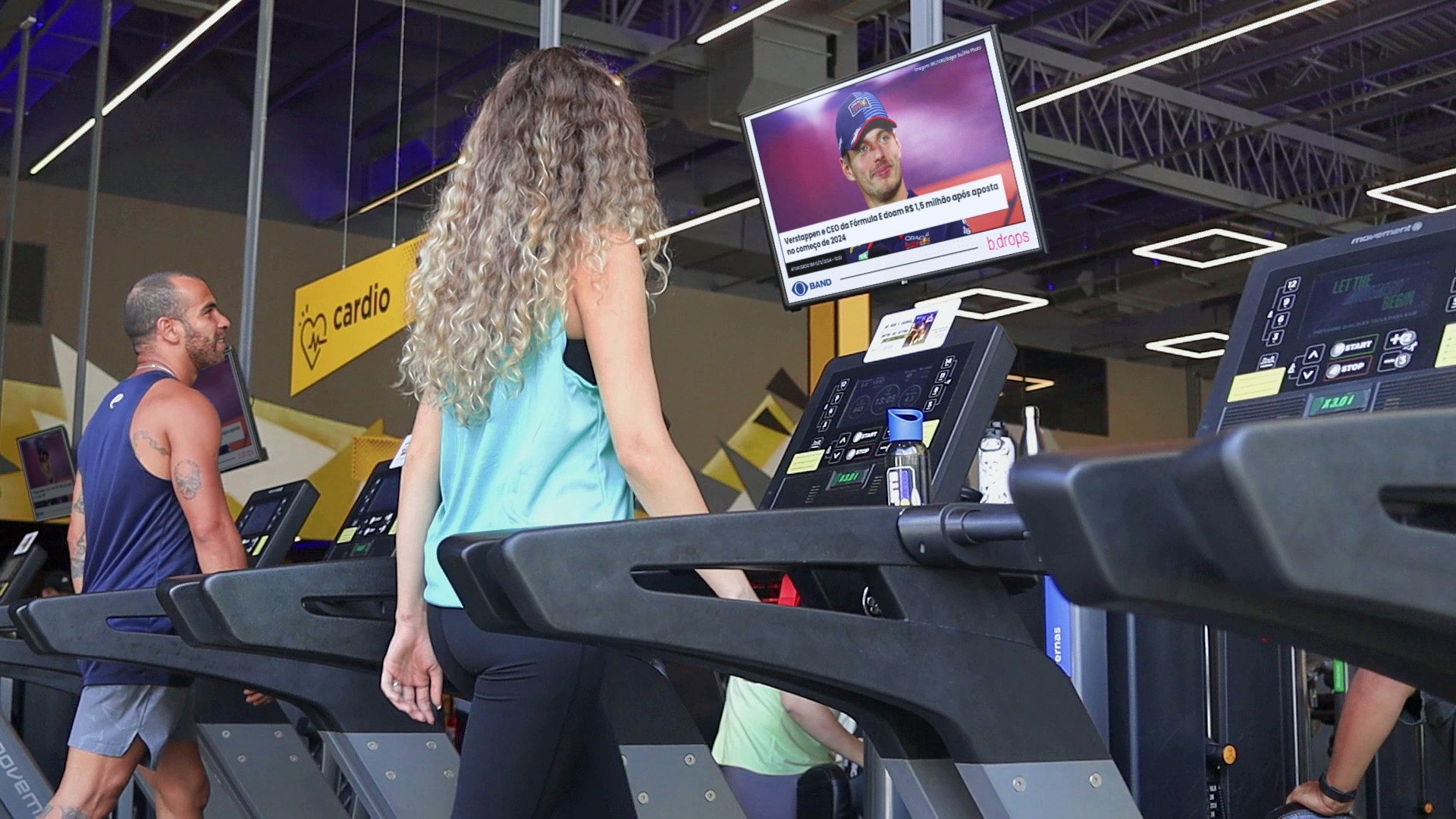
What sits inside the 7,680 screens
The inventory breakdown is where the deal departs from most supply announcements. Gyms dominate. According to VIOOH, 6,241 screens sit inside fitness chains including Smart Fit, generating over 159 million monthly impressions on their own. Beauty salons contribute 1,180 screens, among them locations operated by Jacques Janine, delivering 19 million monthly impressions. Barber shops account for a further 259 screens nationwide and 1.2 million monthly impressions.
Those three figures sum to 7,680 screens, matching the headline count exactly. The impression figures behave differently. Adding the three environment totals produces 179.2 million monthly impressions, above the 165 million cited at the top of the announcement, though each component carries an "over" or approximate qualifier that leaves the arithmetic unresolved in the source material.
Screen and city counts also vary within the announcement itself. The body cites 7,680 screens. Gavin Wilson, Global Chief Commercial Officer at VIOOH, refers in his quoted remarks to "more than 6,000 screens across 120 cities." The company description supplied by b.drops cites more than 7,600 active digital screens, 1,600 partner venues and 200 cities. Those are three different reads on the same network, and buyers evaluating reach claims will encounter all three in the same document.
The dwell-time argument
The commercial case rests on how long people stay put. According to b.drops, the company operates in environments where audiences remain for 45 to 120 minutes, creating what it describes as conditions of attention and receptivity for advertisers. Founded in 2016, b.drops offers geolocation, branded content, live marketing and programmatic media, counting SmartFit, Jacques Janine and Marcos Proenca among its clients.
Dwell time has become the organising argument across a specific class of VIOOH integrations. When the platform integrated Atmosphere TV's place-based streaming network in January 2026, covering more than 60,000 venues including bars, gyms and airports, Wilson cited average dwell times above 40 minutes and inventory that is fully viewable and non-skippable. UK motorway service areas, which joined the platform in June 2026 through i-media's 1,200-screen network, carry an average visit time of 22 minutes according to that operator.
A gym session sits at the far end of that spectrum. A roadside billboard exposure is measured in fractions of a second at vehicle speed; a treadmill session on a b.drops screen is measured in tens of minutes. The two formats trade at the same impression-based unit through the same demand-side platforms, which is the structural point that programmatic DOOH has not yet resolved. An impression served to a stationary viewer with 45 minutes of exposure and an impression served to a passing car are counted identically in a bidding system, even though the underlying attention differs by orders of magnitude.
Two networks, one 5% claim
The market-share figure invites scrutiny. According to VIOOH, b.drops represents 5% of Brazil's DOOH market across 7,680 screens and 165 million monthly impressions. Three months earlier, the platform described its We OOH partnershipin identical share terms: roughly 5% of Brazil's DOOH market, delivered through 320 screens and more than 1.3 billion monthly impressions across 16 Brazilian cities.
The two networks differ by a factor of 24 in screen count and by a factor of roughly eight in impression volume, yet both are presented as the same slice of the same national market. The discrepancy is explicable. Market share in out-of-home is measured inconsistently across screen counts, impression volumes, audience reach and revenue, and a network of large-format billboards will generate impressions at a rate no gym screen can match while occupying far fewer physical positions. But the two figures cannot both describe the same denominator, and the announcement does not specify which basis applies.
For media planners, that matters. Percentage claims of national market coverage are used to justify budget allocation in cross-border planning, and two integrations described identically while behaving completely differently produce a coverage estimate that is not additive in any obvious way.
A third Brazilian layer in nine months
VIOOH's Brazilian sequence now has three distinct components, each targeting a different environment type.
The platform entered Brazil in November 2025 through RZK Digital, connecting more than 800 screens across 43 bus terminals in Sao Paulo, with four billion monthly impressions reaching over 75 million verified visitors. That deal covered transit. The We OOH partnership announced on 28 April 2026 covered roadside and large-format, splitting 1.3 billion monthly impressions across billboards, Mub urban screens and Empena large-format displays. The b.drops integration covers indoor long-dwell venues.
This layering is the recurring shape of VIOOH's supply strategy rather than an accident of timing. In the United States, the Vengo partnership in August 2025 took indoor retail, the OUTFRONT deal in March 2026 took roadside and transit at roughly a quarter of the national market, and Firefly's April 2026 integration added 60,000 moving screens mounted on vehicles. Each new integration adds inventory that is unique rather than duplicative, increasing the addressable universe for buyers already connected to the platform without requiring new technical connections.
Felipe Viante, Co-Founder and Executive Director of b.drops, framed the arrangement in terms of buyer access: "Joining VIOOH's platform opens our national network to a wider pool of international buyers looking to reach Brazilian consumers in the moments that matter most to them."
A jump in the market count
One figure in the announcement stands apart from recent company materials. According to VIOOH, the platform currently trades programmatically in 46 markets and drives demand through partnerships with more than 50 DSPs globally.
That count has moved. VIOOH cited 35 markets in late 2025, reached 37 by March 2026, and repeated 37 in the Grupo IMU announcement of 16 July 2026, which opened more than 400 screens across six Mexican cities. A move from 37 to 46 markets inside twelve days is unusual against that trajectory. The nine-market gap corresponds closely to the nine Latin American territories JCDecaux switched on for programmatic buying on 20 July 2026, when the outdoor group completed its regional roll-out across more than 4,600 screens delivering 8.2 billion monthly impressions. Panama, Costa Rica, Guatemala, El Salvador, Honduras, Nicaragua, the Dominican Republic, Ecuador and Paraguay went live through VIOOH's infrastructure in that announcement. The b.drops release does not explain the revision, and the correspondence is circumstantial.
How the buying works
The mechanics follow established programmatic DOOH protocols. VIOOH sits in the technology layer between media owners and the demand-side platforms through which advertisers execute automated buys. Any advertiser already connected to one of the platform's DSP partners can access b.drops inventory without establishing a separate direct sales relationship with the Brazilian network.
According to VIOOH, programmatic buying through its supply-side platform gives advertisers enhanced flexibility, precision targeting and improved efficiency across the b.drops network. Real-time bidding, private marketplace deals and programmatic guaranteed transactions are the three principal transaction types available through the platform. Targeting parameters through connected DSPs typically include environment type, geography, time of day and audience data integrations.
Venue-type targeting carries specific weight in this deal. The ability to separate gym inventory from salon inventory from barbershop inventory is what makes the network usable for categories with narrow audience assumptions, and it is the parameter most likely to determine whether the long-dwell environments justify a premium over generic Brazilian DOOH supply.
Wilson positioned the environments as the differentiator: "Reaching people in gyms, beauty salons and barber shops puts brands at the heart of wellbeing moments, and making that inventory available programmatically is a real step forward for advertisers targeting Brazilian consumers."
Why this matters for the marketing community
Brazil has been the most contested programmatic DOOH market in Latin America for two years. Vistar Media opened Brazilian inventory through its demand-side platform in August 2025, citing over 30,000 screens nationwide. According to World Out of Home Organization figures cited in that coverage, Latin America's out-of-home market reached 2.7 billion dollars in 2024, with Brazil accounting for more than one-third of the regional total and 31% of regional out-of-home advertising already delivered through digital formats.
Demand-side appetite has been documented. VIOOH's 2026 State of the Nation report, published on 21 March 2026 and based on a survey of 1,050 advertisers and agencies conducted with research consultancy MTM, forecast that programmatic DOOH would feature in 48% of all campaigns globally within 18 months, up from 34% over the preceding period. Among recent buyers, 99% expected to increase or maintain investment, with average anticipated spend growth of 44%.
Three consequences follow for planners.
Inventory granularity is outpacing measurement standards. A buyer can now select Brazilian gym screens by venue type through a DSP interface, but the impression metric that governs pricing does not encode the 45-to-120-minute exposure window that makes those screens commercially distinct from a bus terminal panel. Pricing that difference remains a negotiation rather than a data output.
Coverage claims require independent verification. With two Brazilian networks each described as 5% of the national market on incompatible bases, and screen counts varying within a single announcement, planning documents that stack VIOOH's Brazilian integrations into a single national reach figure risk double-counting or undercounting depending on which basis is assumed.
Wellness and self-care venues are becoming a distinct programmatic category. Gyms have appeared inside broader networks before, notably through Vengo in the United States and Atmosphere TV's streaming venues. The b.drops deal is different in that the entire network is built on that environment class, which gives advertisers a route to buy the category directly rather than as an incidental component of a mixed-venue package.
The broader pattern remains one of supply-side accumulation. VIOOH's programmatic revenues reached 180.5 million euros in JCDecaux's full-year 2025 results, and programmatic DOOH grew 27.2% organically in the group's first quarter of 2026, reaching 10.5% of digital revenue. Each incremental network makes the platform more useful to DSPs already connected to it. Whether that translates into working budgets in Brazilian gyms depends on whether buyers can demonstrate that a treadmill impression is worth more than a billboard impression, and the measurement apparatus for that argument is not yet standard.
Timeline
- 2016 - b.drops founded as a DOOH media company specialising in beauty salons, barbershops and gyms
- 2018 - VIOOH launches in London as a premium global digital out-of-home supply-side platform
- 26 August 2025 - Vistar Media opens Brazilian DOOH inventory through its demand-side platform, citing over 30,000 screens nationwide
- 26 August 2025 - VIOOH partners with Vengo, adding 65,000 US screens and 13 billion monthly impressions across indoor consumer environments
- 6 November 2025 - VIOOH enters Brazil through RZK Digital, covering 800 screens across 43 bus terminals
- January 2026 - VIOOH integrates Atmosphere TV, adding more than 60,000 place-based streaming venues including bars and gyms
- 9 March 2026 - VIOOH and OUTFRONT connect 7,600 screens and 18 billion monthly impressions, reaching about a quarter of the US DOOH market
- 21 March 2026 - VIOOH's 2026 State of the Nation report forecasts programmatic DOOH in 48% of campaigns globally within 18 months
- 23 April 2026 - Firefly adds 60,000 moving screens to VIOOH's programmatic supply
- 28 April 2026 - VIOOH and We OOH open 320 Brazilian screens and over 1.3 billion monthly impressions, described as roughly 5% of Brazil's DOOH market
- 9 June 2026 - i-media integrates 1,200 UK motorway screens delivering 2.9 billion monthly impressions
- 16 July 2026 - VIOOH adds more than 400 screens across six Mexican cities through Grupo IMU, citing 37 trading markets
- 20 July 2026 - JCDecaux completes its Latin American programmatic roll-out, switching on nine markets across 4,600 screens
- 28 July 2026 - VIOOH announces the b.drops partnership, opening 7,680 screens and over 165 million monthly impressions across Brazilian gyms, salons and barbershops, and citing 46 trading markets
Related PPC Land coverage
- VIOOH and We OOH bring 1.3 billion monthly impressions to Brazil - The April 2026 deal that also described its Brazilian inventory as roughly 5% of the national DOOH market.
- VIOOH expands programmatic DOOH in Brazil with RZK Digital partnership - The platform's first Brazilian integration, covering bus terminals in Sao Paulo.
- JCDecaux gains 100% programmatic reach in Latin America across 4,600 screens - The July 2026 roll-out that switched on nine additional regional markets through VIOOH.
- VIOOH gains 400 screens across six Mexican cities in Grupo IMU deal - The Mexican expansion announced twelve days earlier, citing 37 trading markets.
- Vistar expands programmatic DOOH access to Brazil market - Demand-side entry into Brazil, including World Out of Home Organization figures on the regional market.
- VIOOH just unlocked 60,000 streaming TV screens in bars and gyms for programmatic ads - An earlier long-dwell integration covering gyms and hospitality venues.
- UK motorway DOOH hits programmatic as i-media integrates with VIOOH - Motorway service area inventory and the dwell-time argument applied to UK roads.
- pDOOH investment set to surge 44% as programmatic takes over half of campaigns - The March 2026 survey of 1,050 advertisers underpinning demand forecasts for the channel.
- VIOOH and OUTFRONT just unlocked a quarter of the US DOOH market - The March 2026 US deal illustrating the platform's layered supply strategy.
- Firefly puts 60,000 moving screens inside VIOOH's programmatic SSP - Vehicle-mounted inventory added as a distinct format layer in April 2026.
Summary
Who: VIOOH, the London-headquartered premium global digital out-of-home supply-side platform launched in 2018 and majority-owned by JCDecaux, and b.drops, a Brazilian DOOH media company founded in 2016 specialising in beauty salons, barbershops and gyms. Executives quoted are Gavin Wilson, Global Chief Commercial Officer at VIOOH, and Felipe Viante, Co-Founder and Executive Director of b.drops.
What: A partnership connecting 7,680 b.drops digital screens and more than 165 million monthly impressions to VIOOH's programmatic supply-side platform, described as 5% of Brazil's DOOH market. The inventory splits into 6,241 gym screens generating over 159 million monthly impressions, 1,180 beauty salon screens delivering 19 million monthly impressions, and 259 barbershop screens adding 1.2 million monthly impressions.
When: Announced today, 28 July 2026, from London.
Where: Brazil nationwide, covering major cities and regional areas including Sao Paulo, Rio de Janeiro, Brasilia, Curitiba and Belo Horizonte, with b.drops citing partner venues across 200 cities.
Why: Brazil accounts for more than one-third of Latin America's 2.7 billion dollar out-of-home market, and long-dwell indoor venues where audiences remain for 45 to 120 minutes represent an inventory class that has not previously been available to international programmatic buyers at national scale in the country. The integration continues a supply-accumulation strategy in which each new network adds a distinct environment type rather than duplicating existing inventory.


Discussion