
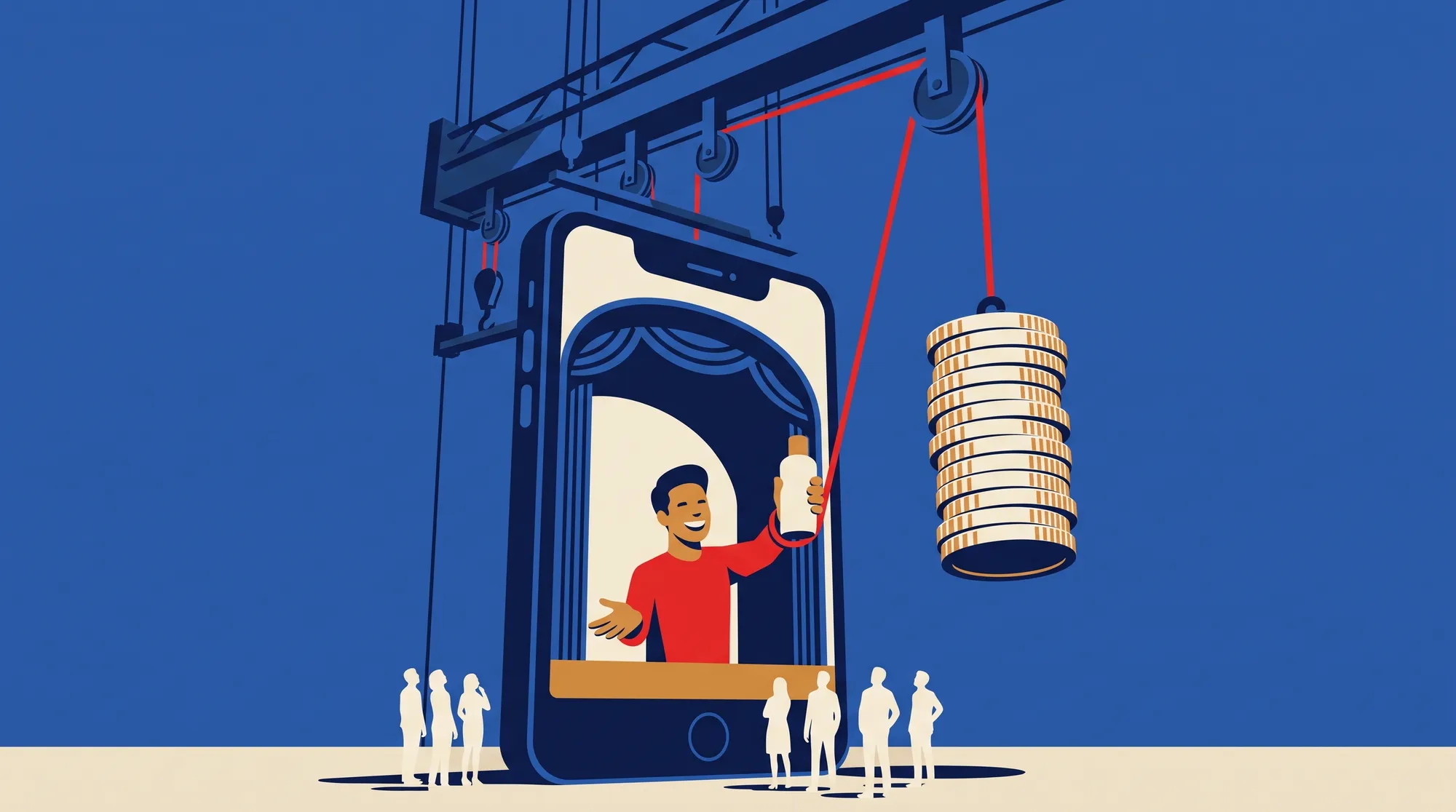

IAB Ireland and RED C Research on September 10, 2026 published consumer research showing that 38% of Irish adults have looked further into a product or brand after encountering content from social media personalities, while fewer than one in five regard commercially funded material from those personalities as genuine. The findings were presented at IAB Ireland's first Creator Marketing Summit, which brought brands, agencies, platforms, publishers and creators together to examine the next phase of the channel in Ireland.
In Short
An Irish advertising trade group asked people about influencers and found that many use them to discover and research products, but very few believe the paid posts are genuine. That matters to brands, agencies and creators working in Ireland, because audiences say honest reviews and clear labelling of paid deals and AI use are what earn their trust. The trade body now wants the industry to judge creator partnerships on credibility and long-term relationships, not only on how many people a post reaches.
A funnel measured in three steps
According to IAB Ireland, creators already occupy several stages of the path to purchase. The research, titled The Creator Effect, found that 38% of Irish adults have researched a product or brand further after seeing creator content. A slightly smaller share, 36%, have discovered a new brand or product that way. Purchase is where the numbers thin: almost one in five Irish adults, or 19%, have bought a product or service as a result of creator content.
Read as a sequence, the three figures describe a familiar shape. Discovery and research sit within two percentage points of each other, while conversion runs at roughly half the research figure. The release does not state whether these are lifetime, annual or recent-period measures, a distinction that matters to anyone trying to set the data against platform-reported conversion rates. Nor does it say whether respondents were asked about paid partnerships specifically or about creator content in general, a category that includes unpaid recommendations functioning closer to word of mouth than to advertising.
That distinction is not academic. The rest of the study turns on it.
Where audience expectations and paid content part ways
Trust, transparency and authenticity matter most to audiences, according to IAB Ireland, with credibility and relatability also playing a role. The researchers then tested those same qualities against sponsored material. The results diverge sharply.
Authenticity
Some 72% of Irish adults say authenticity is important in creator content. Just 17% currently consider sponsored creator content to have that quality. The spread is 55 percentage points, the widest in the published findings.
Transparency
The second measure runs along similar lines, if less steeply. While 68% say transparency around paid partnerships is important, only 21% feel creators are open about their commercial relationships. That leaves a gap of 47 points.
The two gaps are not strictly comparable. Authenticity was measured against sponsored content as a category, whereas transparency was measured against how creators behave regarding their commercial arrangements. Both, however, point at the same place: the paid partnership itself, the commercial core of any brand deal, is where audience goodwill appears thinnest. IAB Ireland characterised the result as a clear gap, one in which audiences value authenticity and transparency but do not always find either in sponsored work.
What Irish adults say builds trust
According to IAB Ireland, honest reviews that set out both positives and negatives are the biggest single driver of trust, cited by 47% of Irish adults. Three further factors trail at a distance. Creators appearing independent and not overly commercialised was cited by 32%, clear disclosure of paid partnerships also by 32%, and long-term relationships with brands by 27%.
The ranking contains a tension the release leaves unresolved. The most cited trust factor, balanced reviews that include criticism, is the element a commissioning brand has the least commercial incentive to encourage. The second, appearing independent, sits uneasily beside the fourth, sustained relationships with brands, which by definition tie a creator more closely to a given advertiser. Respondents appear to reward long partnerships while penalising visible commercialisation. Can a single sponsored post satisfy both?
Disclosure, at 32%, ranks joint second. That is lower than consumer research from other markets might suggest. Research cited in the ANA's influencer marketing report recorded 71% of surveyed consumers saying clear sponsorship disclosure increases trust, and 70% reporting that they felt misled when partnerships were hidden. The questions differ - one asks respondents to select drivers from a list, the other isolates a single factor - so the figures do not contradict each other. They do show how much question design moves the answer.
Gavin Costello, Research Project Manager at RED C Research & Marketing, set out the pattern in the release. "Creators have real influence across the consumer journey, particularly when it comes to discovery and consideration. Audiences clearly value the role creators play, while also having strong expectations around what makes content credible. The opportunity for the industry is to build on that influence through partnerships that feel honest, transparent and genuinely relevant."
AI enters the disclosure question
The study also covered generative AI. According to IAB Ireland, 72% of Irish adults say it is important that creator content is human-generated rather than AI-generated. Four in five want creators to disclose clearly when AI has been used to create or substantially modify content. The 72% figure is identical to the authenticity result reported earlier in the release, though the two are presented as responses to separate questions.
The timing places the finding against an active regulatory backdrop. Ireland is an EU member state, and Article 50 of the AI Act became legally applicable across the bloc on August 2, 2026, setting transparency duties for certain AI-generated and manipulated content. The Commission's guidelines and Code of Practice, finalised on July 20, 2026, attach fines of up to 15 million euros or 3% of worldwide annual turnover to non-compliance and exclude advertising from the lighter regime available to artistic or satirical work. The Irish release does not mention the AI Act. The expectation its respondents expressed is also broader than the law: the regulation targets defined categories, such as deepfakes and AI-written material on matters of public interest, rather than every instance of AI assistance.
Parts of the industry have argued against blanket labelling. Version 2 of the IAB's AI Transparency and Disclosure Framework, published on August 18, 2026, cited an NYU Stern finding that telling consumers an advertisement was made with generative AI cut click-through by 31.5%, and used that cost to support disclosure only where AI use could mislead. The Irish result, with four in five adults wanting disclosure whenever AI substantially alters content, sits closer to the consumer end of that argument than to the framework's position.
Other research points the same way. The January 2026 edition of the IAB framework documented a 37-point gap between advertiser assumptions and consumer sentiment, with 82% of advertising executives believing Gen Z and Millennial consumers felt positively about AI-generated ads against 45% who actually did. On the publisher side, a Raptive study of 3,000 US adults published in July 2025 found that suspected AI content reduced reader trust by nearly 50% and cut purchase consideration for adjacent advertising by 14%.
Platforms have moved on detection rather than waiting for creators to self-declare. YouTube shifted its generative AI labels into more visible positions in May 2026, using C2PA metadata and SynthID watermarks to apply labels even when a creator does not tick the disclosure option at upload.
Suzanne McElligott, CEO of IAB Ireland, linked the AI point to the wider trust argument. "Creator marketing has moved well beyond being a niche part of the digital landscape. These findings demonstrate the genuine influence creators can have on how Irish consumers discover and consider brands. The opportunity now is to build on that influence through best in class partnerships that audiences recognise as credible, transparent and authentic, while ensuring new technologies such as AI are used in a way that protects trust. We look forward to working with our Creator Marketing Council to develop Ireland's Creator Marketing Industry."
For IAB Ireland, according to the release, the findings underline an opportunity to focus on credibility, relevance and longer-term relationships alongside reach. The release does not describe the membership, remit or output timetable of the Creator Marketing Council.
What the release leaves out
Several details that would allow the figures to be tested are absent from the published material.
Methodology. The release gives no sample size, fieldwork dates, survey mode or age floor. It refers only to "Irish adults." IAB Ireland's previous collaboration with the same research firm, Listen Up Ireland 2026, was fielded between March 5 and 15, 2026 using a nationally representative online sample of 1,032 adults aged 16 and above. Whether The Creator Effect followed a comparable design is not stated. The full research deck is available to IAB Ireland members on email request, which means non-members cannot check question wording, base sizes or confidence intervals.
Dates. The release carries a header dated Thursday 10 September 2026, while the page on IAB Ireland's website is bylined September 14, 2026. The release itself does not give the date of the summit at which the findings were presented. IAB's July 2026 planning materials listed IAB Ireland's Creator Marketing Summit in Dublin for September 9, a day before the release header.
Market count. The release describes the summit as part of IAB Global Creator Week, with similar events hosted by IABs in 18 other markets - implying 19 in total. The July announcement described a programme across 17 markets, a figure that already included Ireland as an adjacent event, alongside IAB Europe and IAB MENA. The release does not reconcile the two counts. Additional chapters may have joined since July, or regional bodies may be counted differently, but no explanation is given.
Naming. The release headline refers to Red C Research, while Costello's title is given as Research Project Manager at RED C Research & Marketing. Both appear to refer to the same firm.
Ireland inside a wider creator calendar
The Irish study lands during the busiest week the trade body network has yet organised around creators. Global Creator Week runs from September 14 to 18, 2026, and IAB counts roughly 200 million people worldwide identifying as creators, about 50 million of them working professionally or semi-professionally. In the United States, creator advertising spend is projected at $43.9 billion for 2026. On September 15 in New York, IAB CreatorFronts convenes as part of a week that also stages the Podcast Upfront and PlayFronts, a schedule the trade body tied to a rounded $44 billion projection.
For IAB Ireland, the creator study extends a research programme that has so far concentrated on other channels. The organisation published its first dedicated analysis of the Irish retail media market on December 4, 2025, and its Listen Up series has tracked digital audio since 2019. Searches of PPC Land's archive return no earlier creator-focused study from the Irish body.
The European chapters have taken different routes into the same subject. IAB Polska published a nano and microinfluencer guide on March 19, 2026, citing its own research that only 30% of Polish social media users trust influencer content, with 52% saying they mostly or definitely do not. IAB UK rolled out a paid creator qualification on May 19, 2026, citing ASA research that only around 57% of UK influencer ads met disclosure requirements, while 80% of UK adults called clear labelling essential. Ireland's contribution, by comparison, is a consumer measurement rather than a rulebook or a training course.
Why the findings matter to marketers
Creator budgets sit inside social media marketing plans but are contracted and measured differently from platform advertising, and the Irish data sharpens a problem buyers have struggled to quantify. The factors that most raise audience trust - criticism alongside praise, visible independence - are the same factors that reduce an advertiser's control over the message. The study does not measure whether campaigns built around those factors convert better. It measures only what respondents say they value.
That gap between stated preference and measured behaviour has shown up elsewhere. Reddit's Path to Purchase research, expanded on August 10, 2026, found that first-hand consumer experiences were twice as likely as professional or influencer reviews to be named the most important purchase factor in the United States, and almost 2.5 times as likely in the United Kingdom. The ANA's report found 67% of client-side marketers naming measurement as the hardest step in influencer marketing, and quoted BBB National Programs research in which just 5% of consumers who bought on a creator recommendation said they fully trusted creator content. The Irish finding that purchase trails research by roughly half adds a local data point to that measurement debate, without resolving it.
Liability is the other thread. Industry guidance summarised by the ANA holds that when a creator fails to disclose a paid relationship, the brand is likely to face scrutiny first. Enforcement has followed: Australia's competition regulator fined PhotobookShop 39,600 dollars in March 2026 and penalised Hismile 138,600 dollars in June, while Sweden's consumer agency documented injunction penalties reaching 1.5 million kronor per violation. In the United States, a class action filed against Sephora on September 4, 2026 placed undisclosed creator compensation at the centre of a consumer-protection claim. Against that record, an Irish finding that only 21% of adults see creators as open about commercial ties is less a sentiment statistic than a description of exposure.
None of this means the channel is shrinking. Spending projections point the other way, and the Irish data shows creators already shaping discovery for more than a third of adults. What the study adds is a measure of how much of that influence depends on content audiences do not recognise as paid - and how little of it survives once they do.
Timeline
- July 15, 2025 - Raptive publishes research finding suspected AI content cuts reader trust by nearly 50%
- December 4, 2025 - IAB Ireland publishes its first dedicated retail media report
- December 2025 - IAB research projects US creator ad spend at $43.9 billion for 2026
- January 16, 2026 - IAB publishes its first AI Transparency and Disclosure Framework, citing a 37-point advertiser-consumer perception gap
- March 5-15, 2026 - RED C Research fields IAB Ireland's Listen Up Ireland 2026 survey among 1,032 adults
- March 19, 2026 - IAB Polska publishes a nano and microinfluencer guide, reporting 30% trust in influencer content
- March 2026 - Australia's ACCC fines PhotobookShop 39,600 dollars over concealed paid influencer partnerships
- May 19, 2026 - IAB UK rolls out a creator qualification, citing 57% disclosure compliance
- May 2026 - YouTube moves generative AI labels into more visible positions and widens automatic detection
- June 2026 - Australia's ACCC penalises Hismile 138,600 dollars
- July 20, 2026 - The European Commission finalises Article 50 guidelines and the Code of Practice on AI-generated content
- July 23, 2026 - IAB sets out Global Creator Week across 17 markets, listing IAB Ireland's Dublin summit for September 9
- August 2, 2026 - Article 50 of the EU AI Act becomes legally applicable
- August 10, 2026 - Reddit publishes data showing peer experiences outweigh influencer reviews by 2x in US purchase decisions
- August 18, 2026 - IAB publishes version 2 of its AI disclosure framework, citing a 31.5% click-through cost
- August 20, 2026 - IAB schedules CreatorFronts, Podcast Upfront and PlayFronts in the same New York week
- September 4, 2026 - A class action citing undisclosed creator pay is filed against Sephora
- September 10, 2026 - IAB Ireland and RED C Research release The Creator Effect findings, presented at IAB Ireland's first Creator Marketing Summit
- September 14, 2026 - IAB Ireland posts the release to its website; IAB Global Creator Week begins, running to September 18
- September 15, 2026 - IAB CreatorFronts convenes in New York
Related PPC Land coverage
- IAB unites 17 markets in creator week as US spend hits $43.9bn - The programme of events, including IAB Ireland's Dublin summit, that frames the Irish release.
- IAB unites three ad marketplaces as US creator spend hits $44 billion - How IAB consolidated its creator, podcast and gaming marketplaces into one New York week.
- ANA finds 67% of marketers call influencer measurement the hardest step - Waste, measurement and disclosure liability across 13 steps of influencer marketing.
- IAB UK launches first creator qualification as brands chase trust - A paid training programme built on ASA data showing 57% disclosure compliance.
- IAB Polska publishes nano and microinfluencer guide as trust data turns stark - Polish research finding only 30% of social media users trust influencer content.
- Influencer reviews lose to peer posts by 2x in US buying, Reddit finds - Survey evidence weighing peer experiences against creator endorsements in two markets.
- YouTube will label brand deals that creators fail to disclose - Platform-level disclosure enforcement set against international penalties for hidden partnerships.
- AI ad labels cut click-through 31.5%, IAB framework cites NYU study - The trade body's case against blanket AI labelling and the engagement cost behind it.
- EU AI content rules force publishers to label or risk 3% of turnover - The Article 50 guidelines, Code of Practice and penalty structure now applicable in Ireland.
- Irish digital audio hits COVID-era highs, and advertisers are noticing - IAB Ireland's earlier RED C study, with its disclosed sample and fieldwork dates.
Summary
Who: IAB Ireland, the trade body for Ireland's digital advertising industry, with research firm RED C Research & Marketing. Suzanne McElligott, CEO of IAB Ireland, and Gavin Costello, Research Project Manager at RED C, commented on the findings. The research concerns Irish adults and affects brands, agencies, platforms, publishers and creators working in the Irish market.
What: Consumer research titled The Creator Effect, finding that 38% of Irish adults have researched a product further after seeing creator content, 36% have discovered a new brand and 19% have made a purchase as a result. It measured a 55-point gap between the 72% who value authenticity and the 17% who see it in sponsored content, and a 47-point gap on transparency. Honest reviews were the top trust driver at 47%, and four in five adults want AI use in creator content disclosed.
When: The release is dated Thursday, September 10, 2026, and was posted to IAB Ireland's website on September 14, 2026. The findings were presented at IAB Ireland's first Creator Marketing Summit, which earlier IAB planning materials listed for September 9.
Where: Ireland, with the summit held as part of IAB Global Creator Week, which the release says involves events in 18 other markets.
Why: Creator marketing has grown into a significant share of advertising investment, while disclosure enforcement and EU AI transparency rules are tightening. The findings quantify how far audience expectations of honesty and openness diverge from how sponsored creator content is perceived, and IAB Ireland is using them to press for partnerships judged on credibility and long-term relationships alongside reach.


Discussion