


There is a pattern in the last two days of trade reporting that only becomes visible when the stories are laid side by side. A network of screens in exam rooms held its second upfront. A games publisher packaged three franchises into a single seasonal buy. A grocer told investors its media arm grew profit faster than at any point in five years. A car maker put a film promotion on the dashboard. None of these is a large story on its own. Together they describe a single movement: advertising is running out of conventional inventory and is annexing physical and product surfaces that were never sold before.
 Luis Rijo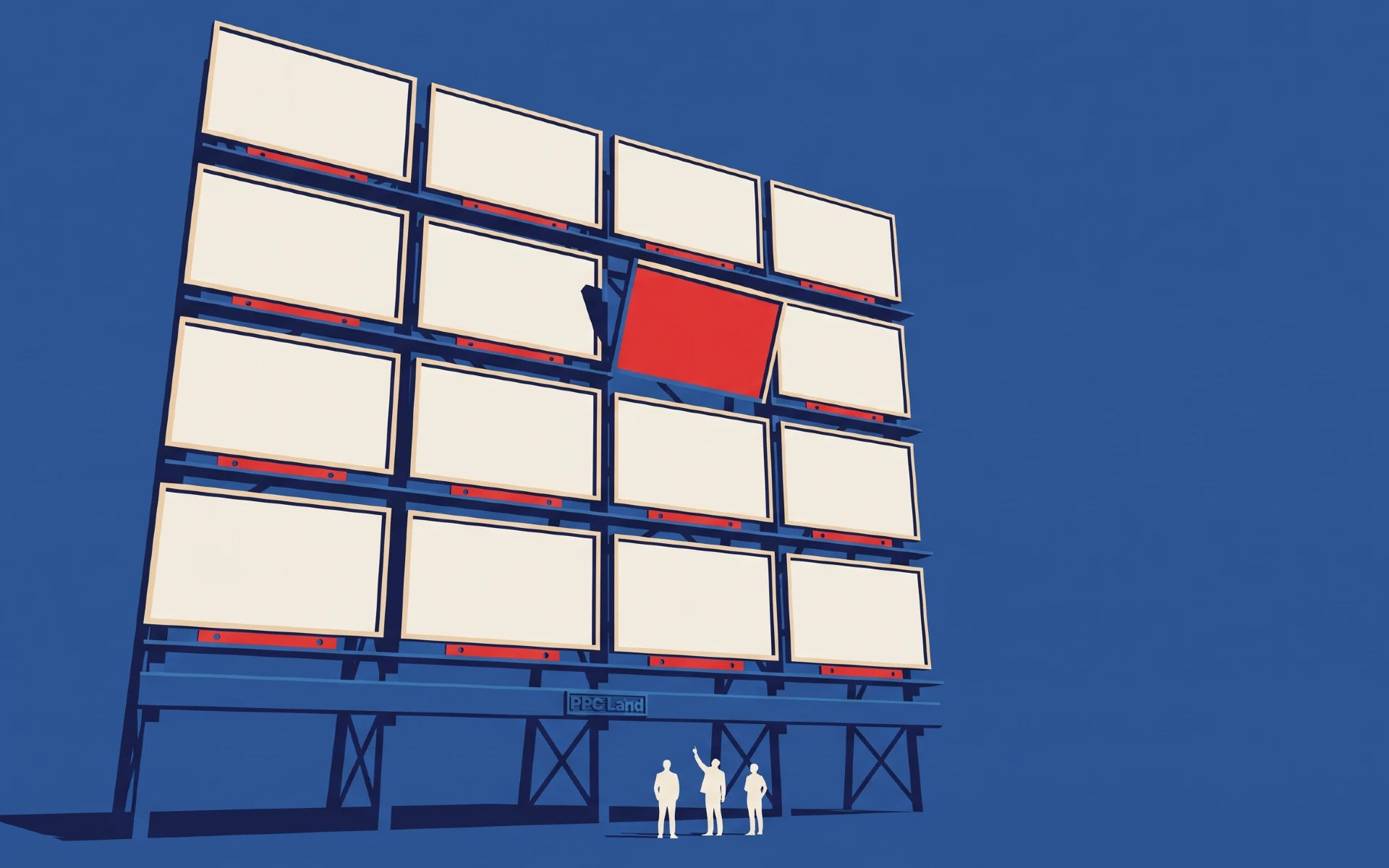
What has not moved at the same speed is the apparatus that tells anyone whether those surfaces work. The measurement layer arrives late, and it arrives unevenly. That gap is the connective tissue across everything below, and it is why the same week that produced a bundled console offering and a waiting-room upfront also produced a Digiday podcast asking when advertising stops being useful and becomes noise, and a US market-share reading showing that three companies took a larger share of advertising revenue in 2025 than in 2024. Inventory is proliferating. Revenue is concentrating. Those two facts are not in tension; they are the same fact seen from two ends.
The exam room becomes a media channel
PatientPoint operates what is now the largest point-of-care advertising network in the United States, a footprint of 145,000 digital screens across 32,000 medical offices. AdExchanger's September 14 piece put that number in a frame worth repeating: the company reaches more locations than Starbucks and McDonald's combined. The network is not a single format. It spans waiting-room displays, digital check-in portals, screens inside exam rooms themselves, back-office placements, and mobile targeting that extends before and after the visit.
Pharmaceutical companies remain the core client base. That is the historical shape of the channel, and it explains the economics: pharma point-of-care marketing spending reached roughly $1.2 billion last year, having passed $1 billion the year before. What is changing is the mix around that core. Consumer packaged goods brands, over-the-counter medication makers and supplement companies are buying into a channel that was built for prescription products, on the argument that wellness has moved from a category into a general consumer posture.
The company has been building the trappings of a conventional media business. It held its first upfront presentations in May 2024, a late date for a network of that size, and the 2026 edition drew more than 150 media buyers in Manhattan. It has secured MRC accreditation for digital campaign reporting, which is the industry's standard signal that a seller's numbers have been audited rather than asserted. Jeremy Hlavacek, previously at The Weather Company, IBM Watson Advertising and Experian, has been appointed general manager of advertising; his background is squarely in programmatic and data businesses rather than health publishing, which says something about where the network expects its next growth to come from.
The privacy architecture is the part that deserves the closest reading, because a doctor's office is not a supermarket aisle. PatientPoint says it does not collect personally identifiable information, and instead uses aggregate claims-level data to characterise the demographics of a practice rather than the people sitting in it. Its Precision product takes a different route, drawing on consented electronic health record data through an explicit opt-in process that the company describes as separate from HIPAA authorisations. Kate Calabrese, senior SVP of client solutions, summarised the design in one sentence: "Everything is tokenized, so we don't know who the individual is."
That claim is the load-bearing element of the whole business, and it is the one that regulators tend to test. A tokenised identifier is still an identifier; the privacy property depends entirely on what can be joined to it downstream and by whom. The distinction the company draws between consented EHR data and HIPAA-covered data is a real legal distinction, not a rhetorical one, but it also means the protection travelling with that data is contractual rather than statutory. Nothing in the reporting suggests any breach of the arrangement. The observation is narrower: a network of this scale in a clinical setting now runs on a consent structure that is defined by the seller rather than by a health privacy statute, and the formulary logic that governs which drugs a practice can prescribe has no equivalent governing which brands can address a patient in the room where the prescribing happens.
There is a public-health veneer on top of the commercial layer. PatientPoint has run a campaign called The Big Screen featuring Katie Couric promoting cancer screening. Campaigns of that sort are common in point-of-care because the setting rewards them, and they also serve the channel's argument to buyers: that a message delivered near a clinical decision carries weight that the same message cannot carry in a feed.
Consoles, dashboards and the measurement that has not arrived
Four months after establishing a dedicated advertising business unit, Electronic Arts has launched a bundled package called Moments of Play, which sells dynamic media placements across multiple franchises at once rather than title by title. The first version spans EA Sports FC 27, EA Sports College Football 27 and skate, and it debuted for the 2026 holiday season on the strength of EA's internal finding that player engagement rises by an average of 25% during that period. Alex Dao, vice president of advertising and sponsorships, was direct about the intent: "Moments is definitely going to be a part of our offerings going forward." The company plans to extend the construct to major sports events and game launches across the year.
The design of the product is a response to a diagnosis, and the diagnosis is not flattering to gaming as an ad channel. Nikhil Lai, principal analyst at Forrester, listed what has held the category back: "fragmented inventory, custom integrations, inconsistent measurement and difficult media-planning workflows." He added that most advertisers care about "audiences, outcomes and operational efficiency" rather than the particular title their message appears in. Bundling is the standard remedy when a market has too many small, non-comparable units; it is what happened to broadcast dayparts, and to display inventory before it. EA is selling across console and mobile, with emphasis on what it calls HD console gaming, meaning PlayStation 5 and Xbox, where it observes the strongest marketer interest, and it offers both premium custom integrations and programmatic buying.
The same week produced a sharper version of the measurement complaint from a different surface. Brian Quinn, US president and general manager at AppsFlyer, used a BMW campaign to make the argument that every new ad network inherits a measurement problem. BMW placed a promotional banner for Spider-Man on vehicle dashboards, which animated with music and lighting effects when drivers started their cars. The backlash was sharpened by history: a BMW executive had said in 2023 that the cabin was "a private space" and unsuitable for commercials.
Quinn's point is not about taste. It is that BMW can almost certainly count banner impressions and tap-throughs, and almost certainly cannot say whether any of it sold a cinema ticket. He also raised a contextual variable that has no analogue in most channels: an advertisement shown while a car is parked is a different product from one that interrupts navigation, and no current framework distinguishes between them. Mobile advertising and connected television both grew once the measurement infrastructure was built; his argument is that in-car advertising cannot become endemic to the media plan until something comparable exists. A scorecard for a channel tends to arrive after the inventory does, and the interval is where the money is wasted.
Digiday's podcast on September 15 put these threads together and added the consumer side of the ledger. Tim Peterson and Kimeko McCoy walked through the expansion of advertising into smart refrigerators, dashboards and AI answers, noting Samsung's smart refrigerator pilot from March 2026 and the BMW activation from August 2026 alongside AI agents encountering advertising on Time's platform. The underlying shift they identified is contractual rather than technical: services that were once sold ad-free now carry advertising, Netflix's basic tier being the most visible example, which means the value exchange consumers thought they had agreed to has been rewritten under them.
Resistance is already taking inventive forms. The episode described users adding profanity to queries in order to trigger advertisers' own brand safety controls and thereby strip the ads out, a workaround that turns a seller-side protection into a consumer tool. Meanwhile Spotify, YouTube and Netflix have all introduced ad-skipping features, which is a strange thing for advertising businesses to do unless they are worried about abandonment. The historical parallel drawn was the ad fatigue of the mid-2000s, which produced Google's Panda update and Apple's ad-blocking features.
One data point from the same 48 hours sits neatly against the expansion narrative. NFL RedZone cut its advertising load by 50% after subscriber backlash, one of several items in AdExchanger's September 15 roundup. A premium property reducing its ad load by half, in the same week that a games publisher and a screen network were expanding theirs, is the clearest available illustration that the ceiling on tolerance is real and that it is discovered by hitting it.
Kroger's media arm outgrows the shelves
Retail media is the oldest of the new surfaces, and it produced the week's hardest numbers. Kroger Precision Marketing grew profit 24% in the second quarter of 2026, the strongest growth the unit has recorded since 2021. Media monetisation rose 88 basis points year over year. E-commerce sales increased 20%, a second consecutive quarter of profitable growth for that side of the business.
The sequencing on the earnings call was itself a signal. Chief executive Greg Foran addressed retail media and e-commerce before traditional merchandising, an ordering that companies do not choose by accident. Foran's history explains the emphasis: he led Walmart's US business when Walmart Connect launched in 2019, and the pattern he established there is visible in what Kroger has assembled over the past two quarters.
That assembly has three distinct layers. The first is off-site distribution: a March partnership with Google that lets advertisers run YouTube and YouTube TV campaigns against Kroger data through Display and Video 360, followed in June by a self-service advertising partnership with TikTok. The second is on-site and in-product: an AI shopping assistant with integrated advertising functionality, now live across most of the company's grocery banners. The third is physical: digital screens rolled out in wine-and-spirits departments across nearly 600 stores, with end-cap screen expansions planned alongside Barrows Connected Store.
The third layer is the one that matters for the argument running through this edition. A retail media network that sells search placements on its own website is selling a digital surface. A retail media network that sells a screen at the end of an aisle is selling the store itself, which is a different asset with different measurement properties and a different relationship to the shopper. The wine-and-spirits placement is a specific choice rather than a generic one: it is a high-margin, heavily branded, legally restricted category where the manufacturer cannot reach the shopper through most conventional channels.
Two outside voices framed the competitive question. Drew Cashmore, chief strategy officer at Vantage, described the company's approach as integrative: "Kroger is thinking about all of the components of media...that culminate in driving a better customer experience." Sean Crawford, managing director at SMG, stated the harder test that every retail network now faces, which is that a retailer must "create something that advertisers feel is worth paying for and that they can't get elsewhere." That condition is getting more difficult to satisfy as the number of networks grows and as the largest platforms ingest retailer data directly. Kroger's answer, visible in the March and June deals, is to stop treating its data as something that only works on its own properties.
An Australian regulator unpicks a portal's listing lock
While advertising was annexing new surfaces, a competition regulator was prising open an old one. Australia's competition authority accepted a binding three-year undertaking from REA Group and realestate.com.au on September 11, 2026, ending mandatory all-listing requirements on the country's dominant property portal.
The mechanics are worth setting out precisely, because the remedy is unusually granular. With immediate effect, REA cannot enforce contract clauses that require agencies to list all or most of their properties on its platform, and cannot make tier upgrades a condition of sponsorship. From January 1, 2027, agencies acquire a positive right: they may downgrade at least 25% of their eligible sale and rental listings to cheaper tiers in each half-year period. That converts what had been a fixed annual commitment into a partially variable one, which is a change in the shape of the contract rather than in its price.
The ACCC reasoning identified two distinct harms. All-or-nothing listing requirements stopped agencies from declining services for individual properties, and they stopped rival portals from competing listing by listing. The second is the competition harm proper: a competitor cannot win a customer incrementally if the customer's contract forbids incremental defection. Chair Gina Cass-Gottlieb framed the outcome in terms of the end client: "REA will give greater flexibility to agents in how their vendor and landlord clients list their properties."
Compliance is not left to good intentions. REA must appoint a compliance officer and an external adviser within three months, run annual competition law training, and submit to independent reviews at the one-year and two-year marks. Material failures must be notified to the regulator within 21 days.
The wider significance is doctrinal. A vertical listings portal is a two-sided marketplace whose power comes from consumer attention on one side and supply commitments on the other, and the case treats portfolio commitments as a competition problem even where alternatives formally exist. That is a lower threshold than a pure exclusivity theory, and it establishes a reference point for how Australian regulators will read platform contract structures. The parallel to advertising is direct: much of the sell side runs on annual commitments, tiering and upgrade conditions that look structurally similar, and a regulator willing to treat volume commitments as a foreclosure mechanism has opened a door that does not close at the property sector's edge.
Anxiety about AI search is being converted into budget
The last thread turns the measurement problem into a budgeting argument. Chief marketing officers in categories with long consideration cycles, specifically insurance, cars and running shoes, are citing AI search disruption as the reason to raise media budgets, and the money they are asking for is upper-funnel brand spending rather than performance.
The logic is not complicated. If the intermediary between a consumer and a purchase is increasingly an AI assistant that surfaces a short list rather than a page of results, then being one of the brands the assistant already knows becomes more valuable than being the brand that bids highest on a keyword. A survey by Dept covering 2,600 shoppers found 61% of US consumers had used AI assistants for shopping research in the previous three months. An IAB survey found 44% of media buyers identifying adaptation to changing search habits as their single largest investment challenge.
Alyson Griffin, head of marketing at State Farm, was unambiguous about the brand spending: "We value it. We're not pulling it back," adding that the company has "to be there and capture more of the open audience." Ryanne Webber, a senior manager at Mercedes-Benz, grounded the case in the category's purchase rhythm: "Most consumers are only purchasing a vehicle every couple years, so our purchase journey is much longer." Allie Tsavdarides, vice president of North America marketing at Hoka, described the balance as "a combination of art and science... performance credibility and emotional connection." Agencies are recommending a dual approach, pairing generative engine optimisation work with awareness and favourability building intended to improve how the models represent a brand.
The obvious hazard is that the second half of that recommendation is nearly unfalsifiable. Digiday's accompanying data piece on the scramble to measure AI visibility set out how far the industry is from a baseline. The IAB is working on standardisation frameworks precisely because none exists. The platform-level variance is extreme: Amazon accounted for 4% of Microsoft Copilot citations in July data, 0.1% on ChatGPT and zero on Gemini, per Tinuiti. Source preferences diverge just as sharply, with ChatGPT leaning on community and reference material, Reddit supplying 28.9% of its citations, while Google's AI surfaces favour video and social, citing YouTube at 21.1% and Facebook at 17%, drawn from Sitecore's Scrunch analysis covering May to July. YouTube is cited regularly by Google AI Mode, Gemini and Perplexity, and not by ChatGPT or Copilot.
Two further findings complicate the picture. An Adobe consumer survey of more than 5,000 US respondents in July 2026 found 95% of AI users rating the technology as trustworthy as traditional search, with 29% calling it very trustworthy, and trust rising with familiarity, from 94% among experimenters to 97% among regular users. And among 200 brand and agency decision-makers surveyed by the IAB, 45% named measurement as their biggest struggle, particularly when comparing AI-driven journeys against traditional ones. The structural reason is that these models are non-deterministic: identical prompts return different results on repeat, which means a visibility metric is a distribution rather than a value.
Against that uncertainty sits a settled number. Google, Meta and Amazon together took 56% of US advertising revenue in 2025, up from 53% in 2024, with each gaining share individually: Google from 28% to 29%, Meta from 17% to 19%, Amazon from 8% to 9%, with everyone else falling from 47% to 43%. Luke Stillman of Madison and Wall expects the pattern to hold: "They're just going to outperform the average every year." The mechanism he describes is circular and well understood. More spending produces better optimisation data, better optimisation attracts more spending.
Which returns the argument to where it started. New surfaces are opening at a rate the industry has not seen in years, in exam rooms and cars and games and grocery aisles, and each of them arrives without the measurement infrastructure that would let a buyer compare it to anything else. In the absence of comparison, budgets move toward the places where outcomes are already legible. The proliferation of inventory and the concentration of revenue are not opposing trends. The first is producing the second.
Also noted
- September 15: Netflix, Amazon and YouTube have formed the Streaming Access and Choice Alliance under the TechNet umbrella, a coalition read as a response to FCC and DOJ scrutiny of live sports migrating to subscription platforms (AdExchanger).
- September 14: Google Ads has opened a beta for Product Value Optimization, letting advertisers set value adjustments that steer automated bidding toward products matching business goals such as margin or seasonal inventory, across Performance Max and Shopping campaigns, after a quiet June 2026 announcement (Search Engine Roundtable).
- September 14: search trackers reported that a Google ranking movement first observed on September 4 appeared to revert on September 13, with no confirmed update from the company in either direction (Search Engine Roundtable).
- September 14: Google is testing a blue "more" link inside shopping results, a small interface change that alters how far a shopping unit extends before a user must click (Search Engine Roundtable).
- September 14: affiliate firm Howl has sold its creator business to Connexity, Taboola's commerce unit, in a quietly disclosed transaction (Adweek).


Discussion