


Google Ads today began moving percentage multipliers for its customer lifecycle goals out of beta, giving retailers a way to raise the value of a new customer's purchase in proportion to the size of the basket rather than by a fixed sum. The change was disclosed on October 22, 2026, in a three-post thread from AdsLiaison, the X account run by Google's ads product liaison, Ginny Marvin. According to the thread, the multipliers range from 1.1x to 5x and are "rolling out globally this month across Search, Shopping, Performance Max, and Demand Gen in both Google Ads and SA360." The same thread said a high value mode for new customer acquisition is coming to Shopping campaigns, and that three customer retention modes are rolling out in Performance Max, Search and Shopping.
In Short
Google lets advertisers tell its bidding system that a brand-new customer is worth more than a repeat one, and until now that extra worth could only be a fixed amount, such as $20 per sale. Now it can also be a percentage, so the bonus grows on big orders and shrinks on small ones. Shops that sell both cheap and expensive items will see their bids for new customers move more closely with basket size, and they also get new settings for winning back old customers.
What Google said, and where
The primary source is Google's own thread. Its opening post, timestamped October 22, 2026, framed the update around a single arithmetic problem. "Retailers: You're no longer limited to flat-rate bidding adjustments for customer acquisition & retention in Google Ads," it read. "A static $20 incremental conversion value set on a small $50 checkout might be too aggressive, but not aggressive enough on a large $1,000 cart."
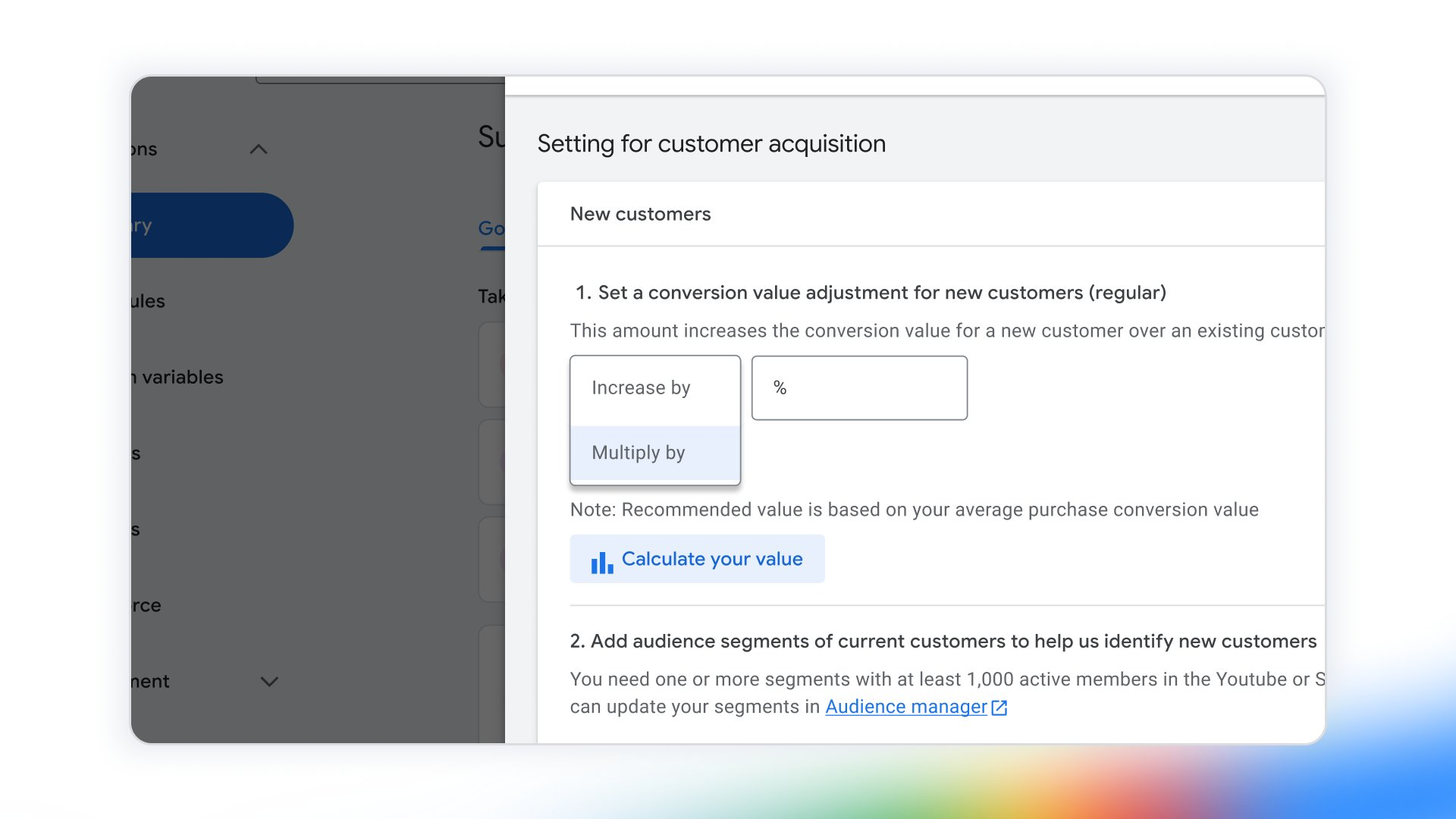
The second post supplied the mechanics. "With the 'Multiply by' option, your bids can scale dynamically with predicted cart size (from 1.1x up to 5x)," according to Google. It then gave a worked example: "At a 1.2x (20%) percentage multiplier for new customer acquisition: - A $100 purchase value dynamically scales to $120. - A $500 purchase value dynamically scales to $600."
The third post listed two further changes. "High value mode is rolling out in Shopping campaigns," it said, and "Customer Retention modes (for Re-engagement, Loyalty, and Retention-only) are rolling out in PMax, Search, and Shopping campaigns to give you more ways to reach existing customer segments."
A second account of the update came from Search Engine Land, which published Google Ads expands customer acquisition and retention controls by its paid media news editor, Anu Adegbola, on the same day. The article does not link to a Google announcement, help page or the AdsLiaison thread. Several of its details match Google's posts, while others go beyond them or leave parts out; those differences are set out below.
How the multiplier changes the arithmetic
Customer acquisition goals in Google Ads work by adding value. When a purchase comes from someone the system classifies as a new customer, the advertiser instructs Google to treat that conversion as worth more than it would be from an existing customer. The bidding system, which in value-based strategies such as Target ROAS and Maximize conversion value aims at conversion value rather than conversion count, then bids more aggressively for people it predicts will be new buyers.
Until now that extra value has been a flat amount. In the Google Ads interface Google shared with its opening post, the setting sits in a panel titled "Setting for customer acquisition." Under the heading "1. Set a conversion value adjustment for new customers (regular)," the interface explains that "This amount increases the conversion value for a new customer over an existing customer." A dropdown offers two choices, "Increase by" and "Multiply by," next to a field with a percent sign. Beneath it sits the line "Note: Recommended value is based on your average purchase conversion value," and a button labelled "Calculate your value."
A fixed bonus ignores basket size, which is the problem Google's $50 and $1,000 example describes. A retailer whose average order value is $100 and who sets a $20 bonus is, in effect, telling the system that a new customer is worth 20% more than an existing one. That ratio holds only for $100 baskets. On a $50 checkout the same $20 is a 40% uplift; on a $1,000 cart it is 2%.
PPC Land's own calculation shows how a 1.2x multiplier would treat the three basket sizes Google mentions across its posts:
- $50 checkout: flat $20 bonus gives $70; 1.2x gives $60
- $100 purchase: flat $20 bonus gives $120; 1.2x gives $120
- $1,000 cart: flat $20 bonus gives $1,020; 1.2x gives $1,200
The $100 and $500 rows in Google's own example follow the same rule. At the top of the permitted range, a 5x multiplier would make a $100 new customer purchase count as $500 for bidding purposes. At the bottom, 1.1x adds 10%.
Google's wording carries one qualification worth noting. The opening line of the second post says bids "scale dynamically with predicted cart size," while the worked example applies the multiplier to "purchase value." The thread does not explain how predicted cart size at auction time relates to the purchase value reported after a conversion, and it does not say whether the multiplier is applied at the auction, to the reported conversion value, or both.
The thread also leaves open whether multipliers apply to retention goals. Its opening sentence mentions "customer acquisition & retention," and it refers to "percentage multipliers for customer lifecycle goals." Every example Google gave, however, covers new customer acquisition only.
Segment requirements
The same Google Ads panel shows a second step: "2. Add audience segments of current customers to help us identify new customers." According to Google's interface, advertisers need one or more segments with at least 1,000 active members, managed in Audience manager. That floor applies to the segments used to separate new from existing customers.
Those segments typically come from Customer Match uploads or tag-based remarketing lists, a set-up PPC Land described in its April 2025 coverage of lifecycle goals, which also noted that Google's auto-detection counts anyone who purchased within the previous 540 days as a returning customer.
Where the multipliers apply
Google's thread names four campaign types (Search, Shopping, Performance Max and Demand Gen) and two platforms, Google Ads and SA360, Google's enterprise search management tool. The rollout is described as global and scheduled for "this month," which means by the end of October 2026.
The Demand Gen inclusion matters because Demand Gen runs on YouTube, Discover and Gmail inventory rather than on search queries. PPC Land reported in June 2025 that value-based bidding in Demand Gen carries eligibility thresholds of at least 50 conversions with value in the past 35 days at campaign level, or 100 across the account. The AdsLiaison thread does not say whether those thresholds apply to campaigns using customer lifecycle multipliers.
High value mode reaches Shopping
The second announced change extends high value mode to Shopping campaigns. Google's thread gives the feature a single line: "High value mode is rolling out in Shopping campaigns."
The Search Engine Land article goes further. According to that report, Google is "extending New Customer High Value Mode to Shopping campaigns after previously introducing it for Search and Performance Max," and the mode "allows advertisers to prioritize acquiring new customers who are expected to bring greater value to their business" while campaigns "continue reaching their broader audience."
Google's thread does not mention Search in connection with high value mode. PPC Land's April 2025 report on customer lifecycle goals listed High Value New Customer Mode as a beta available in Performance Max only. PPC Land's August 2025 roundup of Performance Max rollouts said the new customer acquisition goal with high value mode had moved from beta to full availability that year, again in Performance Max. Neither Google's thread nor Search Engine Land says when the mode reached Search campaigns.
Three retention modes
The third change covers existing customers. Google's thread names three modes: Re-engagement, Loyalty and Retention-only, rolling out in Performance Max, Search and Shopping. It gives no further detail about any of them.
Descriptions of the three come from Search Engine Land. According to that report, Re-engagement Mode "prioritizes customers who haven't purchased recently while continuing to reach the campaign's broader target audience"; Loyalty Mode "helps advertisers reach loyalty program members with relevant messaging or member-only pricing"; and Retention Only Mode "allows advertisers to run campaigns focused exclusively on specified existing-customer segments." Search Engine Land also said Google is "expanding retention goals following earlier beta testing."
According to Search Engine Land, the Google Ads retention settings include a checkbox labelled "Adjust your bidding to help you re-engage existing, high-value, and lapsed customers." Two options sit beneath it, both aimed in part at lapsed buyers. "Bid higher for lapsed customers (Recommended)" carries the explanation "Your campaign will help you re-engage lapsed customers, while driving overall purchases by reaching all customers." The second, "Only bid for specific existing, high-value, and lapsed customers," opens a list of three checkboxes: existing customers, high-value customers and lapsed customers. A separate heading, "Loyalty program members," offers "Bid higher for loyalty program members."
The beta history is partly documented. Google's Think Week product announcements in September 2025 described a "new retention goal in loyalty mode" for Performance Max and Standard Shopping, listed as an open beta. PPC Land covered those loyalty features in its November 2025 report on Google's holiday guidance. Before that, the April 2025 lifecycle goals expansion had introduced two re-engagement betas, Win-Back Mode and High Value Win-Back Mode, both limited to Performance Max. The October 2026 names (Re-engagement, Loyalty, Retention-only) differ from those earlier labels, and Google has not said how the old modes map onto the new ones.
Loyalty Mode builds on a feed-side feature that predates it. In March 2026 Google extended loyalty program features to 14 countries, covering member pricing and member shipping submitted through Merchant Center's loyalty_program attribute, with Customer Match lists required for member shipping annotations.
Where Search Engine Land and Google's posts differ
Laid side by side, the two sources diverge at a handful of points:
- Campaign types for multipliers. Google lists Search, Shopping, Performance Max and Demand Gen. Search Engine Land's article does not name campaign types for the multipliers, and does not mention Demand Gen anywhere.
- SA360 and global scope. Google says the multipliers roll out "globally" in "both Google Ads and SA360." Search Engine Land mentions neither.
- Multiplier range. Google gives 1.1x to 5x. Search Engine Land gives no range.
- Example figures. Google's example uses $100 and $500 purchases. Search Engine Land says a 1.2x multiplier "would increase the value used for bidding by the same proportion whether the customer makes a $50 purchase or a $500 purchase."
- Status. Google says the multipliers are "rolling out of beta." Search Engine Land describes them as something Google "is also introducing," and attributes the earlier beta to the retention goals instead.
- High value mode history. Search Engine Land says the mode was previously introduced for Search and Performance Max. Google's posts do not say so, and earlier PPC Land coverage placed it in Performance Max only.
- Mode descriptions. The definitions of the three retention modes, including the reference to member-only pricing, appear only in Search Engine Land's article.
Search Engine Land's article also carries an editorial disclosure stating that it "is owned by Semrush."
Why it matters for retailers
The flat bonus has been a known weak point. When PPC Land reported in February 2026 that Google was testing a tool that suggests a new customer value from a target ROAS, the suggested figure was a single account-wide amount, DKK 217.40 against a previous DKK 25.00 in the example shared by Andrew Lolk. Lolk said at the time that he wished the adjustment could work at auction, campaign or product level. A multiplier does not do that either, but it does let the uplift follow the basket rather than stay fixed.
That matters most for retailers with wide price ranges. A store selling $15 accessories and $1,200 appliances has, until now, had to pick one bonus figure that was too high for one end of its catalogue and too low for the other. The multiplier removes that particular distortion, though it introduces a different assumption: that a new customer who places a large first order is worth proportionally more than one who places a small one.
That assumption drew an immediate reply on Google's thread. X user Shaoxiao (@shaoxiao_si) wrote: "The 1.2x example assigns $20 of extra value to a $100 order and $100 to a $500 order. That assumes the acquisition premium scales with basket size. For cross-border campaigns, repeat-purchase margin by market is a better basis for that premium than cart size alone." AdsLiaison had not replied to the comment at the time of writing.
Reporting is a second consideration. Both flat and percentage adjustments inflate the conversion value that appears in Google Ads columns. In November 2025 Google added an Original Conversion Value metric that shows values before value rules and lifecycle goal adjustments, so advertisers can separate the two. With multipliers up to 5x, the gap between reported and original value can be far larger than a fixed $20 bonus would produce on the same orders.
Timing is a third. The rollout lands in the weeks before Black Friday and Cyber Monday, and shortly after the bidding change Google applied from August 17, 2026, under which budget-constrained campaigns beating their targets are bid toward those targets. Raising conversion values for new customers raises the measured return of the same traffic, which in turn interacts with any Target ROAS a campaign is running against. Neither Google's thread nor Search Engine Land addresses how the multipliers interact with that change, or what Smart Bidding does in the period after an advertiser switches from a flat amount to a multiplier.
Search Engine Land's own caveat is worth recording: according to its report, "these features depend on advertisers being able to identify and distinguish relevant customer segments," and percentage multipliers "don't guarantee a particular bid increase, acquisition cost or campaign outcome."
Competing platforms have taken a similar direction on acquisition, if not on percentages. Microsoft Advertising added customer acquisition goals to Performance Max in open beta in January 2026, with two modes that mirror Google's original pair and guidance to value new customer conversions at roughly 30% or more of average sale revenue. That figure is itself a percentage expressed through a fixed amount, which is the gap Google's multiplier now addresses inside its own interface.
The broader trajectory is visible in PPC Land's archive. Google introduced a new customer acquisition goal for Performance Max in April 2022 with two modes, bid more for new customers or bid only for them. Three and a half years later the same framework covers acquisition and retention, spans four campaign types and reaches into SA360, and lets advertisers express a new customer's worth either as a dollar figure or as a multiple of up to five.
Timeline
- April 26, 2022 - Google announces a new customer acquisition goal for Performance Max, with "bid more" and "new customers only" modes
- April 8, 2025 - Google expands customer lifecycle goals, adding High Value New Customer Mode (beta, Performance Max) and two Win-Back betas
- June 28, 2025 - PPC Land reports Demand Gen value-based bidding thresholds of 50 valued conversions in 35 days
- August 7, 2025 - PPC Land reports high value mode in Performance Max moved to full availability during 2025
- September 2025 - Google's Think Week announcements list a retention goal in loyalty mode for Performance Max and Standard Shopping in open beta, covered by PPC Land in November 2025
- November 19, 2025 - Google Ads adds the Original Conversion Value metric, excluding value rule and lifecycle goal adjustments
- January 15, 2026 - Microsoft Advertising adds customer acquisition goals to Performance Max in open beta
- February 13, 2026 - Andrew Lolk shares Google's new customer value suggestion tool, which produces one account-wide figure
- March 25, 2026 - Google extends loyalty program features to 14 countries
- August 17, 2026 - Google's bidding target change takes effect for budget-limited campaigns beating their targets
- October 22, 2026 - Search Engine Land publishes its report on the acquisition and retention controls
- October 22, 2026 - AdsLiaison thread says percentage multipliers (1.1x to 5x) for customer lifecycle goals roll out of beta globally this month across Search, Shopping, Performance Max and Demand Gen in Google Ads and SA360; high value mode reaches Shopping; Re-engagement, Loyalty and Retention-only modes roll out in Performance Max, Search and Shopping
Related PPC Land coverage
- Google adds new customer lifecycle targeting options for advertisers - April 2025 report on High Value New Customer Mode, Win-Back modes and the 540-day returning customer window.
- Google's new bidding trick calculates what first-time buyers are actually worth - February 2026 test of a tool that suggests a single account-wide new customer value from a target ROAS.
- Google Ads introduces original conversion value metric for unadjusted performance data - November 2025 metric that strips value rule and lifecycle goal adjustments from reported conversion value.
- Google wraps up Performance Max feature rollouts in 2025 - August 2025 roundup including high value mode reaching full availability in Performance Max.
- Google to introduce a new goal in Performance Max campaigns focused on new customer acquisition - April 2022 launch of the original acquisition goal and its two modes.
- Google outlines five strategies for marketers navigating cautious holiday shoppers - November 2025 holiday guidance that included the retention goal in loyalty mode.
- Google expands loyalty program ads to 14 countries and AI surfaces - March 2026 expansion of member pricing and member shipping in Merchant Center.
- Microsoft adds customer goals and automation across Performance Max - January 2026 open beta of customer acquisition goals on Microsoft Advertising.
- Google clarifies value-based bidding requirements for Demand Gen campaigns - June 2025 conversion thresholds for value-based bidding in Demand Gen.
- Google puts ad group targets in scope for the August 17 bidding change - August 2026 report on the bidding change for budget-limited campaigns that beat their targets.
Summary
Who: Google Ads, through its AdsLiaison account on X (run by ads product liaison Ginny Marvin), with a separate report by Anu Adegbola at Search Engine Land. The changes affect retailers using customer acquisition and retention goals in Google Ads and SA360.
What: Percentage multipliers from 1.1x to 5x are leaving beta as an alternative to flat value adjustments for customer lifecycle goals. High value mode for new customer acquisition reaches Shopping campaigns, and Re-engagement, Loyalty and Retention-only modes roll out in Performance Max, Search and Shopping.
When: Disclosed today, October 22, 2026, with the rollout scheduled for this month.
Where: Globally, according to Google, across Search, Shopping, Performance Max and Demand Gen campaigns in Google Ads and SA360. Retention modes cover Performance Max, Search and Shopping.
Why: According to Google, a fixed bonus such as $20 is too large for a $50 checkout and too small for a $1,000 cart. Multipliers let the extra value assigned to a new customer scale with basket size, ahead of the holiday shopping period.


Discussion