


Google today changed the country filter in the Search Console Performance report so that more than one country can be selected at once, according to a LinkedIn post from Google Search Central. The report then returns a single set of Google Search traffic figures for the chosen markets.
In Short
Google today updated the Search Console report that shows how a website performs in Google Search, so that traffic from more than one country can be added together instead of being read country by country or in side-by-side pairs. It matters to anyone who runs a website or campaigns across multiple markets and wants a regional or group figure in one place. Google's post says the option exists now, but it gives no rollout schedule and does not say whether device types get the same treatment.
What Google said
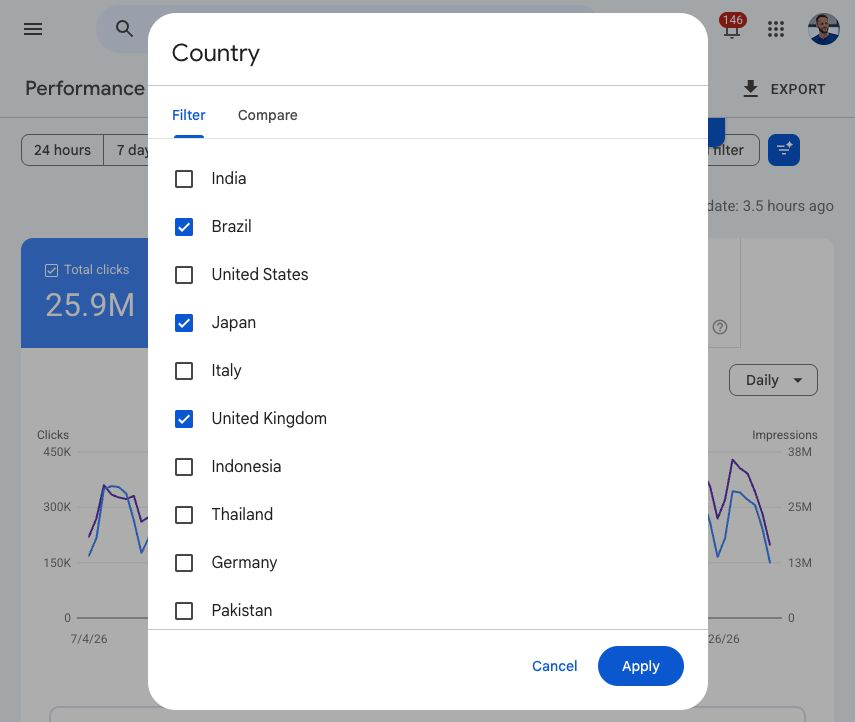
Google Search Central published the update today on LinkedIn, in a short post with a screenshot of the reworked country dialog. According to Google Search Central, "Today we're updating the Search Console performance report filters to make it easier for you to analyze traffic patterns across different countries and devices." The post goes on: "If you operate in multiple countries, you can now view their combined Google Search traffic."
The change sits inside the Performance report of Search Console, the interface where verified site owners read clicks, impressions, click-through rate and average position for their appearances in Google Search. Search Engine Roundtable also covered the update today. According to Search Engine Roundtable, the filter now accepts a tick against more than one country where it previously took a single country, and the publication's own example grouped the United States and Canada.
Two features of the post stand out. Its opening sentence names countries and devices, yet only the country side is spelled out. And its text carries no rollout schedule, no link to documentation and no indication of how many properties see the change at present.
The dialog in Google's screenshot
The screenshot shows the Performance report with a Country dialog open on top. Two tabs, Filter and Compare, head the dialog, and a scrolling list of countries with checkboxes sits beneath them. Brazil, Japan and the United Kingdom are ticked. India, the United States, Italy, Indonesia, Thailand, Germany and Pakistan are visible and unticked. The visible order is not alphabetical, and the post does not say how the list is sorted. Cancel and Apply buttons close the dialog.
Behind it, the report shows a Total clicks tile reading 25.9 million, a chart whose click axis runs to 450,000 and whose impressions axis runs to 38 million, a Daily granularity selector and an Export button, with 24-hour and 7-day range buttons along the top. Whether the 25.9 million figure reflects the three ticked countries or an unfiltered property is not stated, nor is it clear that the data comes from a live site. One small labelling difference: Search Engine Roundtable describes confirming a selection with an update button, while the dialog in Google's own image reads Apply.
What the limit used to be
Before the change, the interface treated countries differently from queries and pages. Google's Search Console Help page on advanced filtering says that several queries or URLs can be filtered together, either by matching or excluding them or through regular expressions. Seeing several devices, search types, countries or search appearance types, by contrast, required a comparison limited to two items. The same page says only one comparison can be active at a time, and that adding a new one replaces the existing one. A separate getting-started page in the Help centre walks through choosing two countries from a list under Compare.
According to that documentation, then, the interface offered no filter that returned a summed figure for three or more countries at once. The advanced filtering page, as retrieved today, still carries the two-item wording. Whether that text predates the update or simply has not yet been revised cannot be told from the page.
A busy stretch for the Performance report
The country filter is the second change to the report's filter and reporting options in 12 days. On September 24, 2026, Google split the Web search type into Text-based and Multimodal, covering Google Lens, Circle to Search on Android, uploaded images and Chrome image search, with no queries dimension for the new type.
Earlier additions run back through the year. The generative AI performance report, which covers AI Overviews and AI Mode, debuted on June 3, 2026 with impressions, pages, countries, devices and dates, but no clicks or queries. Custom annotations arrived on November 17, 2025, and comparison mode for the 24-hour view on July 16, 2025.
Not every change has been smooth. PPC Land reported on April 4, 2026 that a logging error had inflated impressions in the Performance report from May 13, 2025, a fault that had gone unnoticed for nearly a year. Elsewhere, Bing Webmaster Tools added device and country breakdowns on August 7, 2025, a change spotted by an SEO professional rather than announced by Microsoft.
Questions the post leaves open
Devices
The first sentence of the post puts devices next to countries. The Help page described above sets the same two-item ceiling on devices, yet neither the post nor Search Engine Roundtable's report describes a multi-select for them. Whether anything changed on the device side today is unconfirmed.
Reports and metrics
The Performance report spans Search results, Discover and Google News, while the post speaks only of Google Search traffic. The generative AI report also lists countries and devices as dimensions, and the post says nothing about it. On metrics, Google's Help overview defines click-through rate as the click count divided by the impression count, and average position as the position of the topmost result from the site. How those two figures are derived for a merged selection is not described.
Rollout
Google gave no schedule. Earlier Search Console changes have reached users at different speeds. The generative AI report took from early June to August 31, 2026 to reach every site, whereas weekly and monthly aggregation views reached all properties at once on December 10, 2025.
Why the change matters to marketers
Search Console carries unusual weight in organic measurement. Google encrypted search referrers from 2011, so query-level organic data reaches site owners through this service or not at all. Any change to how that data can be sliced therefore touches a reporting layer with few substitutes.
The update is narrow: the post describes no new data, only a different way of grouping figures that already exist. For teams that report by region rather than by country, though, the grouping matters. A set such as Germany, Austria and Switzerland, or Indonesia and Thailand, both of which appear in Google's screenshot, can now be treated as a unit inside the interface, where the documented route had been pairs at most.
Limits that predate the change remain in force. The interface returns at most 1,000 rows per table, ranked by clicks. Google's documentation on performance data filtering describes privacy filtering that removes anonymised queries: those clicks stay in chart totals but drop out once a query filter is applied. Whether a merged country selection alters any of this is not stated. Nor is it clear how soon the option will appear for every account.
Timeline
- May 13, 2025 - A logging error begins over-reporting impressions in the Search Console Performance report
- July 16, 2025 - Comparison mode arrives for the 24-hour performance view
- August 7, 2025 - Bing Webmaster Tools adds device and country breakdowns
- November 17, 2025 - Custom annotations added to Performance report charts
- December 10, 2025 - Weekly and monthly aggregation views reach all properties
- April 4, 2026 - PPC Land reports the impressions logging error
- June 3, 2026 - Generative AI performance reports debut in Search Console
- August 31, 2026 - Generative AI performance report reaches every site
- September 24, 2026 - Web search type splits into Text-based and Multimodal
- October 6, 2026 (today) - Google Search Central posts on LinkedIn that the performance report filters now allow a combined view across multiple countries; Search Engine Roundtable reports the change the same day
Related PPC Land coverage
- Search Console adds Lens and Circle to Search data - The September 24, 2026 split of the Web search type into Text-based and Multimodal, without a queries dimension.
- Every site gets AI search reports without clicks or queries - The August 31, 2026 worldwide rollout of the generative AI performance report.
- Search Console gets its own generative AI visibility reports - The June 3, 2026 debut of reports covering impressions, pages, countries, devices and dates.
- Search Console impressions bug ran for nearly a year - A logging error that inflated Performance report impressions from May 13, 2025.
- Weekly and monthly aggregation views in Search Console - The December 10, 2025 granularity selector for Performance report charts.
- Custom annotations for Search Console performance tracking - The November 17, 2025 addition of notes to Performance report charts.
- Comparison mode for 24-hour performance data - The July 16, 2025 change that let the 24-hour view be compared with an earlier period.
- Bing Webmaster Tools adds device and country filtering - The August 7, 2025 breakdowns added to Bing's Search Performance report.
- Google updates Search Console performance analysis guidance - Google's December 4, 2024 guidance on reading queries, pages, countries, devices and search appearances.
Summary
Who: Google Search Central, the team behind Google's search documentation and Search Console communications. The change affects site owners, SEO teams and marketers who report on traffic across more than one country.
What: The country filter in the Search Console Performance report accepts more than one country at a time, returning a single set of Google Search traffic figures for the selection. The post also mentions devices, without detail.
When: Today, October 6, 2026, according to Google Search Central's LinkedIn post.
Where: The Performance report in Search Console. Google gave no regional rollout detail, and its post does not say whether Discover, Google News or the generative AI report are included.
Why: According to Google Search Central, the update is meant to make it easier to analyze traffic patterns across different countries and devices.


Discussion