


Meta Platforms on October 15, 2026 moved Ads Super Burst toward general availability, a reservation product that lets an advertiser book a window of 3 to 24 hours on Facebook and Instagram and, for a price, keep every competitor in its category out of that window. The announcement, made at the company's Meta Brand Building Summit, also disclosed a United States test of First Impression Ads, which sells the first ad position in Feed to one brand a day, a wider topic list for Reels Trending Ads, and an alpha-stage measurement product called Aggregated View Time that counts a person's seconds with a brand across a week rather than per view.
In Short
Meta now lets a brand rent a burst of 3 to 24 hours on Facebook and Instagram in which its ads reach a very large audience, with the option of keeping competitors in the same category out of that window. That matters to big advertisers who plan around product debuts, sports openers and award nights, and who have traditionally bought television for that kind of guaranteed moment. What changes is that Meta is selling scarcity and timing, not just clicks, while the research behind its effectiveness numbers has not been published.
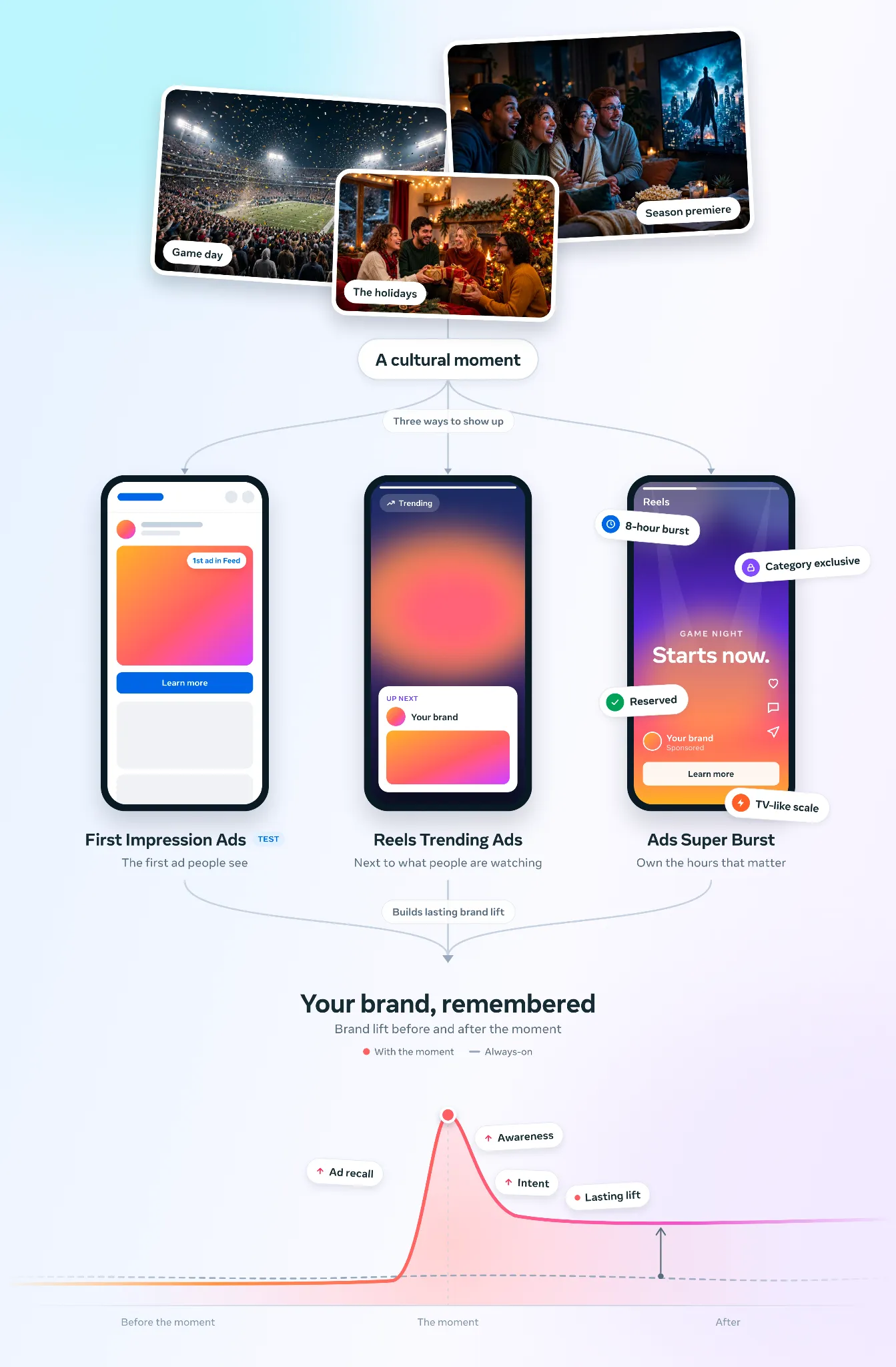
Four products, one pitch
The announcement arrived as a post on Meta for Business dated October 15, 2026, titled "Meta Brand Building Summit: New Ways to Help Marketers Build Unforgettable Brands on Meta." A shorter summary went out by email the same day from Max Nelson, a communications manager for Meta's strategic business group, to PPC Land. The email, stamped 02:52 on October 16 in the recipient's time zone, said the news "came out today," consistent with an October 15 United States release.
The post lists four items. Ads Super Burst is "launching." First Impression Ads is "testing." Reels Trending Ads "continues to expand." Aggregated View Time is being tested and, further down, described as "in alpha." Only the first is a product an advertiser can expect to buy at scale in the near term.
The framing is explicitly about the top of the funnel. Meta argues that the brands people remember are "the ones that show up inside the most memorable moments: the game everyone is discussing, the show everyone is watching, and the trend that goes from niche to everywhere in a weekend." According to Meta, those moments increasingly happen through short form video, and Reels makes up "more than half of all time spent on Instagram." That figure lines up with third-party data: Sensor Tower estimates covered by PPC Land in August put Reels at 51% of user time on Instagram in the second quarter of 2026, with video passing half of Instagram ad placements.
Meta supports its case with three further numbers. According to the company, 71% of people say Meta has the most influence in shaping the cultural trends they follow. Across "a study of more than 1,000 global campaigns," Meta says it "built awareness 18% better than the average brand channel and drove a 73% lift in consideration." Each of those claims carries a superscript footnote in the post, numbered 2 and 3. The saved copy of the page does not include the footnote text, so the sample, method, comparison set and dates behind them cannot be checked from the material available. These are vendor-supplied figures about the vendor's own platform.
Ads Super Burst: buying the hours
Ads Super Burst is the substantive change. According to Meta, it "lets you book a window of 3 to 24 hours and reach your audience at TV-like scale inside that window." The post gives three examples of the moments it has in mind: the window around a product launch, an external event such as an awards night, and "the first weekend of a new sports season."
Two mechanics distinguish it from an ordinary auction campaign.
The first is category exclusivity. According to Meta, "with category exclusivity available, no other advertiser in your category can book the same window." The wording says the option is "available," not that it comes with every booking, and the post does not say how Meta defines a category, how granular those categories are, or what exclusivity costs. Nor does it say whether exclusivity applies only to other Ads Super Burst buyers or also stops competitors' auction-bought ads from appearing to the same people during the window. Those are the details that determine what the product is actually worth to a buyer paying for it.
The second is guaranteed delivery. According to Meta, advertisers plan Ads Super Burst campaigns in Reach Planner "to secure inventory during your desired dates and get an estimate of reach and price, with guaranteed delivery tied to those estimates." That places the product inside Meta's reservation buying system rather than its auction. Meta sold that reservation option for years under the name Reach and Frequency before renaming it Reservation in October 2023; the reach and frequency model it uses requires a minimum audience of 200,000 people and is restricted to awareness and engagement objectives. What Ads Super Burst adds, based on the post, is the compression into hours, the exclusivity option and a scale target measured in tens of millions.
What the test flights showed, according to Meta
Meta reports results from advertisers testing the product "in the past few months." According to the company, they "saw a median 2.9 point lift in ad recall and a 0.6 point lift in intent, reaching a median of 34 million people per flight." Meta adds that this "worked out to 14% of the US adult audience online in a single day."
Several things about those numbers are worth separating.
The reach figure is the headline. Thirty-four million people as a median means half the test flights reached fewer and half reached more. The 14% conversion implies Meta counts roughly 243 million United States adults as online, which is in line with common estimates, but the post does not state the base. It also implies the test flights ran in the United States, although the post never says which markets were tested or which will get the product first.
The lift figures are much smaller. A 2.9 point lift in ad recall and a 0.6 point lift in intent are expressed in percentage points, not percent. A move from, say, 30% to 30.6% purchase intent would be a 0.6 point lift. The post does not give the baseline levels, the number of test campaigns, how many of them were measured with brand lift studies, or what "intent" covers. The superscripts attached to the recall, intent, reach and audience-share claims (footnotes 4 to 7) are, again, not reproduced in the saved page.
One agency planner is quoted by name. Kathryn Quart, VP Planning at Spark Foundry, the Publicis media agency, described a test on behalf of a client: "Ads super burst helped us solve a challenge for our client: how to ensure a priority, time-sensitive message had guaranteed visibility with our target audience within a short window. Our 12-hour activation was seamless to execute, delivered strong reach among our target audience, and performed exactly as expected." She added that the agency had "recommended leveraging ads super burst again during the busy and competitive Holiday season, with an even more concentrated messaging window to maximize impact within a priority timeframe." The quote does not name the client or share any numbers from that activation.
According to Meta, Ads Super Burst "is moving to general availability this month, rolling out in phases." No country list, minimum spend, pricing model or date for the end of the rollout appears in the post. The communications email describes the same product as running "short, highly concentrated campaigns, where basically your ads will get seen a lot in a short period of time," and repeats the 34 million median, without adding detail on availability.
Where it fits in the market
Selling a short, high-reach window is not new in digital video. Google has long sold the YouTube Masthead as a reserved placement, and moved it to CPM buying worldwide in July 2019 after years of selling it by the day. TikTok went further in May 2026, when it made TopReach public as a single purchase combining TopView, the first content seen on opening the app, and TopFeed, the first ad position in the For You feed, with a "One Day Max Reach" mode in open beta. TikTok claimed 59% incremental reach over TopView alone from its own 2025 testing.
Meta's product differs in two ways visible from the post. It sells a time window rather than a single placement, and it adds category exclusivity, a feature that television sponsorship buyers know well but that has been rare in auction-led social advertising. The comparison Meta itself draws is with television, not with TikTok or YouTube: the phrase "TV-like scale" appears in the description of the product.
For Meta's broader ad business, which earns most of its revenue through automated auctions, a reservation product with exclusivity is an attempt to price scarcity. Meta's fourth quarter 2025 results showed ad impressions up 18% and average price per ad up 6%, on advertising revenue of $58.1 billion. A product that guarantees reach inside a few hours, and sells the right to exclude competitors, is one way to raise the price of particular hours rather than to add more ad load across all of them.
First Impression Ads: one brand per day
The second product is far smaller in scope. According to Meta, "Advertisers have asked us for the first ad position in Feed for years, and we are now testing it in the United States." The company says this is "an early test, with just one brand per day," and that it is sharing the news because "we have heard feedback from advertisers that there is appetite for a product like this."
The sources disagree on where that first position sits. The takeaways at the top of the Meta post describe "a chance to be the very first ad someone sees when they open the Facebook app." The body text refers only to "the first ad position in Feed" and "the first ad someone sees when they open their Feed," without naming an app. The communications email widens it again, describing "an opportunity for a brand to make sure they will be the very first ad someone sees when they open an app." The post's own takeaway is the most specific of the three, and points to Facebook only, but Meta has not clarified whether Instagram's feed is part of the test.
The post does not say how the brand of the day is chosen, how the slot is priced, or whether it carries the same category exclusivity as Ads Super Burst. With one advertiser a day, the slot is by construction exclusive, but in a much narrower sense.
The product resembles TikTok's TopFeed, the first ad in the For You feed, which TikTok now sells bundled with TopView through TopReach. It also cuts against a direction Meta has taken elsewhere. In August, some Meta advertisers began losing placement controls, with value rules offered as a substitute that can cut bids by at most 90%. Selling a guaranteed first position to a single brand is the opposite of that automated, placement-agnostic approach, and it is aimed at a different buyer.
Reels Trending Ads: 15 standing topics
Reels Trending Ads, which place an ad "immediately after the most-watched and most culturally relevant Reels on Facebook and Instagram," is the most established of the four products. According to Meta, "Last year, we expanded access to Reels Trending Ads to all advertisers." The post does not give a date for that expansion. At its NewFront in March 2026, Meta extended Reels Trending Ads with category lineups for events such as Fashion Week and NFL games.
The October update adds breadth. According to Meta, there are "now 15 always-on standard topics an advertiser can choose from, including new categories around Home & Garden and Spanish language content." Seasonal lineups are built around "the holidays and the beginning of football and basketball seasons." The post does not list the other 13 standard topics.
Targeting is also changing. Meta says it is "expanding our targeting capabilities, including custom audience exclusions later this year," so brands can control who sees ads in these campaigns. "Later this year" gives the company until the end of December 2026.
On performance, Meta writes that "in campaigns that included Reels trending ads, action intent increased more than 5 percentage points versus control groups with no campaign exposure, and Reels trending ads delivered an incremental 5 percentage point lift in unaided brand awareness." The wording matters. The action intent comparison is against people who saw none of the campaign, not against people who saw the same campaign without the trending placement, so it measures the campaign as a whole rather than the contribution of Reels Trending Ads. The unaided awareness figure is described as "incremental" and attributed to the trending ads themselves, but the post does not state the comparison group for that measure. Both rest on footnote 8, which is not in the saved page. The takeaways at the top of the post merge the two into a single claim of "a lift of more than five percentage points in action intent and unaided brand awareness."
The concept is close to TikTok Pulse, which TikTok rebuilt in March 2026 as a suite placing ads next to top-performing content in the For You feed, including trending user-generated videos and named publishers.
Aggregated View Time: counting seconds across a week
The fourth item is a measurement idea rather than an ad unit, and it is the most technically interesting. According to Meta, "for years, the digital media industry has treated a long video view as an indicator of whether an ad was effective because that is how television worked." Short form video, the company argues, does not work that way.
Meta gives an example. "Someone may see a brand for two seconds in a feed, then one second the next day, then two more seconds on Thursday." According to Meta, "our research found that five seconds of attention added up over a week drove 32% more offline sales than one continuous five second view." The post adds that "independent industry research found the same pattern: looking at views in accumulated seconds can predict outcomes better than focusing on one long view." Neither study is named in the saved page; they sit behind footnotes 9 and 10.
Aggregated View Time is Meta's name for measuring, and eventually optimizing toward, "the total time someone spends with your brand across a week, instead of each impression on its own." The company says it is "in the early stages of testing" and that "this product is in alpha." The communications email adds one detail the post states less directly: the aggregated figure would be used "to help optimize going forward," meaning delivery could eventually be steered by accumulated seconds per person.
A number that has moved
The 32% figure is the newest of several versions of the same claim. Three days earlier, on October 13, Peter Buckley, a Connection Planning Director at Meta, wrote on LinkedIn that Meta's work on what it calls aggregate attention found "multiple short views drive on average 21% more sales lift than one long continuous view." PPC Land reported that statement alongside a Lumen Research, Amazon Ads and Cint study putting the purchase intent threshold at a median 47 seconds of attention. A year earlier, at IAB Europe's Virtual Programmatic Day on July 3, 2025, a panellist cited Meta and Playground xyz research finding attention split into shorter bursts was 21% more effective than one continuous block.
The October 15 post gives 32% and measures it in "offline sales." Buckley's post gave 21% and measured it in "sales lift." The 2025 panel gave 21% and called it "more effective." These may be different studies, different subsets or different outcome measures. Meta's post does not reconcile them, and none of the sources available publishes the method. The direction of the finding is consistent across all three; the size is not.
The idea itself is what attention researchers call cumulative attention, the total seconds one person spends looking at a campaign's ads across every exposure. The Lumen study made the same argument from cross-media data, and Buckley summarised it as "frequency counted properly." Meta's product would bring that logic into its own delivery system, where it controls both the exposures and the measurement.
That is also where the questions sit. Meta has offered video-specific measurement before: in February 2024 it rolled out Engaged-View attribution, which credits conversions to people who watched at least 10 seconds of a video ad, or 97% of a shorter one, within a one-day window. Aggregated View Time goes the other way, counting short exposures that a 10-second threshold would ignore. A metric that sums two-second glimpses across a week will, by design, credit more of Meta's short-form inventory than a long-view threshold does. Whether that is a more accurate model of how people absorb short video, or simply a more generous one, is something the unpublished research would need to show. Meta's own measurement framework, set out in its 2025 white paper and covered by PPC Land in April, argues that rules-based attribution undervalues Meta by a median of 31% and recommends combining experiments with marketing mix modeling. Aggregated View Time is a new input to that argument.
Why it matters for brand budgets
Taken together, the four products show Meta competing directly for budgets that have traditionally gone to television sponsorships, YouTube reservations and TikTok's premium placements. The common thread is guaranteed presence in time: a reserved window, a guaranteed first slot, a placement next to a trending moment, and a metric that rewards repeated brief contact rather than a single long view.
For media planners, the practical shift is in buying mode. Most Meta spend runs through auctions optimised by the company's systems. Ads Super Burst and First Impression Ads are sold with defined inventory and, in the first case, guaranteed delivery tied to an estimate. That makes them easier to plan around fixed dates, but it also moves pricing power toward Meta for the specific hours that advertisers care most about, such as a season opener or a holiday sales weekend.
Measurement is the open issue. Every effectiveness figure in the announcement, from the 18% awareness advantage to the 32% offline sales gain, comes from Meta and rests on footnotes that are not visible in the saved page. Meta has also, in the past, revised its own Reels ranking to look beyond engagement: in January it described a survey-based model that asks Facebook Reels viewers how well videos match their interests. The brand products announced on October 15 depend on the same question in a different form: whether a few seconds of attention, repeated, add up to something an advertiser can see in sales. Meta says they do. The numbers it has published so far do not agree on by how much.
Timeline
- October 2023 - Meta renames its Reach and Frequency buying type to Reservation
- February 3, 2024 - Meta rolls out Engaged-View attribution for video ads, with a 10-second view threshold and one-day window
- July 3, 2025 - IAB Europe panel hears Meta and Playground xyz research putting attention split into short bursts at 21% more effective than one continuous block
- 2025 - Meta expands Reels Trending Ads to all advertisers, according to the October 15, 2026 post (no exact date given)
- January 15, 2026 - PPC Land covers Meta's survey-based model for Facebook Reels recommendations
- January 28, 2026 - Meta reports fourth quarter 2025 ad revenue of $58.1 billion, ad impressions up 18%
- March 2026 - Meta adds event lineups to Reels Trending Ads at its NewFront
- March 24, 2026 - TikTok rebuilds Pulse as a suite of contextual ad products
- May 13, 2026 - TikTok makes TopReach public, combining TopView and TopFeed in one buy
- August 3, 2026 - Sensor Tower data puts Reels at 51% of Instagram time and video at more than half of Instagram ad placements
- August 26, 2026 - Some Meta advertisers lose placement controls, with value rules capped at 90% bid cuts
- October 13, 2026 - Meta's Peter Buckley cites a 21% sales lift for multiple short views while summarising the Lumen, Amazon Ads and Cint attention study
- October 15, 2026 - Meta Brand Building Summit: Ads Super Burst moves toward general availability, First Impression Ads test begins in the US, Reels Trending Ads reaches 15 standard topics, Aggregated View Time enters alpha with a 32% offline sales claim
- October 2026 - Ads Super Burst general availability begins, rolling out in phases, according to Meta
- By end of 2026 - Custom audience exclusions for Reels Trending Ads due "later this year," according to Meta
Related PPC Land coverage
- TikTok TopReach goes public: one buy for TikTok's two top ad spots - TikTok's combined TopView and TopFeed product, the closest rival to Meta's first-position and burst offerings.
- Purchase intent needs a median 47 seconds of ad attention, Lumen finds - The cumulative attention study and Meta's earlier 21% aggregate attention figure.
- Meta apps lose 5% of downloads as Reels takes half of Instagram ad slots - Sensor Tower data on Reels' share of Instagram time and ad placements in Q2 2026.
- Google fires two algorithm updates in three days as NewFronts shift - Includes Meta's March 2026 NewFront expansion of Reels Trending Ads.
- TikTok Pulse suite targets brand-safe trends with new creator and AI tools - TikTok's contextual product for placing ads next to trending content.
- Some Meta advertisers lose placement controls, with bid cuts capped at 90% - The automated, placement-agnostic direction that First Impression Ads runs against.
- Meta launches Engaged-View to help advertisers drive more video insights and performance - Meta's earlier video measurement setting built around a 10-second view.
- Meta's 'suite of truth' framework rewrites how advertisers measure ad impact - Meta's argument that rules-based attribution undervalues its platforms by a median 31%.
- Google rolls out globally YouTube Masthead buying on CPM basis - The reserved YouTube placement that set an early template for guaranteed digital reach.
Summary
Who: Meta Platforms, through its Meta for Business team, with brand advertisers and agencies as the target buyers. Kathryn Quart of Spark Foundry is quoted on an Ads Super Burst test.
What: Ads Super Burst lets advertisers reserve a 3 to 24 hour window with guaranteed delivery and optional category exclusivity; Meta says test flights reached a median 34 million people, with a 2.9 point ad recall lift and a 0.6 point intent lift. First Impression Ads tests selling the first ad position in Feed to one brand per day in the US. Reels Trending Ads now has 15 standard topics, with custom audience exclusions due later in 2026. Aggregated View Time, in alpha, measures a person's total seconds with a brand across a week; Meta claims a 32% offline sales gain for aggregated attention, a figure that differs from the 21% a Meta executive cited on October 13.
When: Announced October 15, 2026 at the Meta Brand Building Summit. Ads Super Burst general availability begins in October 2026, in phases.
Where: Facebook and Instagram. First Impression Ads is tested in the United States, and the 14% audience figure for Ads Super Burst refers to US adults online. Meta did not list markets for the Ads Super Burst rollout.
Why: Meta is competing for brand budgets that go to television, YouTube reservations and TikTok's premium placements by selling guaranteed reach in specific hours and a first-position slot, and by proposing a measurement model that credits short, repeated video exposures. The effectiveness claims are Meta's own and rest on footnoted research not reproduced in the published page.


Discussion