


VIOOH, the London-based digital out-of-home supply-side platform, today said it has partnered with TuMedio, an outdoor advertising company, to put more than 500 digital displays in Spain and Portugal within reach of automated buyers, a network that generates 320 million impressions a month, according to VIOOH.
In Short
A company that sells advertising time on digital screens has teamed up with a company that owns more than 500 of them across Spain and Portugal, so that ad-buying software can book slots on those screens automatically. This matters to brands and agencies that buy outdoor ads in the two countries, and to the screen owner, which now has more potential buyers. Bookings would run through the same kind of automated systems used for online ads, but the companies have not said when that starts, what slots cost or how audience numbers are counted.
What the partnership covers
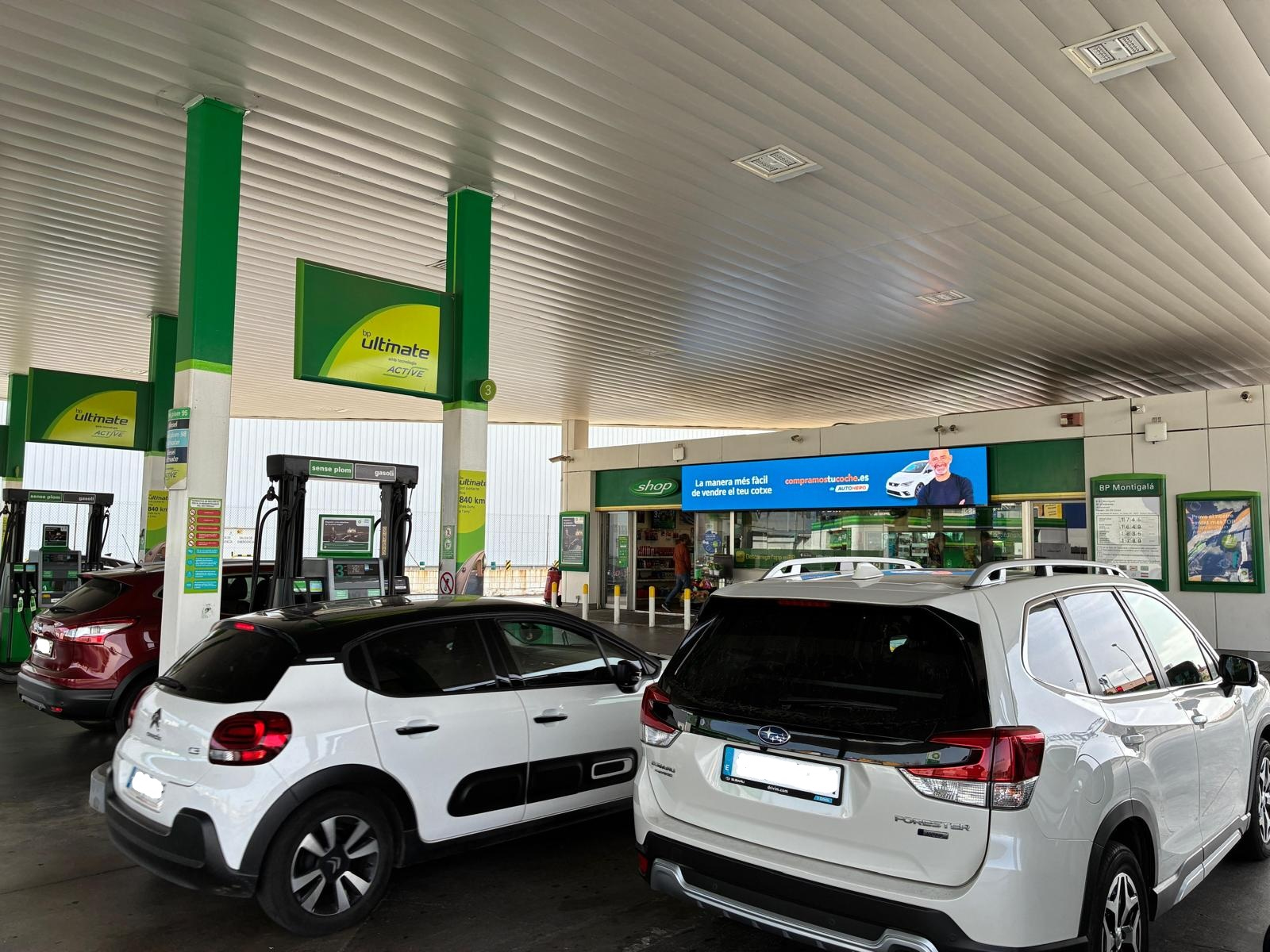
According to VIOOH, the partnership connects more than 500 digital out-of-home (DOOH) screens to programmatic buying, with the network generating 320 million monthly impressions. TuMedio's estate, according to the company, spans large-format displays, fuel stations, parking garages, outdoor billboards and airports, and reaches more than 75 cities. A photograph distributed with the release shows a digital display mounted above the shop entrance on a fuel-station forecourt.
Nine cities are named: Madrid, Barcelona, Valencia, Malaga, Seville, Alicante and Córdoba in Spain, and Lisbon and Porto in Portugal, along with Madrid-Barajas Airport. That leaves at least 66 further cities unidentified. The release gives no division of screens or impressions between the two countries, although seven of the nine named cities are Spanish.
VIOOH is a supply-side platform, software that packages a media owner's screens as sellable inventory and offers it to the demand-side platforms that agencies and advertisers use to bid. As of late August, VIOOH reported trading programmatically in 46 markets and connecting to more than 50 demand-side platforms. TuMedio's screens join that pool.
Gavin Wilson, VIOOH's Global Chief Commercial Officer, described the tie-up as "an important addition to VIOOH's offering in Spain and Portugal" and placed it in "the growing European out-of-home market". His choice of the word addition carries an implication the release leaves unexplored: VIOOH already sold inventory in both countries before today, from owners the document does not name.
Ignacio Carrascal, TuMedio's founder, framed the benefit from the seller's side. Integration with VIOOH, he said, gives the network "unique visibility among international media buyers looking to reach audiences in Spain and Portugal", and "opens up our multi-environment inventory to programmatic buyers". According to VIOOH, advertisers buying this way gain flexibility, precision targeting and efficiency; the release attaches no performance data to those claims.
Reading the impression figures
Divide 320 million by 500 and the answer is 640,000 impressions per screen per month. Because the screen count is given as a floor rather than an exact number, the true average sits below that figure. How does it compare with VIOOH's other recent supply?
Set against JCDecaux Ireland's 288 screens and 311 million monthly impressions, which works out at about 1.08 million per screen, TuMedio's ceiling is well under two-thirds. The closest format match is Germany, where 784 screens at Shell stations carried 204 million monthly impressions, roughly 260,000 each. Roadside-heavy inventory sits far higher: OUTFRONT's 7,600 US screens and 18 billion impressions imply about 2.37 million per screen, whereas Vengo's mostly indoor network of 65,000 screens and 13 billion impressions come to exactly 200,000. TuMedio lands in the middle of that range, and the mix of environments in its estate makes a single average a blunt instrument.
The comparison carries a caveat. A single ad play on a screen reaches an unknown number of people, so DOOH platforms convert plays into audience estimates using an impression multiplier. IAB Australia's 2025 buyers guide set out the arithmetic as audience impressions divided by ad plays, adjusted for screen location, time of day, audience flow and visibility. The release does not say which audience data or multiplier sits behind the 320 million, nor whether airport panels and fuel-station screens are counted on the same basis. At protocol level, IAB Tech Lab added a dooh object to OpenRTB in November 2022, with a quantity field that lets one play count as more or fewer than one impression, so fractional values are routine. Verification of the plays themselves is a separate matter: in a conventional buy the media owner's own content management system logs that a creative ran, and Big Happy became the first Veridooh partner to sell US DOOH on a verified CPM in August, billing only for validated plays. Figures built on different methods in different markets indicate ranges rather than rankings.
Where the deal sits in VIOOH's build-out
The market count offers a measure of pace. VIOOH cited 35 markets in February, 37 in June and 46 in late August. Whether Spain and Portugal already count among those 46 is not stated, and neither is the date on which TuMedio's inventory goes live.
The commercial backdrop is JCDecaux, VIOOH's majority owner. In the first half of 2026 the group reported programmatic revenue of €102.8 million, up 30.9% organically and equal to 12.3% of digital sales. VIOOH's own demand forecast points the same way: its March survey of 1,050 advertisers and agencies projected programmatic DOOH in 48% of campaigns within 18 months, up from 34%. That study was produced by a company that sells the channel.
Competing platforms are working the same territory. Azerion opened more than 1,000 screens across four Belgian DOOH networks to programmatic buyers on September 10, while Magnite opened its first Spanish office, in Madrid, in February. Magnite's move concerned programmatic more broadly rather than outdoor alone, but it points to sell-side attention on the Spanish market.
The Spanish out-of-home market in numbers
IAB Spain's annual study, covered by PPC Land in February, put DOOH investment at €143.5 million in 2025, up 8.9% on the year. That is about 2.3% of the €6,211.2 million digital market. Cumulative DOOH growth since 2022 reached 29.6%, although the rate of expansion has slowed. Across the segments that support automated buying (display, video, native, audio, connected TV and DOOH), direct deals accounted for 60% of investment and programmatic for 40%, and the study's outlook expected programmatic to grow further, DOOH among the segments singled out.
Portugal is thinner on data. The release supplies no market sizing for the country, and no comparable out-of-home figure for Portugal turned up in the PPC Land coverage reviewed for this article.
What the release leaves out
The document is short on the operational details that determine whether inventory turns into spend. It does not state:
- Start date. The partnership "delivers" access in the present tense, yet no go-live date appears.
- Transaction types. Nothing says whether the screens trade through open auction, private marketplace or programmatic guaranteed deals, which carry different price and volume commitments.
- Buying routes. No demand-side platforms are named, and there is no mention of floor prices or minimum spend.
- Measurement. No verification partner, audience data provider or multiplier method is identified.
- Composition. The split by country, and by environment (fuel stations, parking garages, airports, billboards), is absent.
- Exclusivity. It is unclear whether TuMedio's screens can also be reached through other supply-side platforms. Coverage of VIOOH's Screenverse deal flagged the duplication risk: where one screen is reachable through several routes, a campaign can end up bidding against itself.
- Commercial terms. Financial arrangements between VIOOH and TuMedio are not disclosed.
The descriptors "leading premium global" for VIOOH and "leading outdoor advertising company" for TuMedio are the companies' own; the release cites no ranking.
Why it matters to the marketing community
For a planner buying outdoor across borders, the change lies in routing. Inventory that once required negotiation with a media owner can, in principle, be traded through the platforms an agency already uses, on impression-based terms. Every screen network added to VIOOH extends the reach of demand-side platforms that are already connected, without new technical work on the buyer's side. That is the mechanism behind the steady cadence of supply deals.
The value of Iberian inventory, though, depends on details absent from today's document: price, buying method, measurement basis and exclusivity. Spain's DOOH market is modest in size against the total digital market, and growing at a single-digit rate. Whether 320 million monthly impressions turn into booked spend will be visible in buyer uptake, and in whether TuMedio or VIOOH publish the terms that today's release omits.
Timeline
- August 21, 2025 - IAB Australia publishes a programmatic DOOH buyers guide setting out impression multiplier arithmetic
- August 26, 2025 - VIOOH partners with Vengo, covering 65,000 US screens and 13 billion monthly impressions
- January 26, 2026 - VIOOH and ISM open 784 Shell station screens in Germany, with 204 million monthly impressions
- February 5, 2026 - Magnite opens its first Spanish office in Madrid
- February 24, 2026 - VIOOH and JCDecaux Ireland connect 288 screens and 311 million monthly impressions; VIOOH cites 35 markets
- February 25, 2026 - IAB Spain presents its annual study, recording DOOH investment of €143.5 million for 2025
- March 9, 2026 - VIOOH and OUTFRONT connect 7,600 US screens and 18 billion monthly impressions
- March 21, 2026 - VIOOH publishes its State of the Nation survey forecasting programmatic DOOH in 48% of campaigns
- June 27, 2026 - VIOOH reports its Seller Agent processed more than 100 deal requests in the first half; 37 markets
- July 30, 2026 - JCDecaux reports first-half programmatic revenue of €102.8 million, up 30.9% organically
- August 2026 - Big Happy becomes the first Veridooh partner to sell US DOOH on a verified CPM
- August 25, 2026 - VIOOH and Screenverse add 38,000 US screens; VIOOH cites 46 markets
- September 10, 2026 - Azerion opens four Belgian DOOH networks with more than 1,000 screens to programmatic buyers
- September 29, 2026 (today) - VIOOH and TuMedio partner to connect more than 500 screens in Spain and Portugal, with 320 million monthly impressions
Related PPC Land coverage
- VIOOH gains 7.7 billion monthly US impressions in Screenverse deal - The August 25 partnership adding more than 38,000 US screens, with VIOOH reporting 46 markets.
- VIOOH taps German gas stations for 200M impressions in DOOH power play - The January 26 deal opening 784 Shell station screens in Germany to programmatic buyers.
- VIOOH and JCDecaux bring 32% of Ireland's digital OOH to programmatic - The February 24 partnership covering 288 screens and 311 million monthly impressions.
- VIOOH and OUTFRONT just unlocked a quarter of the US DOOH market - The March 9 integration of 7,600 US screens and 18 billion monthly impressions.
- VIOOH partners with Vengo for US programmatic advertising expansion - The August 2025 partnership covering 65,000 US screens.
- VIOOH's Seller Agent automated 100+ DOOH deals in H1 2026 - VIOOH's account of curated deal packages processed in the first half of 2026.
- pDOOH investment set to surge 44% as programmatic takes over half of campaigns - VIOOH's March survey forecasting programmatic DOOH in 48% of campaigns within 18 months.
- JCDecaux gains 5.7% revenue growth as profit nearly doubles in H1 - The parent group's half-year results, including programmatic revenue of €102.8 million.
- Spain's digital ad market hits €6.2bn - and CTV just changed everything - IAB Spain's annual study, with DOOH at €143.5 million and a 60/40 split between direct and programmatic buying.
- Magnite bets on Spain's programmatic potential with first Madrid office - Magnite's February 2026 entry into the Spanish market.
- Azerion adds 1,000 screens across four Belgian DOOH networks - A rival supply-side platform's September 10 European DOOH expansion.
- Big Happy becomes first Veridooh partner to sell DOOH on verified CPM - How play logs and impression multipliers underpin conventional DOOH billing, and the August option to pay only for verified plays.
- IAB Australia releases comprehensive guide for programmatic DOOH buyers - The August 2025 guide explaining impression multipliers and how programmatic DOOH is traded.
Summary
Who: VIOOH, a London-based digital out-of-home supply-side platform backed and majority-owned by JCDecaux, and TuMedio, an outdoor advertising company with screens in Spain and Portugal. Gavin Wilson, Global Chief Commercial Officer at VIOOH, and Ignacio Carrascal, Founder at TuMedio, are quoted in the release.
What: A partnership giving programmatic buyers a route to more than 500 TuMedio digital screens, which generate 320 million monthly impressions across more than 75 cities and environments including fuel stations, parking garages, billboards and airports.
When: Made public today, September 29, 2026. The release gives no go-live date.
Where: Spain and Portugal, with named cities Madrid, Barcelona, Valencia, Malaga, Seville, Alicante, Córdoba, Lisbon and Porto, plus Madrid-Barajas Airport. The release is datelined London.
Why: VIOOH adds supply in two markets where it already sells inventory, while TuMedio gains exposure to international programmatic buyers. Spain's DOOH market reached €143.5 million in 2025 and programmatic accounts for a minority share of automated-buying segments, so the deal extends a shift that is still under way. Pricing, buying methods, measurement and exclusivity remain undisclosed.


Discussion