


Disney+ began rolling out support for 17 additional audio languages on July 15, 2026, raising the total number of supported audio languages to 58 and adding a right-to-left interface built for Arabic and Hebrew, according to The Walt Disney Company.
The expansion widens the linguistic footprint of a platform that Disney has spent two years reworking into an advertising business, and it lands at a moment when localized inventory has become a competitive variable in connected television buying. Subtitles and closed captions are now offered in as many as 42 languages, according to Disney, while the user interface is available in more than 30. The company framed the update as a step toward a streaming experience that is more accessible and localized, pointing to the international performance of local originals including Perfect Crown, Dear Killer Nannies, Battle of Fates, and The Boss.
Language availability, Disney said, is what helps stories and characters find fans beyond their country of origin. That statement carries a commercial subtext. Every additional market that can watch a title in a native audio track, read subtitles in a familiar script, or navigate an interface in a right-to-left layout is a market where the ad-supported tier becomes viable and where advertiser demand can be matched against local audiences.
What the update contains
The July rollout introduced support across three distinct layers of the product: audio, timed text, and the user interface itself. Not every new language received all three. Disney specified that the additions arriving this week span Arabic, Croatian, Hebrew, Thai, Indonesian, Malay, Hindi, Tamil, and Telugu, and that the coverage for each of these languages varies, including interface, audio, and timed text depending on the language.
The headline figure is the jump to 58 audio languages, up 17 from the prior total. That scale of audio localization is substantial for a general-entertainment service, and it reflects the dubbing and voice-track investment required to serve titles across South Asia, Southeast Asia, and the Middle East and North Africa region. Subtitle and caption coverage reaching 42 languages sits above the interface count of more than 30, a gap that is typical of streaming localization, since timed text is faster and cheaper to produce than either dubbed audio or a fully translated interface.
The right-to-left interface
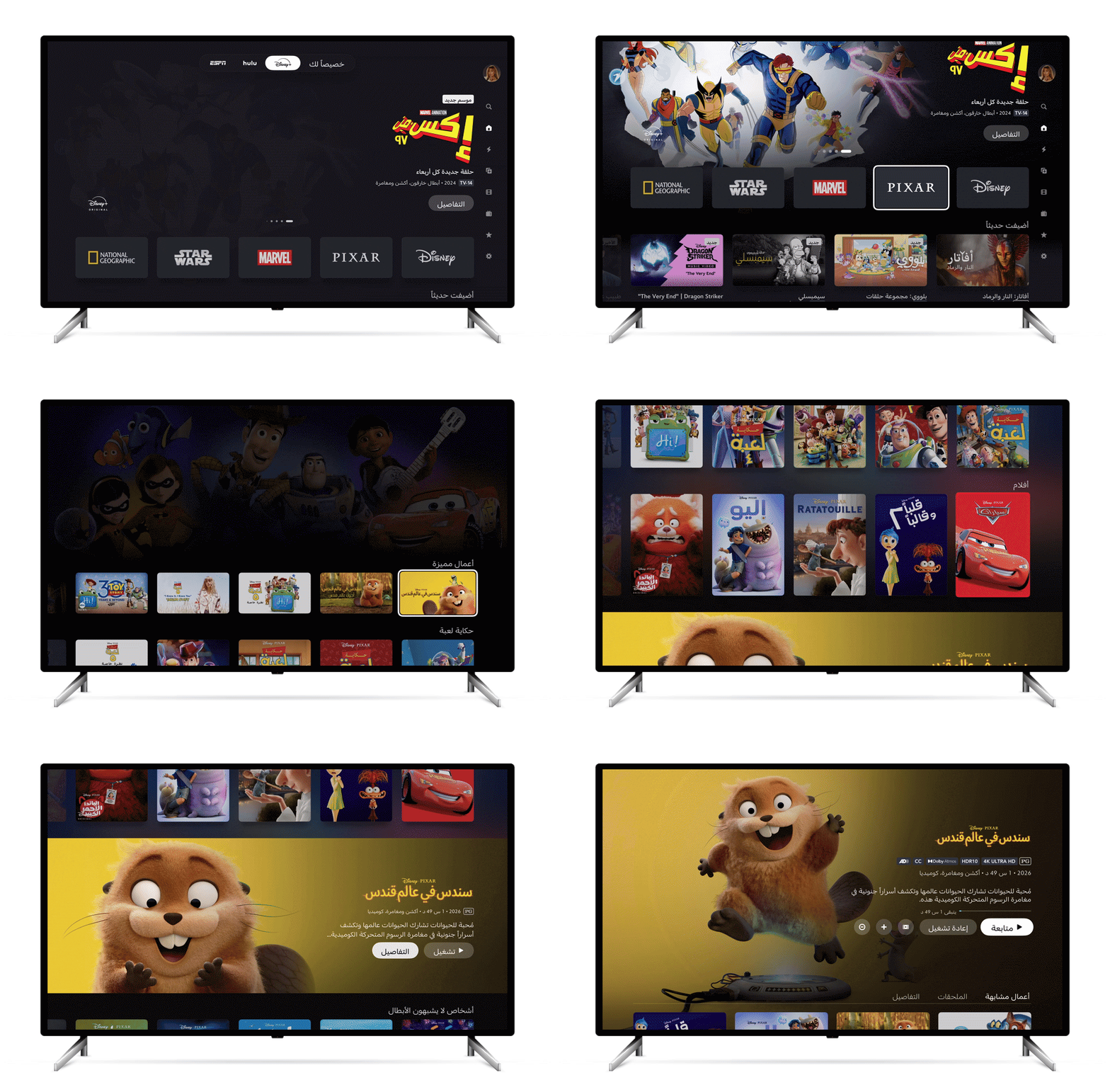
The most technically notable element is the new right-to-left interface. Languages such as Arabic and Hebrew are written and read from right to left, and a streaming interface that has been designed left-to-right does not simply translate into those languages by swapping the words. Menus, navigation elements, progress bars, and content rails all have to be mirrored so that the reading order feels native.
Disney described the new layout as designed for a more natural, intuitive viewing experience for millions of viewers. The company did not publish a figure for how many subscribers the right-to-left interface addresses, nor did it name the specific markets where the layout activates first. What the update establishes is that the Middle East and North Africa region, along with Hebrew-speaking audiences, now receive an interface that matches the directionality of their language rather than a left-to-right layout with translated labels.
For viewers, the mechanics of switching are handled inside the app. Audio, subtitles, or closed captions can be changed by pausing a title during playback and selecting the Audio and Subtitles menu, according to Disney. The application language itself is changed through the profile icon, by selecting Edit Profiles, choosing a profile, and then selecting App Language.
Why localization is an advertising question
On its surface, a language expansion reads as a content and accessibility story. For the marketing community, the relevant frame is inventory. Disney has been converting Disney+ from a subscription-only service into a dual-revenue platform, and the ad-supported tier is where localized language support translates into sellable audience.
The scale of that advertising business is now considerable. Disney reported that its streaming services generated more than five billion dollars in revenue during the quarter ended December 27, 2025, with Entertainment SVOD operating income climbing 72 percent year over year to 450 million dollars, a milestone PPC Land documented as the platform crossing 5.3 billion dollars. The company's ad-supported subscriber base stood at 122 million as of early 2026. A larger set of supported languages does not by itself add subscribers, but it removes a barrier to entry in markets where audiences will not adopt a service they cannot navigate or watch comfortably.
The connective tissue between language support and ad revenue runs through the platform's European footprint. Disney moved its EMEA advertising campaigns onto the Disney Ad Server on June 30, 2026, consolidating the region onto the same global infrastructure the company uses in the United States and integrating its Real-Time Ad Exchange, DRAX, into the EMEA market. That announcement noted the Disney+ ad tier is present in 15 European markets and that advertiser numbers in the region grew 25 percent. Several of the languages added in the July rollout, including Croatian and Hebrew, extend the reach of that ad-supported European footprint.
Measurement and market reach
Localized inventory is only valuable to advertisers if it can be measured. Disney has built that layer in parallel. AudienceProject activated a direct integration with Disney+ on January 21, 2026, providing independent audience measurement of Disney+ campaigns across five European markets: the United Kingdom, Germany, France, Italy, and Spain. That integration gives advertisers and agencies reach and frequency data for campaigns running against the ad-supported tier, the same tier that a wider language set now serves.
The measurement build-out illustrates a pattern in how Disney sequences these commitments. The AudienceProject relationship was first announced in November 2024 with an initial focus on the United Kingdom, Germany, and the Nordic countries, then activated across five markets more than a year later. Infrastructure and measurement announcements at Disney frequently precede full market activation by a year or more, and a language expansion functions as the audience-facing counterpart to that back-end work.
The programmatic context
Behind the subscriber-facing update sits an advertising technology stack that Disney has assembled since 2024. The company connected DRAX directly to Google DV360 and The Trade Desk in March 2024, establishing programmatic pathways that bypassed traditional supply-side intermediaries for large buyers. In June 2025, Disney and Amazon Ads launched a direct integration between DRAX and Amazon DSP, adding a third major buying platform to that architecture.
Disney reported at the EMEA announcement that Disney+ is now integrated with more than ten of the most widely used demand-side platforms, including Amazon DSP, The Trade Desk, and Google Display and Video 360. That reach means the inventory unlocked by broader language support flows through the same automated buying channels advertisers already use for other premium streaming supply. A viewer in a newly supported market watching an ad-supported title in Hindi or Arabic represents an impression that can be transacted programmatically across those integrated platforms.
The company has also been building interactive and creative capabilities on top of that pipe. Disney rolled out four interactive ad formats under its DXC framework between April 2025 and early 2026, with one format, Pause+ Trivia, reaching brand recall ten times above benchmarks. Those formats depend on scale, and the ad-supported subscriber pool that makes format performance data statistically meaningful grows as the service becomes usable in more languages.
Streaming localization as a broader trend
Disney's move sits within a wider industry push toward multilingual streaming and creative. Google released Gemini 3.5 Live Translate on June 11, 2026, a speech-to-speech model supporting over 70 languages, a capability with direct implications for multilingual ad creative and campaign localization at scale. The pressure toward localized content and localized advertising is not unique to Disney, and the platforms competing for connected television budgets are each addressing it through their own infrastructure.
The metadata layer that underpins contextual buying in these environments is also expanding across languages. Gracenote, the content intelligence unit of Nielsen, supplies program-level metadata covering more than 50 million titles across 80,000 channels in over 70 languages and 80 countries. As streaming services add audio and subtitle support in more languages, the demand for verified, multilingual content data that lets advertisers target contextually across those markets rises in parallel.
What Disney disclosed and what it did not
The July 15 update is specific about counts and mechanics but sparse on market-level detail. Disney gave precise figures for audio languages, subtitle languages, and interface languages, and it named the specific languages arriving this week. It did not publish subscriber numbers by market, did not identify which territories receive the right-to-left interface first, and did not attach revenue projections to the expansion.
That reticence is consistent with how Disney communicates product changes. The company tends to announce a capability and its direction ahead of granular, market-by-market rollout data. The language expansion is a completed, subscriber-facing change with a firm date, but its full commercial effect, particularly for advertisers seeking to reach newly served audiences, will become visible only as the ad-supported tier activates against those languages across Disney's programmatic partners.
For marketers evaluating connected television supply, the update is a data point about addressable reach. A service that supports 58 audio languages and 42 subtitle languages, with a right-to-left interface for Arabic and Hebrew, is a service whose ad-supported inventory can be sold against audiences in a broader set of markets than before. Whether that translated reach converts into meaningful incremental advertising revenue depends on subscriber uptake in those markets and on how quickly the ad tier follows the content localization.
Timeline
- November 2024 - Disney+ announces a partnership with AudienceProject for independent audience measurement, initially focused on the UK, Germany, and the Nordic countries
- March 2024 - Disney connects DRAX directly to Google DV360 and The Trade Desk, establishing direct programmatic pathways for large buyers
- June 2025 - Disney and Amazon Ads launch a direct integration between DRAX and Amazon DSP
- Early 2026 - Disney reports streaming revenue above 5 billion dollars for the quarter ended December 27, 2025, with 122 million ad-supported subscribers
- January 21, 2026 - AudienceProject activates direct Disney+ measurement across the UK, Germany, France, Italy, and Spain
- June 11, 2026 - Google releases Gemini 3.5 Live Translate, supporting over 70 languages
- June 30, 2026 - Disney moves EMEA campaigns onto the Disney Ad Server and integrates DRAX into the EMEA market, with the Disney+ ad tier present in 15 European markets
- July 15, 2026 - Disney+ begins rolling out 17 additional audio languages, reaching 58 total, plus six new interface languages and a right-to-left layout for Arabic and Hebrew
Related PPC Land coverage
- Disney moves EMEA campaigns to global Ad Server as advertisers grow 25% - Details Disney's June 2026 consolidation of EMEA advertising onto its global Ad Server and DRAX, with the ad tier live in 15 European markets.
- AudienceProject activates Disney+ measurement across five European markets - Covers the January 2026 launch of independent audience measurement for Disney+ campaigns across the UK, Germany, France, Italy, and Spain.
- Disney streaming ad revenue surges as platform hits $5.3B milestone - Reports Disney's Q1 fiscal 2026 streaming results and its 122 million ad-supported subscribers.
- Disney+ rolls out four DXC interactive ad formats with 10x brand recall gains - Examines the interactive ad formats Disney built into Disney+ between April 2025 and early 2026.
- Disney inventory to become available on Amazon DSP - Documents the June 2025 DRAX integration with Amazon DSP that added a third major buying platform.
- Disney streamlines ad buying process, expands partnerships with Google and The Trade Desk - Traces the March 2024 DRAX Direct connections to Google DV360 and The Trade Desk.
Summary
Who: The Walt Disney Company, through its Disney+ streaming platform.
What: A rollout of 17 additional audio languages, raising the total to 58, alongside six new user interface languages and a new right-to-left interface designed for Arabic and Hebrew. Subtitles and closed captions now reach as many as 42 languages, and the interface is available in more than 30. Newly supported languages this week include Arabic, Croatian, Hebrew, Thai, Indonesian, Malay, Hindi, Tamil, and Telugu.
When: The rollout began July 15, 2026.
Where: Across the Disney+ platform globally, with particular relevance to South Asia, Southeast Asia, and the Middle East and North Africa region, and to the 15 European markets where the ad-supported tier operates.
Why: Broader language support removes adoption barriers in markets where audiences will not use a service they cannot navigate or watch in their own language. For the marketing community, expanded localization enlarges the addressable, ad-supported inventory that Disney sells through its programmatic partners, extending the reach advertisers can buy against connected television audiences in a wider set of markets.


Discussion