


Disney published a detailed account on June 4, 2026 of how it built and deployed four successive interactive ad formats on Disney+ over roughly 12 months, all powered by an internal creative platform called the Disney eXperience Composer. The announcement gives the advertising industry its clearest look yet at the technical architecture and measured performance behind a format strategy that moved from a single notification-based unit in April 2025 to a full suite covering pause triggers, interactive overlays, and viewer-controlled video selection by early 2026.
The platform behind the formats
At the centre of Disney's ad format expansion is the Disney eXperience Composer (DXC), described by the company as an internal creative platform built to handle the full lifecycle of an interactive ad unit - from construction and delivery to post-campaign measurement. According to Disney, DXC allows product teams to test and iterate on new formats without requiring bespoke engineering work for each launch. The implication is a modular build environment where each new format can inherit components from the one before it rather than starting from scratch.
That architecture had direct consequences for the pace of releases. Disney deployed four distinct format categories between April 2025 and early 2026 - a timeline that, for a large media organisation running a premium streaming platform, is unusually compressed. The speed is not incidental; it is a stated design goal of the platform itself.
The significance of DXC extends beyond internal efficiency. Because it sits across both Disney+ and ESPN, it creates a shared creative substrate for formats that span entertainment, sports, franchise, and news content. Advertisers working across those verticals do not need to adapt creative for different technical environments. That standardisation matters increasingly as streaming platforms fragment CTV inventory across dozens of surfaces and buying paths.
Gateway Go: the first unit, April 2025
The first format to ship on Disney+ through DXC was Gateway Go, which launched in April 2025. The mechanics are straightforward: while viewing content, a viewer receives an offer or reminder they can act on through one of three response channels - a push notification, an email, or a QR code. Clicking a button on screen triggers the chosen delivery method. The format does not interrupt playback.
According to Disney, early results from Gateway Go exceeded industry benchmarks by more than 60% on engagement metrics. The company did not specify which benchmark index it used or which advertisers participated in the initial rollout. The claim establishes a baseline that subsequent formats were measured against, but without the underlying benchmark definition, it functions primarily as relative context rather than an absolute performance figure.
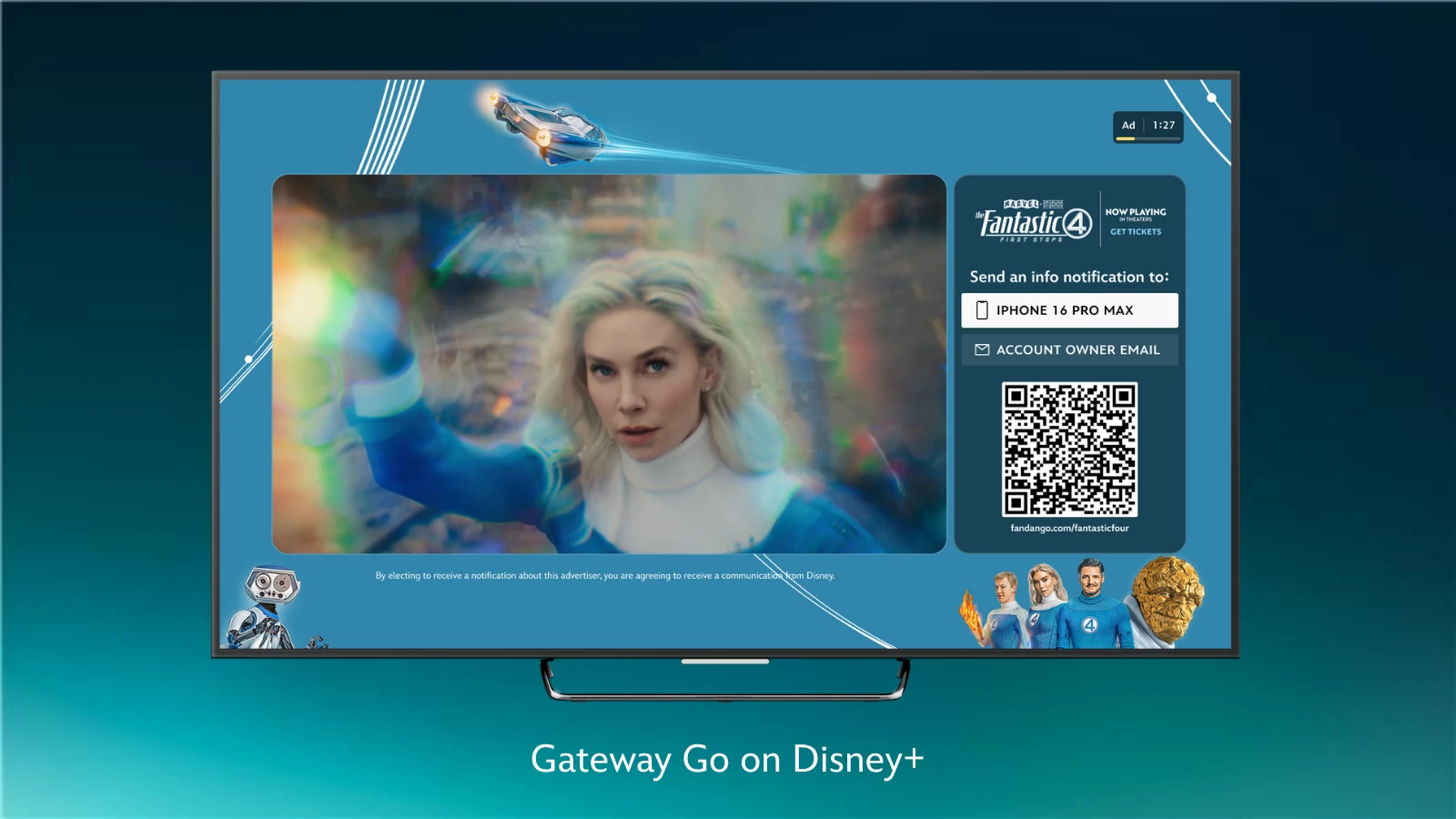
QR code integration in streaming environments has drawn industry interest for reasons grounded in viewer behaviour. Research cited in PPC Land's coverage of Wunderkind's CTV pause ad launch in July 2025 found that 93% of connected television viewers shop on a second device while watching. Gateway Go's three-channel response approach addresses that pattern directly by giving viewers an action path that fits whether they have a phone in hand or not.
Pause Ads: October 2025
Disney introduced Pause Ads on Disney+ in October 2025. The format activates when a viewer stops playback, placing brand creative in the moment before the content resumes. Because the viewer has initiated the pause themselves, the ad appears during a natural break rather than cutting across narrative continuity.
The pause ad category has attracted broad industry attention across 2025. Magnite rolled out pause advertising for streaming television with DirecTV and Fubo in August 2025, citing similar logic about format non-intrusiveness. IAB Tech Lab published formal ad format standards for CTV in December 2025 covering pause ads alongside five other connected television formats, defining creative specifications, file requirements, and interactivity guidelines in a 27-page document. Disney contributed to that working group.
Disney's beta performance data for Pause Ads positioned the format as a brand awareness driver - effective at building familiarity but less optimised for active engagement or conversion. That positioning set up the logic for what came next.
Pause+: the extension, winter 2025
Using the Pause Ad as its technical foundation, Disney launched Pause+ in winter 2025. The extension added three interactive capabilities on top of the basic pause trigger: Billboard, Trivia, and Carousel. Each targets a different point on the advertiser objective spectrum.
Billboard is designed for message association and brand salience. Beta testing produced double-digit percentage lifts in both message association and unaided brand awareness, according to Disney. Trivia is the highest-engagement variant: according to Disney, beta campaigns delivered brand recall at 10 times industry benchmarks. That figure is the strongest performance claim in the document, though again the underlying benchmark index is not specified. Carousel enables multiple creative assets within a single pause interaction, supporting formats that require sequential product presentation or storytelling across frames.
The distinction between Pause Ads and Pause+ reflects a practical measurement insight. According to Disney, standard Pause Ads are strong drivers of broad awareness, while Pause+ formats generate deeper engagement - and that the two work together through what Disney describes as a connected measurement loop. In practice, this suggests Disney is positioning the two tiers as complementary rather than substitutable, with different formats serving different stages of a campaign.
The timing of the Pause+ launch in winter 2025 placed it roughly two months after Disney raised its ad-free tier pricing to $18.99 in October 2025, a pricing move consistent with the broader industry pattern of making ad-supported tiers economically attractive while investing in format quality to retain advertiser confidence in those tiers.
Ad Selector: early 2026
The fourth format in the DXC portfolio launched in early 2026. Ad Selector inverts the standard ad delivery model: instead of a pre-assigned creative, the viewer is presented with a choice of video ads and selects the one they want to watch. According to Disney, this format produces the highest engagement rates of any format in the DXC suite.
The viewer-choice mechanism has a functional explanation beyond preference satisfaction. When a viewer selects an ad, they have made an active decision to engage with it - a qualitatively different attention state than passive exposure. The engagement lift that Ad Selector produces is, in that sense, a predictable consequence of the design rather than a surprising outcome.
Disney's ad-supported subscriber base stood at 122 million as of early 2026, a pool large enough for format performance data to carry statistical weight. Decisions made on the basis of Ad Selector's engagement rates are therefore grounded in meaningful sample sizes rather than narrow beta cohorts. That scale is central to why the DXC data matters to media planners beyond Disney's own ecosystem.
The infrastructure context
The DXC format rollout sits within a larger infrastructure buildout that Disney has pursued across advertising technology since 2024. In March 2024, Disney connected its Real-Time Ad Exchange (DRAX) directly to Google's DV360 and The Trade Desk, establishing programmatic pathways that bypassed traditional supply-side intermediaries for large buyers. In June 2025, Disney and Amazon Ads launched a direct integration between DRAX and Amazon DSP, adding a third major buying platform to that architecture.
In January 2025, Disney launched a live advertising certification program enabling real-time bidding on live streaming inventory, initially with Google Display and Video 360, The Trade Desk, Yahoo DSP, and Magnite. By April 2025, Disney expanded biddable capabilities further to cover live content on Hulu and Disney+ including ESPN and ABC News inventory. In March 2026, Mediaocean announced Prisma Direct with Disney as its first media company integration, targeting automated direct buying workflows expected to go live in Q3 2026.
Each of these moves addresses a different layer of the ad buying stack. The DRAX connections deal with programmatic access and latency. The live certification program addresses a distinct technical challenge - real-time decisioning during live events. Prisma Direct targets the direct sales workflow. DXC operates at the creative and measurement layer. Together they represent a coordinated infrastructure build rather than a series of isolated product decisions.
Disney's streaming advertising revenue reached record levels in Q1 fiscal 2026, with Entertainment SVOD operating income rising 72% year-over-year to $450 million on total streaming revenue exceeding $5 billion. Those figures reflect the period ending December 27, 2025 - before Ad Selector launched - suggesting the financial trajectory was already strong without the full DXC suite in place.
What this means for advertisers
The DXC format portfolio has several practical implications for media buyers and brand advertisers working in connected television.
First, the suite provides a structured way to match format to campaign objective. Gateway Go suits direct-response goals where an immediate viewer action - clicking through to a notification or email - is the desired outcome. Pause Ads fit brand awareness objectives where reach and frequency matter more than interaction. Pause+ Trivia and Billboard serve mid-funnel goals, building recall and message association among viewers who engage with the pause moment. Ad Selector is suited to scenarios where demonstrating active interest has value - launching a new product, for instance, where the self-selection signal tells a brand something about viewer intent.
Second, the measurement architecture that DXC provides is notable. According to Disney, the platform measures across the full format suite using a connected loop, meaning performance data from one format can be compared against another on consistent terms. That comparability is not always available when brands work across multiple platforms or ad servers with different attribution methodologies.
Third, the reach context matters. General entertainment, franchises, sports, and news content are all available as environments for DXC formats on Disney+. That breadth means a single format - Ad Selector, for example - can be deployed against a Zootopia 2 viewer and an ESPN news viewer on the same platform with the same creative framework, though audience profile and engagement characteristics will differ substantially.
The broader CTV industry has been moving toward standardised format definitions across streaming platforms, with IAB Europe and IAB Tech Lab both publishing guidance in late 2025 and early 2026. Disney's DXC rollout is a proprietary implementation on top of that emerging standards layer, not a replacement for it.
According to Alex Combs, VP of Product Management for Ad Platforms at Disney Entertainment and ESPN, "What sets this work apart is not just the breadth of formats, but the speed at which they were brought to market. Each release informed the next, enabling teams to achieve parity across platforms and scale rapidly while maintaining high creative and performance standards. By combining platform flexibility with a viewer-first design philosophy, Disney is laying the foundation for the next generation of premium advertising in streaming."
The phrase "parity across platforms" is significant. It indicates that DXC formats are not Disney+-exclusive in the long term - they are designed to work across the Disney portfolio including ESPN, which carries a distinct audience profile and content environment from general entertainment streaming.
Timeline
- March 2024 - Disney connects DRAX directly to Google DV360 and The Trade Desk, establishing programmatic buying pathways for Disney+ and Hulu inventory.
- January 7, 2025 - Disney launches live advertising certification program with Google DV360, The Trade Desk, Yahoo DSP, and Magnite for real-time bidding on live streaming inventory.
- January 21, 2026 - AudienceProject activates Disney+ measurement across five European markets under a partnership first announced in November 2024.
- April 2025 - Disney launches Gateway Go on Disney+, the first DXC format, delivering viewer offers via push notification, email, or QR code. Early results exceed industry benchmarks by more than 60%.
- April 8, 2025 - Disney expands biddable ad technology across streaming platforms, enabling programmatic integration for live Hulu and Disney+ inventory.
- June 17, 2025 - Disney and Amazon Ads integrate DRAX with Amazon DSP, adding a third major programmatic buying path.
- July 2025 - Wunderkind launches CTV pause ads programmatically, reducing store visit costs by 79%, signalling broader industry momentum behind the pause ad category.
- August 6, 2025 - Disney expands streaming advertising reach through NFL partnership, with ESPN securing non-binding agreements to acquire NFL Network and certain media assets.
- August 27, 2025 - Magnite rolls out pause ads for streaming television with DirecTV and Fubo, extending pause format adoption across non-Disney platforms.
- October 2025 - Disney introduces Pause Ads on Disney+, activated when viewers pause playback, positioned as a brand awareness driver in DXC measurement.
- October 2025 - Disney raises its ad-free Disney+ tier to $18.99, maintaining a pricing gap designed to support ad-supported tier growth.
- Winter 2025 - Disney launches Pause+ on Disney+, extending the Pause Ad format with Billboard, Trivia, and Carousel capabilities. Beta testing shows Pause+ Trivia delivering brand recall at 10 times industry benchmarks.
- December 2025 - IAB Tech Lab publishes CTV ad format standards for public comment, covering pause ads and five other connected television formats in a 27-page specification.
- February 7, 2026 - Disney streaming ad revenue surpasses $5 billion in Q1 fiscal 2026, with Entertainment SVOD operating income up 72% year-over-year.
- Early 2026 - Disney launches Ad Selector on Disney+, the fourth DXC format, enabling viewers to choose which video creative they watch. Disney reports this produces the highest engagement rates across the DXC suite.
- March 15, 2026 - Disney launches Verts, a swipeable vertical video feed for mobile Disney+, expanding the platform's engagement surface.
- March 31, 2026 - Mediaocean announces Prisma Direct with Disney as its first media company integration, targeting automated direct buying workflows slated for Q3 2026.
- April 4, 2026 - IAB Europe publishes its programmatic CTV landscape guide, contextualising the pause and interactive format categories within European market data.
- April 22, 2026 - PPC Land reports on streaming viewer ad behaviour, noting that 52% of respondents have considered cancelling a streaming service because of its advertising.
- June 4, 2026 - Disney publishes a detailed account of the DXC format rollout on Disney+, documenting all four formats, their performance data, and the underlying platform architecture.
Summary
Who: The Walt Disney Company, through its Disney Advertising division, and specifically the team behind the Disney eXperience Composer (DXC) platform, with Alex Combs, VP of Product Management for Ad Platforms at Disney Entertainment and ESPN, providing the on-record statement.
What: Disney disclosed the technical details and performance results of four interactive ad formats deployed on Disney+ over approximately 12 months: Gateway Go (QR and notification-based), Pause Ads (playback-pause triggered), Pause+ (interactive pause formats including Billboard, Trivia, and Carousel), and Ad Selector (viewer-controlled video creative selection). Beta testing for Pause+ Trivia produced brand recall at 10 times industry benchmarks; Billboard delivered double-digit percentage lifts in message association and unaided brand awareness; Gateway Go exceeded engagement benchmarks by more than 60%. Ad Selector produced the highest engagement rates in the DXC suite.
When: The announcement was published on June 4, 2026. The formats launched sequentially: Gateway Go in April 2025, Pause Ads in October 2025, Pause+ in winter 2025, and Ad Selector in early 2026.
Where: All four formats were deployed on Disney+, the company's subscription streaming platform with 122 million ad-supported subscribers as of early 2026. The DXC platform is designed to operate across the broader Disney portfolio including ESPN.
Why: Disney's stated rationale centres on viewer experience preservation alongside advertiser effectiveness. The DXC framework is built to allow new formats to move to market without compromising content quality on the platform. The business context is clear: streaming advertising revenue at Disney reached record levels in Q1 fiscal 2026, with Entertainment SVOD operating income up 72% year-over-year, and the company's pricing strategy has been deliberately structured to grow the ad-supported subscriber base. The format suite gives media buyers structured options matched to distinct campaign objectives - from direct response through to brand recall - across a platform with significant scale in premium streaming content.


Discussion