


Google on September 18, 2026 began testing a "Dive deeper" button inside its Discover feed that opens a short, machine-written topic overview with links to related stories, community reactions and original reporting. The test starts on video content, according to Robby Stein, vice president of product for Google Search. Code strings found by an independent researcher point to article cards as well, and one of the UK's most senior publisher SEO executives has already questioned whether the design sends traffic out or keeps it in.
In Short
Google added a new button to some stories in its Discover news feed that opens a short summary written by Google, with links to news sites listed underneath. News publishers worry that people will read the summary and stop there, instead of tapping through to the article. If many people use the button, the websites that write the news could get fewer visitors, even though their reporting is what the summary is built from.
What Google put on the record
The disclosure was brief. Stein posted it on X at 10:13 PM on September 18, 2026, according to the timestamp displayed on the captured post, which had drawn 3,897 views, 5 replies, 12 reposts, 54 likes and 9 bookmarks at the time the attached screenshot was taken. The post runs to two paragraphs and an image.
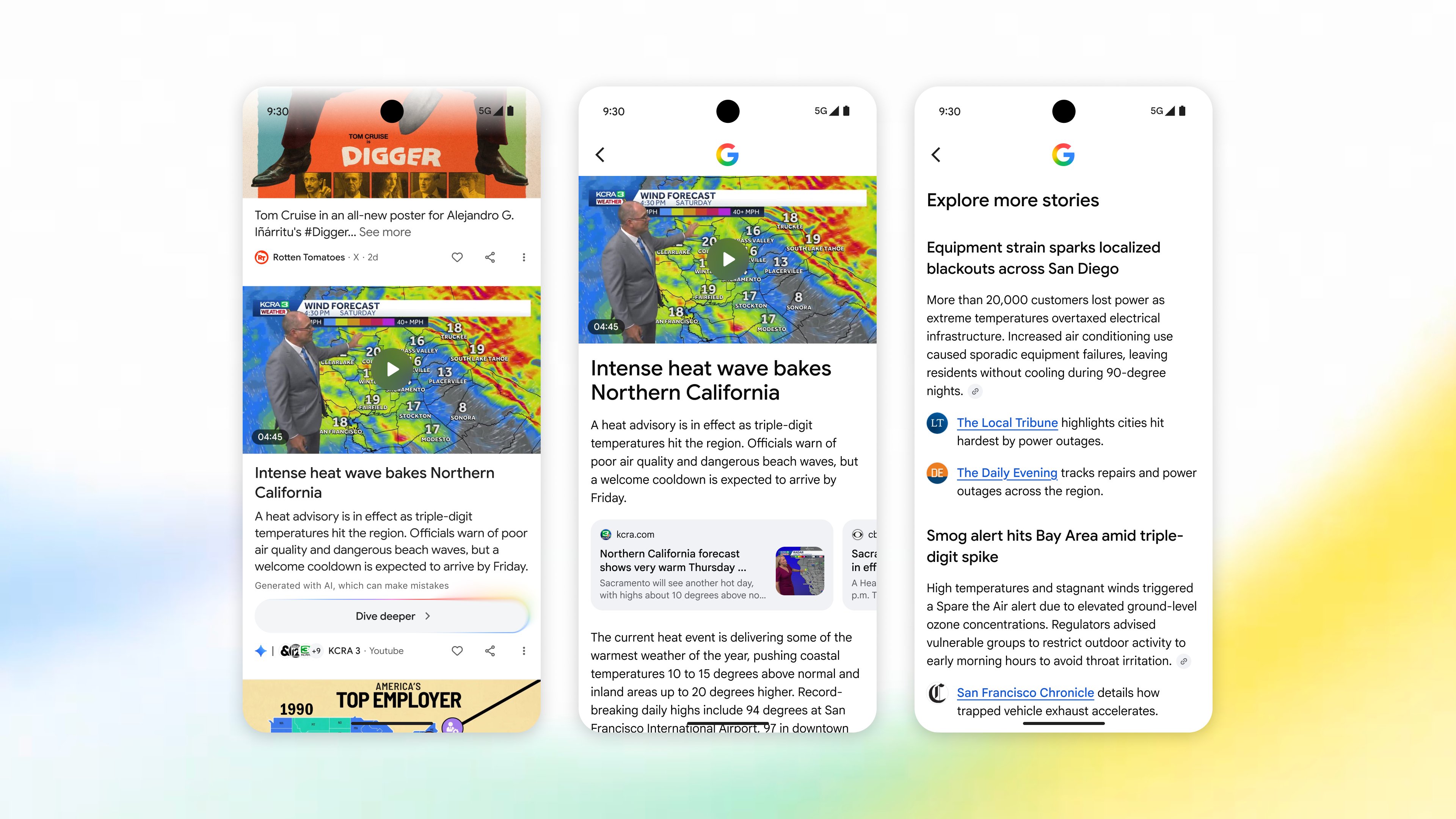
"Today we're experimenting with a new way to make exploring a topic and discovering related web content easier in Discover," Stein wrote. He described the mechanism in a single sentence: "By tapping 'Dive deeper,' you'll see a short topic overview with prominent links to related stories, community reactions & original reporting."
Two operational details follow. The first concerns scope: "We'll test this experience on videos to start." The second concerns iteration, with Google planning to "experiment with multiple designs in the weeks ahead" as it tries "to learn what works best."
That is the entire official account. There is no blog post, no help centre page and no Search Central documentation among the source materials. Google has not said which countries are in the test, what share of users see the button, how long the overview runs, which model writes it, or how sources are chosen for the links beneath it. No traffic figures were published. Nothing in Stein's post addresses whether publishers can opt out.
Inside the mockup
The image attached to Stein's post shows three phone screens, and they contain more technical information than the text does.
On the first screen, a Discover card carries a video under the headline "Intense heat wave bakes Northern California", followed by a short summary paragraph about a heat advisory and triple-digit temperatures. A pill-shaped "Dive deeper" button sits at the bottom of the card, below the summary and above the card's action icons.
The second screen is the overview itself. It repeats the headline, then gives several lines of generated text about the heat event, including a claim that coastal temperatures are running 10 to 15 degrees above normal and inland areas up to 20 degrees higher. Below that sits a horizontal row of source cards. Each card shows a publisher name, a small thumbnail and a headline cut off after a few words.
The third screen carries the heading "Explore more stories" and breaks the topic into follow-up angles. One block, headed "Equipment strain sparks localized blackouts across San Diego", states that more than 20,000 customers lost power. Underneath, Google lists one-line descriptions attributed to named outlets, among them "The Local Tribune highlights cities hit hardest by power outages" and a line crediting The Daily Evening with tracking repairs. A second block, "Smog alert hits Bay Area amid triple-digit spike", closes with a line attributed to the San Francisco Chronicle. These links carry publisher logos but no featured images.
The example is a design illustration rather than a live result. Some outlet names in it do not appear to correspond to real publications, and Stein described the image only as an example of the designs under test. Still, the structure is instructive: a Google-written summary on the card, a longer Google-written overview one tap later, and outbound links placed beneath both, each described in Google's words rather than the publisher's.
What the code says
Hours after Stein's post, Damien Andell, co-founder of the Discover analytics service 1492.vision, published a LinkedIn post stating that he had been able to activate the button on a Discover YouTube summary card. His finding was blunt: "The thing to know is that, for now, the button doesn't do anything."
Andell also listed four configuration strings he had found:
- enabled_ddp_button_entry_point_from_expand_aio_video
- enabled_ddp_button_entry_point_from_inline_aio_video
- enabled_ddp_button_entry_point_from_expand_aio_article
- enabled_ddp_button_entry_point_from_inline_aio_article
Two surfaces, two placements
Read together, the four flags describe a two-by-two grid. Two of them end in "video" and two in "article". Two refer to an "expand" entry point and two to an "inline" one. According to Andell, the button "will apparently be enabled on YouTube AIO (AI Summary) videos, as announced, but also on AI Summary articles."
On the placement question, Andell wrote that Google would have two display options: the button could appear only after a user taps "See more" on a Discover AI Summary card and the card expands, or it could appear inline on the card itself. The Stein mockup appears to show the second arrangement, with the button visible on the card without an expansion step, though a single static image cannot settle how the live product behaves.
The "aio" in each flag almost certainly refers to the AI summary layer that already sits on many Discover cards, rather than to the AI Overviews that appear above Google Search results. The "ddp" prefix has no public definition. Andell's post does not say which app version contained the flags or how he enabled them.
Discrepancies in scope and naming
The documents do not agree on everything, and the differences matter.
On scope, Stein said the test starts with videos. Andell's flags include article entry points. Both statements can be true at once: Google may have built the article path without switching it on. But the flags suggest the video-only framing describes a first phase rather than the intended footprint.
On naming, Stein and Nicola Agius both use "Dive deeper" (Agius capitalises it as "Dive Deeper" in one place). Andell's post calls it the "Deep Diver" button. The flag strings use neither phrase. The most likely explanation is a translation or transcription variation in Andell's post, which is presented partly in stylised text, but the source documents do not confirm it.
On function, Stein describes a working overview with links. Andell, testing a build where he had forced the button on, reported that it did nothing when tapped. One reading is that the client code has shipped ahead of the server-side switch, though neither Google nor Andell has said so.
The publisher case against the design
The sharpest reaction came from Nicola Agius, SEO and Discover director at Reach plc, the UK publisher behind the Mirror, the Express and more than a hundred regional titles. Her LinkedIn post opened with an accusation: "Google just unleashed its latest attack on publisher traffic - this time, Discover is in the firing line."
Her first objection is about the interface. "From a UX perspective, are users more likely to tap the image (which takes them through to the publisher) or the new CTA, which keeps them within Google?" she wrote. On a standard Discover card, the image is the main tap target, and it opens the publisher's page. The new button offers a second target on the same card that opens a Google screen instead.
The second objection concerns what happens after the tap. According to Agius, Google describes the destination as a "short overview", but its length is unconfirmed. "From what we can currently see, it's at least two pars," she wrote, adding that she had seen overviews elsewhere that "constitute short articles."
She then turned to the links Stein described as "prominent". In the screenshots, she noted, "headlines are truncated and featured images are teeny - hardly an ideal setup for driving CTR." She linked that to the summary already shown on the card: "And when you combine that with the fact that Google is already giving users the key details of the story in the AIO, what's the incentive for users to click through to the publisher?"
Agius was not uniformly negative. Of the designs shown, she preferred the "Explore more stories" layout, because it "breaks down follow-up angles to the original story and, importantly, gives users a reason to click through to publisher content." But the same layout raised a different problem. "These links have no featured images, and it doesn't look like publishers will have any say in how their stories are presented. Google chooses the angle."
That last sentence identifies a shift that goes beyond clicks. In the mockup, each outbound link is framed by a Google-written description of what the publisher's story contains. A publisher controls its own headline and image on a normal Discover card. On the overview screen, it controls neither.
Agius said she had not yet seen the feature in the UK.
Replies on X
The public replies under Stein's post, visible in the captured screenshot, were uniformly hostile. None came from Google.
"Don't ship it. It'll kill publishers who are dependent on Discover," wrote Mayank Parmar. An account posting as Media Konsumen raised a sourcing point: "'Original reporting' sounds great in theory. In practice, our original reporting has been invisible on Discover for months. How do you 'dive deeper' into something that isn't even being surfaced to begin with?" The recipe site Inspired Taste, addressing Stein and a second Google account, complained that "features like this" were "taking priority over major fundamental AI Mode and AIO problems" it said publishers had raised for years.
Replies on X are self-selected and not a measure of industry opinion. They do show that the reaction arrived within hours, from accounts identifying as publishers and creators, and that the phrase "original reporting" in Stein's post drew scrutiny rather than reassurance.
Why Discover carries so much weight
The concern makes sense only against the scale of what Discover has become for news businesses. Research covered by PPC Land in August 2025 found that Discover accounted for two-thirds of Google referrals to 2,000 global news and media websites, overtaking traditional search. By the end of that year, NewzDash data showed Google Web Search's share of publisher traffic had fallen from 51% to 27% between 2023 and 2025, while Discover climbed.
Discover itself has not been immune. Chartbeat figures cited in May 2026 showed page views from Google Discover falling 15% between December 2024 and December 2025, against a 34% decline from Google Search over the same period.
Reach, Agius's employer, provides the audited version. In half-year results published on July 22, 2026, the company reported that Google referral volumes fell 55% year on year and halved its interim dividend to 1.44p. Revenue for the six months to June 30 fell 9.0% to £232.9m, and on-platform page views fell 40% while revenue per thousand page views rose 49%. A publisher in that position has little tolerance for a new tap target that points away from its pages.
A feed already reshaped by summaries and video
Dive deeper is not Google's first AI layer in Discover. The company rolled out AI-generated previews in Discover in the United States, South Korea and India on October 13, 2025, describing brief summaries that expand to show more information and links. Those summaries are the "AIO" Agius refers to and the "aio" in Andell's flags.
Their reach grew quickly. Marfeel data published in December 2025 found that 51% of the Discover feed in the US, Brazil and Mexico consisted of AI Summaries. The distribution was uneven: 21.6% of positions 1 to 5, 13.9% of positions 6 to 10, 56% of positions 11 to 20 and 82.7% of positions beyond 20.
Video has followed a similar path. In April 2026, Andell and his 1492.vision co-founder Sylvain Deaure documented a three-stage YouTube pipeline inside Discover whose final stage is entirely YouTube and grew 18.2 times in three months, reaching 13% of English-language devices by February 2026. That makes Google's choice to start Dive deeper on videos significant. Many of the video cards in Discover already point to YouTube, a Google property, rather than to a publisher's site.
Dive deeper stacks a second generated layer on top of the first. On a card that carries both, the user sees a Google summary, then has the option of a longer Google overview, and meets publisher links only at the bottom of that second screen.
A familiar pattern from Search
The mechanics closely resemble a move Google made in Search. On December 1, 2025, Stein described a test that placed an "Ask Anything" button at the bottom of expanded AI Overviews that moved users into Google's conversational search surface with their original query carried over. In both cases, a button appended to an existing AI summary opens a deeper Google-generated experience rather than a website. The AI Mode test in Search was framed as a helpful next step. Dive deeper is framed the same way.
Google has also tried to answer the traffic question with link features. On May 6, 2026, it added five outbound link features to AI Mode and AI Overviews, including inline links and first-hand perspectives. Stein's promise of "prominent links" to "community reactions & original reporting" fits that pattern. Whether small, truncated link cards in a mobile overview produce meaningful clicks is the open question, and independent research on Search has not been encouraging: Ahrefs data from February 2026 found that AI Overviews correlated with a 58% reduction in click-through rates for top-ranking pages.
Control over presentation
The presentation issue Agius raised has a history in Discover too. In May 2026, 1492.vision found that 54 US publishers had quietly received profile controls in Discover, such as custom banners and link shelves, while more than 46,900 other publishers tracked had none. Google later formalised Search profiles for publishers and creators on June 4, 2026. Those tools give some publishers more say over how their brand appears. The Dive deeper overview, as shown, gives them none over how Google describes their story.
Andell has become one of the most consistent sources of evidence on unannounced Discover changes. He first spotted Discover's "You asked to see" transparency label on April 24, 2026, and this month documented that Discover had been switched off globally on desktop without explanation from Google. The Dive deeper flags extend that record: Google's public statement describes one surface, while the shipped code describes more.
What cannot be measured yet
For publishers trying to assess the effect, the tooling is thin. Google's generative AI performance reports in Search Console, which reached all sites on August 31, 2026, cover AI Overviews, AI Mode and Discover but report impressions without clicks or queries. Nothing in the source materials indicates whether an appearance as a link inside a Dive deeper overview would be counted, labelled separately or reported at all.
Several variables will decide the commercial impact. Google has not disclosed:
- how often the button appears, and on what proportion of video and article cards
- whether the overview is generated per topic or per card, and how its sources are selected
- whether the original publisher of the card is guaranteed a link in the overview
- how clicks from the overview are attributed in analytics
- which markets are in the test
Stein's post commits Google to multiple designs over "the weeks ahead". Andell's flags suggest the article path is built. Agius's observation that the feature had not appeared in the UK suggests the initial audience is limited, though no country list has been given. For now, the only numbers attached to Dive deeper are the ones on the post that disclosed it.
Timeline
- August 7, 2025 - Research shows Discover accounts for two-thirds of Google referrals to 2,000 news and media sites
- October 13, 2025 - Google rolls out AI-generated previews in Discover in the US, South Korea and India
- December 1, 2025 - Robby Stein describes an "Ask Anything" button at the bottom of expanded AI Overviews that opens AI Mode
- December 2025 - Marfeel data shows 51% of the Discover feed in the US, Brazil and Mexico consists of AI Summaries
- February 4, 2026 - Ahrefs finds AI Overviews correlate with a 58% reduction in click-through rates for top-ranking pages
- April 24, 2026 - Damien Andell spots Discover's "You asked to see" label
- April 27, 2026 - 1492.vision maps a YouTube pipeline in Discover that grew 18.2 times in three months
- May 6, 2026 - Google adds five outbound link features to AI Mode and AI Overviews
- May 12, 2026 - 1492.vision documents 54 US publishers with exclusive Discover profile controls
- May 2026 - Chartbeat data shows Google Discover page views fell 15% between December 2024 and December 2025
- June 4, 2026 - Google formalises Search profiles for publishers and creators in the US
- July 22, 2026 - Reach plc reports Google referral volumes down 55% year on year and halves its interim dividend
- September 2026 - Andell documents Discover switched off globally on desktop
- September 18, 2026 - Robby Stein posts on X that Google is testing "Dive deeper" in Discover, starting with videos
- September 18-19, 2026 - Damien Andell reports activating the button and lists four entry point flags covering video and article cards
- September 18-19, 2026 - Nicola Agius of Reach plc questions the design on LinkedIn and says she has not yet seen it in the UK
Related PPC Land coverage
- Google Discover dominates news traffic as search declines - The August 2025 research establishing Discover as two-thirds of Google referrals to news sites.
- Google launches AI features for Discover and Search sports updates - The October 2025 rollout of the AI previews that Dive deeper now builds on.
- Google Discover feeds users AI and YouTube while publishers watch traffic vanish - Marfeel's position-by-position analysis of AI Summaries in the feed.
- Google tests AI Mode access directly from search results page - The Search precedent: a button on an expanded AI summary that leads deeper into Google.
- YouTube's 18x surge in Google Discover reveals a hidden video pipeline - 1492.vision's map of how YouTube video reaches Discover users.
- Google Discover gives 54 publishers exclusive profile controls in secret pilot - The tiered presentation controls some publishers received and most did not.
- Google adds 5 outbound link features to AI Mode and AI Overviews - Google's May 2026 attempt to increase outbound clicks from AI search surfaces.
- Reach halves dividend to 1.44p as Google referrals cut 55% of traffic - The financial position of the publisher whose Discover director led criticism of the test.
- Publishers threaten to cut Google off as ad supply falls 40% - Reach's page view and RPM figures in the context of wider publisher ad supply.
- Sam's Club targets 800,000 households it predicts will buy in 12 months - Weekly roundup including the unannounced global removal of Discover on desktop.
- Google's AI summaries now swallow 58% of clicks that once went to websites - Ahrefs click-through data on AI summaries in Search.
Summary
Who: Google, through Robby Stein, vice president of product for Google Search, is running the test. Damien Andell, co-founder of 1492.vision, documented the underlying code flags. Nicola Agius, SEO and Discover director at Reach plc, set out the publisher objections. News publishers and creators dependent on Discover traffic are the parties most affected.
What: A "Dive deeper" button on Discover cards that opens a short Google-generated topic overview with links to related stories, community reactions and original reporting. Google says the test starts on videos with multiple designs to follow. Four flags found by Andell cover both video and article AI summary cards, with "expand" and "inline" entry points.
When: Stein disclosed the test on X on September 18, 2026. Andell and Agius published their LinkedIn posts within the following hours. Google said design experiments would continue in the weeks ahead.
Where: Inside Google Discover on mobile. Google has not named the markets in the test, and Agius said she had not seen it in the UK.
Why: Google frames the button as a way to make exploring a topic easier. For publishers, Discover has become the largest Google traffic source, and the button adds a tap target that leads to a Google screen, where outbound links are small, truncated and described in Google's own words.


Discussion