


Google today is the subject of new research showing that 54 publishers in the United States have quietly received control over their Google Discover profile pages - custom banner images, configurable link shelves, pinned posts - while more than 46,900 other publishers tracked by researchers have nothing. No application. No announcement. No Search Console toggle. Google appears to have simply chosen who gets in.
The findings come from a systematic analysis published on May 12, 2026, by Sylvain Deaure and Damien Andell, co-founders of 1492.vision, a Google Discover analytics service that won the Innovation Award at SMX Paris 2026. Their report, published by Search Engine Land, draws on monitoring data gathered across 46,926 publishers in seven languages between March and May 2026. It is the first public attempt to document the full scope of what the authors describe as an invitation-only pilot program - one that, by its design, places Google in the position of deciding which publishers receive tools that could shape how their brands appear across a surface that has become the dominant traffic source for news organizations.
Deaure is a 28-year veteran of the SEO industry who previously built cocon.se, an internal linking optimization tool, and has worked with Markov chains and text spinning since before AI-generated content became an industry term. He is a regular speaker at French SEO conferences including SEO Summit, TeknSEO, and SEO Camp'Us, and trains custom machine learning models as part of his research work. Andell is a Python developer, Google Bug Hunter, and algorithm specialist who built the proprietary technology 1492.vision uses to collect and analyze Discover data, combining hands-on site-publisher experience with deep technical expertise in Google's systems. The pair have published two major Discover analyses via Search Engine Land in 2026: this one on publisher profiles and, in April 2026, a study of 20 Discover content pipelines across 42 million cards revealing how trends, news, video, and advertising flow through the feed.
That context matters more than it might once have. Google is simultaneously facing two landmark antitrust rulings in U.S. federal courts. The selectivity embedded in this Discover pilot - however modest the feature set - arrives in a legal environment where courts have already found the company acted illegally toward publishers and competitors alike.
What the pilot actually changes
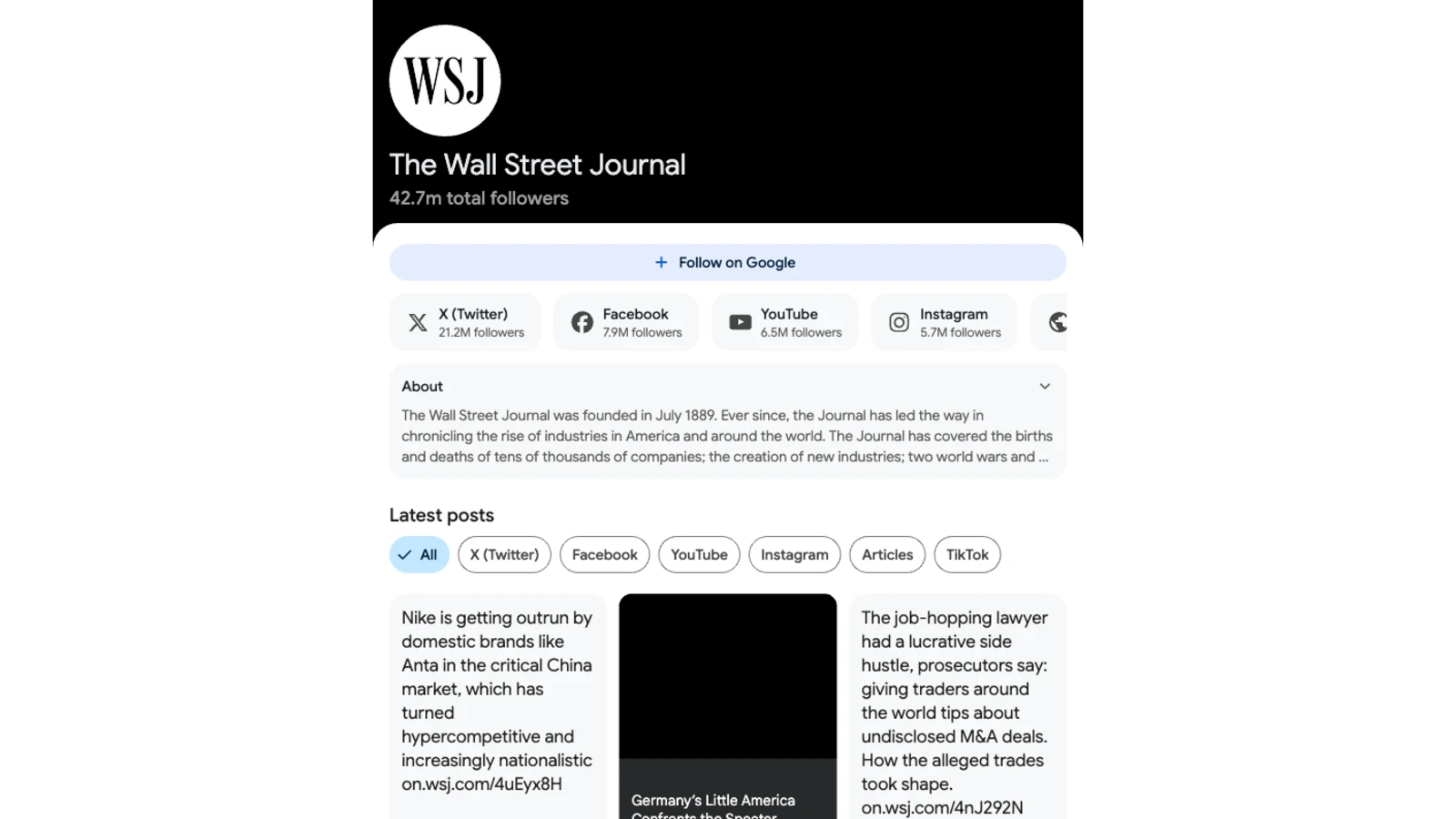
For most publishers, a Discover publisher profile page - hosted at profile.google.com/cp/ and visible when a user taps a publisher's name on a Discover card - is auto-generated by Google. It pulls a name, follower count, social links from the Knowledge Graph, and recent posts. A footer reads "Profile generated by Google." Publishers control nothing.
The 54 publishers in the pilot have a structurally different arrangement. According to the 1492.vision report, their profiles carry no generation label at all - the label disappears once a profile is claimed. They can upload a custom banner image. They can configure a links shelf. They can pin a post, labeled "Pinned" in the publisher interface, formerly called "Featured Posts." And they control the display order of their social links, website, and content tabs. On standard profiles, Google sorts links algorithmically by follower count, with the website placed last. On claimed profiles, the publisher decides.
This is not a Search Console feature. It is not structured data markup. There is no public documentation describing how to gain access, and no form or toggle has been identified. The qualification criteria are, as of publication, entirely opaque.
Who got selected - and what that reveals
The composition of the cohort tells a story. The group breaks into five tiers: 15 national publishers, including the Wall Street Journal, Fox News, the New York Post, Newsweek, and the Philadelphia Inquirer; 13 regional newspapers, including the Boston Globe, SFGate, the CT Insider, and the Times Union; 14 local TV stations, including KTLA, PIX11, MyFox8, WSMV, and Atlanta News First; six lifestyle brands, including Delish, The Dodo, Country Living, and House Beautiful; and six specialty outlets, including Pew Research, The Athletic, Gothamist, and Civil Beat.
All 54 are U.S.-based. All publish in English. Across the six other language markets monitored by 1492.vision - French, German, Italian, Spanish, Dutch, and Portuguese - the researchers found zero enhanced profile deployments. Not one banner. Not one configured link outside the English-language cohort.
Nearly half the cohort - 27 of 54 publishers - consists of regional newspapers and local TV stations. Google has publicly emphasized supporting local journalism in various contexts, and the composition does reflect that stated priority. But the selection process itself remains unexplained. Thousands of regional and local publishers not on this list have no way to determine why they were passed over - or whether they ever will be included.
This is, in structural terms, a tiered access system. Tier one: 54 named publishers with branding controls on a Google-owned surface. Tier two: everyone else, with auto-generated profiles they cannot touch.
The antitrust backdrop
The timing of this pilot - and the selection mechanism behind it - sits uncomfortably against the legal record. In April 2025, U.S. District Judge Leonie Brinkema ruled that Google illegally monopolized two markets: publisher ad servers (DoubleClick for Publishers) and ad exchanges (AdX). According to the Department of Justice, the court found Google "harmed Google's publishing customers, the competitive process, and, ultimately, consumers of information on the open web." The DOJ is seeking forced divestiture of AdX; a remedies ruling from Judge Brinkema was anticipated as of early May 2026 but had not yet been published.
That ruling was preceded in August 2024 by Judge Amit Mehta's finding that Google illegally maintained its search monopoly - primarily through more than $20 billion in annual payments to Apple, Samsung, and others to lock in default search placement on devices. In December 2025, Mehta issued finalized remedies limiting Google to one-year search distribution agreements and extending the injunction to cover generative AI products, for a six-year term with technical committee oversight. In March 2026, a New York judge effectively barred Google from contesting anticompetitive conduct in follow-on private publisher lawsuits, shifting the burden to proving damages only.
The DOJ has brought two separate monopolization cases against Google. Texas reached a $1.375 billion settlement with Google in May 2025 over ad tech practices. PPC Land has covered the DOJ's ad tech antitrust proceedings in detail, including the remedies trial that concluded in November 2025.
None of this makes the Discover publisher profile pilot itself an antitrust violation. But it does mean the practice of Google hand-selecting which publishers receive enhanced capabilities on a Google-owned distribution surface - with no transparent criteria, no application process, and no timeline for broader access - is operating in a context where courts have already determined that Google's selective treatment of the publishers and advertisers who depend on its platforms has caused harm. The DOJ's own description of the ad tech ruling - that Google "harmed Google's publishing customers" - is precisely the population now being divided into profile haves and have-nots inside Discover.
PPC Land has tracked the broader publisher traffic picture: Google Discover now accounts for 67.51% of total Google traffic to news organizations, according to NewzDash data covering more than 400 publishers. Google Web Search traffic fell from 51% to 27% of publisher referrals between 2023 and the fourth quarter of 2025. In that environment, control over how a brand appears inside Discover is not a minor cosmetic question.
The tiering already has precedent
This is not the first time Google has structured publisher access in tiers. In December 2025, Google launched AI-powered article overviews for a select group of major publishers - The Guardian, Der Spiegel, El Pais, The Washington Post, among others - while thousands of publishers outside the arrangement continued absorbing traffic losses from AI Overviews without any financial arrangement in return. PPC Land documented that pattern as a two-tier dynamic: major publishers receive compensation and experimental features; smaller outlets get neither.
The Discover profile pilot follows the same structural logic. And the elimination in March 2025 of Publisher Center controls for Google News - which removed publisher ability to set custom sections, logos, publication titles, and geographic distribution settings - moves in the opposite direction: fewer controls for the many, more controls for the few.
What publishers actually did with the access
Of the 54 publishers, 41 uploaded a banner image. The remaining 13 have the capability but have not used it yet. The 1492.vision report identifies five visual archetypes among uploaded banners.
Brand-pattern banners - wordmarks or abstract identity elements tiled across the header - appeared at the Wall Street Journal, Barron's, and Pew Research. Editorial content banners - food photography for Delish, puppy imagery for The Dodo - dominated the lifestyle tier. Local landmark images, featuring city skylines and regional scenery, appeared at KTLA, Atlanta News First, and the Boston Globe. Brand-statement banners, including curated collages with taglines, appeared at SecretNYC and New York Magazine. And front-page archive grids appeared at the New York Post - a display of 12 iconic covers.
One anomaly: The Athletic uploaded a solid black square measuring 656x656 pixels. Whether that was deliberate minimalism or a broken upload cannot be determined from the data. It is the only non-image banner in the cohort.
On format: 71% of publishers used square banners, likely Google's recommended ratio. Twenty-nine percent used wide landscape formats. No publisher used portrait layout. Based on content delivery network serving patterns, the minimum recommended resolution appears to be 512 pixels on the longest side.
Links: local TV treats it as navigation; nationals do almost nothing
Thirty-three of the 54 publishers enabled the links feature. Thirty-one added at least one link. Across the cohort, 65 links were configured in total, and 85% of them point to the publisher's own sections, weather pages, live streams, or app downloads. This functions more as embedded site navigation than any kind of external promotion.
The tier gap in engagement is stark. Local TV stations across 14 publishers configured 31 links - an average of 2.2 per publisher. Fox affiliates consistently stocked links for Watch Live, Weather, Local News, sub-region pages, and Contact. National publishers across 15 properties configured only 9 links in total - averaging 0.6 per publisher. Most nationals uploaded a banner and stopped.
Three publishers took notably different approaches. PIX11 published a link reading "How to make PIX11 a preferred source on Google" - using the Discover profile itself to promote Discover follows. Gothamist used the links shelf to funnel donations through pledge.wnyc.org, tagging the destination with utm_campaign=discover-profile. That makes Gothamist the only publisher in the cohort treating the profile as a measurable acquisition channel. Fox Nation placed a direct subscription conversion link on what most others used as a navigation surface.
Pinned posts: access granted, rarely used
Fifty-two of the 54 publishers have the Pinned feature enabled. Only 13 use it with an active pinned post. Lifestyle brands are the strongest adopters: five of the six in the cohort have the feature active. Among national publishers, only two of 15 used it at all.
About text: Wikipedia replaced by self-description
On standard profiles, the "About" section is auto-generated by Google, typically sourced from Wikipedia. On claimed profiles, publishers write their own. Thirty-eight of 54 have written custom descriptions; 16 retain Wikipedia-sourced versions.
The tone splits cleanly by tier. Local TV stations write promotional copy, leaning on phrases about "trusted sources" and coverage geographies. National and digital-native publishers stay more factual. According to the 1492.vision report, Newsweek's profile notes its founding in 1933 and commitment to fair, independent, and transparent journalism. Delish's description reads: "you don't have to know how to cook, you just have to love to eat!" Gothamist describes itself as "a website about New York City news, arts, events and food, brought to you by New York Public Radio."
Once a profile is claimed, the publisher takes control of what appears on a Google-owned page. That is a meaningful shift in a relationship that, for most publishers, offers almost no control at all.
UTM tracking: a near-universal blind spot
Only three of the 65 configured links include analytics parameters. Gothamist's donation link is the clearest example of deliberate measurement. The Philadelphia Inquirer instrumented two links, but one reused an Instagram bio campaign tag - meaning Discover traffic from that link will be misattributed to Instagram in downstream reporting. The other 62 links carry no tracking parameters whatsoever. In practice, 95% of the cohort cannot attribute traffic those links may generate.
Social ordering: Facebook first for local TV, X nowhere
On claimed profiles, publishers control the display order of social links. The data reveals distinct patterns. Among local TV stations, 86% - 12 of 14 - list Facebook first. Not a single local TV station in the cohort listed X (formerly Twitter) as its primary social link, despite news media's historical dependency on that platform. National publishers spread their priorities: Facebook first for 33%, Instagram first for 20%, X first for 20%, YouTube first for 13%. Specialty and digital-native outlets lean Instagram-first at 67%.
Damien Andell, whose screenshots of the feature were reported by Barry Schwartz at Search Engine Roundtable on May 12, 2026, noted that Newsweek places YouTube first and Articles second, while Delish leads with Website, then Instagram. According to Andell, "previously, the order was based on social media follower count." On claimed profiles, it is an editorial decision.
The rollout is still expanding
Two snapshots taken 19 days apart confirm the pilot is not static. During that window, four publishers added banners - jp.wsj.com (the Wall Street Journal's Japanese edition), the New York Post, SecretNYC, and Everyday Health - and the New York Post activated the links feature for the first time. The Wall Street Journal's Japanese-language edition entered the cohort entirely during this period. No publishers lost features. The program is growing.
Adoption does not equal performance
The 1492.vision analysis includes a composite adoption score from 0 to 6, assigning one point each for: banner uploaded, links feature active, Featured Posts active, at least one configured link, four or more social platforms listed, and any UTM tracking present. Nobody scored 6. Twenty-two publishers (41%) scored 2, 10 publishers (19%) scored 3, 14 publishers (26%) scored 4, and 8 publishers (15%) scored 5.
National publishers with the largest audiences scored a mean of 2.93. Local TV stations scored a mean of 3.57. Lifestyle brands scored highest at 3.83.
The critical finding: feature adoption shows no correlation with Discover visibility trajectory. The 180-day capture ratio across the cohort ranges from 0.23x for Prevention magazine (down 77%) to 4.27x for NewsNation (up 327%). KTLA scored high on adoption and grew 3.69x. Delish also scored high and fell to 0.90x. MyFox8 configured five links and declined to 0.52x. The profile feature gives publishers a branding surface. It is not a ranking input.
Context for the marketing community
The Discover profile pilot is a small piece of a much larger structural shift. Google launched a Follow button for publishers and creators in September 2025, integrating X, Instagram, and YouTube Shorts into the feed alongside traditional articles. AI-powered brief preview expansions followed in October 2025. A February 2026 Discover core update prioritized locally relevant content and penalized sensational material. A transparency label tied to Discover's natural language "Tailor Your Feed" feature appeared in late April 2026.
For advertisers and media buyers, the profile pilot deepens an already-uneven landscape. The publishers who appear most prominently - who can craft their brand presentation, choose which links appear, and control their social ordering - will increasingly be those Google selected. Small publishers have lost 60% of search traffic over two years according to Chartbeat data, and the Discover surface they depend on for the traffic that replaced it is now being differentiated at the profile level without a transparent process for wider access.
According to Google's own Search Central documentation for Discover, last updated March 9, 2026, "Content is automatically eligible to appear in Discover if it is indexed by Google and meets Discover's content policies." The documentation contains no reference to publisher profile pages, claimed profiles, or any mechanism for requesting access to enhanced features.
According to the 1492.vision methodology, the Profile Features Monitor tracks roughly 47,000 publishers across seven languages through recurring snapshots of profile metadata. Andell built the proprietary data collection technology that underpins the monitor, combining algorithmic analysis with hands-on publisher observation. The 54-publisher cohort was identified through persistent enhanced-feature signals observed across multiple snapshots between March and May 2026. Visibility trajectory data is based on proprietary capture data. The full analysis - including a complete 10-phase timeline, banner image gallery, snapshot-by-snapshot evolution, and tier-by-tier breakdowns - is available at 1492.vision/research/discover-publisher-profiles-en.
Timeline
- August 2024: Judge Amit Mehta finds Google illegally maintained its search monopoly through default search payments to Apple, Samsung, and others exceeding $20 billion annually.
- August 2025: Google launches a Follow button for Discover publishers and creators, beginning the rollout of publisher profile pages at profile.google.com/cp/.
- September 17, 2025: Google officially integrates content from X, Instagram, and YouTube Shorts into the Discover feed alongside the Follow feature.
- October 13, 2025: Google launches AI-powered brief preview expansions inside Discover and a sports-focused "What's new" button for Search.
- November 2025: Google documentation begins referring to Discover publisher profile pages as "source overviews," according to 1492.vision monitoring.
- December 10, 2025: Google launches AI-powered article overviews with select major publishers including The Guardian, Der Spiegel, and The Washington Post - creating a paid two-tier arrangement that leaves most publishers outside any commercial arrangement.
- December 11, 2025: Google's December 2025 core update triggers severe Discover traffic collapses for hundreds of publishers within 48 hours.
- December 2025: Judge Mehta issues finalized remedies in the DOJ search monopoly case, limiting Google to one-year distribution agreements and extending the injunction to cover generative AI products for six years.
- February 5, 2026: Google releases a Discover-specific core update targeting English-language U.S. users, prioritizing local content and reducing sensational material.
- March 2026: A subset of publishers begins gaining access to enhanced Discover profiles with custom banners, configurable links, and pinned posts. Access is invitation-only with no public criteria disclosed.
- March 2026: A New York judge bars Google from contesting anticompetitive conduct in private publisher follow-on lawsuits, limiting defense to damages arguments only.
- March 9, 2026: Google updates its Discover documentation on Search Central - making no mention of publisher profile claiming or enhanced profile access.
- April 17, 2025: A federal court rules Google violated antitrust law by monopolizing publisher ad servers and ad exchanges - finding the company harmed its own publishing customers.
- April 24, 2026: The "You asked to see" transparency label tied to Discover's Tailor Your Feed feature is first spotted, revealing a new natural language personalization layer inside the feed.
- May 12, 2026: Search Engine Roundtable reports on the enhanced publisher profile test. 1492.vision publishes its full systematic analysis covering 46,926 publishers across seven languages, identifying 54 with enhanced profiles. The DOJ ad tech remedies ruling from Judge Brinkema remains pending as of this date.
Summary
Who: Google, as the platform operator, hand-selected 54 U.S.-based English-language publishers across national news, regional newspapers, local TV stations, lifestyle brands, and specialty outlets to receive access to claimed Discover profile pages. The analysis was conducted by Sylvain Deaure and Damien Andell of 1492.vision - Deaure a 28-year SEO industry veteran and SMX Paris 2026 Innovation Award winner, Andell a Python developer and Google Bug Hunter who built the proprietary data collection technology - and published via Search Engine Land. The program operates in parallel with ongoing DOJ and private antitrust litigation in which Google's selective treatment of publishers has already been found to cause harm.
What: An invitation-only pilot giving 54 publishers the ability to customize their Google Discover profile pages with custom banner images, a configurable links shelf, pinned posts, and control over the order of social media links and content tabs. The other 46,900-plus publishers monitored by 1492.vision have auto-generated profiles with no publisher control. Feature adoption shows no measurable correlation with Discover visibility performance, confirming the feature operates as a branding surface rather than a ranking input.
When: Enhanced profiles began appearing in monitoring data from March 2026. The 1492.vision analysis was published May 12, 2026. The program is still expanding within the cohort as of that date. The broader antitrust context spans August 2024 (search monopoly ruling) through April 2025 (ad tech monopoly ruling), with the ad tech remedies decision still pending.
Where: The pilot is exclusively U.S.-based and English-language. Zero enhanced profiles were found across French, German, Italian, Spanish, Dutch, and Portuguese publisher cohorts also monitored by 1492.vision. Profile pages are hosted at profile.google.com/cp/ and surface when a Discover user taps a publisher name on a content card.
Why: The pilot matters because it extends a pattern of selective Google access that courts have already scrutinized - and in the ad tech context, condemned. Google is simultaneously facing a pending remedies ruling in a case where it was found to have harmed publishing customers, while building a Discover profile system that gives branding controls to 54 named publishers and nothing to everyone else. For media buyers and advertisers, the practical effect is a Discover landscape increasingly shaped by Google's choices about which publishers get tools to present themselves professionally - choices made without public criteria, in a market where Discover has become the dominant traffic source for news, accounting for 67.51% of Google traffic to news organizations.


Discussion