


VIOOH, the London-based outdoor advertising marketplace that JCDecaux launched in 2018, today opened 254 digital screens in Estonia, Latvia and Lithuania to automated buying through a partnership with JCDecaux's own Baltic business. According to VIOOH, the screens in Tallinn, Riga and Vilnius generate more than 163 million viewable impressions a month across roadside sites, bus shelters, city centres, a shopping mall and a railway station. The deal lifts the number of markets in which VIOOH says it trades to 49, from 46 in its previous announcement five days ago. Neither company disclosed a start date, deal types, prices or how the impressions are counted.
In Short
VIOOH runs an online marketplace where advertisers' buying software can purchase time on digital screens, and it has added 254 screens in the capitals of Estonia, Latvia and Lithuania that belong to JCDecaux, the same company that created VIOOH. Brands that buy outdoor ads through automated systems, including international advertisers running campaigns in many countries at once, can now reach these Baltic screens through one platform instead of dealing with three separate local companies. The companies say the screens draw 163 million views a month, but they have not explained how those views are counted, and the numbers vary so widely between the three cities that the totals are hard to compare.
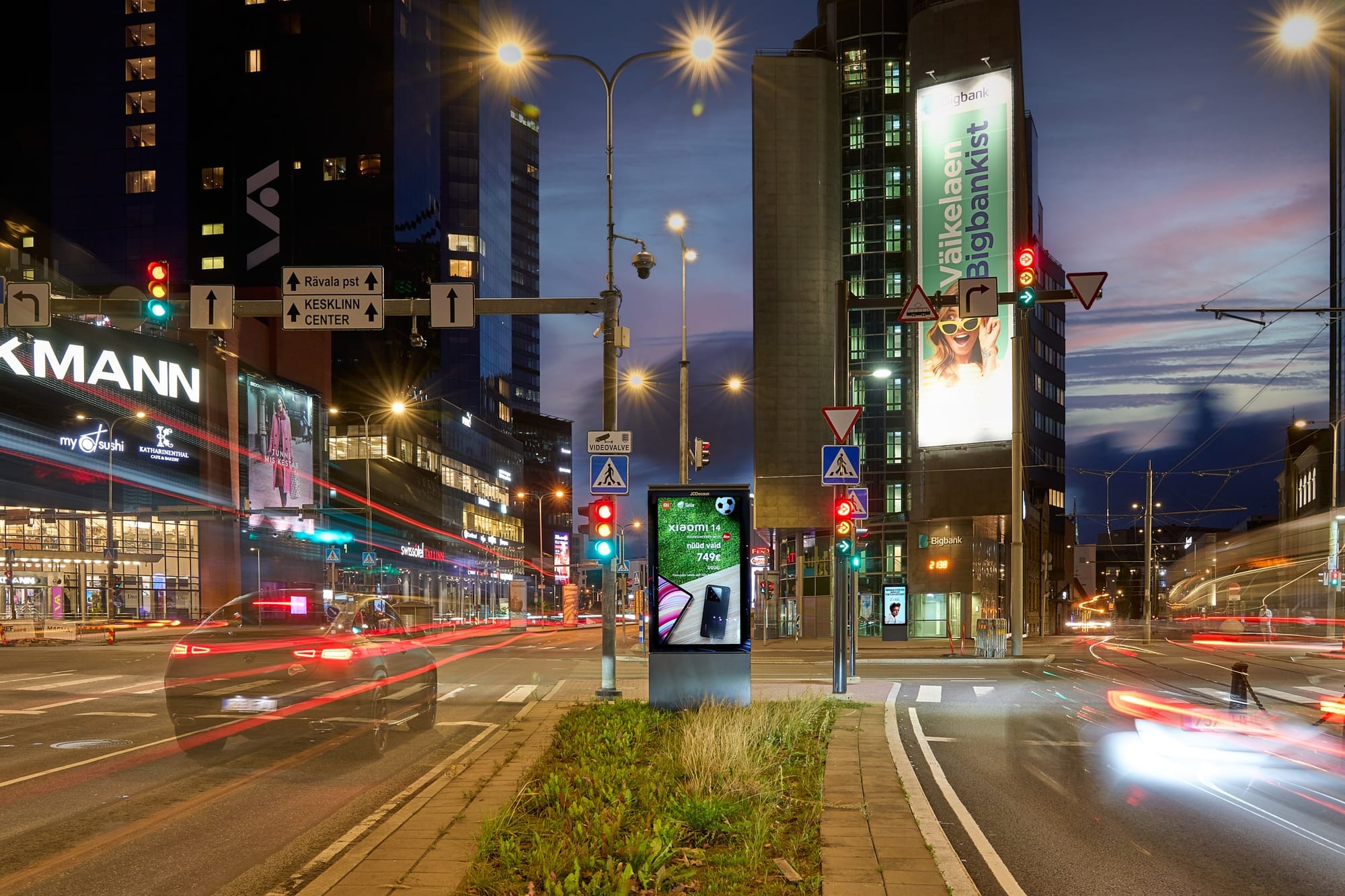
What the companies announced
The release was issued in London and is dated November 3, 2026. VIOOH describes itself as a premium global digital out-of-home supply-side platform, headquartered in London. Its partner is JCDecaux in the Baltics, which, according to JCDecaux, operates as three separate markets in Lithuania, Latvia and Estonia, each selling both traditional and digital outdoor inventory.
According to VIOOH, the partnership "delivers access to 254 digital screens generating over 163 million monthly viewable impressions across the three Baltic markets." The network spans shopping malls, transit hubs, roadside and city centre locations in the three capitals. Buyers reach it through what Gavin Wilson, Global Chief Commercial Officer at VIOOH, called the VIOOH Trading Manager platform.
"Estonia, Latvia and Lithuania are increasingly sophisticated advertising markets, and this partnership gives brands a single point for programmatic DOOH access to all of JCDecaux's premium inventory," Wilson said. "With more than 250 digital screens now available through the VIOOH Trading Manager platform, advertisers can build cross-Baltic campaigns with targeting precision and real-time optimisation. This is a fast-growing region, and programmatic is how brands will capture it efficiently."
The release offers no figure to support the description of the Baltics as fast-growing. It gives no advertising spend, growth rate or programmatic share for any of the three countries.
Øyvind Markussen, Regional Director Baltics at JCDecaux, spoke for the media owner. "This partnership with VIOOH marks an important step in how advertisers can access our premium DOOH network across the region," Markussen said. "VIOOH has opened up access to our screens in Tallinn, Riga and Vilnius for a global marketplace of buyers, bringing advanced targeting capabilities to our roads, city centre and retail environments. Advertisers can now plan and execute campaigns across Estonia, Latvia and Lithuania with far greater efficiency and precision than ever before."
According to the release, buyers gain "enhanced targeting capabilities, real-time campaign optimisation and seamless integration with global DOOH strategies." Those are descriptions of what automated buying offers. No campaign results accompany them.
Country by country
The release breaks the inventory down by country, and the breakdown is more detailed than most VIOOH announcements this year. The figures below are VIOOH's; the per-screen averages are PPC Land's calculation. Because every impression total is a floor ("more than" or "over"), the averages are approximate.
| Country | City | Digital screens | Monthly impressions | Average per screen |
|---|---|---|---|---|
| Estonia | Tallinn | 61 | more than 75 million | about 1.23 million |
| Latvia | Riga | 83 | more than 47 million | about 566,000 |
| Lithuania | Vilnius | 110 | over 41 million | about 373,000 |
| Total | 254 | over 163 million | about 642,000 |
Estonia
In Tallinn, the deal covers roads and the city centre. According to VIOOH, 44 urban panels and bus shelters deliver 50 million monthly impressions, and 17 large-format billboards add 25 million.
Latvia
Riga's 83 screens include 76 urban panels and bus shelters with 24 million monthly impressions and six billboards with seven million. The remaining screen is the Origo Premium 3D screen at Riga's central station, which VIOOH credits with 16 million monthly impressions on its own.
Lithuania
Vilnius is, according to VIOOH, JCDecaux's largest Baltic network. Its 110 screens comprise 80 urban panels and bus shelters, 13 billboards, 16 screens at the Panorama shopping mall and a three-sided spectacular billboard at the Savanorių roundabout. Unlike Estonia and Latvia, Lithuania's 41 million monthly impressions are not split by format.
Mostly street furniture
Across the three capitals, 200 of the 254 screens, or 79%, are urban panels and bus shelters, by PPC Land's count. That reflects JCDecaux's core business. The company designs, installs and maintains street furniture for cities and finances it through the advertising placed on it, according to the release. Billboards account for 36 screens, the Panorama mall for 16, and the two spectaculars in Riga and Vilnius for the rest.
The impression arithmetic
Fewer screens, more impressions
The country figures do not line up with screen counts. Lithuania holds 43% of the screens but delivers 25% of the impressions. Estonia holds 24% of the screens and delivers 46%. Tallinn's 61 screens are credited with 75 million monthly impressions, not far short of the 88 million credited to Riga's 83 and Vilnius's 110 combined, by PPC Land's calculation.
The gap is sharpest in the most comparable format. A Tallinn urban panel or bus shelter averages about 1.14 million impressions a month. A Riga panel averages about 316,000. That is a ratio of roughly 3.6 to one for what the release describes as the same category of street furniture, in two capital cities a few hundred kilometres apart. Billboards are closer: about 1.47 million a month each in Tallinn and about 1.17 million in Riga.
Context makes the Estonian figure stand out further. When JCDecaux won a 21-year street furniture contract in Tallinn in February 2023, it gave the city's population as 452,000. On that basis, the 75 million monthly impressions claimed for Estonia amount to about 166 per resident each month, by PPC Land's calculation. Commuters, visitors and drivers from outside the city add to any count, so the ratio does not prove an error. It does show how much the total depends on the counting method.
There are ordinary explanations for differences of this kind. Screens on busier roads see more traffic. Larger formats are visible from further away. Counting methods differ, too: an impression can be one person passing one screen, or one person passing during one advertiser's slot in a rotating loop, and the second approach produces a smaller number per advertiser. The release does not say which method applies in any of the three countries, whether the same method is used across all three, or which measurement provider, if any, stands behind the figures. With JCDecaux running three separate national companies, the possibility of three different methods cannot be ruled out from the release alone.
What "viewable" means here
VIOOH calls the 163 million total "viewable impressions," while the country figures are described simply as impressions. In web advertising, viewability has a fixed industry threshold, such as half of a display ad's pixels on screen for at least one second. Outdoor media has no single equivalent applied worldwide. In the US, the Media Rating Council has been writing out-of-home measurement rules for several years and opened public comment on the audience phase of its standards in July 2025. The release does not define "viewable" or say whether any audit applies.
One screen, a third of Latvia
The Origo screen at Riga's central station accounts for 16 million of Latvia's 47 million monthly impressions, or 34%, while making up one of 83 screens. That is roughly 533,000 impressions a day, by PPC Land's calculation, and two-thirds of the 24 million credited to all 76 Riga urban panels together. Railway hubs concentrate footfall, so a high count at a station is plausible. Without a stated method, though, the figure cannot be checked against the station's passenger numbers.
Against VIOOH's other deals
At about 642,000 impressions per screen per month, the Baltic network sits at the lower end of what VIOOH has announced this year. When JCDecaux Ireland joined VIOOH in February, its 288 screens were credited with 311 million monthly viewable impressions, or about 1.08 million each. Five days ago, Adams Outdoor's more than 460 US digital billboards were credited with over 4.9 billion monthly impressions, about 10.7 million each. Those networks differ in format and location, and they almost certainly differ in measurement. The comparison shows the spread of figures that buyers on the same platform are asked to weigh, not which is right.
The Irish release also put a number on market share: 32% of Ireland's digital out-of-home market. Today's release gives no equivalent figure for any Baltic country.
What the release leaves out
Several details that matter to buyers are missing. The release does not state:
- whether the screens can be bought today or from a later date;
- whether buyers can transact through open auction, private marketplace deals, programmatic guaranteed buys, or all three;
- prices, floor prices or fees;
- how impressions are counted, by whom, and whether the same method applies in all three countries;
- whether the screens are, or will remain, available through other automated sales platforms;
- how many digital screens JCDecaux operates in the Baltics in total.
The last point is partly answered by the companies themselves, though not in a number. Wilson refers to "all of JCDecaux's premium inventory," and JCDecaux's description of its Baltic business says it is digitising more of its inventory, "all of it now available for programmatic buying." Read together, those passages suggest the 254 screens are JCDecaux's entire Baltic digital network. The release never states that directly.
JCDecaux plugs in its own networks
VIOOH is not an independent marketplace that happened to sign a Baltic media owner. JCDecaux held 93.5% of VIOOH's capital when it launched the platform in the UK and the US in June 2018, with data firm Veltys holding the rest. Eight years on, a large share of VIOOH's recent geographic growth comes from connecting JCDecaux's own national subsidiaries.
The pattern is visible in the company's own market count. VIOOH said it traded in 35 markets when JCDecaux Ireland came on board in February. The figure stood at 37 when Grupo IMU added more than 400 Mexican screens in July. Days later, on July 20, JCDecaux extended automated buying to nine more Latin American countries, covering more than 4,600 screens. JCDecaux's half-year results release on July 30 described VIOOH as active in 46 countries, and VIOOH's own count read 46 when Screenverse added US screens in August. Today it reads 49.
By PPC Land's reading of those figures, 12 of the 14 markets added to VIOOH's count since February coincide with two JCDecaux rollouts: nine in Latin America and three in the Baltics. VIOOH has not itself explained the changes. The same July release from JCDecaux said VIOOH connected 50 demand-side platform partners and 49 third-party media owners; today's release repeats the "+50 DSPs" figure used throughout 2026.
Earlier JCDecaux subsidiaries followed the same route. JCDecaux Portugal's partnership with VIOOH was announced in November 2023, according to VIOOH, and JCDecaux Sweden launched programmatic buying in Stockholm through VIOOH in April 2025, according to ExchangeWire.
JCDecaux in the Baltics
JCDecaux's Baltic presence rests on city contracts. In April 2007, JCDecaux Lithuania won a 15-year street furniture agreement in Vilnius covering 700 bus shelters, 200 columns and 250 free-standing panels, and JCDecaux Estonia won a 15-year agreement in Tallinn covering 320 bus shelters, 140 free-standing panels and 18 public toilets. At the time, JCDecaux said the Vilnius deal would consolidate its "N°1 positions in Street Furniture and Outdoor Advertising in the Baltic countries."
The Tallinn relationship was renewed on a larger scale in February 2023, when JCDecaux Eesti won an exclusive 21-year contract for 1,200 bus shelters, 34 self-cleaning toilets and 141 free-standing City-Light-Poster displays. According to JCDecaux, the final tender evaluation "was 100% based on non-financial criteria." The company said then only that "part of the media portfolio in Tallinn's vibrant city centre will be digitised," without a screen count. Today's release counts 44 digital urban panels and bus shelters in Tallinn. Set against the 1,200 bus shelters and 141 free-standing displays in the 2023 contract, those figures indicate that most of JCDecaux's street furniture in the Estonian capital still carries no screen that can be bought programmatically.
Europe's automated outdoor market
The Baltic deal is the latest of several European supply additions for VIOOH this year. In January, Jet Line opened more than 600 screens across Poland's eight largest cities, and VIOOH signed a German petrol station network credited with 200 million impressions. In June, i-media brought UK motorway service area screens onto the platform, and in late September TuMedio added more than 500 screens in Spain and Portugal.
The market those screens feed is still small. In its first global count, the World Out of Home Organization put programmatic digital out-of-home at $1.339 billion in 2025, 7% of global digital out-of-home spending. The Europe, Middle East and Africa region accounted for $521 million, at 9.4% penetration. Germany led all markets at 31.8%. The Nordics, grouped together, came tenth by spend at $21.1 million. No figure for Estonia, Latvia or Lithuania appears in the published results. The study also found that 75.7% of global programmatic outdoor spend ran through private marketplace deals, against 17.4% through open auction.
That last figure bears on how the Baltic screens are likely to be sold. VIOOH has been building curated deals: in June it said its Seller Agent had processed more than 100 curated private marketplace deal package requests in the first half of 2026. Whether Baltic inventory will be packaged that way, offered at open auction, or both, the release does not say.
The money at JCDecaux
For JCDecaux, automated selling is growing faster than the rest of the business but remains a minority of sales. In its first-half 2026 results, programmatic revenue rose 30.9% organically to EUR 102.8 million, or 12.3% of digital revenue, up from 10.1% a year earlier. Revenue in the Rest of Europe segment rose 7.8% organically, and VIOOH turned cash-flow positive for the first time. In the first quarter, the programmatic share had been 10.5%. For the whole of 2025, JCDecaux reported programmatic revenue of EUR 180.5 million, 10.9% of digital. The company is due to report third-quarter revenue on November 4.
The Baltic network is small against those totals. JCDecaux does not report Baltic revenue separately, and the release gives no indication of what the region contributes.
Why this matters for marketers
For advertisers that buy outdoor media through software, the deal puts three small markets, each served by a separate JCDecaux company, behind a single automated route. A campaign that previously required three sets of local arrangements can, according to the companies, be planned across Tallinn, Riga and Vilnius in one place and bought through any of the buying platforms connected to VIOOH. For international brands that include the Baltics in wider European plans, that is a practical change.
The scale is modest. At 163 million monthly impressions, the whole Baltic network is credited with about 3% of what VIOOH says Adams Outdoor's US billboards deliver, and about half of JCDecaux Ireland's network. Coverage is limited to the three capitals.
The measurement questions are the bigger issue. Within one announcement, a bus shelter screen in Tallinn is credited with more than three times the monthly impressions of one in Riga. Buyers paying per thousand impressions will price those screens differently on the basis of that number. Whether the gap reflects real differences in traffic or different counting rules is not something the release allows anyone to determine, and it is the question on which the value of the Baltic inventory depends.
Timeline
- April 10, 2007 - JCDecaux Lithuania wins a 15-year street furniture agreement in Vilnius covering 700 bus shelters.
- April 24, 2007 - JCDecaux Estonia wins a 15-year street furniture agreement in Tallinn.
- June 17, 2018 - JCDecaux launches VIOOH in the UK and the US, holding 93.5% of its capital.
- February 21, 2023 - JCDecaux Eesti wins an exclusive 21-year street furniture contract in Tallinn covering 1,200 bus shelters.
- November 2023 - JCDecaux Portugal partners with VIOOH.
- April 2025 - JCDecaux Sweden launches programmatic buying in Stockholm through VIOOH.
- July 28, 2025 - The MRC opens public comment on the audience phase of its out-of-home measurement standards.
- January 19, 2026 - Jet Line opens more than 600 Polish screens through VIOOH; VIOOH cites 35 markets.
- January 26, 2026 - VIOOH adds a German petrol station network credited with 200 million impressions.
- February 24, 2026 - JCDecaux Ireland brings 288 screens and 32% of Irish digital out-of-home to VIOOH.
- March 13, 2026 - JCDecaux reports 2025 programmatic revenue of EUR 180.5 million.
- May 5, 2026 - JCDecaux reports programmatic at 10.5% of first-quarter digital revenue.
- June 9, 2026 - i-media opens UK motorway service area screens through VIOOH.
- June 26, 2026 - VIOOH says its Seller Agent processed more than 100 curated deal package requests in H1 2026.
- July 16, 2026 - Grupo IMU adds more than 400 Mexican screens to VIOOH; VIOOH cites 37 markets.
- July 20, 2026 - JCDecaux extends programmatic buying to nine more Latin American countries.
- July 30, 2026 - JCDecaux reports H1 programmatic revenue of EUR 102.8 million; VIOOH turns cash-flow positive.
- August 25, 2026 - Screenverse adds more than 38,000 US screens to VIOOH; VIOOH cites 46 markets.
- September 29, 2026 - TuMedio brings more than 500 Spanish and Portuguese screens to VIOOH.
- October 12, 2026 - WOO puts global programmatic digital out-of-home at $1.339 billion for 2025.
- October 29, 2026 - Adams Outdoor puts more than 460 US digital billboards into VIOOH; VIOOH still cites 46 markets.
- November 3, 2026 - VIOOH and JCDecaux in the Baltics announce their partnership covering 254 screens; VIOOH cites 49 markets.
Related PPC Land coverage
- VIOOH and JCDecaux bring 32% of Ireland's digital OOH to programmatic - The February deal connecting another JCDecaux subsidiary, with 288 screens and 311 million monthly viewable impressions.
- JCDecaux gains 100% programmatic reach in Latin America across 4,600 screens - The July rollout that added nine Latin American countries to VIOOH.
- VIOOH gains 460 Adams Outdoor digital billboards to sell programmatically - VIOOH's previous supply deal, five days ago, with an average of 10.7 million impressions per board.
- Polish DOOH network joins global programmatic platform - Jet Line's 600-plus screens across Poland's eight largest cities, announced in January.
- VIOOH taps German gas stations for 200M impressions in DOOH power play - A German petrol station network added in January.
- Advertisers gain access to 500+ Spain and Portugal screens via VIOOH - TuMedio's Iberian inventory, added in September.
- UK motorway DOOH hits programmatic as i-media integrates with VIOOH - Motorway service area screens in the UK.
- Programmatic DOOH hit $1.339bn in 2025, just 7% of digital OOH, WOO finds - The first global count of programmatic outdoor spend, with EMEA at $521 million.
- JCDecaux gains 5.7% revenue growth as profit nearly doubles in H1 - Programmatic revenue of EUR 102.8 million and VIOOH's first positive cash flow.
- JCDecaux Q1 2026: programmatic DOOH hits 10.5% of digital as Middle East bites - First-quarter trading at VIOOH's parent.
- JCDecaux's record cash flow hides a digital advertising arms race - Full-year 2025 results, with programmatic at 10.9% of digital revenue.
- VIOOH's Seller Agent automated 100+ DOOH deals in H1 2026 - How VIOOH assembles curated private marketplace packages.
- VIOOH gains 400 screens across six Mexican cities in Grupo IMU deal - A July deal announced when VIOOH cited 37 markets.
- VIOOH gains 7.7 billion monthly US impressions in Screenverse deal - The August deal in which VIOOH's market count first read 46.
- MRC opens public comment for out-of-home audience measurement standards phase 2 - The US audit body's draft rules on counting outdoor audiences.
- JCDecaux launches VIOOH, first in the UK and in the US - The 2018 launch and JCDecaux's 93.5% stake.
Summary
Who: VIOOH, the London-based digital out-of-home supply-side platform launched by JCDecaux in 2018, and JCDecaux in the Baltics, which runs separate companies in Estonia, Latvia and Lithuania. Gavin Wilson, Global Chief Commercial Officer at VIOOH, and Øyvind Markussen, Regional Director Baltics at JCDecaux, are quoted.
What: A partnership that makes 254 JCDecaux digital screens, credited with more than 163 million monthly viewable impressions, available through VIOOH's programmatic marketplace. Estonia's 61 screens are credited with 75 million impressions, Latvia's 83 with 47 million, and Lithuania's 110 with 41 million. No start date, deal types, prices or measurement method were disclosed.
When: Announced today, from London.
Where: Tallinn, Riga and Vilnius, including roadside sites, urban panels and bus shelters, the Panorama shopping mall in Vilnius, a three-sided billboard at the Savanorių roundabout and the Origo Premium 3D screen at Riga's central station.
Why: JCDecaux is connecting its national subsidiaries to its own programmatic platform, as it did in Ireland in February and across Latin America in July, and the three Baltic countries take VIOOH's market count from 46 to 49. For buyers, the deal offers a single automated route into three small markets, though the per-screen impression figures differ so widely between the capitals that the counting method is the open question.


Discussion