


Spotify today made its Ad Exchange inventory available in Walmart DSP, opening audio, video and display placements across its music, podcast and video content to eligible US advertisers, according to Spotify. Walmart Connect announced the integration, which pairs those placements with Walmart first-party audiences and Walmart's own sales-linked reporting, according to Spotify.
In Short
Companies that buy online ads through Walmart's ad-buying tool can now also buy ads on Spotify, across music, podcasts and video. Brands can aim those ads at people who match Walmart shopper groups and then check how many of those listeners later added items to a cart or bought something at Walmart, but only eligible advertisers in the United States can do it. Spotify now sits inside the same tool that Walmart advertisers already use for display, video and connected TV, though the performance numbers released with the news come from Spotify itself.
What Walmart DSP buyers can now do
Spotify framed the move as part of a wider shift in which retail media networks extend beyond their own sites and apps into channels such as audio. The change itself is narrow and specific. According to Spotify, advertisers using Walmart DSP can add Spotify to their offsite retail media plans through the same workflows already used for display, video and CTV, and can reach existing and prospective Walmart customers across music, podcasts and video content. Measurement runs through Walmart's closed-loop system, the arrangement in which ad exposure is matched against purchase records held by the retailer.
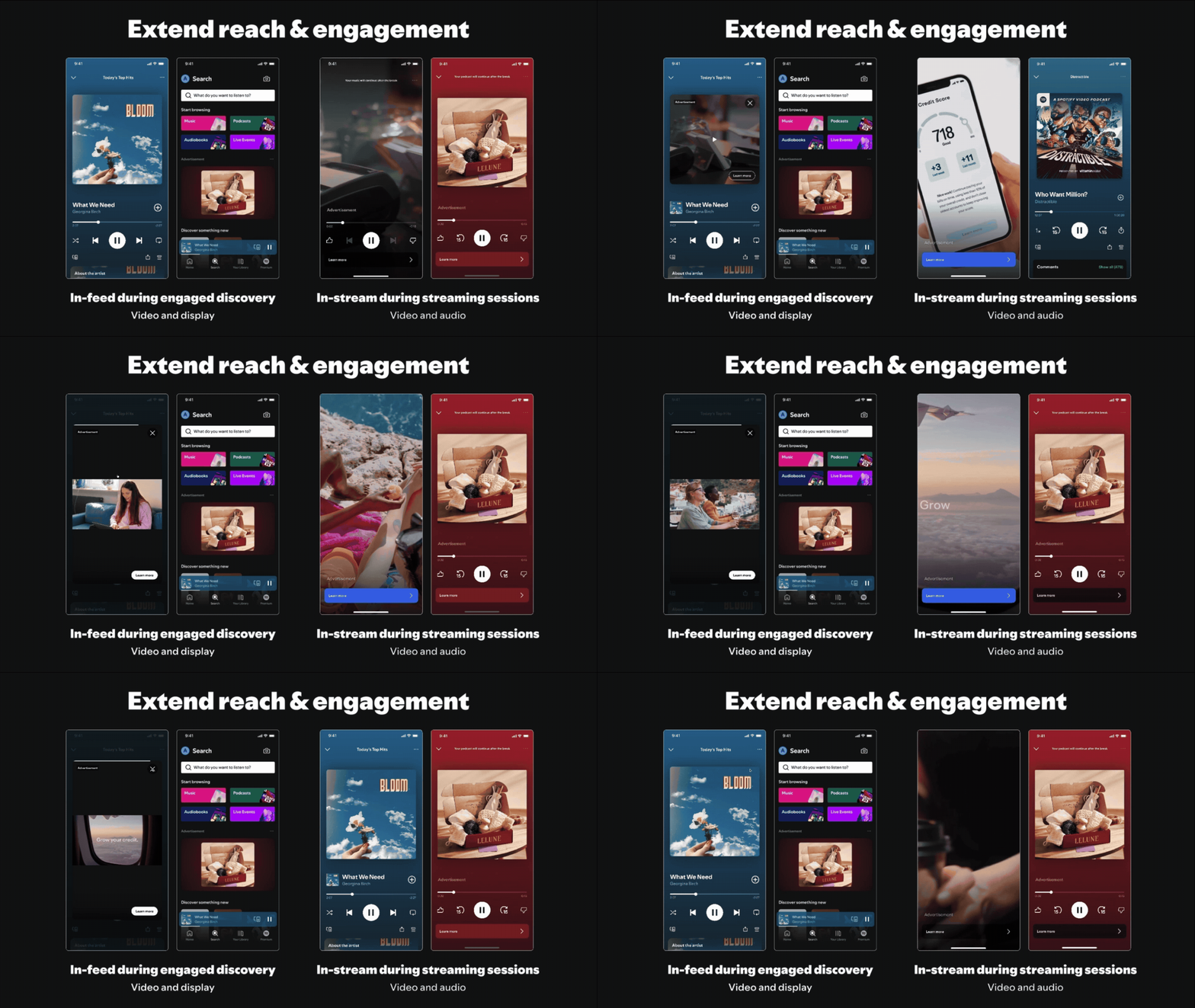
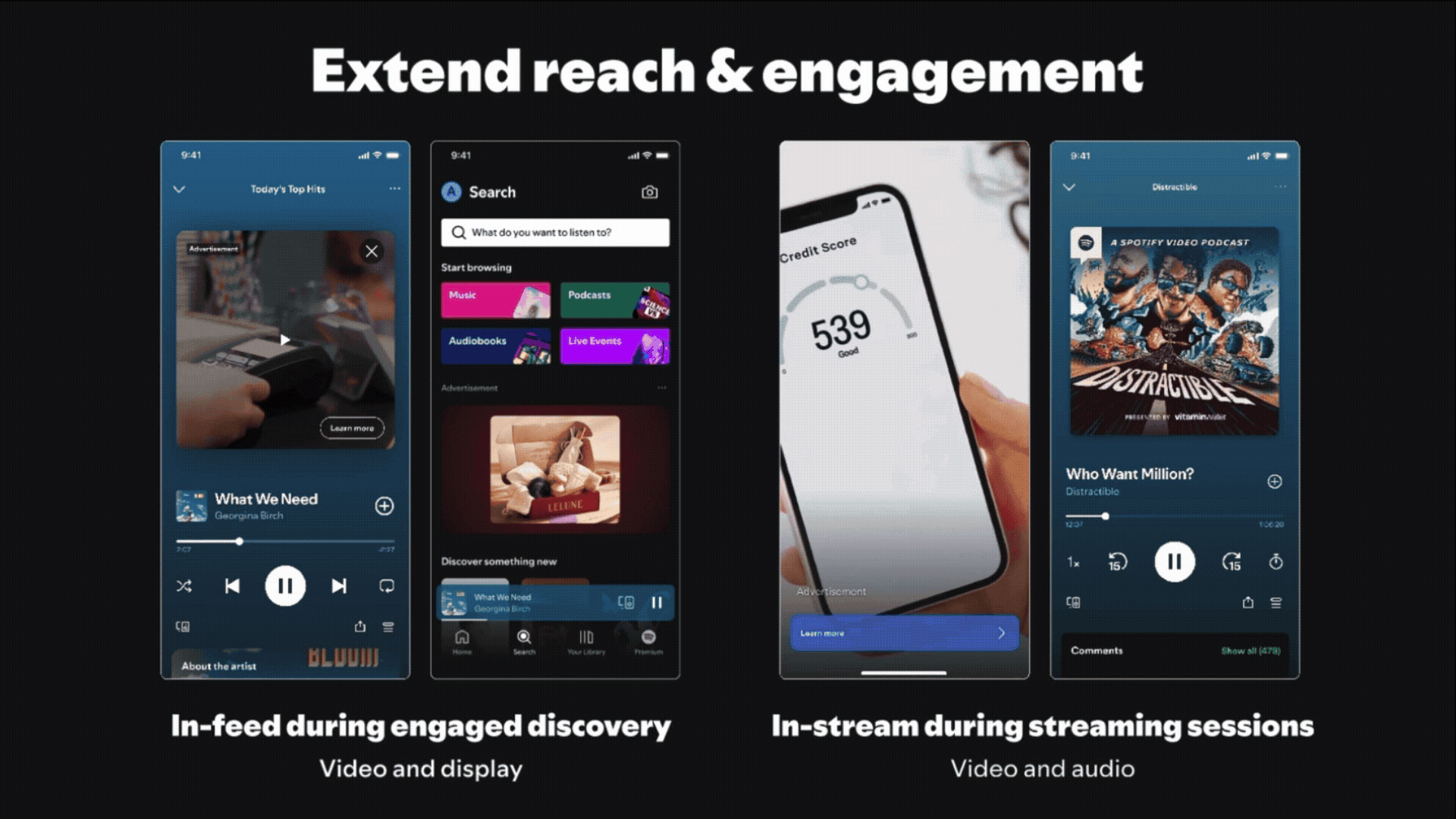
Spotify said the three formats are available "at parity with standard programmatic specs," which in the company's telling means Walmart campaigns can get started today. It added that its generative AI creative tools, free of charge, can produce a first audio ad, with the resulting assets usable within Spotify campaigns only. Access begins through a Spotify Advertising or Walmart Connect representative, according to Spotify.
The Spotify Ad Exchange is the supply side of the arrangement. Spotify opened the exchange on April 3, 2025, with Google's Display & Video 360 and Magnite as the first buying routes, selling access to logged-in listeners through real-time auctions. Walmart DSP is a newer demand-side route into the same marketplace.
What the materials leave open
The documents released with the news describe eligibility only as eligible US advertisers. They do not state what makes an advertiser eligible, what Walmart DSP or Spotify charge for these placements, which deal types apply (private marketplace, programmatic guaranteed or open auction), or how much podcast and video supply sits behind the integration. No timetable is given for markets outside the United States, although Spotify said the Walmart DSP integration is "the latest step, with more to come."
How the integration works
Spotify describes two functions. The first makes Spotify inventory addressable through Walmart's first-party data targeting. The second makes Spotify campaigns measurable against Walmart signals.
Audience activation
According to Spotify, advertisers can apply Walmart first-party audiences to Spotify inventory and reach segments such as brand buyers, category buyers or in-market shoppers during commuting, working, cooking and shopping. The documents do not describe how a Walmart customer record is recognised on Spotify, whether match rates are reported, or where the audience join takes place. Those mechanics determine how much of a Walmart segment is reachable in practice, and neither company has set them out in the materials reviewed.
Measurement
Spotify said eligible campaigns can connect Spotify exposure to outcomes across Walmart's digital properties and its stores, which the company puts at more than 4,600, citing Walmart first-party data from 2025. The reporting maps to three objectives. Awareness is measured through reach, frequency and ad plays; consideration through product detail page views and add-to-cart rates; conversion through attributed sales, new-to-brand buyers and ROAS. Spotify noted that the audiences and metrics listed are "not comprehensive but indicative."
Every conversion metric named is an attribution measure, crediting purchases made by shoppers who were exposed to an ad. None of the materials mentions holdout groups or incrementality testing, the methods that separate purchases caused by advertising from purchases that would have happened anyway.
The figures Spotify attached
Spotify supplied a set of audience and performance statistics with the news. Apart from the store count, all of them come from Spotify's own first-party data or from studies the company cites, and none was produced by Walmart.
- Reach: adding Spotify to omnichannel plans can lift incremental reach by 22% on top of social and digital campaigns in the United States, according to Spotify, which cites a Nielsen Mixer study covering 2023 and 2024.
- Shopping behaviour: 60% of users stream Spotify while they shop, citing Foursquare Retail data from the second quarter of 2019 to the first quarter of 2024.
- Data volume: 3.4 trillion taste signals are generated on the service every day, according to Spotify first-party data from 2026.
- Habit: 92% of users include Spotify in a daily routine (GWI, global, 2024), and 76% say it helps them enjoy daily activities more (GWI, global, first quarter of 2025).
- Attention: Spotify ads capture twice the attention of social platforms, citing the Adelaide Attention Study, global, April 2024.
- Efficiency: multi-format campaigns show a 34% lower cost per action, according to Spotify first-party data, global, December 2025 to March 2026.
The 34% figure appears with two different baselines. Spotify's summary materials describe it as lower than a benchmark, while the published post specifies the Spotify median. The second is the narrower claim, a comparison with Spotify's own campaigns rather than with campaigns bought elsewhere. Geography also varies: the reach figure covers the United States, whereas the attention and cost-per-action figures are global.
The post also describes three unnamed campaigns:
- CPG: one campaign paired Spotify audio with CTV during the holiday season and recorded 58% incremental reach compared with CTV alone.
- Tech and telecom: one telco campaign using audio and video on Spotify recorded a 35% lower cost per offline purchase and a 30% lower cost per online purchase than the overall audio average.
- Retail: one retailer shifted investment into digital audio on Spotify and recorded a ROAS 28% above traditional radio, with a further 15-percentage-point lift against the previous year.
Each figure carries a footnote marker in the post, but the source list was absent from the version reviewed. The documents also do not say whether any of the three campaigns ran through Walmart DSP.
Spotify's route to market
The exchange has collected demand partners steadily over two years. Spotify began testing it with The Trade Desk for video inventory in October 2024. On July 11, 2025, automated podcast buying reached roughly 170 million listeners across 12 markets, with Spotify reporting a 64% rise in programmatic adoption since the exchange opened. Then came the retail route that Walmart now repeats. Amazon DSP added Spotify's global audio and video inventory across nine markets on October 1, 2025. Roughly nine months later, on July 6, 2026, Spotify extended that direct integration to podcasts, to Australia and Japan for audio and video, and to India for video, adding Programmatic Guaranteed and Open Auction alongside private marketplace deals. Spotify put the podcast network's unique reach at 90% against its ad-supported music tier.
A smaller route opened between the two. On May 28, 2026, Azerion connected the exchange directly to its Hawk DSP, covering audio, display, video and podcasts across the three main deal types.
Spotify's own statements link the distribution push to its revenue mix. According to Spotify, automated channels made up nearly 40% of ad-supported revenue in the second quarter of 2026, and active advertisers grew 60% year over year. The second-quarter report put ad-supported revenue at 446 million euros, up 1% as reported and 3% at constant currency, with the automated share rising from just over 30% three months earlier and pricing and buyer appetite, rather than infrastructure, now the stated constraint. The advertiser growth rate sat below the 68% recorded for the first quarter, when biddable programmatic crossed one-third of ad-supported revenue for the first time. That first-quarter figure was reported on April 28, 2026, and was followed on May 21 by an Investor Day in which Spotify described an advertising platform organised around high-impact sponsorships and scaled biddable channels.
Anne Bouttier, Global Head of Automation at Spotify, said the company's focus with the exchange is "to make reaching Spotify's attentive audience as frictionless as possible for programmatic buyers." Connecting directly with retail buying platforms, she added, puts Spotify in front of automated media teams within the workflows they already run, so that commerce signals can be layered onto streaming audio, video and display at scale.
Walmart Connect's year of widening access
Walmart Connect has spent 2026 opening its advertising stack in both directions. On April 27, it opened Connect Select, a curated connected TV marketplace inside Walmart DSP, with Magnite, PubMatic, FreeWheel and Index Exchange as supply partners. On May 28, its first-party audiences became available in Yahoo DSP via Magnite, reaching 150 million shoppers on VIZIO CTV with closed-loop sales measurement, according to Walmart Connect as reported there. On June 11, purchase-based audiences extended into Display & Video 360 for YouTube inventory.
Those moves exported Walmart's data to other buying platforms. The Spotify integration points the other way, bringing a third party's audio supply into Walmart's own tool, much as Connect Select did for CTV. Whether Spotify inventory is surfaced through Connect Select or through a separate path is not stated.
Why this matters for the marketing community
Walmart DSP joins Amazon DSP as a retailer-owned platform with a direct line to the Spotify Ad Exchange. Each pairs Spotify's audience with a different retailer's purchase records. For a brand that sells through both retailers, the same listener can in principle appear in two separate closed loops, and neither company has described a common standard that would let the results be compared.
The question for Spotify is whether more demand paths turn into more revenue. Ad-supported revenue grew 1% in the second quarter even as the automated share climbed, so each new connection adds a route to buyers but not, by itself, price or volume. Walmart's shopper audiences are a distinct kind of demand signal, tied to purchase history rather than to listening, and that difference is the substance of the integration.
The evidence base is thin so far. The performance figures are vendor-supplied, mostly global, and drawn from campaigns not shown to have used Walmart DSP. Independent evidence on whether Walmart-segment targeting changes outcomes on Spotify would have to come from live campaigns, since none is cited. Open items include pricing, deal types, the audience matching method, market scope beyond the United States and any incrementality design. Spotify says more partnerships and measurement integrations are coming, which leaves the same questions open for each new route.
Timeline
- October 2024 - Spotify begins testing its ad exchange with The Trade Desk for video inventory.
- April 3, 2025 - Spotify opens the Spotify Ad Exchange, with Display & Video 360 and Magnite as first buying routes.
- July 11, 2025 - Spotify extends automated podcast buying to about 170 million listeners across 12 markets.
- October 1, 2025 - Amazon DSP adds Spotify's global audio and video inventory across nine markets.
- April 27, 2026 - Walmart Connect opens Connect Select, a curated CTV marketplace, inside Walmart DSP.
- April 28, 2026 - Spotify reports first-quarter results, with biddable programmatic above one-third of ad-supported revenue.
- May 21, 2026 - Spotify sets out a platform built around sponsorships and biddable channels at its Investor Day.
- May 28, 2026 - Walmart Connect audiences become available in Yahoo DSP via Magnite.
- May 28, 2026 - Azerion connects the Spotify Ad Exchange directly to Hawk DSP.
- June 11, 2026 - Walmart Connect audiences extend into Display & Video 360 for YouTube inventory.
- July 6, 2026 - Spotify adds podcast inventory and new markets to the Amazon DSP integration.
- August 4, 2026 - Spotify reports second-quarter ad-supported revenue of 446 million euros, with automated channels near 40%.
- October 6, 2026 - Spotify Ad Exchange inventory becomes available in Walmart DSP for eligible US advertisers.
Related PPC Land coverage
- Spotify launches ad exchange, partners with The Trade Desk for video - Covers the early testing of Spotify's exchange with The Trade Desk, starting with North American video inventory.
- Spotify launches programmatic ad exchange and AI-powered creative tools - Reports the April 2025 event that opened the exchange to Display & Video 360 and Magnite buyers.
- Spotify expands automated podcast buying to 170 million listeners - Documents the July 2025 podcast expansion across 12 markets and the 64% rise in programmatic adoption.
- Amazon DSP adds Spotify's global audio and video inventory - Reports the October 2025 integration that first placed Spotify supply inside a retailer-owned DSP.
- Amazon DSP gains Spotify podcast ads as reach hits 90% unique - Details the July 2026 podcast addition, new markets and the extra deal types.
- Azerion gives Hawk DSP a direct line into Spotify Ad Exchange - Covers the May 2026 direct integration with Azerion's DSP.
- Spotify hits 761M users as biddable ads top a third of ad revenue - Reports first-quarter 2026 results and the programmatic milestone.
- Spotify rebuilt its ad platform around two engines, here is what it means - Explains the sponsorship and biddable architecture presented at the May 2026 Investor Day.
- Spotify ad revenue gains 1% as automated channels near 40% of total - Reports second-quarter 2026 revenue and the growing share of automated sales.
- Walmart Connect opens CTV to all advertisers with Connect Select - Describes the curated CTV marketplace inside Walmart DSP and its supply partners.
- Walmart Connect's first-party data lands in Yahoo DSP for VIZIO CTV reach - Covers the first use of Walmart audiences inside a third-party DSP.
- Walmart Connect brings real purchase data into Google DV360 for YouTube ads - Reports the June 2026 extension of Walmart purchase-based audiences into Display & Video 360.
Summary
Who: Spotify and Walmart Connect, the retail media arm of Walmart. Anne Bouttier, Global Head of Automation at Spotify, is quoted. The integration is open to eligible US advertisers buying through Walmart DSP.
What: Spotify Ad Exchange inventory across audio, video and display formats, covering music, podcasts and video content, is now available in Walmart DSP. Advertisers can apply Walmart first-party audiences to that inventory and connect Spotify exposure to outcomes in Walmart's digital properties and stores through Walmart's closed-loop measurement. Spotify supplied reach, attention and cost-per-action figures with the news, none of which was independently verified in the documents.
When: Today, October 6, 2026.
Where: The United States. The documents name no other market.
Why: According to Spotify, retail media networks are expanding beyond onsite placements into channels such as audio, and the integration places Spotify inside the buying and measurement workflows that retail media teams already use. Spotify also links its automated buying routes, which accounted for nearly 40% of ad-supported revenue in the second quarter of 2026, to growth in its advertising business.


Discussion