


Google today launched a new data control in Google AdSense that lets publishers include the full IP address in programmatic bid requests sent to demand partners. The feature, announced June 1, 2026, in the AdSense Help Center, does not activate automatically. It is blocked by default, and publishers must change a setting in their account to enable data sharing.
The addition is modest in scope but meaningful in context. IP address data is one of the more durable signals in the programmatic ecosystem - one that buyers use for geolocation, invalid traffic detection, and frequency estimation. Truncating it has always been a trade-off between publisher privacy posture and inventory signal quality. The new toggle hands that trade-off decision to publishers.
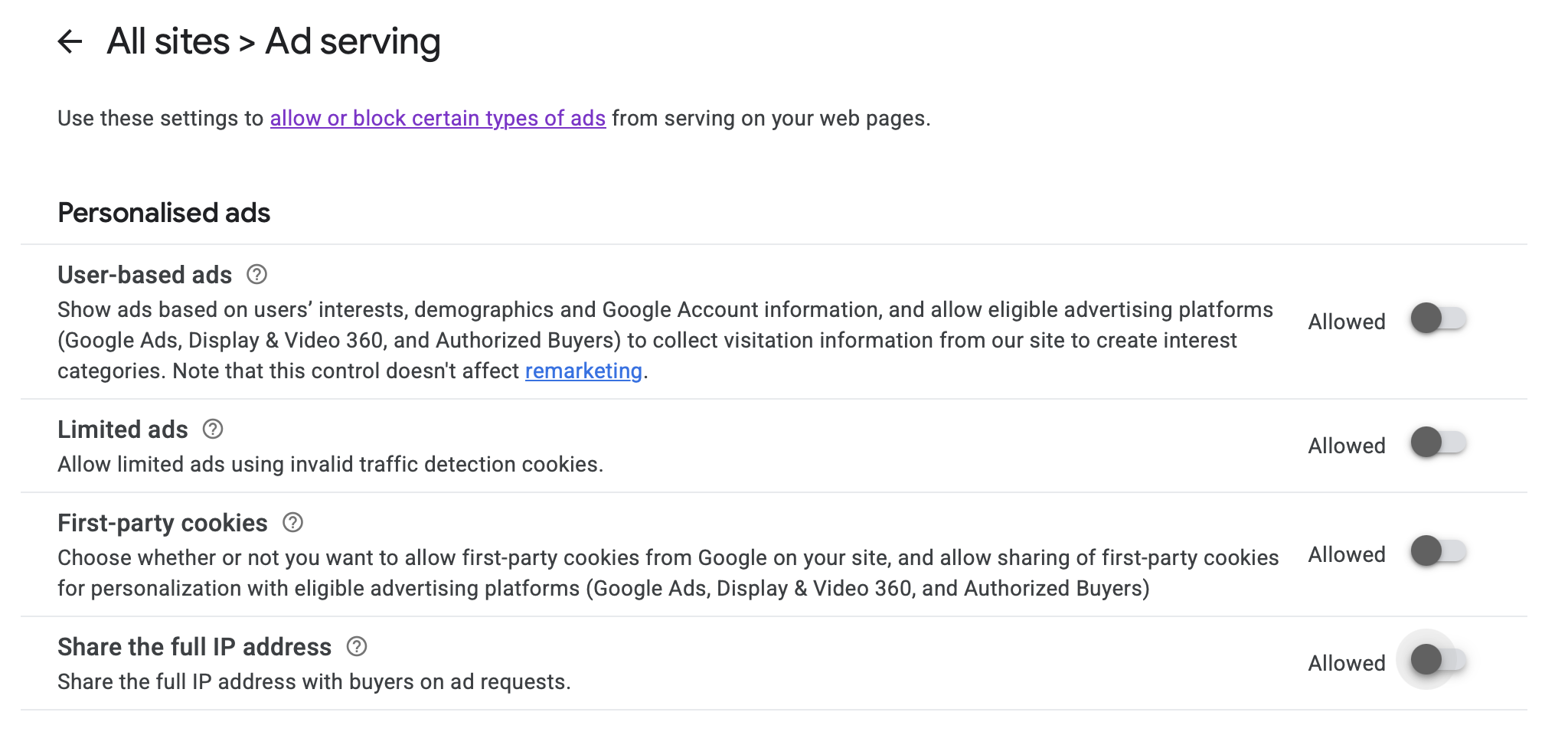
What the feature adds to bid requests
A standard IPv4 address consists of four numeric groups separated by dots - for example, 93.184.216.34. In the default AdSense configuration, bid requests carry only the first three groups: 93.184.216.0. That last octet - the final numeric segment - is withheld. The difference sounds small. In practice, it collapses the precision of IP-derived geolocation from a specific block of addresses to a broader subnet, and it reduces the resolution available to fraud detection systems comparing impressions against known traffic pattern databases.
According to Google, "many buyers consider the full IP address a critical signal for assessing the quality and relevance of an ad impression." The new feature provides that complete signal to all supported demand sources simultaneously when publishers opt in.
Three demand channels are in scope: Authorized Buyers, Display & Video 360, and Google Ads. Authorized Buyers covers the range of demand-side platforms and ad networks with programmatic access to Google Partner Inventory - the ad supply from publishers using AdSense, Ad Manager, and AdMob. Display & Video 360 is Google's own demand-side platform. Google Ads represents the performance advertising campaigns run directly by advertisers. No partial configuration is available: the feature either sends the full IP to all three or withholds it from all three.
The toggle and how to configure it
The setting lives in a specific location within AdSense: Brand safety, then Content, then Blocking controls, then Manage Ad serving. Inside that section, under Personalized ads, publishers see a row labeled "Share full IP address."
The toggle operates counter-intuitively relative to its label. According to Google's documentation, to allow full IP address sharing, a publisher must disable the toggle. To block sharing, the toggle should be enabled. The reason is architectural: the toggle sits within a blocking controls interface, where the on state represents an active restriction and the off state removes it. Enabling the toggle means the block is on; disabling it means the block is lifted and data flows through.
That framing is consistent with other controls in the same section. The Authorized Buyers control introduced in November 2025 follows similar logic, where the presence of a toggle in a blocked state reflects a publisher-managed restriction rather than a permission grant. Publishers encountering the new IP setting for the first time should read the directional text carefully before saving changes.
After adjusting the toggle, publishers must click Save. No ad tag modifications, no page code changes, and no third-party integrations are required. The entire control operates at the account level.
Default state and non-disruption guarantee
According to Google's documentation, "full IP address sharing is off ('Blocked') by default." The document adds directly: "when it's turned off, only the truncated IP address is shared. This feature won't affect your current serving logic unless you change the setting."
That last sentence is a practical guarantee for publishers who take no action. Existing campaign performance, auction participation, and revenue patterns are unaffected by the feature's existence. The toggle is a pure addition: it can be adopted or ignored without consequence to current operations. For a platform that serves an enormous range of publishers - from individual bloggers to large independent media sites - that assurance matters. Platform changes that silently alter serving behavior have historically generated significant publisher concern.
Where full IP sharing is restricted
Not every ad request qualifies for full IP address sharing even when a publisher has enabled the feature. According to Google's documentation, "sharing of the full IP addresses is restricted on non-personalized ads (NPA), limited ads (LTD) requests, and on restricted data processing (RDP) requests."
These three categories define the outer boundaries of what personalized programmatic advertising is permitted to do within Google's ecosystem.
Non-personalized ads serve when users have declined consent for behavioral targeting. Google removed the account-level NPA control from European AdSense settings in May 2025, directing publishers toward code-based implementation as the mechanism for communicating user preferences. Requests flagged as NPA will not carry the full IP even if the publisher's account toggle is set to allow sharing.
Limited ads apply when valid consent is absent under IAB Europe's Transparency and Consent Framework or equivalent signals. This mode governs much of the non-consented traffic in GDPR-regulated markets. Google's TCF v2.3 transition, which became mandatory on March 1, 2026, made limited ads an increasingly common serving mode for publishers who have not completed their consent management platform migrations.
Restricted Data Processing activates for users in US states with applicable privacy laws. Google has expanded that state list multiple times over the past year, adding Indiana, Kentucky, Rhode Island, and others to the set of jurisdictions where it automatically limits data use for users transmitting Global Privacy Control signals.
The practical effect of all three exclusions is that full IP address data will only flow on personalized ad requests - impressions where user consent has been established and no regulatory processing restriction is active. For publishers with significant European traffic or large shares of US users in privacy-law states, a substantial portion of impressions will remain on the truncated IP path regardless of account settings.
Why buyers value the complete IP address
The commercial case for full IP data in bid requests runs across several distinct use cases. Each has become more significant as the programmatic ecosystem has shed other identifying signals.
Geographic targeting is the most immediate application. Campaigns with location-specific parameters - city-level, metropolitan area, or ZIP code targeting - depend on IP-derived geolocation in the absence of user-provided location data. An IPv4 address's last octet corresponds to a specific host within a /24 subnet. Removing it reduces geolocation precision from a narrow address block to a broader range. Buyers with tight geographic requirements may discount bids or decline to bid on impressions where location resolution falls below their targeting threshold.
Invalid traffic detection is the second major application. Verification vendors and buyers' internal fraud systems cross-reference IP addresses against databases of known data center ranges, residential proxy networks, and behavioral patterns associated with non-human activity. A truncated IP reduces that resolution - certain traffic patterns that cluster within a /24 subnet become harder to identify when the host octet is absent. The RTB settlement approved by a federal judge on March 26, 2026 documented in detail the IP address data that already flows through Google's Ad Manager-based real-time bidding infrastructure, including full addresses in bid requests sent to Authorized Buyers. The AdSense feature extends that same data fidelity to the AdSense publisher base.
Frequency management in cookieless environments is a third factor. As third-party cookie coverage has contracted, buyers have relied more heavily on IP addresses as a probabilistic proxy for unique users and device households. A complete IP provides a stronger signal for estimating how many times a unique user has seen a particular creative. Truncated addresses undermine that estimate by collapsing multiple distinct hosts onto a single subnet-level identifier, inflating perceived unique reach and distorting frequency caps.
None of these use cases comes with a guarantee of CPM uplift. Bid price dynamics in programmatic depend on competition, category, format, time of day, and dozens of other signals. The full IP address is one input among many. Whether enabling it produces measurable revenue gains depends entirely on the specific buyer mix, geographic composition, and ad category distribution of a publisher's inventory.
Regulatory backdrop and timing
The feature lands amid extended regulatory and legal scrutiny of IP address data in programmatic systems specifically. European data protection authorities have consistently classified IP addresses as personal data under the GDPR. That classification has consequences for how they may be processed and shared. The Belgian Data Protection Authority's 2022 ruling on IAB Europe's TCF addressed IP data flow in RTB directly, contributing to the pressure that has pushed the industry toward stricter consent frameworks.
The April 2026 Google Analytics consent overhaul addressed a parallel question: how encrypted IP addresses flow between Google Analytics properties and linked Google Ads accounts, with the key change taking effect June 15, 2026. That announcement consolidated IP data handling internally under Consent Mode within Google Ads. The AdSense full IP sharing feature, announced the same week, moves in a different direction - expanding optional external sharing under publisher control. The two developments are distinct in mechanism but connected in timing.
PPC Land's coverage of the January 2025 EPIC and ICCL FTC complaint documented the breadth of identifying information shared through Google's RTB system, including IP addresses broadcast through bid requests to thousands of certified companies globally. The AdSense full IP sharing feature operates within a considerably more contained scope: publisher-elected, limited to three Google-connected demand channels, and automatically excluded for consent-restricted requests. That difference in scale and mechanism matters for publishers evaluating the compliance implications of enabling the feature.
The partner ad opt-out feature that Google introduced in May 2026 was required under the RTB litigation settlement and strips IP addresses - among other identifiers - from bid requests when users activate the RTB Control. The AdSense full IP sharing feature sits on the opposite side of that dynamic: a publisher-facing control that optionally adds IP data to bid requests, rather than a user-facing control that removes it. Both changes affect what appears in bid streams, but through entirely different mechanisms and for entirely different reasons.
Context within AdSense platform development
The Brand safety and ad serving controls area of AdSense has gained a range of new settings over the past 12 months. Full IP address sharing joins a list that includes the Offerwall general availability in April 2026, consent optimization auto-enrollment in April 2026, and the Authorized Buyers system that replaced ad network blocking controls in November 2025. Each of these sits within the same Brand safety navigation area as the new IP toggle. Publishers who monitor their ad serving configuration regularly will find the new setting in familiar territory.
Earlier in 2025, Google Ad Manager expanded user identifier sharing with curation partners - a related but separate change targeting publishers using Google's full-stack ad server rather than AdSense. The curation partner update extended richer data sharing to improve match rates and deal transaction rates. The AdSense full IP feature follows comparable commercial logic: more complete signal in the bid stream may support stronger buyer valuations.
The consistent pattern across these moves is one of optional expansion with conservative defaults. Google surfaces new data-sharing capabilities, sets the default to the most restricted state, and leaves the activation decision to publishers. That structure delegates both the potential revenue benefit and the associated compliance responsibility. Publishers who choose to enable full IP address sharing take on the task of determining whether that action is compatible with their consent management practices, their applicable privacy laws, and their users' reasonable expectations.
Timeline
- March 26, 2021 - Complaint filed initiating In re Google RTB Consumer Privacy Litigation, documenting IP address sharing in Google's real-time bidding infrastructure across millions of bid requests
- May 16, 2025 - Google removes account-level non-personalized ads control from AdSense European settings, moving publishers to code-based NPA implementation
- July 24, 2025 - Google Ad Manager expands user identifier sharing with curation partners, increasing signal richness in bid requests for Ad Manager publishers
- October 6, 2025 - Google announces replacement of ad networks blocking control with Authorized Buyers system in AdSense, taking effect November 6, 2025
- December 14, 2025 - Google extends Restricted Data Processing coverage to additional US states under state privacy laws, expanding the category of requests excluded from full data sharing
- March 26, 2026 - Federal judge approves Google RTB consumer privacy settlement, requiring implementation of RTB Control that strips IP addresses from bid requests for users who opt out
- April 10, 2026 - Google announces auto-enrollment of AdSense publishers in consent optimization
- April 14, 2026 - Google AdSense Offerwall reaches general availability
- April 16, 2026 - Google restructures IP address and consent data handling between Analytics and Ads, with key changes effective June 15, 2026
- May 11, 2026 - PPC Land reports on Google's partner ad opt-out feature, required under the RTB litigation settlement and designed to strip IP addresses and other identifiers from bid requests on user request
- June 1, 2026 - Google announces full IP address sharing feature in AdSense; feature is off by default; setting accessible at Brand safety > Content > Blocking controls > Manage Ad serving; restricted on NPA, LTD, and RDP requests
Summary
Who: Google, through Google AdSense, and the publishers who use the platform to monetize web content through programmatic advertising.
What: Google today introduced a new data-sharing control in AdSense that allows publishers to include the full IP address in programmatic bid requests sent to Authorized Buyers, Display & Video 360, and Google Ads. The feature is blocked by default. Publishers who want to enable it must navigate to Brand safety > Content > Blocking controls > Manage Ad serving and disable the "Share full IP address" toggle within the Personalized ads section. Sharing remains restricted on non-personalized ads, limited ads, and restricted data processing requests regardless of account settings.
When: The feature was announced on June 1, 2026, in the Google AdSense Help Center.
Where: The setting is available within the Google AdSense account interface, under the Brand safety > Data sharing settings section. When enabled, the full IP address is shared with three demand channels: Authorized Buyers, Display & Video 360, and Google Ads.
Why: IP addresses are considered by many programmatic buyers to be a critical signal for assessing impression quality, determining geographic targeting eligibility, detecting invalid traffic, and managing ad frequency in environments without reliable cookie-based identification. Sharing the full address - rather than the truncated version that omits the final octet - gives buyers more precise data to inform bidding decisions. The opt-in structure and automatic exclusions for consent-restricted requests reflect the sensitivity of IP address data as a personal identifier under GDPR and equivalent regulatory frameworks.


Discussion