Amazon MCF comes to Germany: what D2C brands need to know now
Amazon Multi-Channel Fulfillment launches a dedicated German-language website, offering D2C brands EU-wide delivery in 1-3 days with no long-term contracts.


Amazon Multi-Channel Fulfillment launches a dedicated German-language website, offering D2C brands EU-wide delivery in 1-3 days with no long-term contracts.
Amazon this week formalized its push into the German direct-to-consumer fulfillment market, with the launch of a dedicated German-language website for its Multi-Channel Fulfillment (MCF) service at supplychain.amazon.de/de/. The move, announced by Christian Breukhoven, Head of Business Development Continental Europe for Amazon MCF, targets brands already selling on Amazon that also run independent D2C channels outside the marketplace.
The launch matters. Germany is the largest e-commerce market in the German-speaking region and among the top four in Europe. Brands with both Amazon and direct-website sales have historically faced the operational friction of managing separate inventory pools - one for Amazon orders, another for everything else. MCF, according to Amazon's official documentation, eliminates that split by letting sellers store a single inventory in Amazon's fulfillment centers and draw from it to ship orders from any sales channel.
The distinction between Fulfillment by Amazon (FBA) and MCF is worth stating clearly. According to Amazon's documentation, FBA processes orders placed by customers on Amazon's own marketplace. MCF handles orders that arrive through other channels - a brand's own website, social media shops, or any other sales platform. The same physical inventory can serve both purposes. If a seller already uses FBA, existing stock is immediately eligible for MCF orders without requiring a separate inbound shipment.
Critically, MCF does not require sellers to be Amazon marketplace partners at all. According to the FAQ published on the German MCF website, the service is open to any business, regardless of whether it sells on Amazon. Companies without a Seller Central account can register directly for MCF. That opens the service to pure D2C brands that have never listed a product on Amazon but want access to the company's fulfillment infrastructure for their own web orders.
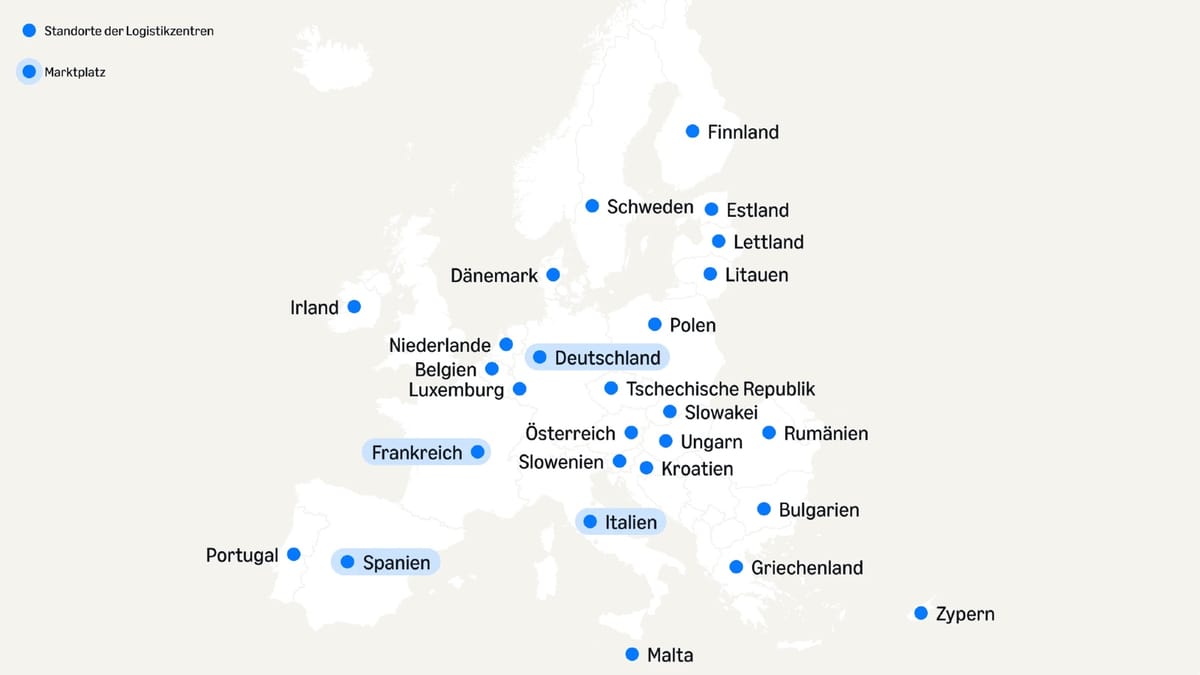
Two Click-to-Delivery (CTD) speed tiers are available. According to Amazon's documentation, the Express option delivers within 1 to 2 business days, while Standard delivers within 2 to 3 business days. The service covers EU-wide delivery, with Amazon's logistics map showing fulfillment center locations across Germany, France, Italy, Spain, the Netherlands, Poland, the Czech Republic, and a range of other European countries including Finland, Sweden, and the Baltic states.
Within Germany specifically, MCF orders ship in unbranded packaging - without Amazon's logo or branding. According to Amazon's documentation, sellers are automatically enrolled in this option at no additional fee, and no manual configuration is required. Not every product qualifies; only eligible and sortable items ship in unbranded packaging. The neutral packaging option matters for D2C brands concerned about customer-facing brand experience, since receiving an Amazon-branded box for an order placed on an independent website can undermine a brand's identity.
Order tracking works through Seller Central. According to Amazon's FAQ, sellers access shipment status under "Manage Orders," where pre-shipment entries show the planned dispatch date and estimated delivery window. Once dispatched, a tracking number and link to the carrier's tracking page appear, with real-time status updates regardless of which transport service handles the final delivery.
MCF charges shipping fees based on product dimensions, weight, product size category, and the delivery speed selected. According to Amazon's published FAQ, the service operates on a pay-as-you-go basis with no long-term contracts - a meaningful distinction for smaller brands testing multi-channel fulfillment before committing to fixed infrastructure costs.
Multi-item orders carry a volume discount of up to 25%, according to Amazon's documentation. That applies to orders with more than one unit in a single shipment. Sellers can download a fee schedule from the MCF website for specific rate breakdowns.
Long-term storage fees apply to units held in Amazon fulfillment centers for longer than 271 days. According to Amazon's FAQ, these fees are charged in addition to standard monthly inventory storage costs. Sellers can avoid long-term storage fees on specific items by submitting a removal order before the next inventory cleanup date.
The reimbursement framework is also defined. From August 23, 2024, the maximum reimbursement for a single eligible unit fulfilled through MCF is capped at €275. According to Amazon's documentation, reimbursements are calculated based on estimated sales proceeds, determined by comparing multiple pricing indicators or benchmarking against comparable products when direct data is unavailable. For lost orders, sellers have 90 days from the committed delivery date to file a claim - and the claim must include an order number, proof of the original external order (such as a Shopify screenshot), and proof of any refund or replacement provided to the customer.
Amazon reimburses the seller, not the end customer. The seller is responsible for resolving the issue on the consumer side.
MCF returns follow a two-path model. According to Amazon's documentation, sellers can direct returned items either to their own warehouse or to an Amazon fulfillment center. For the latter route, the ReturnGO tool integrates with MCF and provides a centralized interface for managing returns, exchanges, and customer refund options across both Amazon and non-Amazon locations.
The returns process through Seller Central requires the seller to navigate to "Manage Orders," select the relevant order, click "Return," specify the item quantity, and provide a return reason. The resulting Return Merchandise Authorisation (RMA) generates two documents: a return label addressed to the specific Amazon fulfillment center that will receive and process the item, and a return authorisation containing a barcode and item description that must be included in the return parcel.
One important operational note: the return label does not include postage. According to Amazon's documentation, the seller or the customer must arrange and pay for postage to send the item back to Amazon. Since MCF orders are placed and paid outside Amazon's marketplace, refunds to the end customer are entirely the seller's responsibility. Amazon does not intervene in the seller-to-customer refund relationship for MCF transactions.
After a returned item arrives at the fulfillment center, Amazon staff inspect its condition. Resalable items are returned to the seller's inventory. Non-resalable items are handled according to the seller's pre-configured settings for unsellable stock - either returned to the seller or disposed of on their behalf.
Amazon's website for the German MCF launch cites global adoption figures. According to the documentation published at supplychain.amazon.de, more than 300,000 selling partners worldwide use Amazon Multi-Channel Fulfillment to pick, pack, and ship orders from their own websites, social media shops, and other channels.
Three case studies appear on the German MCF landing page. According to Amazon's documentation, audio electronics company JLab used MCF to enable faster deliveries and improve DTC conversion rates. Oral care brand MySweetSmile improved delivery speed by 43% while cutting operating costs by 8% through MCF. Luxury goods and home textiles manufacturer Fishers Finery grew its e-commerce revenue outside Amazon by 988% over 10 years with MCF's support.
These figures come from Amazon's own promotional materials and have not been independently verified. The Fishers Finery number, in particular, spans a decade and reflects compounding growth across multiple business factors beyond fulfillment alone.
The German website launch fits a pattern of steady MCF expansion that has accelerated since 2024. By September 2024, Amazon MCF was already serving over 200,000 U.S. merchants, with total fulfilled orders growing 70% year-over-year. That growth reflected Amazon's effort to position the fulfillment network as shared infrastructure for multi-channel retail rather than a service tied exclusively to its own marketplace.
In October 2024, Google Merchant Center announced an integration with Amazon MCF that allowed merchants to display accurate delivery speed estimates from MCF directly in Shopping ads. Google's own data indicated that merchants offering free shipping with delivery in three days or fewer could see between 1.5% and 7.6% more clicks on U.S. Shopping ads, and between 1.9% and 7.2% higher conversion rates.
May 2025 brought another expansion of MCF's commercial reach. Walmart updated its marketplace shipping policies to explicitly permit sellers to use Amazon MCF for Walmart orders, provided shipments used neutral packaging and unbranded delivery vehicles - a structural accommodation that would have been unthinkable in earlier years when Walmart enforced account suspensions for any use of Amazon's fulfillment infrastructure.
On January 15, 2026, Amazon launched its MCF 2026 Preferred Pricing program, offering sellers discounts on outbound fulfillment fees alongside FBA credits per unit shipped. The structure offers up to 15% off outbound fees and $1 in FBA credit per MCF unit dispatched, though a hard ceiling of 50,000 units on the six-month enrollment track limits effective savings for high-volume operations.
The German launch extends this trajectory into a new geographic and linguistic market. According to the German MCF website, the service is currently available in Australia, Canada, France, Italy, Japan, Mexico, Spain, the United Kingdom, the United States, and Germany. The European footprint, in particular, spans fulfillment centers across more than 20 countries visible on the logistics map published at supplychain.amazon.de.
For performance marketers and e-commerce advertisers operating in German-speaking markets, the MCF launch has direct implications for campaign measurement and ad efficiency. Delivery speed is a documented conversion signal. When MCF's fulfillment capabilities integrate with advertising platforms - as already demonstrated by the Google Merchant Center integration and Amazon's Fast Badges appearing on Google Shopping, TikTok ads, and product detail pages by June 2025 - the logistics layer becomes a direct input into paid media performance.
Brands that can display 1-2 day delivery estimates on Google Shopping ads, TikTok product pages, or their own website product listings gain a measurable advantage in conversion rate optimization. The MCF infrastructure makes that possible without requiring brands to build or maintain their own fast-delivery logistics network. That changes the cost-benefit calculation for D2C advertising campaigns targeting German consumers who increasingly expect Prime-equivalent delivery speeds from non-Amazon brands.
The operational consolidation argument is similarly relevant. Managing two separate inventory pools - one for Amazon, one for D2C - introduces discrepancy risk, carrying costs, and forecasting complexity. MCF's single-inventory model reduces those variables. For brands running concurrent Amazon Sponsored Products campaigns and D2C performance campaigns, unified inventory simplifies the relationship between ad-driven demand and fulfillment capacity.
Whether the German MCF launch ultimately delivers meaningful adoption will depend on pricing competitiveness against local third-party logistics providers, the breadth of platform integrations available in the German market, and how effectively Amazon surfaces the service to FBA sellers who already have inventory in European fulfillment centers.
Who: Amazon, through its Multi-Channel Fulfillment (MCF) division, announced by Christian Breukhoven, Head of Business Development Continental Europe. The service targets D2C brands and e-commerce sellers in Germany, whether or not they currently sell on Amazon's marketplace.
What: Amazon launched a dedicated German-language website for its Multi-Channel Fulfillment service at supplychain.amazon.de/de/, enabling brands to use Amazon's European fulfillment network to ship orders placed on their own websites or other external sales channels. The service offers two delivery speeds (Express: 1-2 business days; Standard: 2-3 business days), unbranded packaging within Germany, a pay-as-you-go fee structure, up to 25% multi-item discounts, and long-term storage fees for inventory held beyond 271 days.
When: The German MCF website launched and was announced on March 8, 2026. The broader MCF program has been expanding globally since at least 2024, with the €275 reimbursement cap taking effect in August 2024 and the 2026 Preferred Pricing program launching January 15, 2026.
Where: The service operates within Amazon's European logistics network, with fulfillment centers across more than 20 countries. The German-language website is accessible at supplychain.amazon.de/de/, with the global MCF program operating across 10 countries including the USA, Canada, Japan, Australia, and multiple EU markets.
Why: Amazon is expanding MCF's reach to capture a share of the third-party logistics market for D2C brands that want fast, reliable EU delivery without building their own warehousing infrastructure. The launch reflects Amazon's broader strategy of positioning its fulfillment network as commercial infrastructure beyond its own marketplace - a posture evidenced by integrations with Google Merchant Center, Walmart, and TikTok.