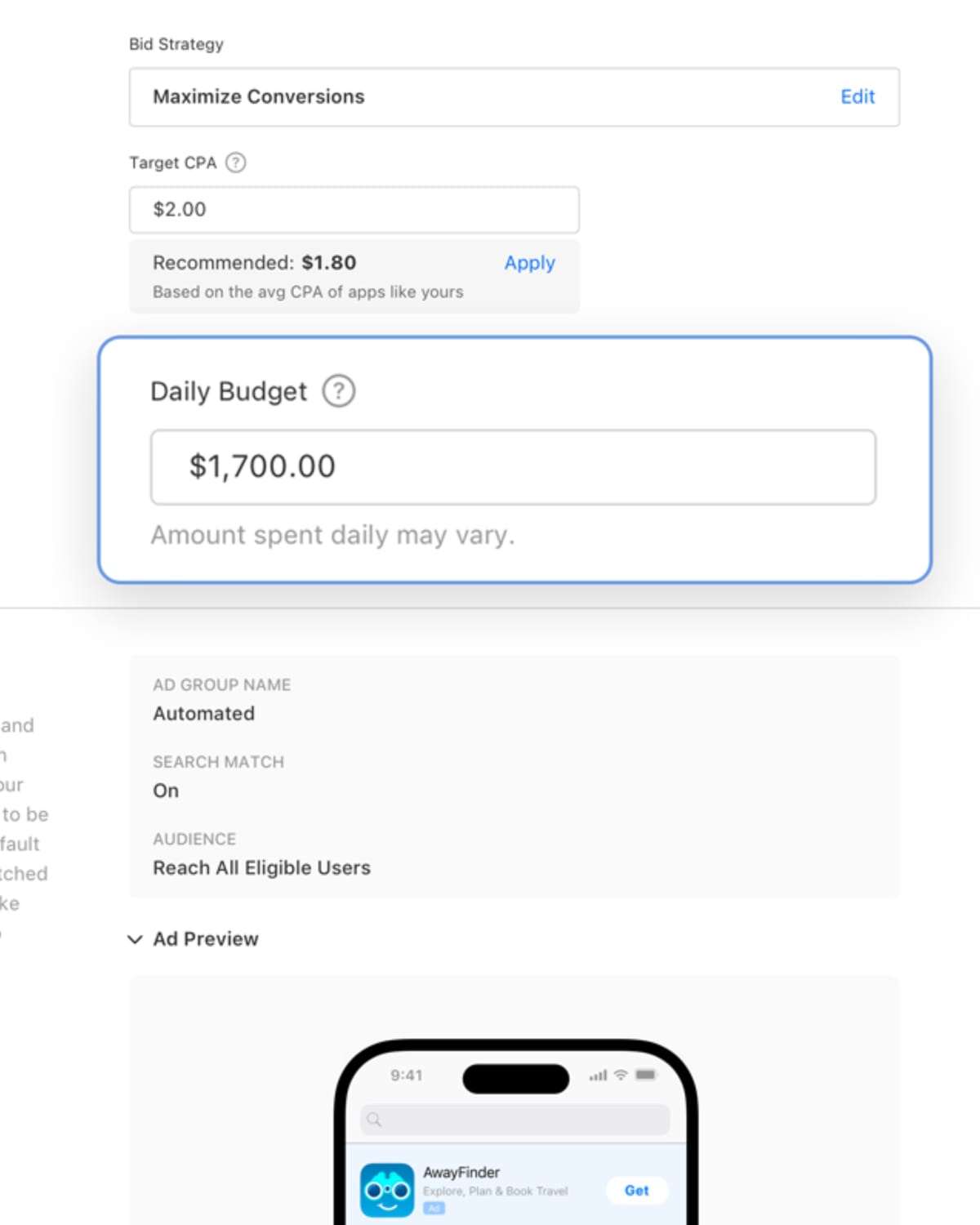
Apple today made Maximize Conversions available to all advertisers across its App Store advertising platform, marking a significant shift in how app developers will manage bids and control acquisition costs on search results campaigns. The automated strategy, documented in updated best practices and help materials published by Apple, replaces the existing CPA cap mechanism - a change that carries material implications for the tens of thousands of developers running paid campaigns across Apple's 175 App Store storefronts.
The rollout comes as Apple's advertising business has expanded sharply. The platform rebranded from Apple Search Ads to Apple Ads in April 2025, signalling broader ambitions beyond the App Store's original search placement. Services revenue, the segment that includes advertising, reached $27.423 billion in the June 2025 quarter - up 12 percent year-over-year - according to Apple's financial statements. Advertising has been a growing contributor to that figure.
How Maximize Conversions works
At the core of the Maximize Conversions system is an automated bidder that sets bids in real time for every relevant search query, without requiring advertisers to manage individual keyword bids manually. According to Apple's documentation, "campaigns use an auto-bidder and Search Match to prioritize the keywords most likely to lead to installs." Search Match is on by default and cannot be turned off in the automatically created ad group - it provides broad coverage across a variety of relevant keywords so that advertisers do not need to build exhaustive keyword lists before going live.
The strategy is available only for search results campaigns. It does not apply to Search tab, Today tab, or product page placements. When a developer creates a Maximize Conversions campaign from the Apple Ads Campaigns dashboard, they select the search results ad placement, choose the Maximize Conversions bid strategy, set a target CPA, and set a daily budget. Two numbers, then, govern the whole system.
Target CPA explained
Target CPA - cost per acquisition - is the average amount an advertiser wants to spend per tap-through install. According to Apple, "our auto-bidder uses this amount to calculate optimal bids for each search query, with the goal of maximizing the number of installs you get at your target CPA." The word "average" matters here. On any given day, the actual CPA may be above or below the target. The system tolerates that variance and tries to meet the target across a week rather than enforcing it on a daily basis. Apple recommends setting a daily budget that allows for at least five conversions per day, to give the algorithm sufficient signal to operate effectively.
When creating a new campaign, Apple will surface a suggested target CPA to help advertisers get started. Adjustments can be made at any time, though Apple's documentation cautions that "it's recommended to let your campaign run for at least two weeks before making changes." That two-week window lets the system learn user behaviour patterns and calibrate bids accordingly. Campaigns set without an end date will continue spending each month based on the configured daily budget unless paused or removed.
Monthly spend is bounded: according to Apple, the total will not exceed the daily budget multiplied by 30.4 - the average number of days in a calendar month. On individual high-opportunity days, the system may exceed the daily budget, but the monthly cap holds.
Why CPA cap is going away
The announcement makes explicit that CPA caps will soon be unavailable. That is not incidental language. According to Apple's documentation, a CPA cap "acts as a ceiling for each search query match and limits the number of impressions you can get. Your keyword bid will never be over your CPA cap - no matter how valuable the search term is - which can lead to missed opportunities." The rigidity of the cap effectively prevents the system from competing on high-value queries where a slightly elevated bid would still deliver an acceptable return overall.
Target CPA addresses this by allowing bids to flex. Higher bids on more valuable queries, lower bids elsewhere - but the daily budget caps total spend regardless. The practical effect is that advertisers who previously relied on CPA cap for cost control will need to recalibrate their approach, shifting their protective floor from a per-query bid ceiling to a daily budget and an average weekly target.
Ad group structure
When a Maximize Conversions campaign is created, Apple's system automatically creates an Automated Ad Group with Search Match enabled and audience settings set to Reach All Eligible Users. That automated group creates an ad using the app's default product page. It is designed for maximum reach with minimal setup. A second, manually configured ad group is optional. In that group, advertisers can adjust audience settings, use a custom ad, and select or pause specific keywords. Negative keywords can also be added there to prevent the ad from appearing for certain search terms.
One constraint is notable: "you can't add or manage keyword bids in Maximize Conversions campaigns." Developers who want granular keyword-level bid control must use a Manage Bids search results campaign instead. That is a deliberate trade-off in the product design - breadth of reach in exchange for reduced bid-level control. For app marketers used to building tightly structured keyword lists with individual max CPT bids, that will require a mental shift.
Switching between strategies in an existing campaign is possible. Going from Manage Bids to Maximize Conversions archives existing ad group and keyword bids, adds a target CPA, removes default max CPT bids, and creates the automated ad group with Search Match required. Reversing that - moving back from Maximize Conversions to Manage Bids - restores previous bids if the campaign had previously used the Manage Bids strategy, removes the target CPA, and places the automated ad group on hold.
Apple cites one advertiser testimonial in its published best practices. According to Danté Moore, Founder of Songwriter's Pad + Lyrics AI: "With Maximize Conversions, I was able to get over 30 percent more installs with the same budget. I am seeing better conversions and positive return on ad spend." That figure - 30 percent more installs with identical spend - is the most concrete performance data Apple has shared publicly. The footnote on the best practices page notes those results were based on ad formats available from April 2025 to May 2025.
Search Match is the engine underneath the discovery layer. According to Apple's documentation, it "will provide broad coverage across a variety of relevant keywords, so that you don't need to spend time adding keywords that might be relevant." For keyword discovery specifically, Apple positions Maximize Conversions as a simpler alternative to running separate discovery campaigns: the system mines search terms automatically through Search Match without requiring advertisers to maintain parallel ad groups.
Search results ads at the top of App Store search deliver more than a 60 percent average conversion rate, according to Apple's data spanning November 2024 through October 2025. That rate represents tap-through install rates across all available Apple Ads countries and regions - a performance benchmark that contextualises why intent-driven App Store search remains a priority for app growth teams.
Attribution and reporting
There are no changes to AdServices attribution for Maximize Conversions campaigns, according to Apple's help documentation. Performance data is accessible through the same reporting interface used for all other Apple Ads campaigns. Developers who switched to AdAttributionKit - which Apple registered with on April 10, 2025 - will continue to evaluate Apple Ads campaigns alongside third-party networks using the same consolidated attribution framework introduced alongside the rebrand.
The Campaign Management API also supports the creation of Maximize Conversions campaigns, which means developers managing campaigns programmatically can automate setup without manual dashboard interaction.
Broader context: platform direction
The elimination of CPA cap and the push toward Maximize Conversions fits a pattern visible across major advertising platforms. Microsoft consolidated its bidding strategies in August 2025, restricting new campaign creation to Maximize Conversions and Maximize Conversion Value strategies and removing standalone Target CPA and Target ROAS options. Google removed Enhanced CPC for search and display by March 2025. The direction across the industry is consistent: fewer manual controls, more algorithmic management, with advertiser-set targets guiding automated systems rather than direct bid inputs constraining them.
For Apple specifically, this shift is occurring alongside a planned expansion of ad positions within App Store search results beginning March 3, 2026 - first in the United Kingdom and Japan, with global rollout completing by end of March. More inventory combined with an automated bidding system that can flex bids per query creates conditions where advertisers who set targets and budgets correctly may access more impressions than they could under the old cap-based model.
The advertising business operates across 175 storefronts and 44 currencies. The combination of that geographic footprint, the platform's high conversion rates, and a simplified campaign structure increasingly built around automated bidding and broad match signals where Apple wants to take its advertising product.
Developers transitioning from Apple Ads Basic to Advanced gain additional benefits under Maximize Conversions: deeper reporting, more intelligent bidding on search terms, and more ad placement options. According to Apple's documentation, the process involves pausing the Basic app promotion and setting up a new Advanced account, then selecting Maximize Conversions when creating the first campaign. The two-week learning period applies here as well - Apple explicitly states the strategy is designed for post-launch campaigns only and is not available for pre-order campaigns.
Timeline
- October 2016: Apple launches Search Ads with a single top-of-search placement in the United States
- May 2021: Apple introduces Search tab campaigns
- December 2023: Today tab ads updated to be larger and more dynamic, featuring custom product page assets
- October 3, 2024: Apple Search Ads expands to 21 new countries, including Turkey, Cyprus, and Morocco
- April 10, 2025: Apple announces Apple Search Ads will register with AdAttributionKit
- April 14, 2025: Apple rebrands advertising business from Apple Search Ads to Apple Ads
- April-May 2025: Advertiser results referenced in Apple's Maximize Conversions best practices documentation are collected
- August 4, 2025: Microsoft consolidates bidding strategies, restricting new campaigns to Maximize Conversions and Maximize Conversion Value
- December 18, 2025: PPC Land reports Apple planning multiple ad placements in App Store search results for 2026
- January 24, 2026: PPC Land publishes detailed breakdown of the App Store search ad expansion arriving March 3, 2026
- February 26, 2026: Apple today makes Maximize Conversions available to all App Store advertisers, with CPA cap set for removal
- March 3, 2026 (planned): Apple begins rolling out multiple ad positions in App Store search results, starting with the UK and Japan
Summary
Who: Apple and app developers advertising on the App Store via Apple Ads Advanced.
What: Apple today rolled out the Maximize Conversions bid strategy to all App Store search results advertisers. The strategy uses an automated bidder and Search Match to optimise bids in real time against a target CPA set by the advertiser. CPA cap, the previous bid ceiling mechanism, is being deprecated. The change removes per-query bid ceilings in favour of a flexible system that aims to hit the target CPA on average across a week, while bounding total spend through a daily budget.
When: February 26, 2026, the date Apple published its updated documentation and best practices confirming the general availability of Maximize Conversions and the upcoming retirement of CPA cap.
Where: Apple Ads, the advertising platform operating across 175 App Store storefronts in 44 currencies. Maximize Conversions is available for search results campaigns only. Campaign management occurs through the Apple Ads Campaigns dashboard or the Campaign Management API.
Why: The change matters because it aligns Apple's advertising platform with a broader industry shift toward automated, goal-based bidding and away from manual bid caps. For app developers, it means greater potential reach - the system can bid more on high-value queries that a CPA cap would have blocked - but it also transfers bid control from the advertiser to Apple's algorithm. Combined with the planned expansion of ad positions in App Store search beginning March 3, 2026, the shift creates a structurally different advertising environment for app marketers who have relied on manual controls to manage acquisition costs.
Share this article
The link has been copied!