China mandates new rules targeting platform pricing and behavioral tracking compliance
China releases comprehensive pricing regulations for internet platforms requiring PIPL compliance for behavioral pricing by April 2026.


China releases comprehensive pricing regulations for internet platforms requiring PIPL compliance for behavioral pricing by April 2026.
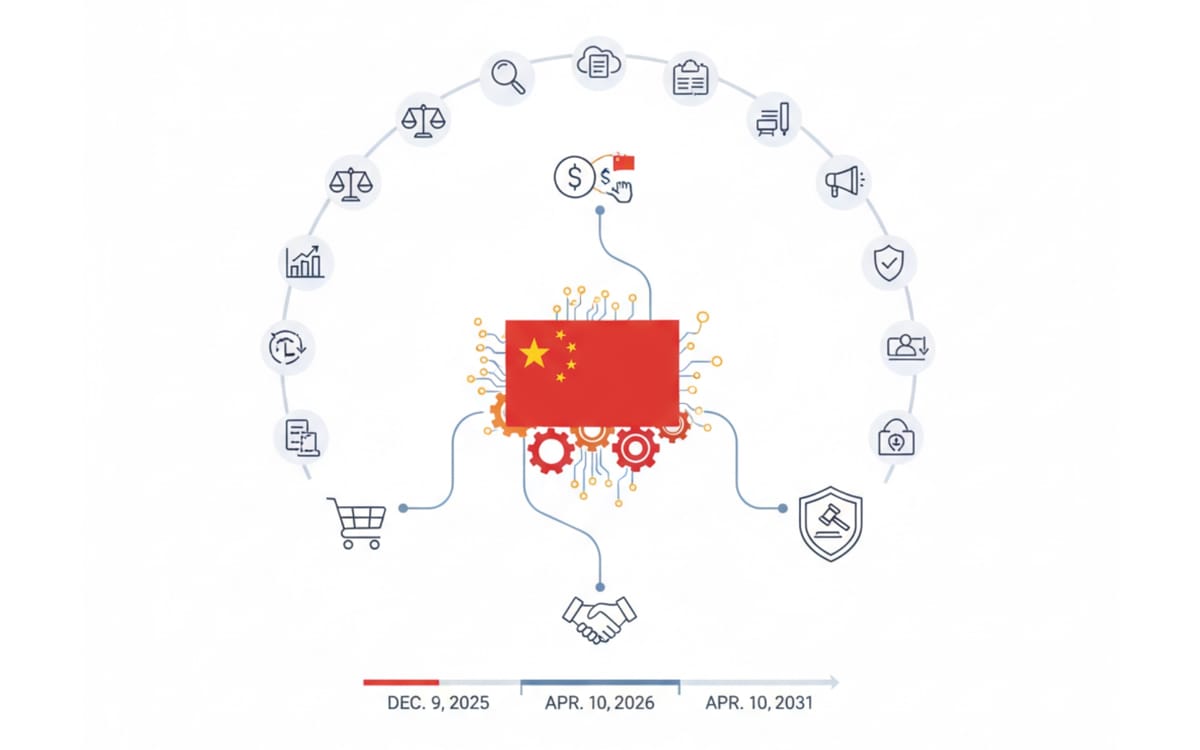
Three Chinese government agencies jointly issued comprehensive pricing regulations for internet platforms on December 9, 2025. The National Development and Reform Commission, State Administration for Market Regulation, and Cyberspace Administration of China published the "Rules for Price Behavior on Internet Platforms" (Development and Reform Price Regulation [2025] No. 1607), establishing a normalized supervision framework that will take effect April 10, 2026.
The regulations address price-setting authority, fee structures, consumer protections, and algorithmic discrimination across platform economies within China. According to the notice, the rules apply to "the price behavior of platform operators and platform operators in business activities such as selling goods or providing services through Internet platforms and other information networks within the territory of the People's Republic of China." The framework establishes a five-year validity period through April 10, 2031.
The announcement arrives as global regulators intensify scrutiny of platform pricing practices. China launches data protection officer registration system mandated DPO reporting for organizations handling over 1 million individuals' personal data effective July 2025, creating complementary enforcement infrastructure. China implements mandatory AI content labeling standards effective September required comprehensive labeling across all AI-generated media formats starting September 1, 2025, demonstrating sustained regulatory momentum.
Subscribe PPC Land newsletter ✉️ for similar stories like this one
Article 15 specifically prohibits price discrimination based on personal information analysis. According to the regulations, "Platform operators and intra-platform operators must not violate Article 9 of the Regulations for the Implementation of the Law of the People's Republic of China on the Protection of Consumer Rights and Interests by using data, algorithms, platform rules, and other means to set different prices or charging standards for the same goods or services under the same transaction conditions without consumers' knowledge, based on information such as willingness to pay, ability to pay, consumption preferences, and consumption habits."
This provision directly references China's Personal Information Protection Law, which took effect November 1, 2021. The PIPL establishes comprehensive requirements for personal data processing, consent mechanisms, and cross-border data transfers. TikTok wins delay on order blocking China data access during appeal highlighted ongoing tensions between European privacy regulators and Chinese platforms over data protection adequacy, with Ireland's High Court allowing TikTok to maintain Chinese employee access while appealing a €530 million penalty.
The regulations prohibit platform operators from engaging in price discrimination against operators on the platform. This dual protection framework addresses both consumer-facing behavioral pricing and business-to-business discrimination between platforms and their merchants.
The framework constrains platform operators' ability to control merchant pricing decisions. According to Article 5, platform operators shall not take measures including "raising charging standards, increasing charging items, deducting deposits, reducing subsidies or discounts, restricting traffic, decreasing search order, degrading algorithms, blocking stores, and removing goods or services" to impose unreasonable restrictions on merchant pricing behavior.
Specifically prohibited actions include forcing or disguising force to make operators reduce prices, requiring platform prices match or fall below other sales channels, and compelling automatic price follow-up or reduction systems. The regulations create an exception for platforms implementing unified pricing based on their business model.
Platform operators must follow fairness principles when charging merchants. According to Article 6, platforms must "reasonably formulate charging standards and publicize them" while considering merchant operating conditions and must not charge unreasonable fees. Any additions or changes to charging items require prominent homepage disclosure with minimum seven-day public comment periods. According to the document, "Where it has a significant impact on operators on the platform, reasonable transitional measures shall be formulated."
Fee transparency requirements mandate that platforms "fully consider the operating conditions of operators on the platform based on operating costs, service agreements, transaction rules, etc." when setting charges. If merchants reject modifications and request withdrawal, platforms cannot prevent exits. Both parties bear responsibilities according to pre-modification agreements.
Buy ads on PPC Land. PPC Land has standard and native ad formats via major DSPs and ad platforms like Google Ads. Via an auction CPM, you can reach industry professionals.
Article 7 establishes comprehensive price indication requirements. Platform operators and merchants must "clearly mark the prices of goods or services they provide" through network pages and electronic documents. Goods require product name, price, and unit markings. Services require service items, content, price, or pricing method disclosure.
Transportation costs, delivery methods, timing, payment methods, and other unavoidable charges must appear prominently. According to the regulations, platforms and merchants "shall not violate Article 13 of the Price Law of the People's Republic of China by increasing prices or charging any unspecified fees in addition to the listed price."
Dynamic pricing requires specific disclosure. According to Article 8, platforms implementing "different prices for consumers with different transaction conditions" must disclose rules prominently on service pages with timely updates. Time-sharing pricing and other dynamic models require prominent rule disclosure "clearly explaining the factors affecting the price." Fixed prices with dynamic additional service fees require distinction between marked price and additional fees.
Estimated price displays must reveal composition and alert consumers to possible differences from final settlement prices. According to Article 12, if displayed estimated prices have payment method restrictions or other limitations, platforms must clearly remind consumers in conspicuous manner advance.
Bidding rankings require "advertising" labels. According to Article 13, platforms displaying search results must mark ranked results clearly when using bidding mechanisms. Platforms must inform participating merchants of ranking rules, recommendation algorithms, and bidding ranking mechanics.
The regulations establish detailed promotion disclosure requirements. According to Article 10, platforms must indicate promotion prices in consumer-friendly manner including publicizing rules, activity periods, and application scope prominently. Discount benchmarks must be truthful. Points, gift certificates, vouchers, and advance payment mechanisms require conspicuous calculation method indicators.

Article 14 prohibits selling goods or services below cost "for the purpose of crowding out competitors or monopolizing the market, disrupting the normal order of production and operation, and harming national interests or the lawful rights and interests of other operators." The regulations create exceptions for fresh goods, seasonal items, backlog merchandise, and temporary goods sold at reduced prices or services provided at reduced prices for justifiable reasons.
Platform operators cannot force merchants to adopt below-cost pricing through platform rules. The regulations establish an important carve-out. According to the document, "If the business model of a platform operator is free for users for a long time, and is conducive to promoting innovation and progress and improving the long-term welfare of operators and consumers, it may not be found to violate the provisions of Article 14, Paragraph 2 of the Price Law of the People's Republic of China."
This provision addresses business models relying on subsidized pricing to build network effects and market share. The language acknowledges legitimate innovation-driven pricing strategies while maintaining restrictions on predatory pricing intended to eliminate competition.
The framework prohibits using "platform rules, data, algorithms, and other means to collude with each other, manipulate market prices, and harm the lawful rights and interests of other operators and consumers," according to Article 16.
Article 17 establishes specific prohibitions on fabricating or disseminating price increase information. Banned activities include fabricating tight supply information, spreading false price increase plans from other operators, disseminating deceptive price expectation terms, hoarding goods without justifiable reasons when supply tightens, and compulsory bundling that disguises price increases.
During emergencies, platforms and merchants cannot significantly increase prices on emergency supplies and important livelihood commodities without corresponding cost increases. According to the regulations, they cannot "unreasonably and substantially increasing transportation costs or charging other unreasonable fees" even when not raising commodity prices directly.
Article 18 prohibits multiple deceptive practices including falsely claiming government-priced or guided pricing, tricking consumers with low advertised prices but high settlement prices, selling through false discounts or price comparisons, and using deceptive language or media when indicating prices.
Platforms cannot refuse to perform price commitments without justifiable reasons. They cannot fail to mark or significantly weaken unfavorable price conditions, fabricate transaction records, or delete actual transaction prices to deceive consumers.
Voucher and discount obligations require enforcement. According to Article 18, platforms and merchants cannot refuse "to discount the price as agreed when using points, gift certificates, exchange vouchers, vouchers, etc." without justification.
Article 19 addresses platform-level deceptive practices. Platforms cannot display lower prices on homepages than detail pages. Promotional activity scope and rules must match announced parameters. Platforms cannot use technical means forcing merchants into false price markings.
Automatic renewal and password-free payment services require conspicuous option displays with convenient cancellation methods. According to Article 20, platforms adopting automatic renewal must remind consumers before each deduction about timing, amount, and cancellation channels. Charging standard changes require simultaneous consumer notification.
Platforms cannot disguise price changes through adjusting quality specifications. According to Article 21, platforms and merchants "must not violate the provisions of Article 14, item 6 of the Price Law of the People's Republic of China, by using means such as raising or lowering the level or falsely increasing the quantity or duration, or raising or lowering prices in disguise."
Article 22 encourages platforms establishing online price dispute resolution mechanisms with public rules resolving disputes fairly. The regulations encourage commodity quality commitment systems urging merchant obligation fulfillment and effective consumer dispute resolution.
Article 24 requires platforms strengthen price self-discipline and establish compliance management systems. Requirements include improving internal compliance frameworks, enhancing platform management rules guiding merchant compliance, establishing and publicizing price complaint channels, properly preserving price and transaction information, and establishing commodity quality control systems.
Platforms must establish price supervisor systems conducting internal behavioral monitoring. They must strengthen network data security management and handle personal information according to law in price behavior contexts. Algorithm filing procedures must occur according to law with cooperation in security assessments and supervision.
Article 23 assigns supervision authority to development and reform, market supervision, and internet information departments according to their respective duties. These agencies may remind, admonish, and interview platform operators and merchants. Provincial-level departments and above may investigate platform operations. Platforms and merchants "shall truthfully provide the required information in accordance with the requirements" of supervising departments.
Market supervision departments conduct business behavior inspections and investigate violations according to law. The framework emphasizes industry self-discipline. According to Article 25, industry associations and chambers of commerce should guide platforms and merchants toward regulatory compliance. The regulations encourage establishing communication mechanisms protecting merchant rights, particularly for small, medium, and micro enterprises.
Administrative punishment law provisions apply. According to Article 26, "Where the illegal acts of platform operators or operators within the platform are minor and corrected in a timely manner without causing harmful consequences, no administrative punishment shall be imposed."
Article 27 extends rules to "self-built website operators and other operators participating in the platform economy." The regulations apply broadly across China's digital commerce infrastructure beyond traditional marketplace platforms.
Implementation begins April 10, 2026. According to the notice, the rules establish a five-year validity period concluding April 10, 2031. This timeline provides platforms and merchants approximately four months to establish compliance frameworks, modify existing practices, and implement technical systems supporting regulatory requirements.
The regulations require coordination across multiple technical and operational domains. Platforms must implement transparent pricing display systems, algorithmic auditing mechanisms ensuring non-discriminatory pricing, consent management systems for personal information use in pricing contexts, and merchant communication systems for fee changes and complaint resolution.
Platform advertising businesses face significant adjustments. Behavioral targeting mechanisms using purchase history, browsing patterns, and demographic characteristics for dynamic pricing require consumer knowledge and consent under PIPL frameworks. This affects not only e-commerce transactions but advertising auction mechanics where user data informs bid adjustments and inventory pricing.
China unveils global AI governance action plan framework released July 26, 2025 emphasized categorized and tiered management approaches reflecting varied risk profiles across AI applications. The pricing regulations align with this risk-based framework, establishing specific requirements where algorithmic systems affect economic outcomes for consumers and businesses.
Search advertising and bidding ranking transparency requirements affect how platforms monetize inventory. The mandatory "advertising" labeling for bidding-ranked results mirrors requirements in other jurisdictions but establishes explicit obligations within pricing regulation rather than advertising-specific frameworks.
The estimated price disclosure requirements carry implications for programmatic advertising and dynamic pricing systems. Real-time bidding mechanics producing variable inventory costs require transparent composition disclosure and consumer alerts about possible price variations. This affects not just final transaction prices but the visibility of advertising-driven pricing mechanics to end users.
Cross-border advertising platforms face complexity when operations span Chinese and international markets. Kentucky files lawsuit against Temu over data collection practices highlighted geopolitical tensions around Chinese platforms' data access and transfer practices. Companies operating in China must implement PIPL-compliant behavioral pricing while potentially facing conflicting requirements in jurisdictions like the United States and European Union.
EU eliminates customs exemption for low-value imports from China effective November 13, 2025 targeted direct-to-consumer Chinese e-commerce platforms. These platforms relied heavily on algorithmic pricing optimization and subsidized promotional strategies. The pricing regulations' restrictions on below-cost selling and promotional subsidy disclosure requirements affect business models dependent on aggressive pricing to capture market share.
Fee transparency requirements between platforms and merchants parallel ongoing debates in programmatic advertising about supply chain costs and intermediary margins. Index Exchange introduces dynamic pricing model prioritizing publisher revenue demonstrated industry movement toward transparent per-impression pricing adjustments. China's regulations establish legal obligations for similar transparency in merchant-platform relationships.
The emergency pricing provisions address scenarios where platforms might exploit supply chain disruptions or crisis situations through algorithmic price increases. This carries implications for real-time bidding systems that adjust inventory pricing based on demand signals and competitive dynamics. Platforms must demonstrate that price increases during tight supply conditions reflect legitimate cost changes rather than opportunistic exploitation.
Consent mechanisms for personal information use in pricing require substantial technical infrastructure. Platforms must capture, store, and respect consumer preferences about data usage for behavioral pricing while maintaining seamless transaction experiences. This parallels challenges facing advertising platforms implementing Global Privacy Control and other consent signals.
Google quietly adds three states to privacy compliance toolkit demonstrated ongoing expansion of automated privacy controls in response to state-level legislation. Chinese platforms face similar implementation demands but within a unified national framework rather than fragmented state-by-state requirements.
Algorithm auditing and bias detection systems become necessary compliance tools. Platforms must verify that pricing algorithms do not engage in prohibited discrimination based on protected characteristics or consumer data profiles. This requires technical capabilities for algorithmic transparency, regular testing protocols, and documentation supporting non-discriminatory operation claims.
Data retention and audit trail requirements support regulatory investigations and merchant disputes. Platforms must "properly preserve relevant price and transaction information" according to Article 24. This establishes obligations for comprehensive logging of pricing decisions, algorithm parameters, merchant fee calculations, and consumer transaction records extending beyond typical business operational needs.
The seven-day comment period requirement for fee structure changes necessitates merchant notification systems and feedback collection mechanisms. Platforms must implement prominent homepage disclosure systems and tracking mechanisms ensuring compliance with consultation obligations before implementing material changes affecting merchant economics.
The pricing regulations represent one component within China's comprehensive platform economy governance framework. Data protection, content moderation, competition policy, and financial regulation operate simultaneously affecting platform operations.
Programmatic digital out-of-home adoption reaches 30% in China showed steady market growth with 30% adoption rates by 2025. Platform pricing regulations affect not just traditional e-commerce but expanding programmatic advertising infrastructure across multiple channels including digital out-of-home, connected television, and mobile applications.
The five-year validity period through 2031 establishes a defined regulatory horizon. Platform operators and merchants can plan compliance investments knowing the framework's temporal boundaries. However, rapid technological evolution and platform business model innovation may prompt regulatory updates before the expiration date.
Enforcement mechanisms remain partially undefined. While supervision authority assignments are clear, specific penalty structures and enforcement priorities await implementation experience. Initial enforcement patterns will likely focus on major platforms and high-visibility cases establishing interpretation precedents for ambiguous provisions.
International platform operators face decisions about China-specific implementations versus global standard adoption. Where Chinese requirements exceed international baselines, platforms may implement separate systems for Chinese operations. Where Chinese requirements align with emerging global standards around algorithmic transparency and behavioral pricing restrictions, platforms might adopt unified approaches reducing compliance complexity.
The regulations acknowledge legitimate innovation in platform business models through carve-outs for long-term free services promoting consumer welfare. This suggests regulatory recognition that not all subsidized pricing or below-cost offerings constitute predatory anticompetitive conduct. Platforms can argue that pricing strategies serve innovation and long-term consumer benefit rather than short-term competitor elimination.
Subscribe PPC Land newsletter ✉️ for similar stories like this one
Subscribe PPC Land newsletter ✉️ for similar stories like this one
Who: The National Development and Reform Commission, State Administration for Market Regulation, and Cyberspace Administration of China issued the regulations affecting platform operators and merchants conducting business through internet platforms in China. The rules also impact consumers using these platforms and regulatory bodies responsible for enforcement including development and reform departments, market supervision agencies, and internet information offices.
What: Comprehensive pricing regulations establishing restrictions on behavioral pricing discrimination, platform fee structures, algorithmic pricing mechanisms, promotion disclosure requirements, below-cost selling limitations, and consumer protection mechanisms. The rules mandate compliance with China's Personal Information Protection Law when using personal data for pricing purposes, require transparent fee disclosures between platforms and merchants, prohibit price manipulation and deceptive practices, and establish supervision frameworks including platform self-discipline obligations and regulatory investigation authority.
When: The regulations were published December 9, 2025 as Development and Reform Price Regulation [2025] No. 1607, take effect April 10, 2026, and remain valid through April 10, 2031 establishing a five-year regulatory framework.
Where: The regulations apply to "business activities such as selling goods or providing services through Internet platforms and other information networks within the territory of the People's Republic of China" according to Article 2, covering both domestic Chinese platforms and international platforms operating in Chinese markets.
Why: The regulations aim to "improve the normalized price supervision mechanism of Internet platforms, standardize relevant price behavior, protect the legitimate rights and interests of consumers and operators, and promote the innovation and healthy development of the platform economy" according to Article 1. The framework addresses concerns about algorithmic price discrimination, platform market power over merchants, consumer protection gaps in digital transactions, and coordination challenges across multiple regulatory agencies overseeing platform economy aspects.