Criteo sets Luxembourg vote as ad platform seeks capital flexibility
Criteo schedules February 27, 2026 shareholder meeting for Luxembourg redomiciliation vote, streamlining corporate structure with direct Nasdaq listing.


Criteo schedules February 27, 2026 shareholder meeting for Luxembourg redomiciliation vote, streamlining corporate structure with direct Nasdaq listing.
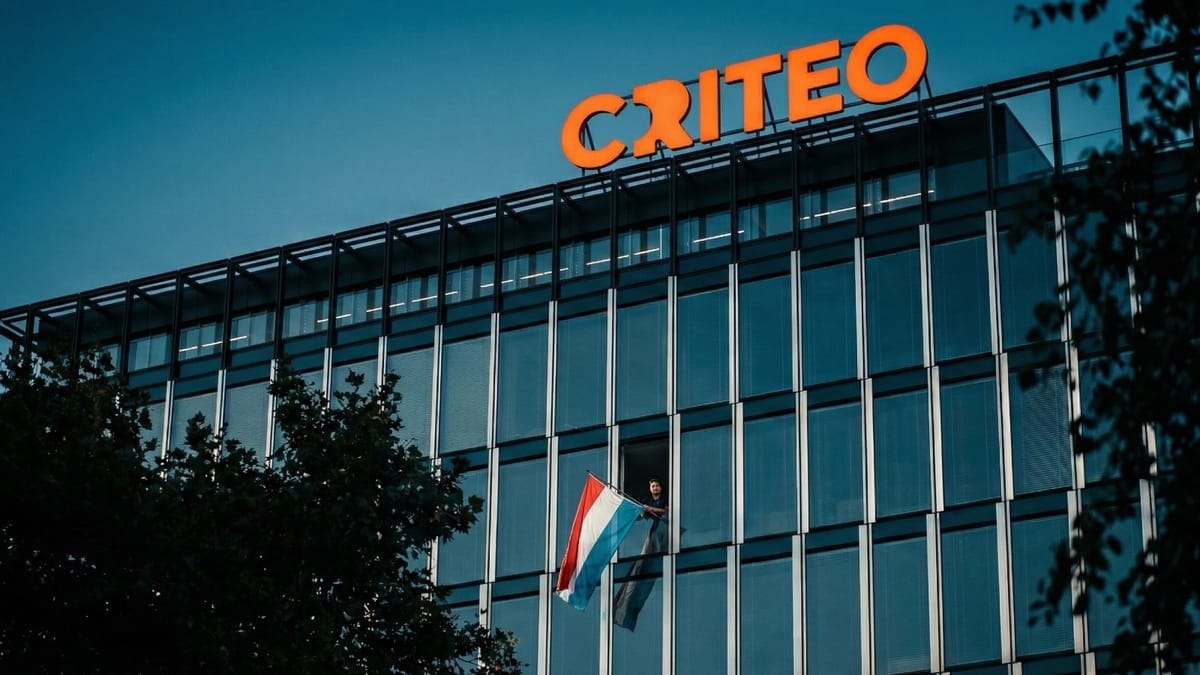
Criteo announced on January 7, 2026, that its board of directors has approved a cross-border conversion to transfer the company's legal domicile from France to Luxembourg, scheduling a shareholder meeting for February 27, 2026, to obtain approval for the corporate restructuring. The advertising technology platform simultaneously plans to replace its American Depositary Shares structure with ordinary shares directly listed on Nasdaq.
The board's approval followed a favorable opinion from Criteo's works council, a requirement under French labor law for corporate restructuring decisions affecting employee interests. According to the announcement, the general meeting will be held at 10:00 a.m. Paris time at the company's registered office at 32 Rue Blanche, 75009 Paris, France.
Frederik van der Kooi, Chairman of Criteo's Board of Directors, stated that the board "agreed that this move positions us to unlock significant shareholder value by streamlining our corporate structure, enhancing our capital management flexibility and aligning our capital markets presence with our long-term strategic ambitions."
The redomiciliation represents a strategic shift for Criteo, which has maintained its French legal domicile since its founding despite operating as a global commerce advertising platform with significant U.S. market presence. The company trades on Nasdaq under the ticker symbol CRTO and generated more than $1 trillion in annual commerce sales data through its advertising technology platform, according to the company's statements.
Criteo has established separate record dates for different classes of shareholders. The company fixed the close of business on February 25, 2026, as the ordinary record date for shareholders entitled to vote at the meeting. Ordinary shareholders of record at that time will be entitled to participate in the voting process.
For holders of American Depositary Shares, the depositary set the close of business on January 20, 2026, as the ADS record date. ADS holders of record at that time will be entitled to instruct the depositary how to vote their underlying shares. Shareholders holding ADSs through brokers, banks, or other nominees should follow the instructions their financial intermediaries provide for voting.
The dual record date structure reflects the complexity of Criteo's current corporate framework, which includes both direct shareholders and ADS holders. The proposed conversion would eliminate this dual structure by replacing ADSs with ordinary shares directly listed on Nasdaq, simplifying the capital structure and potentially improving liquidity.
The Luxembourg redomiciliation functions as an intermediate step in Criteo's broader corporate strategy. According to the announcement, following completion of the Luxembourg conversion, Criteo intends to pursue a subsequent corporate redomiciliation from Luxembourg to the United States. This additional redomiciliation would occur "if the Board of Directors determines such action is in the best interests of the Company and its shareholders, subject to the prior Company's works council consultation process."
The staged approach suggests Criteo seeks to manage regulatory complexity and stakeholder concerns while pursuing its ultimate objective of U.S. domicile. Luxembourg has established itself as a preferred European jurisdiction for corporate redomiciliation due to its flexible corporate law framework, favorable tax treatment, and established procedures for cross-border conversions under European Union directives.
The expected timing for completion of the Luxembourg conversion remains the third quarter of 2026, subject to shareholder approval and other customary conditions. This timeline indicates approximately eight months from the shareholder vote to conversion completion, reflecting the administrative and regulatory processes required for cross-border legal entity changes.
French corporate law provides shareholders who oppose the conversion with dissenting shareholders' exit rights, allowing them to withdraw their investment at a determined price. According to Criteo's announcement, detailed information about the redomiciliation, general meeting, dissenting shareholders' exit right, and associated filings is available on the company's investor website at http://criteo.investorroom.com.
The announcement notes that the transaction could fail if "the option to withdraw shares for cash in connection with the transaction is exercised above a certain threshold." This condition protects the company from scenarios where excessive shareholder exits would materially impair its capital structure or financial position.
Criteo filed a Registration Statement on Form S-4 with the U.S. Securities and Exchange Commission that includes a preliminary proxy statement for the special shareholder meeting. The definitive proxy statement/prospectus will be mailed to shareholders as of the record date established for voting on the transaction. The SEC filing requirement reflects Criteo's Nasdaq listing and the securities law implications of the corporate restructuring.
Buy ads on PPC Land. PPC Land has standard and native ad formats via major DSPs and ad platforms like Google Ads. Via an auction CPM, you can reach industry professionals.
Van der Kooi emphasized in his statement that "Criteo remains deeply committed to its teams in France and its role in the French technology and AI innovation ecosystem." This commitment addresses potential concerns about the company's continued presence in France following the legal domicile transfer.
The advertising technology platform has maintained significant French operations since its founding, with engineering teams and corporate functions based in the country. The redomiciliation affects legal domicile and corporate governance structure but does not necessarily require changes to operational footprint or employment levels.
Criteo's business model centers on connecting brands, agencies, retailers, and media owners through its AI-powered advertising platform. The company positions itself as "the global platform connecting the commerce ecosystem," leveraging unique access to commerce sales data to power personalized advertising experiences. The platform has evolved from retargeting origins to encompass retail media and broader commerce advertising capabilities.
The retail media segment has become increasingly important to Criteo's business strategy, reflected in partnerships with major retailers including Costco, Shipt, and Albertsons for advertising technology services. The company announced a multi-year partnership with DoorDash in October 2025, serving as an extension of the delivery platform's U.S. advertising sales team.

The elimination of the ADS structure represents a meaningful simplification of Criteo's capital markets presence. American Depositary Shares function as negotiable certificates issued by U.S. depositary banks representing shares in foreign companies, allowing easier trading in U.S. markets. However, the ADS structure adds administrative complexity, costs, and potential liquidity fragmentation between ADS holders and direct shareholders.
Direct listing of ordinary shares on Nasdaq would eliminate the depositary intermediary, potentially improving trading efficiency and reducing administrative costs. The structure would align Criteo more closely with U.S.-domiciled technology companies trading on the exchange, potentially improving comparability for investors and analysts.
The Luxembourg domicile offers several advantages for multinational corporations with significant European operations. The jurisdiction provides established legal frameworks for European cross-border transactions, access to European Union directives facilitating corporate mobility, and favorable tax treatment for international operations. Luxembourg has positioned itself as a preferred location for European headquarters of multinational technology and financial services companies.
Van der Kooi's reference to "enhancing our capital management flexibility" suggests the redomiciliation may facilitate more aggressive capital allocation strategies. Different jurisdictions impose varying constraints on dividend distributions, share repurchases, and other capital management activities. Luxembourg's corporate law framework generally provides greater flexibility for these activities compared to French corporate law.
The announcement acknowledges multiple conditions that could prevent or delay the conversion. According to the forward-looking statements section, risks include "failure to obtain the required shareholder vote to adopt the proposals needed to complete the transaction" and "failure to satisfy any of the other conditions to the transaction."
The works council consultation requirement reflects French labor law's emphasis on employee participation in corporate decision-making. The favorable opinion obtained from the works council represents a significant milestone, as negative opinions can complicate or prevent corporate restructuring in France. However, the announcement notes that a subsequent works council consultation would be required for any future U.S. redomiciliation.
Additional risks identified in the announcement include potential legal proceedings or regulatory actions instituted in connection with the transaction, failure to maintain Nasdaq listing following the transaction, and the board's ability to defer or abandon the transaction up to three days prior to the shareholder meeting.
The company's forward-looking statements also acknowledge broader risks affecting its business, including "adverse changes in the marketing industry," "changes in applicable laws or accounting practices," and "uncertainty regarding legislative, regulatory or self-regulatory developments regarding data privacy matters." These factors could influence the board's assessment of whether to proceed with the redomiciliation.
Criteo operates in an increasingly complex regulatory environment for data-driven advertising. The company's business model relies on access to commerce data and advertising inventory across multiple jurisdictions with varying privacy requirements. European privacy regulation, particularly the General Data Protection Regulation, imposes stringent requirements on data collection, processing, and sharing for advertising purposes.
The Luxembourg domicile maintains Criteo within the European Union's regulatory framework while potentially providing operational advantages. However, the company's stated intention to pursue subsequent U.S. redomiciliation suggests management views U.S. domicile as ultimately more advantageous for its business model and growth objectives.
The staged redomiciliation approach may reflect management's desire to maintain flexibility while navigating regulatory uncertainty. By establishing Luxembourg domicile first, Criteo preserves European options while preparing for potential U.S. redomiciliation. The board retains discretion over the timing and execution of the second redomiciliation stage based on its assessment of business conditions and shareholder interests.
Criteo's recent financial results have shown mixed performance across its business segments. The company reported revenue of $451 million for the first quarter of 2025, representing modest year-over-year growth of 0.3%. Net revenue excluding traffic acquisition costs grew 4% to $264 million. Profitability metrics showed stronger performance, with net income surging 367% to $40 million and adjusted EBITDA rising 30% to $92 million.
The company's retail media segment has been growing faster than its performance media business but faced challenges when its largest retail media client announced significant service changes in May 2025. The client notified Criteo that it would continue using the company's technology platform under a multi-year committed contract but would discontinue managed services and curtail brand demand sales services in November 2025.
These business dynamics provide context for management's focus on capital structure optimization and operational flexibility. The redomiciliation may position Criteo to respond more effectively to competitive pressures and market changes affecting the commerce advertising industry.
The advertising technology sector has experienced significant consolidation and strategic repositioning in recent years. Companies face pressure from privacy regulation, platform changes affecting data access, and competition from integrated retail media networks. Criteo's integration with Google Search Ads 360 as the first onsite retail media partner, announced in September 2025, exemplifies strategic partnerships aimed at maintaining competitive position.
The Luxembourg redomiciliation and potential U.S. domicile may facilitate additional strategic transactions, whether acquisitions, partnerships, or capital markets activities. The simplified corporate structure and enhanced capital management flexibility could support more aggressive strategic positioning in a consolidating industry.
Market analysts and investors will scrutinize shareholder response to the February 27 meeting, particularly the level of dissenting shareholder participation. Strong shareholder support would validate management's strategic direction and facilitate the conversion timeline. Significant opposition or high levels of share withdrawals could complicate or delay the transaction.
The advertising technology industry continues adapting to structural changes affecting data access, measurement capabilities, and competitive dynamics. Criteo's corporate restructuring represents one company's strategic response to these pressures, aiming to position itself for sustained competition in the evolving commerce advertising ecosystem.
Subscribe PPC Land newsletter ✉️ for similar stories like this one
Subscribe PPC Land newsletter ✉️ for similar stories like this one
Who: Criteo S.A. (NASDAQ: CRTO), a global commerce advertising platform, along with its Board of Directors led by Chairman Frederik van der Kooi, announced the corporate restructuring. The company's works council provided a favorable opinion on the proposal, and shareholders will vote on the conversion.
What: Criteo's Board of Directors approved a cross-border conversion transferring the company's legal domicile from France to Luxembourg, accompanied by elimination of its American Depositary Shares structure in favor of ordinary shares directly listed on Nasdaq. The Luxembourg conversion represents the first stage of a potential two-stage redomiciliation, with a subsequent move to the United States planned if the board determines this serves shareholder interests.
When: The announcement occurred on January 7, 2026. The company established January 20, 2026, as the ADS record date and February 25, 2026, as the ordinary share record date for voting eligibility. A general shareholder meeting is scheduled for February 27, 2026, at 10:00 a.m. Paris time. The expected completion date for the Luxembourg conversion is the third quarter of 2026, subject to shareholder approval and other conditions.
Where: The shareholder meeting will take place at Criteo's registered office at 32 Rue Blanche, 75009 Paris, France. The redomiciliation will transfer legal domicile from France to Luxembourg, though the company emphasized continued commitment to its French teams and operations. Criteo maintains its Nasdaq listing under ticker symbol CRTO.
Why: According to Chairman van der Kooi, the redomiciliation aims to "unlock significant shareholder value by streamlining our corporate structure, enhancing our capital management flexibility and aligning our capital markets presence with our long-term strategic ambitions." The conversion eliminates the complexity and costs of the ADS structure while positioning Criteo for potential subsequent U.S. redomiciliation. The staged approach allows the company to maintain European Union regulatory framework while preparing for potential U.S. domicile that management views as advantageous for its business model and competitive positioning in the commerce advertising industry.