Google shuts down session tracking for new advertisers in Ads API
Google restricts IP address and session attribute imports in Google Ads API starting February 2, forcing developers toward Data Manager API migration.


Google restricts IP address and session attribute imports in Google Ads API starting February 2, forcing developers toward Data Manager API migration.
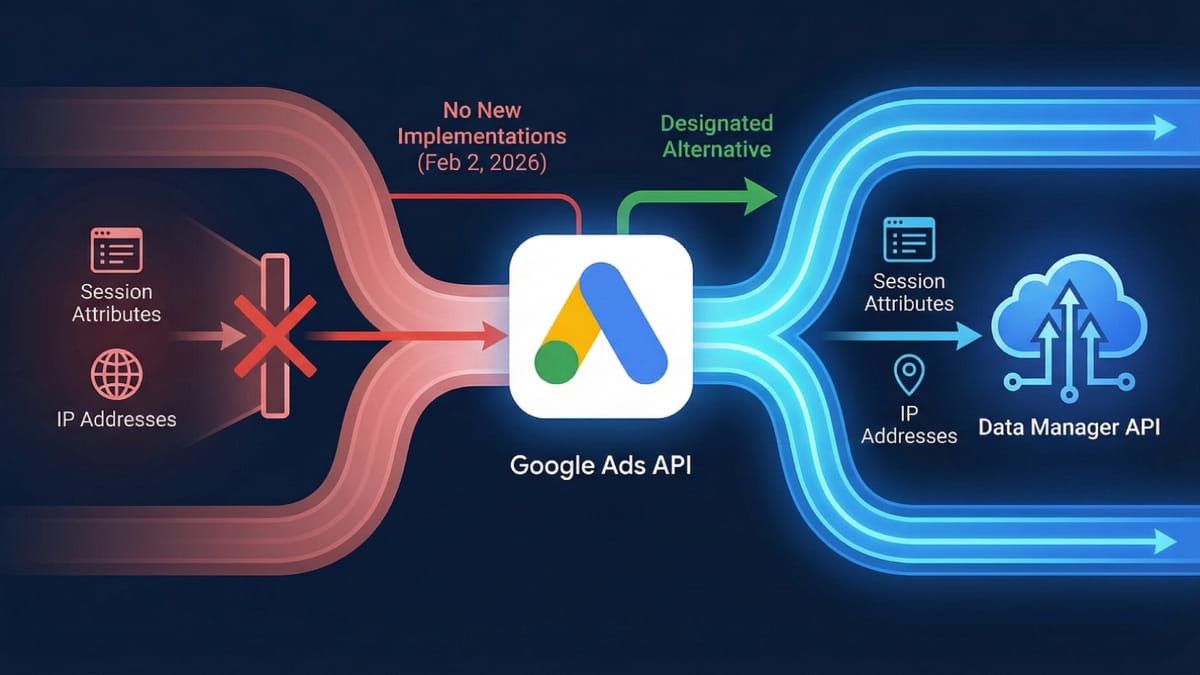
Google announced on January 7, 2026, that the Google Ads API will cease accepting new implementations of session attributes and IP address data for conversion imports starting February 2, 2026. The change pushes developers toward the Data Manager API, marking a significant architectural shift in how Google handles complex conversion tracking data.
The restriction applies to advertisers who have not yet implemented session attributes or IP addresses in their click conversion imports through the Google Ads API. Developers already using these features can continue importing that data indefinitely through the existing API, creating a two-tier system based on adoption dates.
"To ensure a more robust and scalable experience for handling complex data, we recommend that Google Ads API developers transition to the Data Manager API - where session attributes and IP address are accepted - as their primary conversion and user data import API," according to Ben Karl, writing on behalf of the Google Ads API Team.
The enforcement mechanism operates through developer token allowlisting. Once the February 2 rollout completes, developers attempting to import conversions with session attributes or IP addresses will encounter the error code "CUSTOMER_NOT_ALLOWLISTED_FOR_THIS_FEATURE" in partial_failure responses. This error indicates rejection of the associated conversion due to prohibited data elements.
Session attributes enable advertisers to pass additional context about user interactions during conversion events. These might include information about the browsing session, device characteristics, or interaction patterns that preceded a conversion. IP addresses serve similar attribution purposes, helping advertisers understand geographic patterns and validate conversion authenticity.
The Data Manager API represents Google's newer infrastructure for handling first-party data imports, including audience lists, conversion uploads, and offline attribution. The API's general availability launch in December 2024 introduced enhanced capabilities for managing customer match audiences and conversion data through a unified interface.
Google's technical documentation outlines a three-step migration process for affected developers. First, developers must temporarily strip session attributes and IP addresses from their Google Ads API conversion import requests while maintaining other conversion data. Second, they need to update their codebase to integrate with the Data Manager API, implementing session attributes and IP addresses in the new format. Third, once successful imports flow through the Data Manager API, developers should discontinue conversion uploads to the Google Ads API entirely.
The February 2 cutoff date provides less than four weeks for new advertisers to prepare systems. Developers planning to implement session attribute tracking or IP address data must either accelerate their Google Ads API integration before the deadline or build directly against the Data Manager API.
Existing implementers face a different calculation. While they retain indefinite access to session attributes and IP addresses through the Google Ads API, Google's recommendation suggests eventual deprecation. The announcement explicitly encourages migration to the Data Manager API even for grandfathered accounts, though no deadline currently exists for these transitions.
The architectural reasoning behind the split reflects data complexity management. Session attributes and IP addresses add substantial volume to conversion import requests, requiring more sophisticated data validation, storage, and processing systems. By consolidating these features in the Data Manager API, Google can optimize the infrastructure for heavy data loads while keeping the Google Ads API focused on simpler conversion tracking scenarios.
Google's offline conversion tracking requirements have grown increasingly complex, with the April 2025 introduction of mandatory conversion_environment parameters for app conversions. That change required advertisers to specify whether conversions occurred on websites or within applications, improving cross-environment attribution accuracy for Smart Bidding.
The Data Manager API migration follows similar patterns. Rather than overloading a single API with expanding feature sets and data types, Google has created specialized endpoints optimized for specific use cases. The Data Manager API handles bulk data operations, first-party audience management, and complex conversion scenarios, while the Google Ads API maintains campaign management and simpler tracking implementations.
Third-party advertising platforms, agencies, and marketing technology vendors face the most significant impact. These organizations often build conversion tracking solutions serving multiple clients, requiring standardized implementations across diverse advertiser accounts. The allowlisting mechanism means any client onboarding after February 2 will lack session attribute and IP address capabilities unless the provider has already completed Data Manager API integration.
Custom enterprise implementations experience similar constraints. Large advertisers with internal development teams building proprietary conversion tracking systems must evaluate whether session attributes and IP addresses provide sufficient value to justify Data Manager API adoption. For organizations not currently using these features, the decision point arrives when business requirements evolve to demand session-level attribution or IP-based analysis.
The technical migration complexity varies by implementation scale. Small developers with straightforward conversion uploads can adapt relatively quickly, as the Data Manager API supports similar data structures with modified endpoints. Enterprise systems with sophisticated attribution models, data validation layers, and reporting integrations face more substantial engineering efforts.
Error handling mechanisms require updates across affected systems. The CUSTOMER_NOT_ALLOWLISTED_FOR_THIS_FEATURE error must trigger appropriate fallback behavior, whether that means stripping prohibited data elements, logging exceptions for manual review, or queuing imports for Data Manager API processing. Developers need monitoring systems to detect partial_failure responses and alert operations teams to systematic rejection patterns.
Buy ads on PPC Land. PPC Land has standard and native ad formats via major DSPs and ad platforms like Google Ads. Via an auction CPM, you can reach industry professionals.
Google's approach to API management has increasingly emphasized specialization over consolidation. Rather than maintaining a single advertising API handling all possible data types and operations, the company has segmented functionality across purpose-built interfaces. The Google Ads API focuses on campaign management, bidding strategies, and basic conversion tracking. The Data Manager API handles bulk data operations, audience management, and complex attribution scenarios. The Merchant API manages product inventory and shopping feed data.
This architectural philosophy creates implementation challenges for developers but enables Google to optimize each API for its specific workload characteristics. The Data Manager API's asynchronous processing model suits high-volume data imports better than the Google Ads API's synchronous request-response pattern. Session attributes and IP addresses generate substantial data volumes, making asynchronous processing and batch validation more efficient.
The shift mirrors broader changes in Google's advertising measurement infrastructure, particularly around enhanced conversions and customer match integration. These features similarly require specialized handling of first-party customer data, with strict validation requirements and privacy safeguards that benefit from dedicated API infrastructure.
Previous API consolidation efforts have proven instructive. Google's introduction of the Google Ads API as a replacement for AdWords API demonstrated the company's willingness to rebuild foundational interfaces when existing architectures constrain scalability or feature development. The Data Manager API represents a continuation of that modernization strategy.

Session attributes and IP addresses represent sensitive data points under various privacy regulations. IP addresses constitute personal data under GDPR and similar frameworks, requiring explicit consent mechanisms and data processing justifications. Session attributes, depending on their content, may contain behavioral tracking information subject to consent requirements.
The Data Manager API's architecture includes enhanced compliance features addressing these concerns. Request-level and user-level consent settings enable developers to specify whether users have granted permission for ad user data collection and personalization. The system enforces terms of service acceptance for Customer Match uploads, ensuring regulatory compliance at the API level rather than relying solely on client-side implementations.
By concentrating session attribute and IP address handling in the Data Manager API, Google can implement consistent validation, consent verification, and data retention policies across all conversion imports containing these elements. The Google Ads API's broader scope makes unified enforcement more challenging, as different conversion types carry different privacy implications.
Enhanced conversion implementations have faced similar compliance requirements, with web and lead-based approaches requiring distinct handling of customer information. The Data Manager API's design accommodates these variations through flexible data structures and granular consent controls.
Google provides multiple support channels for developers navigating the transition. The Google Ads API support team handles questions about existing implementations and migration planning timelines. The Data Manager API support channel addresses technical questions about the new integration, including authentication, data formatting, and error resolution.
The company's "Google Advertising and Measurement Community" Discord server offers peer support and direct access to Google engineering teams. Developers can discuss implementation approaches, share code examples, and troubleshoot integration challenges in real-time conversation rather than asynchronous support ticket systems.
Technical documentation for the Data Manager API includes detailed specifications for conversion import endpoints, authentication requirements, and data validation rules. Sample code demonstrates proper formatting for session attributes and IP addresses within the new API structure, helping developers adapt existing implementations.
Migration complexity depends heavily on existing system architecture. Organizations using abstraction layers or conversion tracking middleware can often update their API client libraries without modifying upstream application code. Direct API integrations require more extensive changes, as endpoint URLs, authentication methods, and request structures differ between the two APIs.
Advertisers relying on session attributes or IP addresses for conversion tracking must understand whether their vendors or internal systems require updates. Agency-managed accounts should verify that advertising platforms have completed Data Manager API migrations. Custom implementations need technical assessment to determine migration timelines and resource requirements.
The practical impact on campaign performance depends on attribution model sophistication. Advertisers using basic last-click attribution may not notice material differences, as core conversion data continues flowing regardless of API endpoint. Organizations leveraging session-level analysis for fraud detection, attribution modeling, or bidding optimizations face more significant implications if their systems lack Data Manager API support.
Smart Bidding algorithm performance can degrade when conversion data quality declines, making reliable data import infrastructure critical for automated campaign optimization. Interruptions in session attribute or IP address data flows could affect bidding accuracy until alternative attribution mechanisms compensate.
Testing and validation procedures should precede production migrations. Developers can use the Data Manager API's validate_only parameter to verify request formatting, authentication, and destination configurations without actually ingesting data. This capability enables thorough testing while maintaining existing production conversion flows through the Google Ads API.
Google's announcement positions the Data Manager API as the "primary conversion and user data import API" for developers, suggesting eventual deprecation of conversion import functionality in the Google Ads API. While no timeline exists for removing conversion uploads entirely from the older API, the strategic direction favors consolidating data ingestion operations in specialized infrastructure.
This pattern has played out before in Google's advertising ecosystem. The company typically begins with feature differentiation - making new capabilities available only in newer APIs - before eventually sunsetting legacy endpoints. The extended grandfather period for existing session attribute users demonstrates Google's awareness of migration complexity and commitment to providing reasonable transition timelines.
Future enhancements to conversion tracking, attribution modeling, and data validation will likely focus on the Data Manager API. Developers building new integrations should default to the Data Manager API for conversion imports, even without immediate need for session attributes or IP addresses. The API's asynchronous architecture, enhanced error reporting, and flexible data structures provide advantages beyond the specific features blocked in the Google Ads API.
Campaign Manager 360's recent conversion tracking enhancements illustrate Google's broader emphasis on standardized data handling across advertising platforms. The company increasingly expects consistent implementation of conversion tracking, audience management, and measurement infrastructure regardless of specific advertising product.
The February 2 deadline represents an inflection point for new advertisers and developers. Organizations not currently implementing session attributes or IP addresses must now choose between Google Ads API simplicity and Data Manager API capabilities. Those already using these features can maintain existing implementations while evaluating migration benefits.
Subscribe PPC Land newsletter ✉️ for similar stories like this one
Subscribe PPC Land newsletter ✉️ for similar stories like this one
Who: Google's Ads API Team, led by Ben Karl, announced the changes affecting developers, third-party platforms, agencies, and advertisers using session attributes or IP addresses in conversion tracking through the Google Ads API.
What: Starting February 2, 2026, the Google Ads API will no longer accept new implementations of session attributes or IP address data in conversion imports. Developers must use the Data Manager API for these features. Existing users can continue using the Google Ads API indefinitely but are encouraged to migrate.
When: The announcement was made on January 7, 2026, with enforcement beginning February 2, 2026. Developers have less than four weeks to complete implementations before the cutoff or begin Data Manager API integration.
Where: The changes affect conversion import functionality in the Google Ads API globally, with the Data Manager API serving as the designated alternative for session attributes and IP address data across all markets.
Why: Google aims to provide a "more robust and scalable experience for handling complex data" by consolidating session attributes and IP addresses in the Data Manager API's specialized infrastructure, optimizing each API for specific workload characteristics while maintaining conversion tracking reliability.