


Google today unveiled four new ad formats for Search at Google Marketing Live, marking its most detailed public description yet of how advertising will work inside AI Mode and the broader conversational search environment it has been building since 2025.
The announcements, attributed to Vidhya Srinivasan, VP and GM of Google Ads and Commerce, cover two formats currently in testing within AI Mode - Conversational Discovery ads and Highlighted Answers - and two formats coming to standard Search in the months ahead: AI-powered Shopping ads and Business Agent for Leads. Each one departs from the static text-and-headline structure that has defined Search advertising for more than two decades.
The context: AI Mode's rapid growth
The timing reflects how fast AI Mode has grown. According to Google, AI Mode has surpassed 1 billion monthly users, with queries more than doubling every quarter since launch. AI Mode searches are on average three times as long as traditional searches, and 1 in 6 queries are non-text, using voice or images. Those figures, cited at Google I/O 2026 and in internal data, frame why Google is building ad formats specifically for the interface rather than simply porting existing units across.
AI Mode's rapid adoption has been tracked closely since Google formally announced shopping ads for the surface in February 2026. At that point, the surface already had more than 75 million daily active users. By Google I/O 2026, monthly users had surpassed 1 billion - a trajectory that makes the commercial architecture of AI Mode one of the most consequential decisions in digital advertising right now.
According to Google, 75% of people report making faster, more confident decisions using AI Mode in Search. That figure, from a Google-commissioned Ipsos Global Consumer Journeys survey conducted in December 2025 across 25 countries with 13,189 respondents, provides the stated rationale for building ad formats tailored to a surface where users already report high engagement with AI-generated answers.
Conversational Discovery ads
The first of the two AI Mode formats is Conversational Discovery ads. According to Google, this format generates ad creative in direct response to a user's specific query. Rather than serving a pre-built ad, the Gemini model builds creative tailored to the search, highlighting specific relevant features of the advertised product or service.
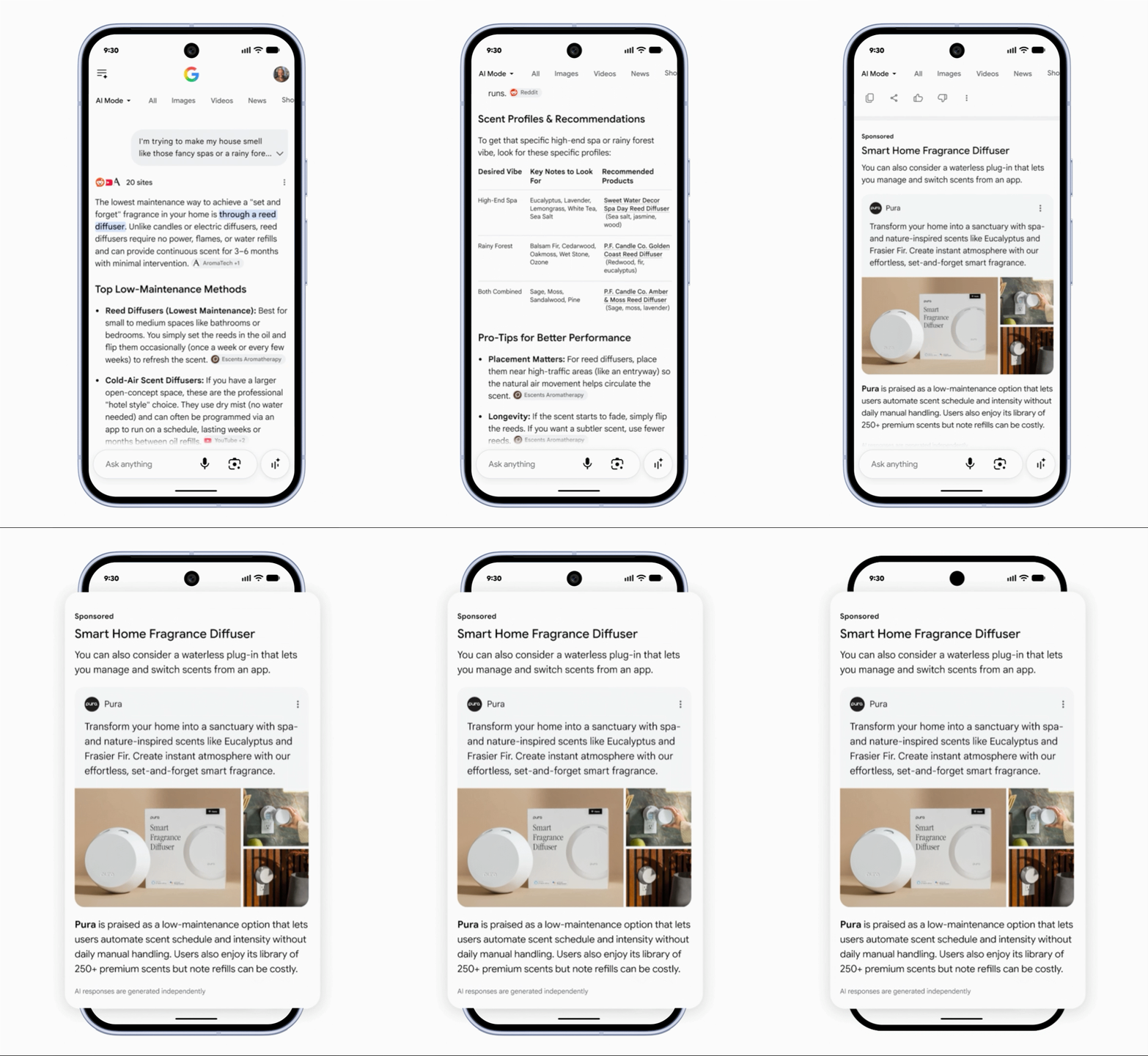
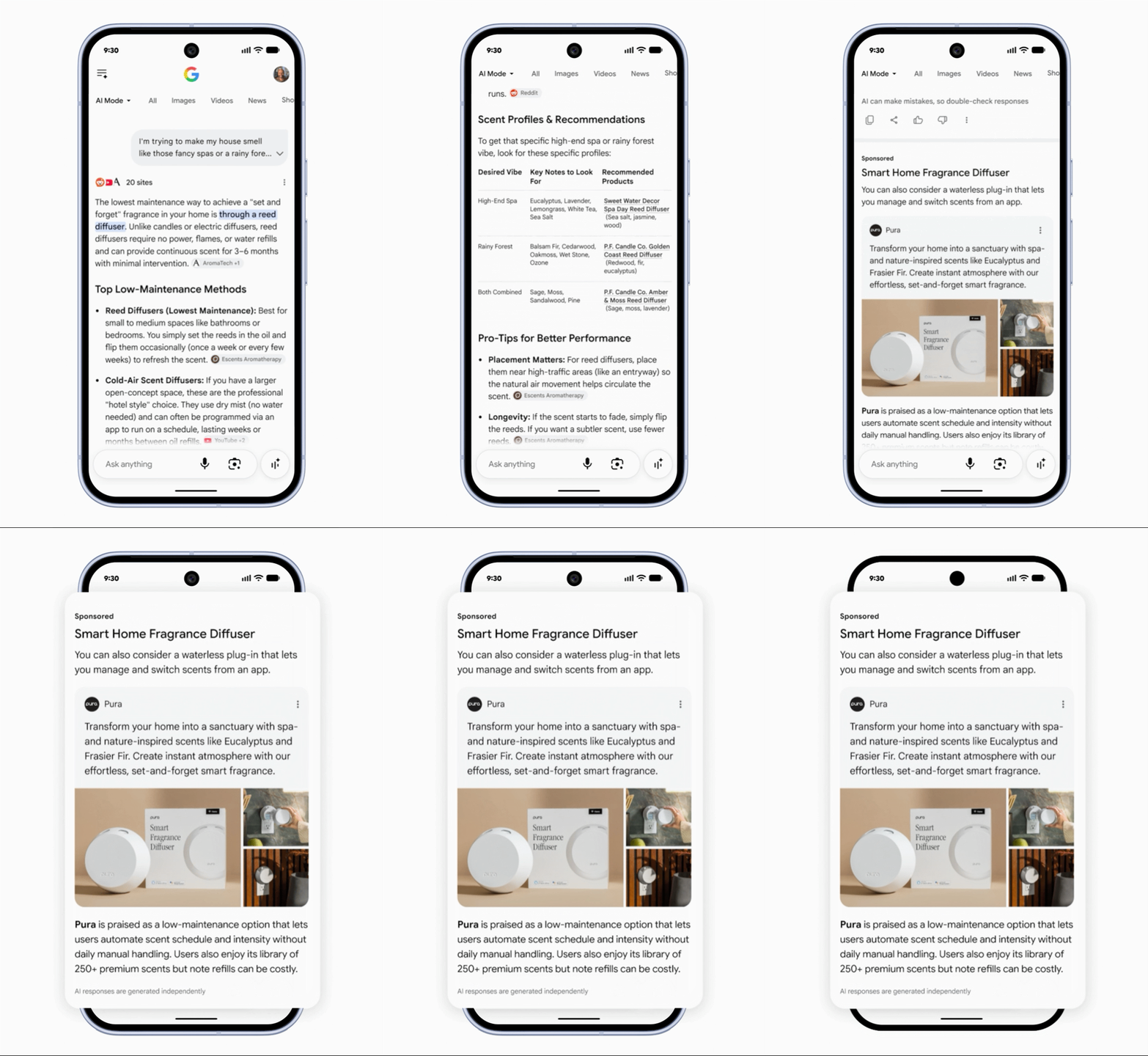
The example provided in the announcement involves a search along the lines of: "I am trying to make my house smell like those fancy spas or a rainy forest. What are some low-maintenance ways to make my home smell amazing?" The system reads that query and constructs creative relevant to the intent embedded in it - not just the category (home fragrance), but the specific context (low maintenance, spa-like atmosphere). An independent AI explainer accompanies each ad, generated by Google's Gemini model. This explainer evaluates and synthesizes information about the product or service, and displays that context alongside the advertiser's own creative, independent of the advertiser's input.
According to Google, both AI Mode ad formats will continue to carry a clear "Sponsored" label. The independent explainer is described as providing transparency and building trust - an acknowledgment that placing AI-generated text inside a paid format requires a legibility mechanism that traditional ad disclosure labels alone may not provide.
The format is currently being tested in the United States on both mobile and desktop.
Highlighted Answers
The second AI Mode format, Highlighted Answers, works differently. When AI Mode generates a list of recommendations in response to a research query - for instance, the best language learning apps to use before a trip - advertisers with highly relevant, high-quality ads are eligible to appear as one of the items on that list. The ad takes the form of a Highlighted Answer, positioned within the AI-generated recommendation set rather than above or below it.
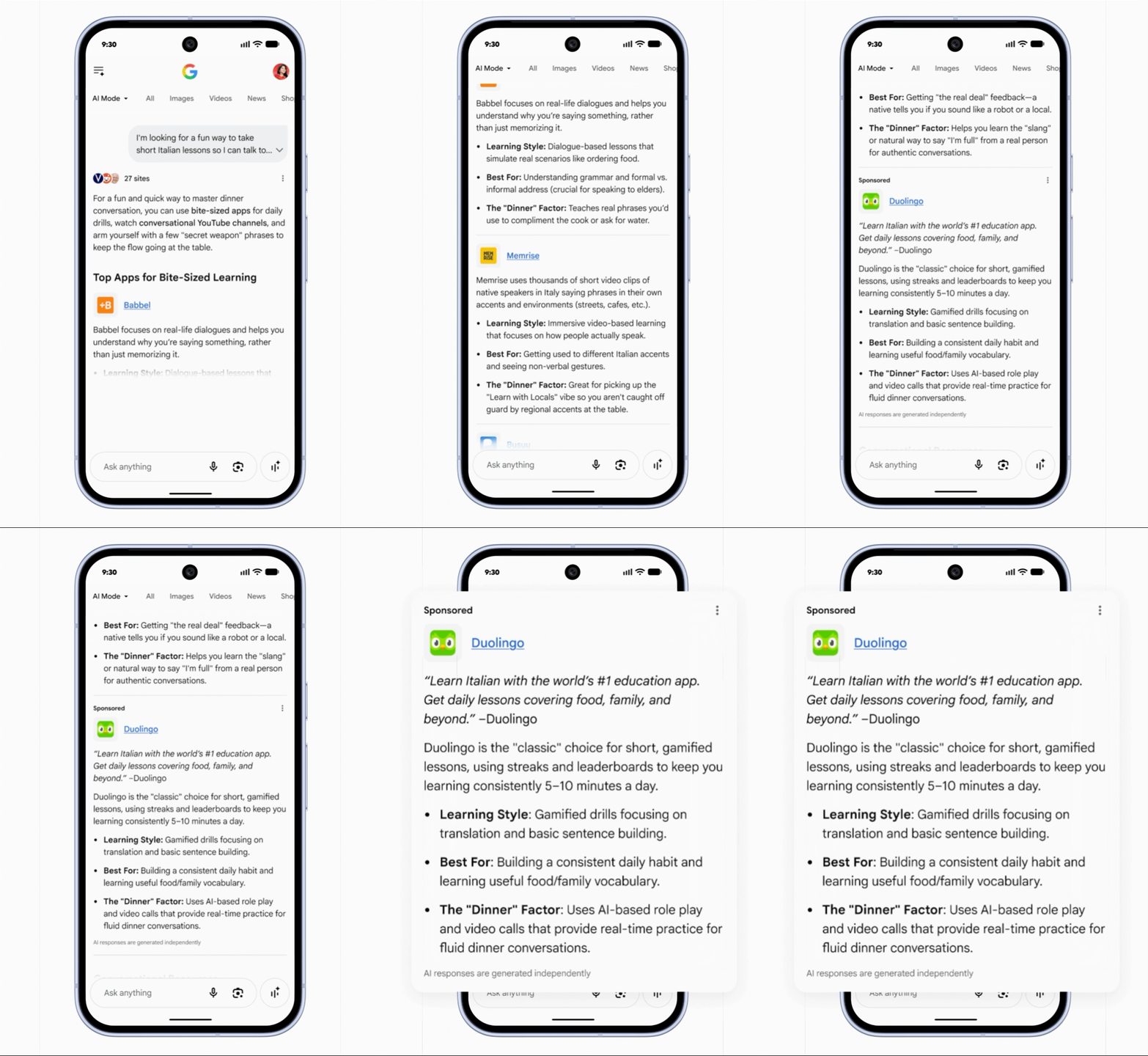
According to Google, the eligibility condition is dual: the ad must be both highly relevant to the query and high quality. The format also includes an independent AI explainer, constructed in the same way as in Conversational Discovery ads, alongside the advertiser's creative.
This placement logic is a meaningful shift. In traditional search, sponsored results appear in defined positions - top, bottom, or alongside organic results. In AI Mode's list-based answers, the ad sits within the answer itself, indistinguishable in position from organic recommendations except for the "Sponsored" label. Google's search terms reporting changes announced earlier this month already flagged that query data in AI Mode may reflect inferred intent rather than literal text, adding another layer of complexity for advertisers trying to understand how these placements are being triggered.
Both Conversational Discovery ads and Highlighted Answers are in testing in the US on mobile and desktop. No timeline for broader availability has been specified.
AI-powered Shopping ads
For standard Search - not just AI Mode - Google is bringing a new format called AI-powered Shopping ads. The format is intended for high-consideration purchases, described in Google's announcement as items like appliances and electronics. When a shopper searches for, say, an espresso machine, the Gemini model pulls up the most relevant products and generates a custom explainer on the spot, describing why a specific product may be the right choice for that search.
According to Google, the explainer is written in real time by the model, tailored to the individual query. This is a departure from standard Shopping ads, which pull headline text, price, and an image directly from a product feed without generating any additional copy.
The availability is listed as rolling out in the United States later in 2026. This is a US-only rollout at launch, though no specific date within 2026 has been confirmed.
The expansion of AI Max to standard Shopping campaigns, announced on April 30, 2026, already signaled that Google is systematically applying AI-generated copy and intent matching to Shopping infrastructure. AI-powered Shopping ads extend that logic from bidding and targeting into the ad unit itself.
The AI-powered Shopping ad format also connects to Google's Shopping Graph, which according to Google contains more than 60 billion listings as of April 2026. The depth of the graph - updated billions of times each day - is what allows the Gemini model to generate relevant explainers at search time rather than relying solely on advertiser-supplied content.
Business Agent for Leads
The fourth format, Business Agent for Leads, is a lead generation unit built with Gemini. According to Google, it embeds a brand agent trained on the advertiser's website directly inside the ad. Rather than presenting a static form, the format lets someone researching a decision - the announcement uses the example of a student researching universities - click a "Chat" button within the ad and receive instant answers based on the brand's website content.
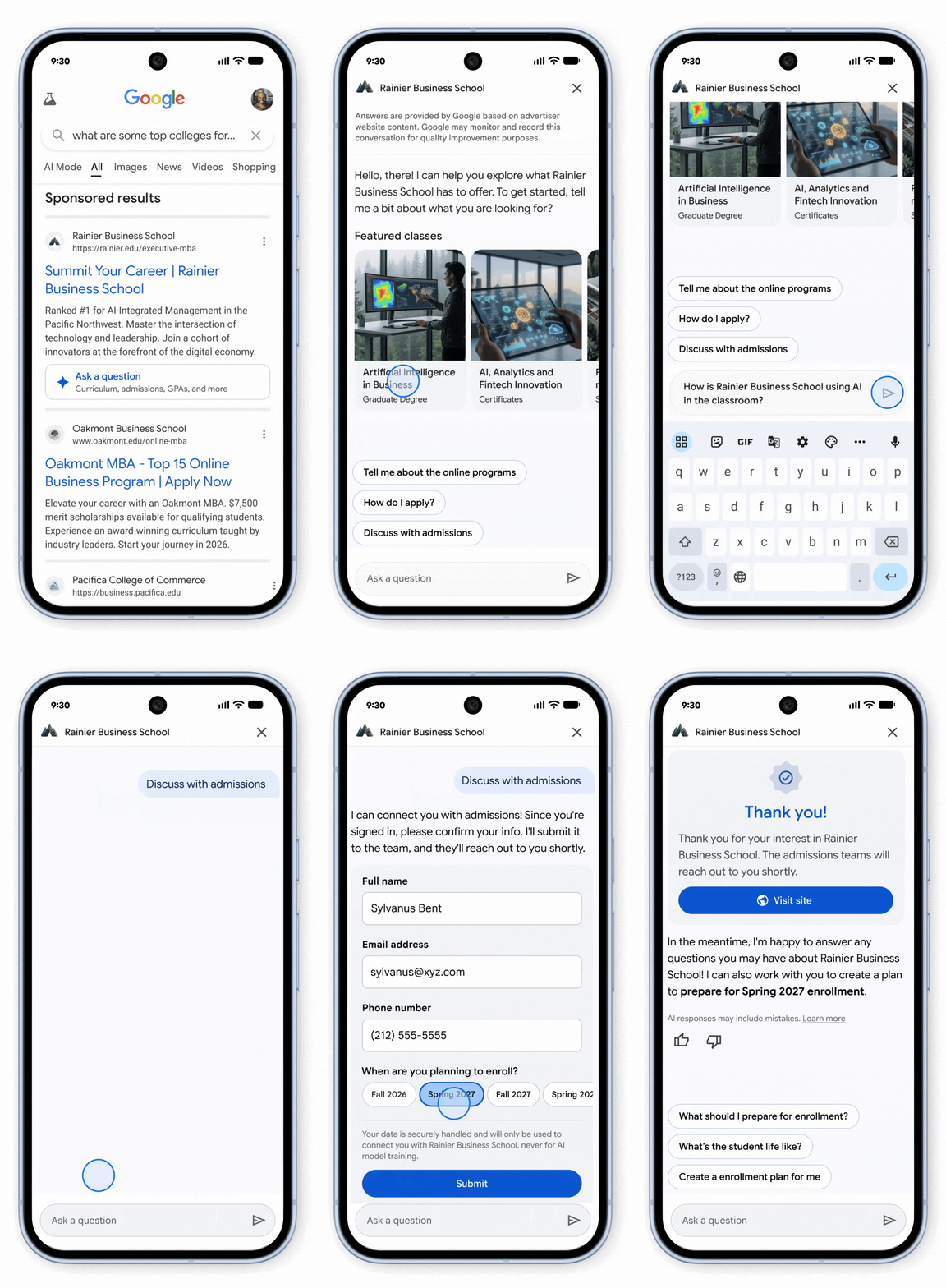
The interaction functions as a pre-qualification layer. A prospective lead can ask questions and get responses drawn from the advertiser's own content before deciding whether to submit a form. According to Google, this turns a practical interaction into a valuable lead.
Business Agent for Leads is available in open beta in the United States for English-language accounts. Like Conversational Discovery ads and Highlighted Answers, it relies on Gemini as its underlying model, continuing a pattern visible across nearly every product announcement at Google Marketing Live 2026.
Expanding the Direct Offers pilot
Alongside the four new formats, Google is upgrading the Direct Offers pilot that launched in January 2026. Brands including Chewy, Gap, and L'Oreal have been participating in the pilot since launch, surfacing deals within AI Mode as shoppers explore options.
According to Google, the upgrade brings three additions. First, promotion bundling: brands will be able to supply a variety of promotions - discounts, giveaways, and local coupons - and use Gemini to construct a contextually relevant deal, like a product bundle, for a specific search. Advertisers define eligible products and guardrails; the model constructs the offer. Second, native checkout: Universal Commerce Protocol (UCP) merchants get native checkout integration within Direct Offers, allowing shoppers to secure promotions without leaving the AI Mode interface. Third, travel expansion: travel partners including Booking and Expedia will be able to surface special offers within AI-assisted trip planning directly in AI Mode.
Google launched the Direct Offers format as part of the Universal Commerce Protocol in January 2026. The expansion to promotion bundling, native checkout, and travel categories broadens the surface area of commercial intent that the format can address.
Direct Offers remains a pilot for US advertisers. With the May 20 upgrade, the format will surface naturally within AI Mode responses as shoppers explore options.
The independent AI explainer: a structural detail
Across Conversational Discovery ads and Highlighted Answers, a recurring technical element is the independent AI explainer. According to Google, the Gemini model evaluates and synthesizes information about the product or service independently of the advertiser's supplied creative, and displays that context alongside the ad. The word "independent" is doing deliberate work here - it positions the explainer as something distinct from advertiser-controlled content, generated by Google's model rather than submitted through the campaign.
This design has implications for what advertisers can and cannot control in the final ad unit. The explainer is generated based on what Google's model determines is relevant and accurate about the product, not what the advertiser would choose to highlight. The "Sponsored" label remains, making clear the unit is paid, but the content of the explainer itself is outside the advertiser's direct input.
Adthena's analysis of 29.1 million queries, published in April 2026, documented that over 60% of AI Overview ad appearances concentrate on three- to four-word searches rather than the longer, conversational queries AI Mode is built for. The new formats being announced today are specifically designed for those longer, higher-context queries - a different auction environment from what the industry has been measuring so far.
Scale and campaign infrastructure
According to Google, advertisers using AI Max for Search campaigns are seeing 27% more conversions at a similar CPA or ROAS compared to campaigns that mostly use exact and phrase match keywords. AI Max and Performance Max are, according to Google's internal data from 2026, unlocking billions of net new queries that those advertisers were not reaching previously. The new AI search ad formats announced today are positioned as additions to that foundation - formats that function best, according to Google, when paired with AI Max for Search, AI Max for Shopping campaigns, and Performance Max.
Dynamic Search Ads are being retired and automatically upgraded to AI Max starting September 2026. That structural change, announced April 15, 2026, means the campaign infrastructure underpinning AI-generated ad formats will become the default for a broad category of advertisers who have not actively opted in. Taken together with the May 20 format announcements, the direction is clear: query matching and creative generation are both moving toward AI mediation at scale.
Why this matters for the marketing community
The four formats announced today represent Google's most direct answer yet to a question the industry has been circling since AI Mode launched in 2025: what does advertising inside a conversational search interface actually look like in practice? The answer, as of May 20, 2026, is a combination of real-time creative generation (Conversational Discovery ads), placement within AI-generated recommendation lists (Highlighted Answers), model-generated product explainers on existing Shopping infrastructure (AI-powered Shopping ads), and interactive brand agents embedded in lead gen units (Business Agent for Leads).
For media buyers and paid search professionals, each format changes a different aspect of the traditional advertiser-platform relationship. In Conversational Discovery ads and AI-powered Shopping ads, the model generates a portion of the ad creative. In Highlighted Answers, the placement is determined by the model's assessment of relevance to a recommendation list. In Business Agent for Leads, the model conducts a conversation with the prospect on the advertiser's behalf.
Google has been building toward AI-mediated ad experiences since Think Week 2025 in September. What has changed in the May 20 announcements is specificity. Advertisers now have named formats, defined mechanics, and in some cases open beta availability to work with, rather than a directional vision.
Timeline
- September 2025 - Google unveils comprehensive AI advertising suite at Think Week 2025, introducing Asset Studio, AI Max for Search open beta, and Ads in AI Mode testing
- November 2025 - Adthena first detects ads inside Google AI Overviews in production, at 0.052% frequency across 25,000 SERPs
- December 19, 2025 - Google quietly expands AI Overview ads to 11 countries without formal announcement
- January 2026 - Direct Offers pilot launches as part of Universal Commerce Protocol; brands including Chewy, Gap and L'Oreal begin participating
- February 11, 2026 - Google formally announces shopping ads in AI Mode; AI Mode is at more than 75 million daily active users at this point
- February 25, 2026 - Google's ad UI and UX leads discuss design process for search text ads as AI Mode and Direct Offers reshape the landscape
- February 26, 2026 - Text guidelines for AI Max and Performance Max go global, giving advertisers controls over AI-generated ad copy
- March 25, 2026 - Sponsored stores units and "Quick results from the web" spotted inside AI Mode by analyst Glenn Gabe
- April 2026 - Adthena publishes 29.1-million-query report documenting AI Overview ad behavior; 60%+ of AI ad appearances on three- to four-word searches
- April 15, 2026 - Google announces retirement of Dynamic Search Ads, to be automatically upgraded to AI Max from September 2026
- April 30, 2026 - Google extends AI Max to standard Shopping campaigns, introducing text customization from Merchant Center feed attributes
- May 2026 - Google's search terms report updated: query data in AI Mode and other advanced surfaces may now reflect AI-inferred intent rather than literal text
- May 20, 2026 - Google Marketing Live: four new AI search ad formats announced (Conversational Discovery ads, Highlighted Answers, AI-powered Shopping ads, Business Agent for Leads); Direct Offers pilot expanded with promotion bundling, native checkout, and travel partners
Summary
Who: Google, through its Google Ads and Google Marketing Live team, led by Vidhya Srinivasan, VP and GM of Google Ads and Commerce.
What: Four new AI-powered search ad formats: Conversational Discovery ads and Highlighted Answers (both in testing in AI Mode in the US), AI-powered Shopping ads (rolling out in the US later in 2026), and Business Agent for Leads (open beta in the US in English). The existing Direct Offers pilot was also expanded with promotion bundling, native checkout for UCP merchants, and travel partner integrations with Booking and Expedia.
When: Announced May 20, 2026 at Google Marketing Live. Conversational Discovery ads and Highlighted Answers are in current US testing on mobile and desktop. AI-powered Shopping ads are planned for US rollout later in 2026. Business Agent for Leads is in open beta now in the US in English.
Where: All formats are initially US-only. Conversational Discovery ads and Highlighted Answers operate within AI Mode. AI-powered Shopping ads and Business Agent for Leads operate within standard Search. The Direct Offers expansion surfaces within AI Mode responses.
Why: AI Mode has surpassed 1 billion monthly users with queries doubling every quarter. According to Google, AI Mode searches are three times longer than traditional searches and 75% of users report making faster, more confident decisions using the surface. Google is building ad formats architecturally suited to conversational, multi-turn search behavior that existing text and Shopping ad units were not designed for.


Discussion