

Google today announced the end of Dynamic Search Ads as a standalone format, confirming that legacy DSA campaigns will automatically upgrade to AI Max for Search starting in September 2026. The announcement, published April 15, 2026 on the Google Ads and Commerce Blog by Brandon Ervin, Director of Product Management at Google Ads, also declares AI Max out of beta after months of global testing with hundreds of thousands of advertisers.
The move marks one of the most significant structural shifts in Google's search advertising platform in years. DSA, which has long served as a catch-all mechanism for traffic expansion beyond keyword lists, is being folded into a broader automated system - one that, according to Google, delivers measurably better outcomes but has drawn persistent scrutiny from independent advertising professionals.
What is changing and when
According to the announcement, three legacy campaign configurations will be affected: Dynamic Search Ads, automatically created assets (ACA), and the campaign-level broad match setting. All three will upgrade automatically to AI Max for eligible campaigns by the end of September 2026.
The transition unfolds in two phases. The first phase, beginning this week, introduces voluntary upgrade tools that allow DSA advertisers to port their historical settings and data into new standard ad groups. For ACA and campaign-level broad match setting users, a pop-up banner will appear in the Google Ads interface. The second phase begins in September, at which point Google will stop allowing the creation of new DSA campaigns through Google Ads, Google Ads Editor, and the Google Ads API.
Google has been explicit about the scope. According to the blog post, "starting in September, remaining eligible Search campaigns with legacy settings will automatically upgrade to AI Max, and you won't be able to create new campaigns with DSA via Google Ads, Google Ads Editor and the Google Ads API." Notifications will go out to affected accounts before the transition begins.
For DSA advertisers specifically, the migration will convert dynamic ad groups into standard ad groups. All three AI Max features - search term matching, text customization, and final URL expansion - will be switched on by default, with existing URL controls preserved. ACA campaigns will get search term matching and text customization by default. Campaigns using the campaign-level broad match setting will receive search term matching only.
What AI Max does differently
DSA has operated for years on a straightforward principle: scrape a website's landing page content, generate relevant headlines, and match ads to queries that align with that content. It worked. But according to Google, the constraints of pure landing-page targeting have become more apparent as user queries grow longer, more conversational, and harder to anticipate from a static crawl alone.
AI Max expands on that foundation in three ways. Search term matching combines broad match keyword expansion with keywordless targeting - a mechanism similar to DSA but one that draws on a wider input set. Rather than relying on landing pages alone, it incorporates existing ad copy, keywords in the ad group, and real-time intent signals. Text customization, which replaces what was previously called automatically created assets, generates headlines and descriptions tailored to individual queries rather than pulling text wholesale from a page. Final URL expansion routes users to the most relevant page on an advertiser's site for each individual query, regardless of the destination URL originally specified in the ad.
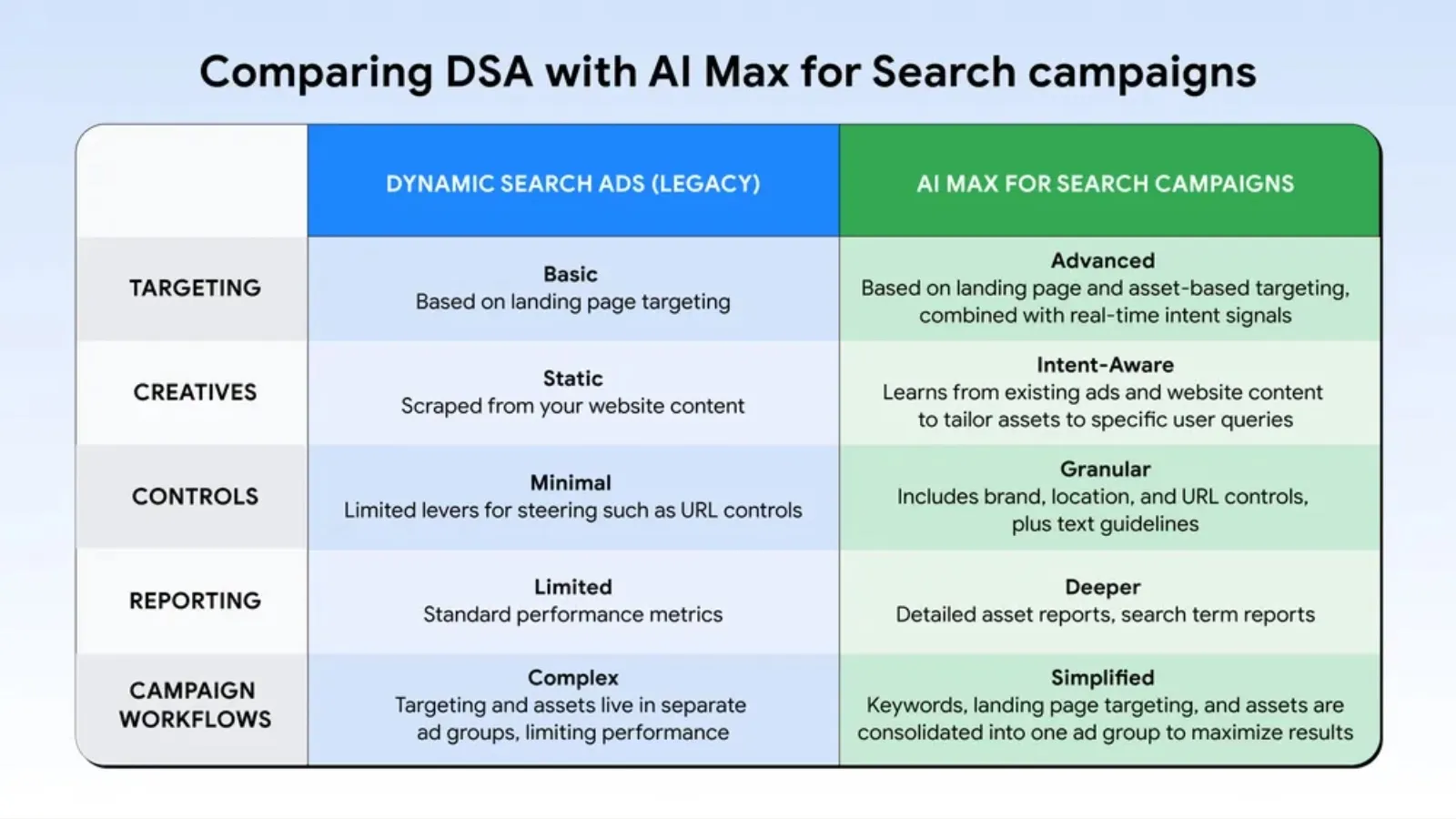
The comparison chart Google has published alongside the announcement illustrates the structural differences clearly. DSA targeting is described as basic, based on landing page data alone. AI Max targeting is described as advanced, incorporating landing page and asset-based targeting combined with real-time intent signals. DSA controls are minimal - limited to URL controls. AI Max controls are described as granular, covering brand, location, and URL settings as well as text guidelines. Campaign workflows under DSA require keywords, landing page targeting, and assets to be managed in separate ad groups. Under AI Max, all three are consolidated into a single ad group structure.
The performance claim
According to the announcement, AI Max for Search campaigns see an average of 7% more conversions or conversion value at a similar CPA/ROAS when using the full feature suite - search term matching, text customization, and final URL expansion together - compared to search term matching alone. That is a more cautious figure than the 14% uplift Google cited when AI Max first launched in May 2025, a number that itself attracted scrutiny given how it conflicted with early independent testing data.
PPC Land documented those early discrepancies in August 2025, when analysis from Ezra Sackett, Director of Paid Search at Monks, showed that across roughly 30,000 search terms activated by AI Max features, 99% of impressions generated zero conversions. Independent testing published in November 2025 went further, finding that AI Max delivered conversions at approximately 35% lower return on ad spend than traditional match types across more than 250 retail campaigns.
Separate analysis by Xavier Mantica documented a cost per conversion of $100.37 under AI Max versus $43.97 for phrase match over a four-month testing window. These numbers have circulated widely in professional advertising communities, and the gap between Google's aggregate performance claims and individual advertiser experiences has been a recurring point of tension throughout the AI Max rollout.
API implications
The deprecation of DSA creation via the Google Ads API carries meaningful operational consequences for large accounts and automated management platforms. Advertisers or agencies that programmatically create DSA campaigns through API calls will need to update their workflows before September.
This is not the first time the API transition has created friction. Google Ads API version 21, released on August 6, 2025, introduced the ai_max_setting.enable_ai_max field to enable AI Max programmatically, but at that point the feature was still in beta and the implementation required explicit enablement. The upcoming transition changes that default posture - legacy settings will be automatically upgraded unless advertisers intervene during the voluntary phase.
There is also a specific API complication noted in community discussions: activating or deactivating AI Max can cause errors for API requests managing text customization and brand settings, because AI Max is not yet uniformly available across all API and editor surfaces. LinkedIn posts from advertising professionals captured in documentation surrounding this announcement flag the risk directly, noting that high-volume accounts where DSAs represent more than 50% of the search mix - particularly non-e-commerce accounts where Google Shopping is not an option - face disproportionate operational complexity during the migration.
Control mechanisms available
Google has made a point of emphasizing the control layer that distinguishes AI Max from its predecessor. The text guidelines feature, which went global on February 26, 2026, allows advertisers to specify up to 25 term exclusions and 40 messaging restrictions that constrain what AI generates in ad copy. Brand controls limit which brands can appear in keyword expansion. Location controls restrict geographic targeting. URL controls preserve exclusions from existing DSA configurations.
The consolidation of these controls into a single ad group structure - rather than managing DSA ad groups separately from standard keyword ad groups - is one of the architecture changes Google is presenting as an operational improvement. Under the old structure, DSA and standard keyword targeting competed against each other within accounts in ways that were difficult to manage. The unified ad group is intended to eliminate that internal competition.
Industry context
The sunset of DSA as a standalone format continues a pattern Google has pursued consistently: retiring legacy campaign formats that require more manual input in favour of systems that hand more decisions to automated models. PPC Land's coverage of Google Ads' 25-year evolution placed AI Max in a direct line from Universal App Campaigns in 2015 and Performance Max in 2020 - each successive automated format absorbing more targeting, bidding, and creative decisions that advertisers previously controlled directly.
The call-only ads deprecation announced in late 2025, with creation disabled from February 2026 and full shutdown by February 2027, followed a similar pattern. In each case, legacy formats were given a transition window, voluntary migration tools were introduced first, and then automatic changes were applied to remaining campaigns.
What distinguishes the DSA-to-AI Max migration is the scale. DSA has been a foundational tool for a broad category of advertisers - not just e-commerce accounts with large product catalogs, but service businesses, lead generation campaigns, and publishers with complex site architectures. The format's flexibility, particularly for non-shopping advertisers who lack access to product feed-based automation, made it a default component of many campaign structures.
Jean-Michel Fontaine, a Google Ads professional with 19 years of experience, noted in LinkedIn comments following the announcement that high-volume accounts where DSAs represent more than 50% of the search mix face particular challenges. Standard campaigns and Performance Max cannot always handle the inventory complexity those accounts require - and for non-e-commerce advertisers, Shopping is not available as an alternative. The forced migration to AI Max compresses the timeline for resolving those operational questions.
The Power Pack strategy Google announced in September 2025 - combining AI Max for Search, Performance Max, and Demand Gen - frames the AI Max transition as part of a broader shift toward a smaller number of campaign types, each handling a wider surface. The DSA deprecation is consistent with that framing: fewer formats, more automation within each.
What advertisers should watch
The voluntary upgrade period running from now through September gives advertisers several months to migrate on their own terms. Doing so earlier has a practical advantage: the automatic upgrades in September will apply settings configured to mirror legacy setups, which may not align with what an advertiser would configure deliberately. Migrating voluntarily allows for deliberate configuration of AI Max features from the start.
Reporting tools introduced in September 2025 - specifically the AI Max expanded matches and AI Max expanded landing pages metrics - provide a way to measure how much traffic AI Max adds beyond traditional keyword targeting, and at what conversion cost. These metrics become more important during and after migration, as the baseline shifts from DSA's landing-page-only logic to AI Max's broader signal set.
One structural issue that remains unresolved is how the migration handles accounts that run both standard keyword ad groups and DSA ad groups within the same campaign. The LinkedIn discussion surfaced a pointed question from Joao de Braganca, a Digital Marketing Consultant at Knewledge: whether the upgrade impacts all ad groups in a mixed campaign, or only the dynamic ones, and whether advertisers will be forced to separate DSA ad groups into standalone campaigns to avoid AI Max being applied to their standard keyword targeting. Google's announcement does not address this scenario directly, and advertisers managing mixed-structure campaigns will need to consult the Google Ads Help Center for detailed eligibility and feature mapping information.
Timeline
- May 6, 2025 - Google announces AI Max for Search campaigns, promising 14% more conversions at similar CPA/ROAS
- May 31, 2025 - Google publishes AI Max implementation guide with detailed deployment instructions
- July 2, 2025 - Google rolls out AI Max match type reporting; industry experts flag aggressive Search Partner Network expansion
- August 6, 2025 - Google Ads API v21 introduces AI Max support via the ai_max_setting.enable_ai_max field
- August 17, 2025 - Independent testing shows 99% of AI Max impressions yield zero conversions across roughly 30,000 search terms
- August 29, 2025 - Google Ads Decoded podcast launches, detailing AI Max technical implementation
- September 9, 2025 - Google introduces AI Max expanded matches and expanded landing pages reporting metrics
- September 10, 2025 - Google announces text guidelines for AI Max and Performance Max
- September 16, 2025 - Google introduces Power Pack strategy, combining AI Max, Performance Max, and Demand Gen
- October 15, 2025 - Google presents AI Max framework during live stream with detailed performance benchmarks
- November 8, 2025 - Independent analysis across 250+ retail campaigns shows AI Max at 35% lower ROAS than traditional match types
- February 26, 2026 - Text guidelines for AI Max and Performance Max go global with full language and vertical support
- April 15, 2026 - Google announces AI Max exits beta and DSA will automatically upgrade to AI Max starting September 2026; voluntary upgrade tools begin rolling out this week
Summary
Who: Google, represented by Brandon Ervin, Director of Product Management at Google Ads; affecting all advertisers using Dynamic Search Ads, automatically created assets, or campaign-level broad match settings globally.
What: AI Max for Search campaigns exits beta and Google announces DSA will be retired as a standalone format. All eligible legacy campaigns will automatically migrate to AI Max by end of September 2026. New DSA campaigns cannot be created via Google Ads, Google Ads Editor, or the Google Ads API from September onward. AI Max combines search term matching, text customization, and final URL expansion into a unified ad group structure, replacing the separate dynamic ad group model used by DSA.
When: Announced April 15, 2026. Voluntary upgrade tools begin rolling out this week. Automatic upgrades begin in September 2026, with all eligible campaigns expected to complete migration by end of September 2026.
Where: The changes apply across Google Ads globally, affecting campaign management through the Google Ads interface, Google Ads Editor, and the Google Ads API.
Why: According to Google, AI Max delivers 7% more conversions or conversion value at similar CPA/ROAS when using its full feature suite compared to search term matching alone. Google frames the retirement of DSA as a necessary step as consumer search queries become more complex and landing-page-only targeting becomes insufficient to capture intent across longer, conversational searches. The consolidation also fits Google's broader platform direction - reducing the number of distinct campaign formats while expanding the automation capabilities within each.


Discussion