How digital advertising quietly undermines the news industry
IAB Europe's December 2025 report reveals digital advertising's social impact remains fragmented and unmeasured, threatening media plurality and journalism funding.


IAB Europe's December 2025 report reveals digital advertising's social impact remains fragmented and unmeasured, threatening media plurality and journalism funding.
IAB Europe released a comprehensive examination of digital advertising's social dimensions on December 17, 2025, exposing systematic gaps in how the industry addresses its influence on media ecosystems, information quality, and democratic discourse. The report, titled "Beyond Reach: The Social Impact of Digital Advertising and Media," reveals an advertising industry increasingly focused on environmental sustainability while largely overlooking the social consequences of where marketing budgets flow.
The Brussels-based trade association's findings arrive during a period when news advertising generates superior campaign performance yet publishers face mounting economic pressure. Digital advertising now represents approximately 1.1% of U.S. GDP according to recent economic analyses, yet no standardized framework exists for measuring its social impact across markets.
Subscribe PPC Land newsletter ✉️ for similar stories like this one
IAB Europe's Sustainability Standards Committee surveyed stakeholders across publishers, advertisers, agencies, technology providers, and academic institutions between February and November 2025. The research identified significant activity around social sustainability topics including media plurality, misinformation, accessibility, and diversity, but found no shared definitions, interoperable key performance indicators, or consistent governance structures.
"Social sustainability is broad by definition, and understanding the focus, goals, and limitations of existing projects is key to supporting meaningful progress," according to Dimitris Beis, IAB Europe's Data Analyst and Sustainability Lead, in the December 17 announcement.
The mapping exercise documented nine participating organizations including WPP Media's Back to News initiative, Channel Factory's Conscious Advertising Programme, and academic institutions like Germany's Research Center for Sustainable Media & Marketing. These entities pursue distinct methodologies ranging from independent audits to self-declaration, operating at different granularities from content-level analysis to media owner assessments.
This fragmentation prevents equivalent evaluation across markets. Publishers cannot demonstrate social value in ways that influence investment decisions consistently, while advertisers lack comparable signals for managing social impact alongside traditional performance metrics like cost per acquisition or viewability rates.
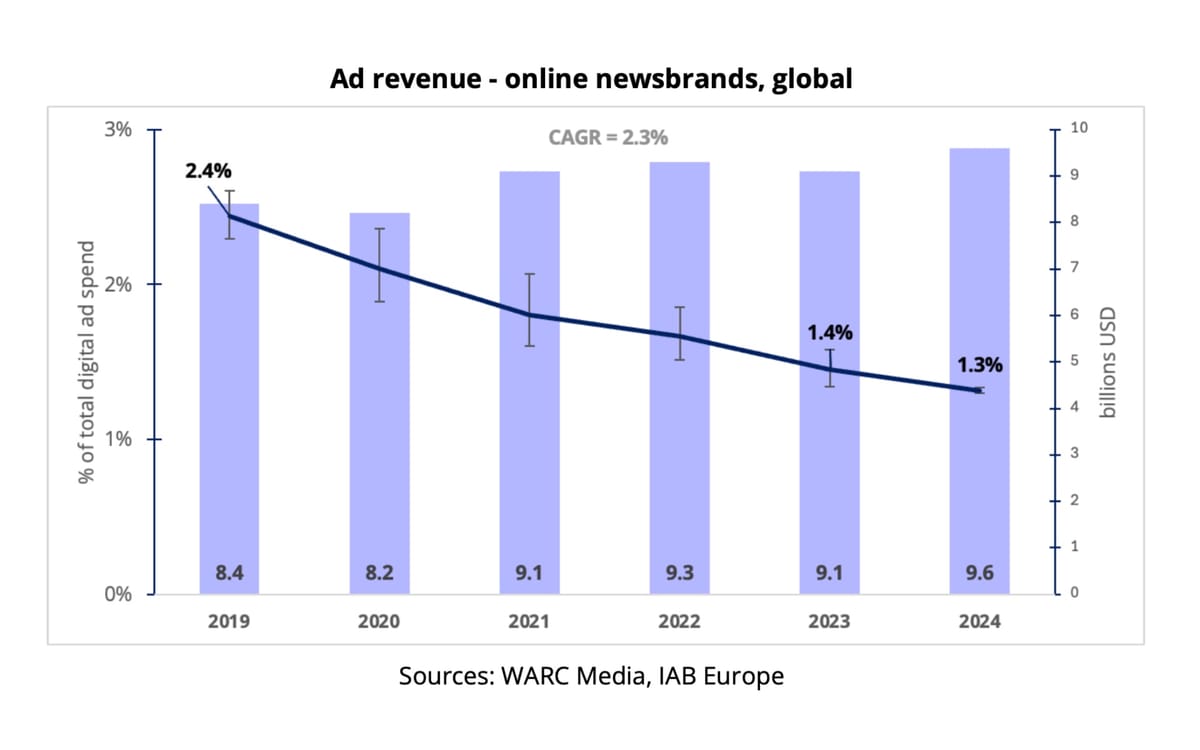
Online newsbrands captured 2.4% of total digital advertising expenditure in 2019, according to data compiled by WARC Media and IAB Europe. That proportion declined to approximately 1.4% by 2023, while global spending on content media including television, radio, magazines, and news fell behind expenditure on search, social media, retail media, and digital pure players after 2019.
The report documents annual growth rates for online newsbrand advertising trailing total digital advertising growth by an average of 13 percentage points between 2019 and 2023. Several years saw negative growth despite overall market expansion, particularly during 2020 and 2023 when newsbrand advertising revenue contracted while broader digital spending increased.
These trends compound challenges facing journalism organizations already navigating AI-driven traffic losses. Google's network advertising revenues, which support third-party publishers through revenue-sharing arrangements, declined 1% year-over-year during the second quarter of 2025. Platform-controlled environments increasingly retain users rather than directing traffic to external publishers.
Interviews conducted for the IAB Europe report highlighted concerns about AI's impact on publisher business models. Anni Lintula, CEO of IAB Finland, described how "language models draw heavily on the content produced by media organizations" while "consumer behavior is shifting rapidly, and people are increasingly accessing information through conversational interfaces rather than traditional search."
The research mapped social impact considerations into four broad categories: consumer-related effects including privacy protection and impacts on vulnerable groups, content-related factors such as societal value and brand safety, diversity considerations encompassing accessibility and representation, and organizational practices including labor standards and regulatory compliance.
Misinformation and societal polarization emerged as acute concerns in the World Economic Forum's January 2025 Global Risks Report, which IAB Europe referenced as evidence of mounting pressure on information environments. The Forum identified these risks alongside algorithmic bias and reduced barriers to content production through generative AI.
Analysis by civil society organizations including the Global Disinformation Index estimates that domains spreading disinformation generated approximately 3.6 billion page views during 2024 in Germany alone. This reach reflects both audience demand for emotionally resonant content and the commercial incentives driving made-for-advertising sites designed to maximize engagement through high volumes of low-quality material.
The IAB Europe report noted persistent difficulties in representing qualitative media factors without introducing bias. Brand safety frameworks, while addressing reputational risks, do not inherently capture social sustainability considerations. Recent research by UK agency Bountiful Cow demonstrated that inventory deemed unsafe achieved better attention scores and generated 22 percentage point improvements in brand lift compared with heavily filtered campaigns, suggesting that excessive content avoidance may undermine both performance and support for quality journalism.
Buy ads on PPC Land. PPC Land has standard and native ad formats via major DSPs and ad platforms like Google Ads. Via an auction CPM, you can reach industry professionals.
Organizations documented in the mapping pursue various implementation mechanisms including inclusion and exclusion lists, scoring systems providing signals for optimization, private marketplaces enabling curated inventory access, and research initiatives raising industry awareness. Channel Factory reported that campaigns optimized through its content categorization deliver 82% higher return on advertising spend compared with general online video, while GoodNet data showed inventory scoring in top quartiles against its ESG Media Index achieved 27% reductions in cost per click.
These performance advantages have not translated into systematic adoption. The report identifies structural constraints limiting scalability beyond isolated pilots, including commercial incentives that do not prioritize social impact, resource gaps preventing smaller publishers from participating in verification programs, and global market discrepancies in regulatory environments and transparency infrastructure.
WPP Media's forecast released December 10, 2025, projects global advertising revenue reaching $1.14 trillion in 2025, with commerce channels surpassing television for the first time. Retail media networks are expected to capture approximately 20% of total advertising revenue by 2030, representing more than $300 billion in spending. These shifts occur as AI-powered answer engines begin reshaping search behavior and creator-driven content displaces professionally produced media.
Steffen Hubert, Director of External Affairs & Sustainability at Seven.One Entertainment Group and Chair of IAB Europe's Sustainability Standards Committee, stated in the December 17 announcement that "the next step is to turn this map into interoperable KPIs and simple governance tools, so that public value, risks and opportunities become more visible in everyday media decisions."

The absence of universal standards creates regulatory parity issues. Traditional media sectors operate under concentration limits designed to preserve plurality, while dominant digital platforms maintain overwhelming market shares without comparable constraints. Restrictions on outbound links within platform ecosystems further disadvantage publishers by keeping users inside closed systems, undermining traffic generation and revenue opportunities.
Dr. Michael Fretschner, professor of e-commerce and marketing at NORDAKADEMIE University of Applied Sciences, contributed research on media brand trust to the report context. His work demonstrates that news environments generate substantially higher advertising acceptance rates compared with video and social platforms, where users actively skip advertisements whenever possible. This acceptance reflects audience understanding that journalism requires advertising support, yet advertisers continue directing budgets toward environments generating higher avoidance behaviors.
The disconnect between advertising performance in news environments and actual budget allocation suggests perception problems rather than evidence-based decision-making. Research cited in the IAB Europe report showed advertisements adjacent to content considered "not brand safe" performed comparably to placements beside brand-safe material, while news consumers viewed brands significantly more positively than general populations.
IAB Europe's gap analysis establishes groundwork for standards development anticipated throughout 2026. The Sustainability Standards Committee identified four priority areas: creating universal definitions and boundaries for social impact assessment, developing transparent criteria for classification and scoring, establishing acceptable evaluation methodologies across media types, and implementing auditability requirements.
Current efforts face challenges representing qualitative factors through quantifiable metrics. Professor Lisa-Charlotte Wolter, Head of the Research Center for Sustainable Media & Marketing, emphasized in recent interviews that "measurability arises through clarity, i.e., clean definitions." Her center works with its Value Media Board to operationalize social impact indicators comparable to established brand equity constructs in marketing measurement.
The report concludes that responsible media buying extends beyond avoiding harmful content. Systematic assessment across safety, privacy, fraud prevention, accessibility, and other social considerations requires directing investment toward media generating demonstrable public value alongside campaign performance. Progress depends on establishing technically robust standards, creating operationally feasible implementation pathways, and aligning commercial incentives across supply chains.
Technical infrastructure for social impact measurement exists in fragmentary form through initiatives documented in the mapping. Converting these isolated efforts into ecosystem-wide practice requires coordinated action across advertisers, agencies, publishers, technology providers, and regulatory bodies. Without intervention, concentration dynamics and platform economics will continue favoring closed environments over open web publishers supporting journalism and diverse content production.
Subscribe PPC Land newsletter ✉️ for similar stories like this one
Subscribe PPC Land newsletter ✉️ for similar stories like this one
Who: IAB Europe's Sustainability Standards Committee conducted research involving publishers, advertisers, agencies, technology providers, and academic institutions including WPP Media, Channel Factory, Research Center for Sustainable Media & Marketing, and IAB Finland.
What: A comprehensive gap analysis examining how digital advertising addresses social sustainability, revealing fragmented measurement approaches, declining news media investment, and absence of universal standards for assessing social impact across content, consumer, supply chain, and governance dimensions.
When: Research conducted between February and November 2025, with report release on December 17, 2025, documenting five-year trends showing online newsbrand advertising share declining from 2.4% to 1.4% of total digital spending.
Where: Analysis encompasses European and global markets, with particular focus on Germany, Finland, United Kingdom, and international advertising ecosystems where digital spending now represents between 0.6% and 1.1% of GDP in major economies.
Why: Digital advertising funds online media environments shaping information access, democratic discourse, and cultural narratives, yet industry lacks systematic approaches for measuring and managing social outcomes beyond environmental sustainability, creating risks for media plurality, journalism viability, and information integrity as AI features and platform dynamics reshape traffic flows and revenue distribution.