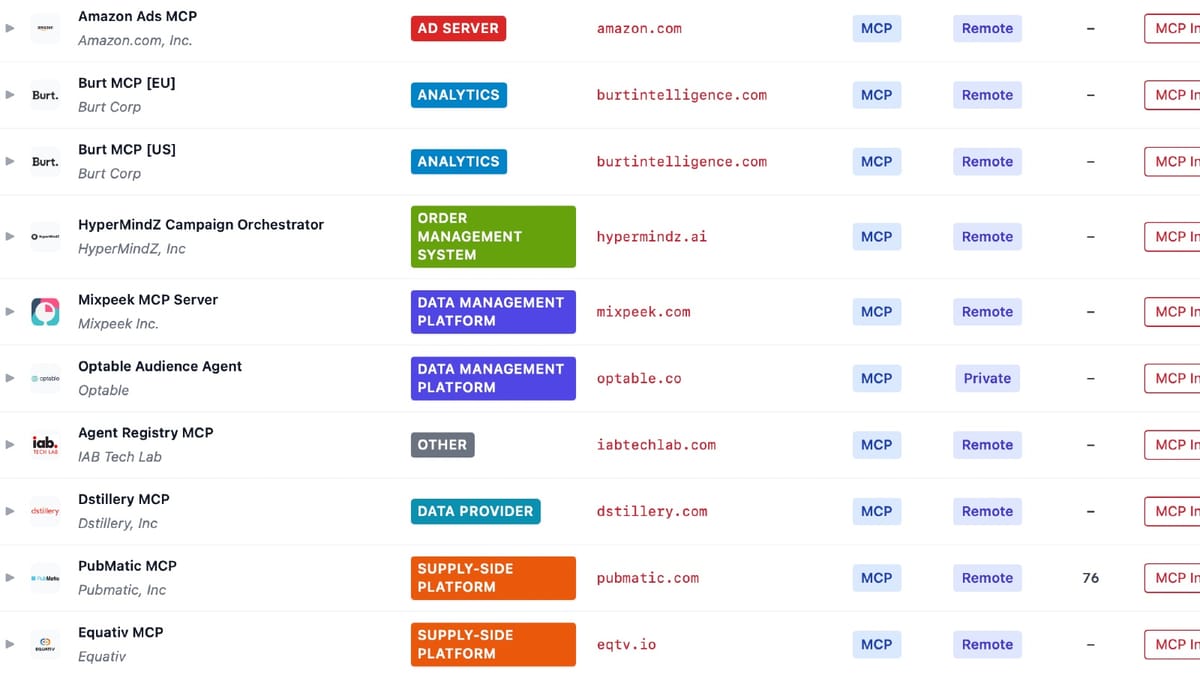
The IAB Tech Lab today expanded its Agent Registry to 10 active entries, adding new participants from Amazon, Burt Intelligence, Optable, Dstillery, and HyperMindZ.ai while introducing a three-tier deployment classification system designed to make agentic advertising infrastructure more discoverable and easier to integrate. The announcement was made by Anthony Katsur, chief executive officer of IAB Tech Lab, in a post published March 11, 2026.
The registry, which sits at the top layer of IAB Tech Lab's Agentic Advertising Management Protocols (AAMP) initiative, now shows 10 total agents, all of them active and all operating under the Model Context Protocol standard. Zero A2A (Agent-to-Agents) entries appear in the registry at this point, with all 10 classified as MCP servers. Registration remains free.
A registry built for a fragmented market
The timing of today's expansion carries context that extends well beyond a headcount update. IAB Tech Lab formally named the AAMP initiative on February 26, 2026, just two weeks ago, clarifying three pillars - execution, protocols, and the Agent Registry itself - and stating that the registry was set to launch "next week" from that date. Today's update represents the registry moving from anticipated to operational with an expanded set of participants.
According to IAB Tech Lab's documentation, the registry "aims to bring trust and transparency to the Agentic Advertising ecosystem." Companies can register their MCP or A2A agents and browse for agents they want to work with. Each agent can be associated with standardized functions to make discovery easier, and each company is validated against its IAB Tech Lab GPP and TCF (Global Privacy Protocol) ID. That verification requirement carries regulatory weight: domain names, legal entities, and privacy compliance IDs must all align before an entry is approved.
As PPC Land documented following the AAMP naming announcement, the Agent Registry addresses a structural problem that neither the Agentic RTB Framework nor the protocol layer can resolve independently. In a programmatic environment where buyer agents negotiate with seller agents autonomously, verifying the legitimacy, capabilities, or behavior patterns of counterparties without an independent record becomes impossible. The registry serves as that record - neutral by design, accessible to all participants, and separate from any individual buyer or seller's proprietary system.
Three deployment types: remote, local, and private
Today's update introduced a new three-tier deployment classification system. According to Katsur's post, the categories are defined as follows:
- Remote: Accessible to anyone via the internet, even if authentication is required. Described as best for hosted services, cloud APIs, and SaaS offerings.
- Local: Must be downloaded and installed locally. Described as best for downloadable software, CLI tools, npm packages, or standalone applications.
- Private: Deployed to a customer's private network or infrastructure. Described as best for enterprise on-premise installations or VPC deployments.
Of the 10 current registry entries, 9 are classified as Remote and 1 - the Optable Audience Agent - is classified as Private. No Local deployments appear in the current registry. That asymmetry reflects the dominant architecture of advertising technology vendors, most of whom deliver services through hosted cloud infrastructure rather than on-premise installations.
The classification system fills a practical gap. Before this update, a company browsing the registry could identify what protocol an agent used and which category it fell into, but lacked a clear signal about how the agent was actually deployed and accessed. A supply-side platform evaluating a data provider's MCP server now knows immediately, from the registry entry alone, whether integration requires internet access, local installation, or a private network arrangement.
Who is in the registry today
The 10 current entries span several distinct functional categories, covering the advertising supply chain from ad serving to data management to campaign orchestration.
Amazon Ads MCP, registered under Amazon.com, Inc., sits in the ad server category and is classified as Remote. Its MCP endpoint is published publicly at https://advertising-ai.amazon.com/mcp with no authentication required. According to the registry's documentation panel, the Amazon Ads MCP Server is "a standardized access layer for AI models and agents," transforming "complex multi-field API operations into simple conversational queries" to make campaign data, performance metrics, billing, and account information accessible to large language models through natural language. The server lists a broad set of tools including campaign_management-delete_target, reporting-create_campaign_report, reporting-create_inventory_report, ads_accounts-create_ads_account, campaign_management-update_ad_association, terms_token-create_terms_token, user_permissions-update_user_permissions, and account_management-update_account_currency, among others. Its maturity is listed as General Availability.
Amazon's MCP Server first launched in closed beta on November 13, 2025, before entering open beta on February 2, 2026 at IAB Annual Leadership Meeting. Its registration in the IAB Tech Lab registry today marks the first time the server appears in a neutral, industry-managed discovery layer rather than solely within Amazon's own infrastructure.
Burt Intelligence appears twice in the registry, with separate EU and US MCP servers, both in the analytics category and both classified as Remote. The dual registration reflects data residency considerations that are increasingly common in European advertising technology deployments. Burt Corp operates under the domain burtintelligence.com.
HyperMindZ Campaign Orchestrator, operated by HyperMindZ, Inc. under hypermindz.ai, sits in the order management system category and is classified as Remote. Order management systems occupy a specific niche in the advertising workflow, managing the contractual and operational side of media buys rather than the auction-based programmatic layer.
Mixpeek MCP Server, by Mixpeek Inc. under mixpeek.com, is categorized as a data management platform and is classified as Remote.
Optable Audience Agent, by Optable under optable.co, is also a data management platform but carries the Privatedeployment classification - the only such entry in the registry. Optable previously appeared as a founding member of the Ad Context Protocol when that initiative launched in October 2025, and the private deployment classification here aligns with the company's focus on privacy-preserving audience infrastructure.
Agent Registry MCP, operated by IAB Tech Lab itself under iabtechlab.com, appears in the other category and is classified as Remote. The registry listing a server for the registry itself creates a meta-layer: an MCP agent can now access the IAB Tech Lab Agent Registry through the registry's own MCP interface, enabling programmatic discovery of registered agents by AI systems.
Dstillery MCP, by Dstillery, Inc. under dstillery.com, is categorized as a data provider and classified as Remote.
PubMatic MCP, by Pubmatic, Inc. under pubmatic.com, is listed as a supply-side platform and is the only entry in the current registry to carry a GPP and TCF ID - number 76. That ID links PubMatic's registry entry to its Global Privacy Protocol registration, connecting the advertising technology supply chain's privacy compliance infrastructure to the agentic discovery layer.
Equativ MCP, by Equativ under eqtv.io, also sits in the supply-side platform category and is classified as Remote.
Technical registration process
The IAB Tech Lab registry accepts entries through a REST API at https://registry.iabtechlab.com/api/agents using a POST request requiring an authorization token. The minimum required fields are agent_name, primary_domain, and endpoint_url. Optional fields include legal_name, protocol_type (which defaults to "mcp" if not specified), gpp_id, category, status, description, and image_url.
Upon submission, the API returns a success response that includes a verification token formatted as iab-agent-verify-abc123def456 and instructions for DNS TXT record verification. Three verification checks are described: gpp_verified, domain_verified, and endpoint_health_verified. In the example success response shown in the documentation, endpoint_health_verified returns true immediately, while GPP and domain verification remain pending following initial registration.
The registration form itself also requires category selection from IAB Tech Lab's taxonomy, contact information including a required email address and optional phone number and support URL, and up to 10 endorsements or certifications. Authentication requirements can be flagged per agent. The registry supports both MCP and A2A protocol types, though no A2A agents have been registered as of today's update.
Feedback and feature requests for the registry are directed to [email protected] or the GitHub repository at https://github.com/IABTechLab/AAMP/issues.
The registry's growth from zero to 10 entries in a matter of weeks reflects how quickly the advertising industry is moving to formalize agentic infrastructure. The absence of a neutral, industry-governed discovery layer has been a recurring concern since multiple agentic protocols converged in a single week in November 2025, when Amazon, Google, and IAB Tech Lab simultaneously announced capabilities without a shared framework for how those capabilities could be discovered and verified by counterparties.
How IAB Tech Lab plans to prevent agentic AI's fragmentation problem has been one of the more persistent questions for the programmatic advertising community since the Agentic RTB Framework entered public comment in November 2025. A registry that validates participants against existing privacy compliance infrastructure - specifically the GPP and TCF IDs that underpin consent management across the industry - provides an accountability mechanism that purely technical protocols cannot offer on their own.
PubMatic's GPP ID 76 appearing in the registry is a small but significant detail. It demonstrates that the verification chain the registry is designed to create - connecting an MCP server's capabilities to a company's legal identity and privacy compliance status - is functioning in at least one case. Whether other entrants without current GPP IDs will complete that verification over time will determine how much of the registry's accountability infrastructure actually gets used in practice.
The deployment classification system introduced today addresses a different but related problem: operational discoverability. Knowing a company has registered an MCP server tells a potential integrator relatively little about how to actually connect to it. Remote, Local, and Private classifications map directly onto integration complexity and security requirements. A media buyer's engineering team evaluating 10 potential data providers can now filter the registry to show only Remote deployments if it lacks the capacity for private network arrangements, or only agents already at General Availability maturity if it needs production-ready integrations.
IAB Tech Lab's CoMP specification released yesterday added a parallel layer requiring AI systems to have commercial agreements with publishers before crawling content. Together, the Agent Registry expansion and the CoMP specification represent two pieces of the same infrastructure challenge: establishing who agents are, what they can do, and under what terms they can access content and data.
Timeline
- October 15, 2025 - Six companies launch Ad Context Protocol, drawing skepticism from IAB Tech Lab CEO Anthony Katsur about protocol fragmentation
- November 3, 2025 - LiveRamp donates User Context Protocol to IAB Tech Lab for agentic advertising infrastructure
- November 13, 2025 - Amazon Ads launches closed beta for its MCP Server, enabling natural language access to advertising APIs
- November 13, 2025 - IAB Tech Lab releases Agentic RTB Framework v1.0 for public comment through January 15, 2026
- November 15-16, 2025 - Amazon, Google, and IAB Tech Lab converge on agentic infrastructure in a single week
- January 6, 2026 - IAB Tech Lab announces comprehensive agentic roadmap extending OpenRTB, AdCOM, and VAST with modern protocols
- February 2, 2026 - Amazon Ads MCP Server enters open beta at IAB Annual Leadership Meeting
- February 26, 2026 - IAB Tech Lab formally names AAMP initiative at Beet Retreat, announces Agent Registry launching imminently
- March 10, 2026 - IAB Tech Lab releases CoMP v1.0 specification requiring AI systems to have commercial agreements before crawling publisher content
- March 11, 2026 - IAB Tech Lab Agent Registry reaches 10 active entries with new deployment classification system; Amazon Ads MCP, Burt Intelligence (EU and US), HyperMindZ, Mixpeek, Optable, IAB Tech Lab Agent Registry MCP, Dstillery, PubMatic, and Equativ all registered
Summary
Who: IAB Tech Lab, led by CEO Anthony Katsur, expanded the Agent Registry with participation from Amazon.com Inc., Burt Corp, HyperMindZ Inc., Mixpeek Inc., Optable, Dstillery Inc., Pubmatic Inc., and Equativ, alongside IAB Tech Lab's own registry agent.
What: The Agent Registry reached 10 active entries, all operating under the Model Context Protocol (MCP). A new three-tier deployment classification system - Remote, Local, and Private - was introduced to help organizations understand how agents are deployed and integrated. Amazon's MCP server, accessible publicly at https://advertising-ai.amazon.com/mcp, is now listed under the ad server category at General Availability maturity.
When: The announcement was made today, March 11, 2026, by Anthony Katsur via LinkedIn, marking the registry's operational expansion following the February 26, 2026 AAMP naming announcement.
Where: The registry is accessible at the IAB Tech Lab Tools Portal at tools.iabtechlab.com, with registration via REST API at https://registry.iabtechlab.com/api/agents. The announcement was made on LinkedIn and tagged with the hashtags #AAMP, #AgenticAdvertising, #Agentic, #AI, #IABTechLab, and #Standards.
Why: The expansion addresses a core infrastructure gap in the agentic advertising ecosystem - the absence of a neutral, industry-governed layer where companies can discover and verify the identity, capabilities, and compliance status of advertising agents. As autonomous agents begin executing media transactions without human intervention, the ability to confirm who those agents are, what they can do, and whether they are registered against valid privacy compliance IDs becomes operationally and legally necessary.
Share this article
The link has been copied!