IAB Tech Lab today released version 1.0 of its Content Monetization Protocol (CoMP) specification for public comment, establishing a technical framework that requires AI systems to have commercial agreements in place with publishers before any content crawling or use occurs. The specification, published on March 10, 2026, will remain open for comment until April 9, 2026.
The move comes as the organization - a non-profit consortium established in 2014 - attempts to address what it describes as a structural gap in the economics of AI: content, unlike chips or power, has no consistent commercial infrastructure governing how it is accessed and compensated.
"AI systems require chips, power, and information. Information is the only input in that equation that does not yet have a consistent commercial infrastructure around it," said Anthony Katsur, CEO of IAB Tech Lab. "If we expect high-quality content to continue fueling AI-driven products, we need clear terms of engagement and a mechanism that supports compensation, accountability, and long-term sustainability. CoMP is designed to help the industry move in that direction."
The announcement marks a significant step in a process that began months earlier. IAB Tech Lab formed the CoMP Working Group on August 12, 2025, following a workshop that drew more than 80 executives from publishers, edge cloud providers including Cloudflare, Fastly, and AWS, and startups building content monetization solutions. The initiative was initially introduced under a different name - the LLM Content Ingest API - before being renamed to better reflect its broader scope.
The scale of the problem
The CoMP framework did not emerge in a vacuum. Publishers have reported search referral traffic losses exceeding 50 percent in some cases, driven by the expansion of AI-generated search summaries that answer queries directly without directing users to source websites. The pattern has accelerated sharply. IAB Tech Lab's own framework documentation notes that AI-driven search summaries reduce publisher traffic by 20-60 percent on average, with niche sites experiencing losses as high as 90 percent.
The problem extends beyond search. A growing share of top websites now block AI crawlers entirely, reflecting widespread frustration with content being scraped and used without permission or compensation. Yet the llms.txt protocol - a proposed standard for publishers to signal AI access preferences - has stalled because no major AI provider, including OpenAI, Anthropic, or Google, currently supports it.
The context is stark. Traffic to established websites fell more than 11 percent over the past five years, as AI platforms reshaped how audiences find information online. Some individual publishers have experienced much sharper losses. IAB Europe has also moved in a parallel direction, releasing its own "Crawling for Compensation" framework in September 2025, establishing three mechanisms for AI platform compensation to publishers across European markets.
How CoMP works technically
The CoMP specification operates through a structured sequence. When an AI bot arrives at a website and requests permission to scrape, the content owner can deny the request if no agreement exists. The bot is then directed to a licensing URL - CoMP points to realsimplelicensing.com as one such destination - where commercial terms can be established.
Once an agreement is in place, the bot sends an access request along with the reason for that request. The content owner acknowledges the request, and an access token is issued to allow content ingestion. This token-based approach creates an auditable record of permissions and usage that does not currently exist under the open web's default architecture.
The protocol is designed to work across both direct licensing arrangements and third-party content marketplaces. Rather than requiring each publisher to build bespoke technical integrations with every AI platform, CoMP establishes a single standardized protocol. A content owner implements CoMP once. AI systems implementing CoMP once gain access to any participating publisher's content under agreed terms.
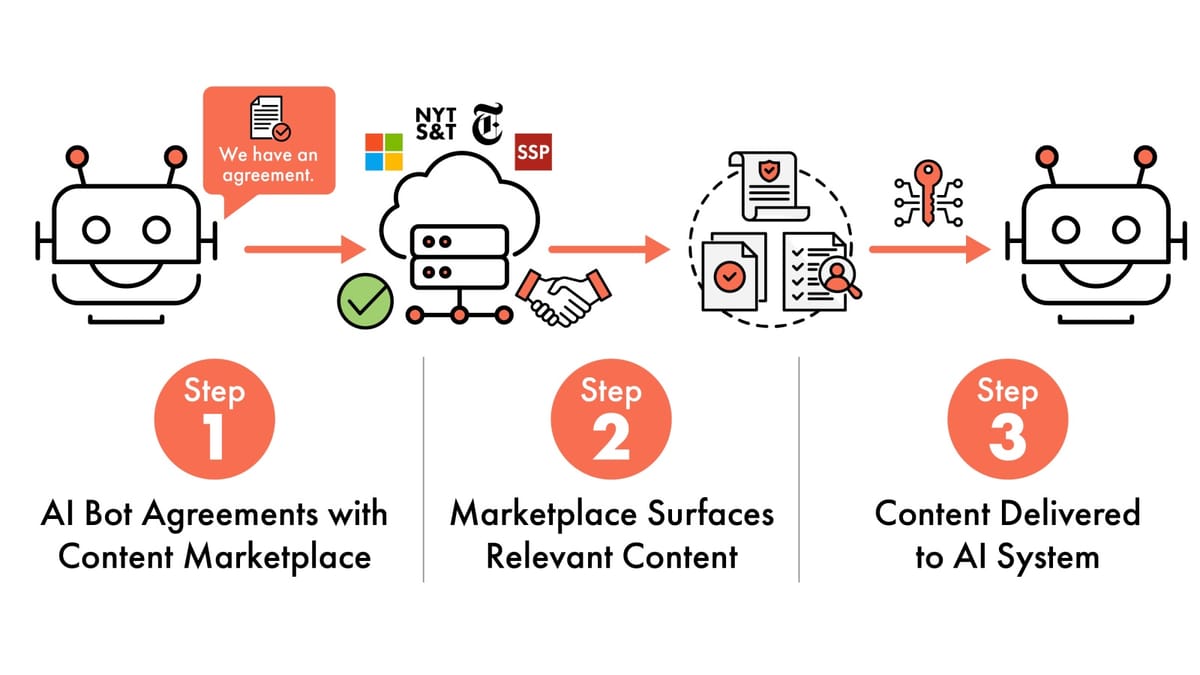
As adoption increases, the framework anticipates a marketplace layer emerging. Under this scenario, AI bots would establish agreements with a marketplace rather than individual publishers. The marketplace would then surface relevant content based on agreed dimensions: relevance, quality, recency, and latency. Content meeting those parameters would be delivered to the AI system for formatting and presentation to end users.
Three distinct monetization models are supported under the specification: pay-per-crawl, aggregation or pay-per-use arrangements, and outcome or attribution-based payment. The CoMP Working Group - which includes representatives from publishers, marketplaces, technology providers, and AI developers - has deliberately avoided mandating a single model, recognizing that different use cases require different economic structures.
Critically, CoMP does not attempt to replace existing access controls. The specification assumes content owners have already established blocking strategies at the delivery layer, such as their Edge Compute or Content Delivery Network(CDN) infrastructure. With that blocking foundation in place, CoMP provides the standardized path from restriction to structured commercial access.
Why brands are also stakeholders
Beyond publishers, the CoMP framework addresses how brands interact with AI systems that increasingly serve as the primary discovery layer between companies and their customers. According to the specification, the LLM Ingest APIcomponent enables AI operators to query a brand's content using natural language prompts, returning content or content paths that enhance brand visibility and customer engagement.
The underlying logic is that AI systems may currently present brand information stripped of context, or in ways the brand has not authorized. CoMP creates a mechanism for brands to participate in how their content surfaces in AI responses, rather than having it extracted and reformatted without oversight. The framework positions AI crawler interactions as something closer to a structured API call than an uncontrolled scraping event.
Industry voices at launch
Organizations across the publishing and advertising technology sector have expressed support for the framework at launch - though with varying degrees of enthusiasm and caveats.
"At The Weather Company, we believe the future of the industry depends on human-centric, AI-driven innovation that prioritizes the end user," said Julianne Jennings, senior director of content and product at The Weather Company. "Our collaboration with the IAB Tech Lab on the CoMP framework is a critical step in establishing a foundation for secured data collaboration that benefits the entire ecosystem. By creating a standardized path for commercial agreements, we ensure our high-fidelity weather data remains effortlessly accessible across activation channels."
Achim Schlosser, VP Global Data Standards at Bertelsmann, framed the release as a necessary infrastructure step. "The first release of the CoMP API marks an important step toward establishing interoperable, transparent standards for fair value exchange in the AI ecosystem, recognizing that AI systems depend on high-quality, trusted content. As an early contributor, we believe scalable, robust compensation frameworks - alongside visibility and attribution for content usage - are essential to sustaining high-quality journalism and premium content in the AI era."
Jon Roberts, Chief Innovation Officer at People Inc., connected the framework to broader global economic structures. "We know the best AI products require the best inputs and the AI economy will need more quality content in the future, not less. A global information economy needs global standards and we have been a supporter of the IAB CoMP initiative from the beginning. We support global standards that help all creators get paid fairly."
Rob Beeler, of Beeler.Tech - a publisher-focused Ad Ops community - acknowledged that the framework does not resolve all outstanding questions. "Publishers should be compensated for the use of their intellectual property - and for the real investment required to produce quality content. While much remains to be figured out about how LLMs will work with publishers, CoMP provides a necessary framework for those discussions, helping us move faster from theory to practice and better protect the future of publishing."
Jennifer Bas, Chief of Staff at Mobian, addressed the trust dimension that sits underneath the technical specification. "As AI systems and agents become the front door to information, they inherit the authority, credibility, and trust of the publishers and brands whose content they learn from and surface. CoMP creates a mechanism for that quality and trust to be valued in the AI supply chain."
The broader IAB Tech Lab context
The CoMP release fits into a wider program of work at IAB Tech Lab addressing the structural implications of AI on digital advertising infrastructure. The organization launched an Agentic RTB Framework version 1.0 for public comment in November 2025, standardizing how containerized agents participate in real-time bidding. In the same period, LiveRamp donated its User Context Protocol to IAB Tech Lab in November 2025, enabling standardized embedding exchanges between autonomous advertising agents.
Separately, the organization published its Programmatic Auction Definitions document in January 2026 and has been actively working on an Agentic Advertising Management Protocols (AAMP) initiative and an Agent Registry. IAB Tech Lab CEO Anthony Katsur warned in late December 2025 that the industry was chasing agentic AI without adequate attention to privacy guardrails, measurement frameworks, and supply chain transparency - themes that run through the CoMP specification's emphasis on accountability and attribution.
The CoMP initiative has not been without critics. An ad tech veteran published a critique in January 2026 arguing that IAB's technical standards work operates on multi-month timelines while publishers face immediate revenue pressures - a tension the organization acknowledged at its Annual Leadership Meeting.
What participation looks like
IAB Tech Lab has extended invitations to AI developers including OpenAI, Anthropic, Google Gemini, Meta, Perplexity, Grok, and other emerging AI agents to participate in shaping the CoMP protocols. Publishers, platforms, edge cloud providers, and technology companies of every size are also invited. The public comment period runs until April 9, 2026. Input from that period will inform updates to the framework before finalization.
Timeline
- August 3, 2024: Over 35% of leading websites block AI crawlers as publisher concerns about content scraping mount
- April 20, 2025: Google's AI Overviews cut organic clicks by 34.5% for top-ranking pages
- July 2, 2025: llms.txt adoption stalls as major AI platforms including OpenAI, Google, and Anthropic decline to implement the standard
- July 30, 2025: IAB Tech Lab hosts workshop with 80-plus executives from publishers and edge cloud providers on AI content scraping
- August 12, 2025: IAB Tech Lab announces formation of the Content Monetization Protocols (CoMP) Working Group, previously called the LLM Content Ingest API
- August 9, 2025: Google Discover surpasses traditional search as dominant traffic source for news websites
- September 14, 2025: IAB Europe releases "Crawling for Compensation" framework establishing three mechanisms for AI platform compensation to European publishers
- November 13, 2025: IAB Tech Lab releases Agentic RTB Framework v1.0 for public comment through January 15, 2026
- November 3, 2025: LiveRamp donates User Context Protocol to IAB Tech Lab for agentic advertising infrastructure
- December 30, 2025: IAB Tech Lab CEO Anthony Katsur warns industry against chasing agentic AI without resolving privacy and supply chain transparency issues
- January 3, 2026: Traffic to established websites fell more than 11% over five years as AI platforms redistributed audience flow
- January 15, 2026: Ad tech veteran criticizes IAB's 2026 agenda for prioritizing long-term standards over immediate publisher revenue needs
- March 10, 2026: IAB Tech Lab releases CoMP Specification v1.0 for public comment; comment period runs through April 9, 2026
Summary
Who: IAB Tech Lab, the global non-profit digital advertising technical standards organization established in 2014, with participation from industry supporters including The Weather Company, People Inc., Bertelsmann, Beeler.Tech, and Mobian.
What: The release of CoMP (Content Monetization Protocol) Specification v1.0 for public comment - a standardized technical framework requiring AI systems to establish commercial agreements with publishers before crawling or using their content, supporting pay-per-crawl, aggregation, and outcome-based monetization models.
When: Published on March 10, 2026. The public comment period runs through April 9, 2026, after which the specification will be updated based on feedback and finalized.
Where: The specification is globally applicable and available at https://iabtechlab.com/comp/. The framework is designed to function across direct licensing arrangements and third-party content marketplaces, with implementation at the edge compute or CDN layer.
Why: Publishers have experienced search referral traffic declines exceeding 50 percent in some cases, driven by AI-generated search summaries and uncontrolled content scraping. The CoMP framework attempts to create the commercial infrastructure that currently does not exist for content as an input to AI systems - addressing compensation, attribution, and accountability for the use of publisher intellectual property in AI-driven products.
Share this article
The link has been copied!