
Luma AI puts $1M on the line for creatives to crack Cannes Lions with AI
Luma AI today revealed an 18-person jury for its Dream Brief competition offering $1 million to any team that wins a 2026 Cannes Lions Gold Lion using its platform.

Luma AI today revealed an 18-person jury for its Dream Brief competition offering $1 million to any team that wins a 2026 Cannes Lions Gold Lion using its platform.
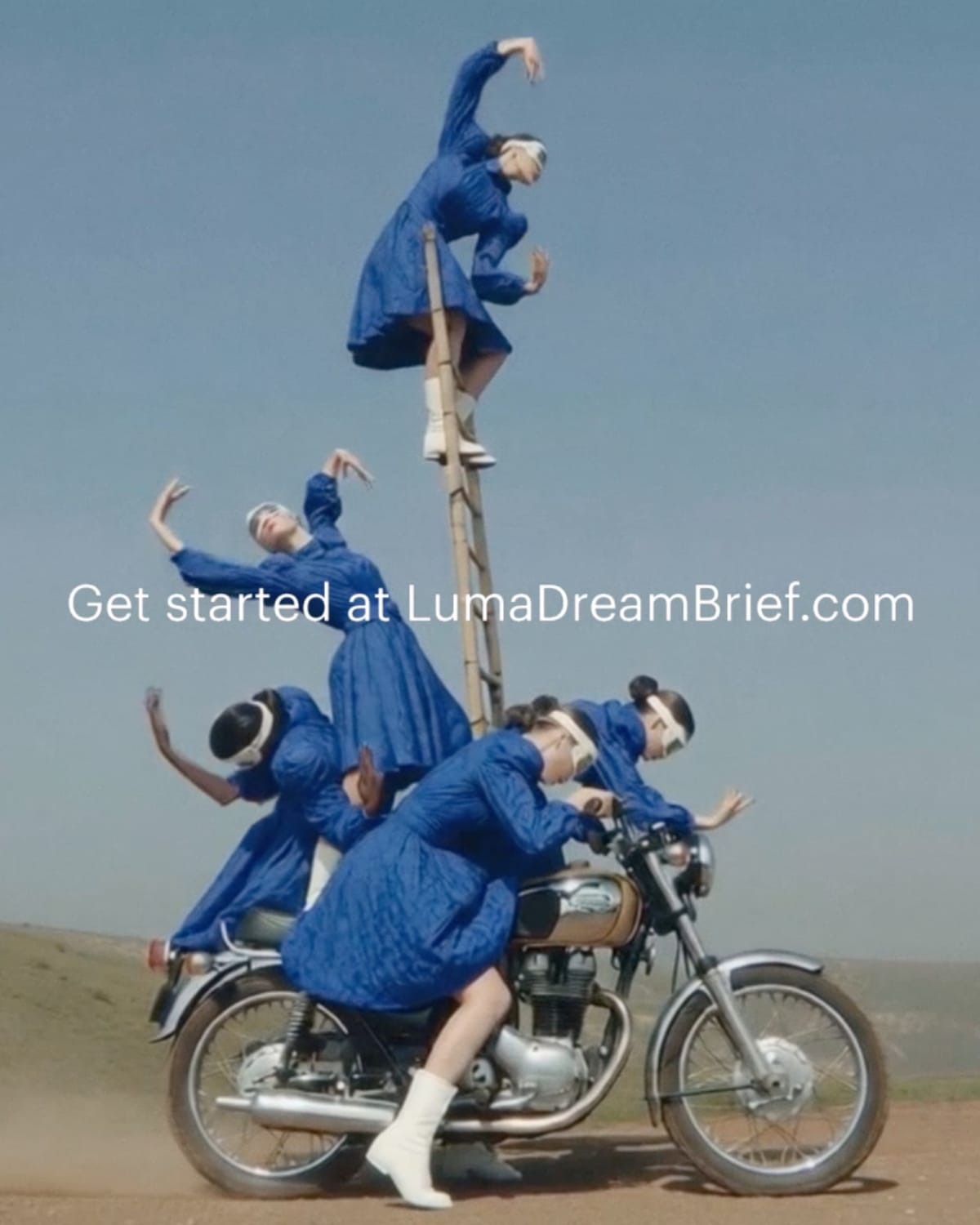
Luma AI today announced the jury for The Luma Dream Brief, a global creative competition that will award $1 million to any team that wins a Gold Lion at the 2026 Cannes International Festival of Creativity using Luma AI tools. The Palo Alto, California-based company named 18 industry figures drawn from advertising, brand building, entertainment, and culture to evaluate entries.
The competition, which opened on February 2, 2026, accepts submissions until March 22, 2026 at 11:59:59 PM Pacific Time. Featured submissions will be announced April 9, 2026, with the grand prize determination resting on results from the Cannes Lions festival in June 2026.
The 18-person panel reads like a cross-section of the past two decades of award-winning commercial work. Susan Hoffman, Chief Creative Officer at Wieden+Kennedy, joins George Felix, Chief Marketing Officer of Chili's Grill & Bar, and Katie Gurgainus, Global Director of Brand Voice at Nike. Lesya Lysyj, CMO of Boston Beer, sits alongside Michael Hagos, VP of Brand Creative at HBO Max. Bill Oakley, a writer on The Simpsons, and Isaiah Mustafa, the actor best known for Old Spice campaigns, give the panel a wider entertainment dimension that extends beyond traditional agency circles.
Other jurors include Jeff Kling, Founder and CCO of Das Favorite; John Deschner, Head of Brand at Maximum Effort; Jon Williams, Founder and CEO of The Liberty Guild; Tara Lawall, CCO and Partner at Rethink; Melissa Cabral, Head of Strategy at Sid Lee; Richard Turley, Editorial Director of Interview Magazine; Lora Schulson, Global Chief Production Officer at 72 and Sunny; Mal Ward, Managing Director and Partner at Arts & Sciences; Carol Dunn, Managing Director at Barking Owl; and Alicia Nassardeen, Head of Business Affairs at Mother.
According to Caroline Ingeborn, COO of Luma AI, "This group of people have shaped modern brands, entertainment, and culture at the highest level. These are leaders who've built iconic work and understand what it takes to move an industry forward. Bringing that caliber of talent together sends a clear signal: this is about redefining what world-class creative looks like in the next era."
The jury will evaluate submissions on the platform and select finalists for formal Cannes Lions entry. Luma AI will then pay all required Cannes festival submission fees on behalf of selected entrants.
The competition was developed in collaboration with brand experience company studio DEYAN. Its Chief Creative Officer, Jason Kreher - formerly of Wieden+Kennedy, Maximum Effort, and Accenture Song - built the contest around a tension that runs through most advertising careers. According to the press release, Kreher shaped it "around a frustration familiar to anyone who has worked in the industry - the premise that some of advertising's best ideas never get made - not for lack of originality, but because they are perceived as too risky, expensive, or difficult to execute."
Kreher described his anticipation of the jury process: "I cannot wait to see what happens when we get this bench of insanely talented and also insane industry leaders into the proverbial room. There is a genuine intellectual curiosity and diversity of thought among these judges, and with the work I've already seen being submitted, the discourse is going to get loud and weird."
The logic is deliberate. By pairing ambitious creative ideas with generative video and image tools capable of producing complex visuals at a fraction of traditional production costs, the contest aims to surface work that would otherwise remain unbuilt. Two practical barriers have historically separated bold creative concepts from legitimate awards consideration: the need for a paying client brief and the need for paid media support. Luma AI is removing both. The company will provide an official client brief and cover paid media so that winning entries run publicly within the required Cannes eligibility timeframe.
The contest terms specify that submissions must be at least 10 seconds long and comprised of at least 70% material generated using Luma AI's platform. Entries must advertise, feature, or promote Luma AI - though the product being sold can be fictitious, such as Luma Candy or Luma Insurance. Non-English entries must include English subtitles. Submissions may not include watermarks or social media handle text on screen.
Video specifications require files in .mp4, .mov, or .mpeg format. The codec must be MJPEG H264. Minimum resolution is 720x400 pixels; maximum is 1920x1080 HD. File size should not exceed 8 GB. Audio requirements specify 48kHz sound, either PCM uncompressed, MP3, or AAC at above 160 kBit/s where possible. Duration is capped at a recommended maximum of 180 seconds, though any entry must exceed 10 seconds. Progressive, deinterlaced footage is recommended.
Entrants must submit via a YouTube link uploaded to lumadreambrief.com, along with a downloadable link, a credits list, a brief description, and a link to their Luma AI board. Teams are permitted, though Luma AI will correspond only with the designated team leader, who is responsible for distributing any prize among members.
The $1 million prize is not guaranteed. According to the contest terms, if no featured submission wins a Gold Cannes Lion, Luma AI reserves the right to award no grand prize at all. If multiple Luma entries win Gold Lions, the $1 million is split equally among winners. All taxes on the prize remain the sole responsibility of the recipient.
Eligibility excludes legal residents of Belarus, Cuba, India, Iran, Myanmar/Burma, North Korea, Russia, Sudan, Syria, Turkey, Vietnam, Crimea, and the Donetsk and Luhansk regions. Entrants must be at least 18 years old. Employees, officers, or contractors of Luma AI and its affiliates are ineligible for the grand prize.
Participants retain ownership of their underlying creative idea - the "Best Unmade Idea" - though by submitting they grant Luma AI a non-exclusive, irrevocable, royalty-free worldwide license to use, distribute, and publicly display the submission in connection with the contest and paid media activity.
Entrants are responsible for ensuring all materials, characters, and assets in their submissions are cleared for use. No celebrities or famous licensed music may appear. Copyright clearance is the entrant's responsibility, not Luma AI's.
Luma AI's flagship platform, Dream Machine, enables users to generate professional-grade video and images through generative AI. In 2025 the company released Ray3, described in its announcement as "the world's first reasoning video model capable of creating physically accurate videos, animations, and visuals." The company's technology is used by entertainment studios, advertising agencies, and technology partners including Adobe and AWS, and is available via subscription or API.
Adobe's partnership with Runway in December 2025 illustrated the increasingly competitive landscape among generative video providers vying for placement inside professional creative workflows - a market Luma AI is also actively pursuing. The IAB reported in July 2025 that 86% of buyers currently use or plan to implement generative AI for video advertisement creation, with the study projecting that AI-generated creative will account for 40% of all advertisements by 2026.
Luma AI is backed by HUMAIN, Andreessen Horowitz, Amazon, AMD Ventures, NVIDIA, Amplify Partners, Matrix Partners, and individual investors from across technology and entertainment. The company is headquartered at 715 Alma St, Palo Alto, California 94301.
The Dream Brief sits at an intersection that has been building pressure for years. Generative AI tools have dramatically reduced the cost of producing complex video visuals. Research published on PPC Land showed that AI-assisted commercial production can compress timelines from weeks to roughly 10 days while cutting costs by up to 60%. Google's Asset Studio, launched in September 2025, lets advertisers generate and edit video assets directly within Google Ads using Veo and Imagen 4 models. Meta announced expanded AI video generation at Cannes Lions in June 2025. The tools are proliferating fast.
What Luma AI's competition adds is a different question: can AI-assisted production unlock creative ideas that were shelved not for lack of originality, but because the industry's cost structure made them too difficult to justify? That argument has implications for agencies, independent creatives, and brand marketers who hold years of unbuilt work. The Cannes Lions Gold Lion is one of advertising's most rigorous benchmarks. If any submission made using Luma AI wins that award, it would constitute a meaningful data point in an industry still debating how much weight to assign AI-generated creative in professional contexts.
A study on PPC Land found that AI-generated advertisements perform comparably to human-made creative in click-through rate terms - so long as they do not appear obviously AI-generated. The perception gap remains a live challenge. Whether the Dream Brief jury will surface work that clears that bar is an open question, but the jury composition - which spans production companies, brand CMOs, agency creatives, and entertainment writers - suggests evaluations will not be confined to novelty alone.
Related PPC Land coverage
Who: Luma AI, a Palo Alto-based generative AI company backed by HUMAIN, Andreessen Horowitz, Amazon, NVIDIA, and others, along with 18 jurors from Nike, HBO Max, Wieden+Kennedy, Chili's, Boston Beer, The Simpsons, and other organizations.
What: The Luma Dream Brief - a global creative competition offering up to $1 million to any team that wins a Gold Lion at the 2026 Cannes Lions International Festival of Creativity by creating a commercial using Luma AI's generative video and image platform. Submissions must be at least 70% AI-generated using Luma AI, at least 10 seconds long, and must advertise a Luma-branded product. Luma will provide a client brief, pay Cannes entry fees, and run winning commercials as paid media.
When: The competition opened February 2, 2026. The jury was announced today, February 25, 2026. Submissions close March 22, 2026. Featured entries are announced April 9, 2026. The grand prize is determined at Cannes Lions in June 2026.
Where: The competition is open to creatives worldwide, excluding residents of certain jurisdictions including Belarus, India, Iran, Russia, Syria, Turkey, and others. Submissions are made at lumadreambrief.com. The contest is governed by California law, with venue in San Francisco. Luma AI is headquartered at 715 Alma St, Palo Alto, CA 94301.
Why: The competition was designed around the observation that many strong advertising ideas are never produced because they are perceived as too expensive or risky to execute. By combining creative ambition with AI tools that can realize complex visuals at lower cost, the contest aims to bring previously unbuilt ideas into existence and test whether AI-assisted production can produce work that meets the standards of advertising's most established award programs.