Meta Ads Library adds WhatsApp filter and low impression labels
Meta Ads Library introduced WhatsApp platform filtering and low impression count labels, enhancing competitive research capabilities for digital advertisers.


Meta Ads Library introduced WhatsApp platform filtering and low impression count labels, enhancing competitive research capabilities for digital advertisers.
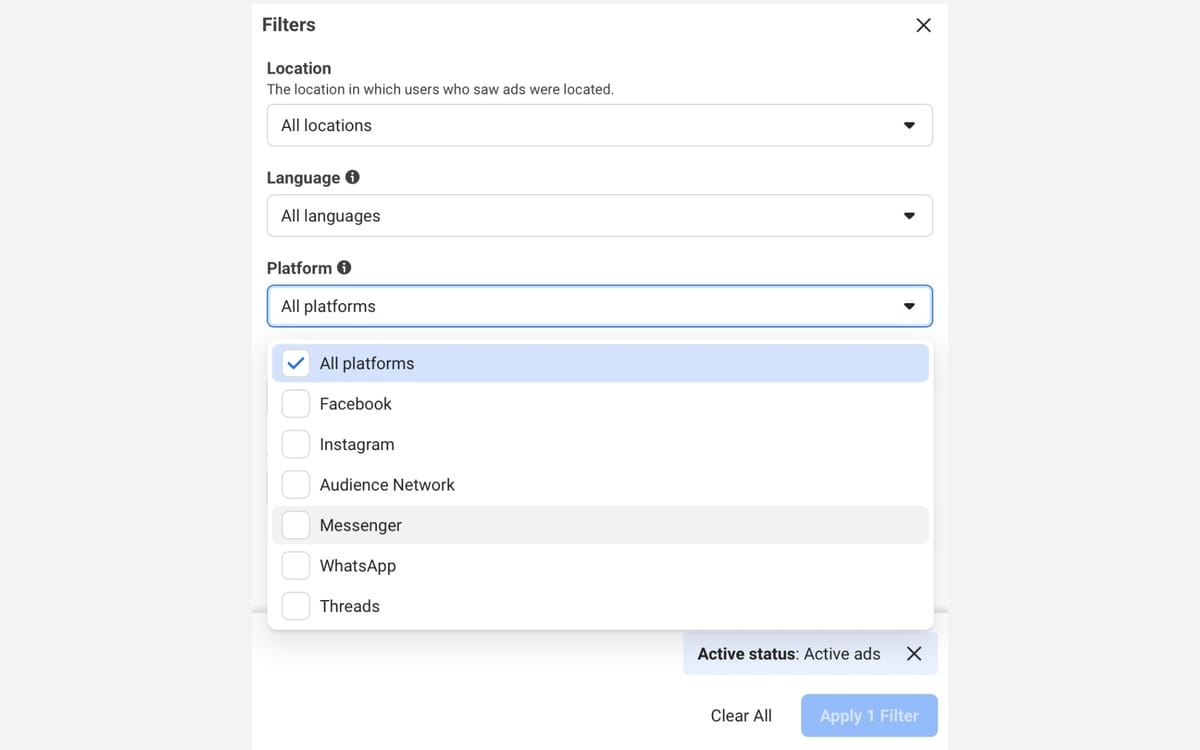
Meta introduced two substantial updates to its Ads Library interface on December 22, 2025, expanding competitive intelligence capabilities for advertisers researching campaign strategies across the social media platform's expanding ecosystem. The changes include WhatsApp as a filterable platform option and a new low impression count indicator for advertisements generating fewer than 100 impressions.
According to digital marketing specialist Bram Van der Hallen, who documented the updates in a LinkedIn post on December 22, advertisers can now filter advertisements specifically by the WhatsApp platform within Meta's Ads Library. The addition follows Meta's recent introduction of Threads as a filterable platform option, creating a more comprehensive view of where competitors allocate advertising resources across Meta's entire family of applications.
The WhatsApp filter enables advertisers to identify which competitors maintain active advertising campaigns on the messaging platform. Meta began introducing WhatsApp Status advertisements in June 2025, utilizing personal data from connected Instagram and Facebook accounts to target the platform's 1.5 billion daily users. The company reported during its second quarter 2025 earnings that WhatsApp advertising launched globally with a limited set of advertisers, though the platform acknowledged structural monetization challenges due to geographic concentration in markets with lower advertising spend per capita.
Subscribe PPC Land newsletter ✉️ for similar stories like this one
The low impression count label represents a critical addition for competitive analysis workflows. Meta now displays a badge indicating "Low impression count" on advertisements that have accumulated fewer than 100 impressions since launch. The label appears alongside existing metadata including the advertisement's start date and total active time measured in hours.
Van der Hallen's documentation shows an advertisement carrying the low impression count indicator alongside notation that it "Started running on Dec 22, 2025" with "Total active time 19 hrs" and "Impressions: <100." This temporal context allows researchers to distinguish between newly launched campaigns still in early delivery phases and advertisements that failed to generate significant reach despite extended active periods.
The distinction between low-performing established campaigns and recently launched advertisements matters significantly for competitive intelligence workflows. Advertisers frequently analyze competitor creative approaches to identify successful messaging strategies and format choices. Without temporal context, a low impression count might suggest poor performance when the advertisement simply hasn't accumulated sufficient delivery time.
Meta's Ads Library functions as a searchable repository of active and recently completed advertisements running across Facebook, Instagram, Messenger, Audience Network, WhatsApp, and Threads. The platform provides visibility into advertiser identities, advertisement creative assets, targeting approaches, and spending ranges for political advertisements. Digital advertising platforms maintain these transparency repositories partly in response to regulatory requirements and partly to address industry demands for competitive visibility.
The low impression count threshold of 100 impressions reflects Meta's internal classification systems for advertisement delivery performance. Campaigns typically enter a learning phase during initial deployment as Meta's algorithms gather performance signals to optimize delivery. Low impression volumes during this learning period represent normal behavior as the system evaluates which audiences respond most favorably to specific creative approaches.
Marketing professionals utilize ad libraries for multiple strategic purposes beyond simple creative inspiration. Systematic monitoring reveals competitor spending patterns, geographic targeting priorities, seasonal campaign timing, format preferences across platforms, and creative refreshment frequency. Third-party analytics platforms have emerged to aggregate this publicly available data into more sophisticated competitive intelligence dashboards.
The WhatsApp platform filter arrives as Meta continues expanding monetization options across its messaging properties. The company introduced marketing message optimizations leveraging artificial intelligence to analyze subscriber lists and recommend optimal recipients for specific campaign objectives. Brazilian financial technology companies participating in testing saw 30% reductions in cost per page view alongside 20% increases in click-through rates.
Meta's advertising infrastructure generated $46.6 billion during the second quarter of 2025, representing 22% year-over-year growth. Ad impressions across Meta's family of applications increased 11% while average price per advertisement rose 9%, demonstrating strong advertiser demand. WhatsApp advertising represents a smaller component of this revenue base due to geographic mix challenges, with the platform's user base concentrated in Southeast Asia and Latin America where advertising spend per capita remains lower than markets like North America and Western Europe.
The platform filtering capabilities within Meta's Ads Library now encompass six distinct properties: Facebook, Instagram, Audience Network, Messenger, WhatsApp, and Threads. Each platform maintains different advertisement format specifications, creative requirements, and audience demographics. Facebook supports comprehensive advertisement formats including video, carousel, collection, and dynamic product advertisements. Instagram emphasizes visual creative with strong performance from Stories and Reels formats. Messenger enables conversational advertising through sponsored messages and click-to-message campaigns.
Buy ads on PPC Land. PPC Land has standard and native ad formats via major DSPs and ad platforms like Google Ads. Via an auction CPM, you can reach industry professionals.
Threads advertising launched globally in April 2025, initially supporting only single image and video formats before Meta expanded capabilities to include carousel advertisements and Advantage+ catalog advertisements in October. The platform's 400 million monthly active users represent a substantial audience base, though Meta cautioned that advertisement supply remains constrained and the platform won't contribute meaningfully to overall impression growth in the near term.
WhatsApp's advertisement implementation differs substantially from Meta's other properties. Status advertisements appear within the Updates tab rather than within private message threads, maintaining the platform's core value proposition around private communication. Meta emphasized that personal messages, calls, groups, and contact information remain excluded from advertising algorithms. The company stated phone numbers will never be sold or shared with advertisers.
The European Centre for Digital Rights raised questions about WhatsApp advertising's legality under the Digital Markets Act and General Data Protection Regulation. Max Schrems, chairman of the privacy advocacy organization, argued that linking data across Meta platforms without freely given consent violates European Union requirements. The organization highlighted concerns about Meta's Pay or Okay model, where users face monthly fees to access Instagram or Facebook without advertisements.
Competitive intelligence gathering through advertisement libraries has evolved into standard practice across digital marketing organizations. Agencies and in-house teams maintain systematic monitoring programs tracking competitor advertisement launches, creative approaches, messaging evolution, and platform prioritization. This research informs strategic planning around budget allocation, creative development, and platform selection.
The low impression count indicator addresses a longstanding gap in advertisement library functionality. Researchers previously lacked context about whether advertisements with minimal visibility reflected deliberate targeting to narrow audiences, recent launch timing, or poor campaign performance. The new label provides this disambiguation, though advertisers must still evaluate the total active time metric to determine whether low impressions stem from recency or delivery challenges.
Meta's Creative breakdown feature introduced in July 2025 provides advertisers with granular performance insights into Flexible formats and AI-generated images. This transparency represents a broader strategic shift as Meta addresses advertiser demands for visibility into algorithmic optimization processes. The Ads Library updates continue this trajectory toward enhanced transparency, though the repositories still display only creative aspects of campaigns without revealing complete performance metrics.
Advertisement libraries cannot replace comprehensive competitive analysis. The repositories show what competitors test but not which approaches generate optimal results. Marketing teams should complement library research with broader market analysis, customer research, and systematic campaign testing to validate insights drawn from competitor creative monitoring.
Meta continues developing its advertising infrastructure with substantial investments in artificial intelligence and automation capabilities. Advantage+ sales campaigns demonstrate 22% average return on ad spend improvements, while backend AI innovations like GEM improve advertisement conversions by up to 5%. The platform completed global rollout of streamlined campaign creation flows that activate Advantage+ by default for sales and application campaigns.
The Ads Library interface modifications reflect Meta's ongoing product development across its advertising ecosystem. The company maintains separate documentation for advertisers, developers, and researchers accessing the transparency repository. The platform provides application programming interfaces enabling programmatic access to advertisement data for research purposes, though these interfaces carry rate limiting and authentication requirements.
Marketing professionals monitoring the Ads Library should note that advertisement visibility depends on multiple factors beyond impression volume. Meta's delivery systems evaluate relevance scores, auction competitiveness, budget constraints, and audience availability when determining advertisement distribution. Low impression counts may reflect any combination of these factors rather than simple creative performance.
The integration of WhatsApp into Meta's advertisement library follows the platform's broader strategy of unified measurement and reporting across its family of applications. Value rules functionality enables advertisers to adjust bids based on age, gender, operating system, location, and placement factors across Facebook, Instagram, Messenger, and WhatsApp. This cross-platform optimization reflects Meta's architectural approach treating its properties as an interconnected advertising system rather than independent platforms.
Advertisement transparency requirements vary substantially across jurisdictions. European regulations mandate detailed disclosure of advertisement targeting parameters, spending ranges, and sponsoring entities. The Digital Services Act imposes specific obligations on designated platforms regarding advertisement repositories and researcher access. Meta faced enforcement actions when the European Commission identified transparency violations, though those penalties targeted a competing platform rather than Meta's properties.
The December 22 updates arrive as advertisers prepare for 2026 planning cycles. Marketing teams typically conduct competitive analysis during fourth quarter periods to inform budget allocation and strategic planning for subsequent years. Enhanced Ads Library functionality enables more comprehensive competitor monitoring during these critical planning windows.
Meta's advertising platform processed millions of auction decisions daily across its ecosystem. The complexity stems from integration across multiple social media properties and extensive data collection capabilities supporting audience targeting. Automated optimization systems utilize artificial intelligence and machine learning algorithms to adjust campaign settings, bidding strategies, and advertisement delivery based on predicted audience behavior patterns.
The WhatsApp platform's addition to filterable options creates opportunities for marketers to track early adoption patterns among competitors. As WhatsApp advertising scales throughout 2026, systematic monitoring will reveal which industries and business categories prioritize the messaging platform for customer acquisition and engagement campaigns. Geographic analysis may also surface regional differences in WhatsApp advertising adoption based on the platform's varying penetration rates across global markets.
Subscribe PPC Land newsletter ✉️ for similar stories like this one
Subscribe PPC Land newsletter ✉️ for similar stories like this one
Who: Meta Platforms introduced the updates affecting digital marketing professionals, competitive intelligence analysts, advertising agencies, and brands conducting research through the Meta Ads Library transparency tool.
What: Meta added two features to its Ads Library: a WhatsApp platform filter enabling advertisers to isolate advertisements running on the messaging application, and a low impression count label appearing on advertisements that generated fewer than 100 impressions, providing context about campaign reach and delivery phase.
When: Digital marketing specialist Bram Van der Hallen documented the updates on December 22, 2025, with the features appearing in the Ads Library interface at 19 hours after an example advertisement's launch.
Where: The updates apply globally within Meta's Ads Library interface accessible at facebook.com/ads/library, affecting research capabilities for advertisements running across Meta's family of applications including Facebook, Instagram, Messenger, Audience Network, WhatsApp, and Threads.
Why: Meta implemented these transparency enhancements to provide advertisers with more granular competitive intelligence capabilities as the company expands monetization across additional platforms, particularly WhatsApp and Threads, while addressing the need for contextual information distinguishing newly launched campaigns from underperforming advertisements during research workflows.