Meta on March 6, 2026 submitted its third annual Digital Markets Act compliance report to the European Commission, alongside a non-confidential public summary and a separately audited overview of its consumer profiling techniques. The filings, spanning 79 pages in the main compliance report, mark the most technically detailed account yet of how Meta is reshaping its advertising and data infrastructure across Facebook, Instagram, WhatsApp, Messenger, and Meta Ads in response to European digital market rules.
The submission was announced publicly by Andre Mintz, Meta's DMA Head of Compliance, in a LinkedIn post dated March 6. "Today, I'm proud to share that we submitted our third DMA compliance report on March 6th as part of our commitment to demonstrating how we continue to comply with the DMA," Mintz wrote. At the same time, Meta published the non-confidential summary of its Consumer Profiling Techniques Audit report, a document required under Article 15 of Regulation (EU) 2022/1925 and independently audited before submission.
For the marketing and advertising community, the filings contain material detail on how Meta's ad auction mechanics, consumer consent flows, data portability tools, and messaging interoperability have evolved since the 2025 compliance report. They also confirm that WhatsApp advertising is imminent in the EU, and that Meta is appealing a €200 million fine imposed by the Commission in April 2025.
What the 2026 report covers
The compliance report addresses Meta's obligations under Articles 5, 6, and 7 of the DMA in respect of its five designated core platform services (CPSs): Facebook, Instagram, Meta Ads, Facebook Messenger, and WhatsApp. Facebook Marketplace no longer appears among them. According to the filing, on April 23, 2025, the Commission de-designated Facebook Marketplace as a core platform service - a move Meta describes in the report as "welcomed." The company notes this outcome is consistent with a position it communicated to the Commission both before and after the initial designation in September 2023.
The document is structured around the articles that apply to Meta. Some obligations - Articles 5(4), 5(5), 5(6), 5(7), and 6(13) - are listed as already fully compliant since the date of designation. Others, notably Article 5(2) on consent for data combination and Article 7 on messaging interoperability, receive the most extensive treatment and have involved the most significant product changes during the 2025-2026 compliance period.
The personalized ads dispute and the €200m fine
The most contested section of the 2026 report concerns Article 5(2), which governs how Meta may combine personal data across its services to personalize advertising. This obligation has been at the center of an escalating standoff between Meta and the Commission since at least 2023.
According to the compliance report, Meta launched its Subscription for No Ads service in November 2023 in response to Article 5(2) requirements. The Commission subsequently determined that this model did not comply with its interpretive framework for the article. Meta disagreed and continued dialogue with the Commission while, in November 2024, launching an additional Less Personalized Ads option. This option, according to the filing, uses 90% less data than personalized ads and constitutes what Meta describes as a non-behavioral advertising alternative.
Despite this, in April 2025, the Commission issued a decision finding Meta's Subscription for No Ads model non-compliant and imposed a €200 million fine. According to the compliance report, "Meta fundamentally disagrees with the Commission's decision and has appealed." The appeal is ongoing.
The report simultaneously documents the subsequent evolution of the Less Personalized Ads experience. According to the document, "Meta rolled out revised and updated choice flows to all users starting in January 2026." All eligible users who select the ad-supported service are now required to choose between personalized ads and less personalized ads. A further non-dismissible reminder is scheduled for January 2027 for users who clicked "OK" on the LPA choice screen without making a selection.
The pricing structure for the subscription alternative has also been updated. According to the report, desktop subscribers are currently charged €5.99 per month for an initial account in Accounts Center, with an additional €4 per month for each subsequent account, or €3 per month for a WhatsApp account added to the same Accounts Center. iOS and Android subscribers pay €7.99 for an initial account and €5 per month for additional accounts, or €4 per month for a WhatsApp account, to reflect app store charges from Apple and Google.
For advertisers, the technical architecture of ad delivery remains grounded in a four-step consumer profiling pipelinedescribed in the separately published Consumer Profiling Techniques document. The steps are: inventory assembly, signal gathering, prediction via ML models, and scoring to determine ad placement. According to that document, "tens of millions of ads are continuously checked, ranked, and indexed" before a user even generates an ad request. At the point a user opens or refreshes an app, an ad request is generated. The pre-request pool is then narrowed by advertiser selections, image quality, and past performance data, among other factors. The Consumer Profiling Techniques document, dated March 6, 2026, notes that as of January 6, 2026, Meta Ads remains the CPS to which advertising profiling applies.
Advertisers operating in the EU should note that Meta's less personalized ads option has been progressively refined since its November 2024 launch, and the January 2026 choice flow rollout means that virtually all EEA users have now been presented with a binary decision between personalized and less personalized advertising.
WhatsApp ads arriving in the EU
One of the most commercially significant disclosures in the 2026 report is the confirmation that Meta is preparing to launch advertising on WhatsApp Channels and Status in the European Union "in the coming weeks" from the date of filing - March 6, 2026. According to the compliance report, "Meta has already previewed to the European Commission that it is rolling out ads on WhatsApp Channels and Status in the EU in the coming weeks." The filing states that personal messages, calls, and status updates remain fully end-to-end encrypted and that no ads will appear in users' personal chats.
This development follows WhatsApp's June 2025 global announcement that Status advertising would use signals from connected Instagram and Facebook accounts to target the platform's 1.5 billion daily users in the Updates tab. The EU rollout had been pending regulatory review given the complexities of Article 5(2) and the DMA consent requirements for cross-service data combination. According to the 2026 report, Meta has "carefully designed this ads experience to ensure that it complies fully with Meta's regulatory obligations, including incorporating carefully designed choice flows into the user experience."
For media buyers, this is a material change. WhatsApp has historically been an organic or paid-click-to-chat channel in the EU. Ads on Status and Channels will open programmatic and direct-response placements on a platform used daily by hundreds of millions of European users.
WhatsApp joins Accounts Center, enabling cross-app data consent
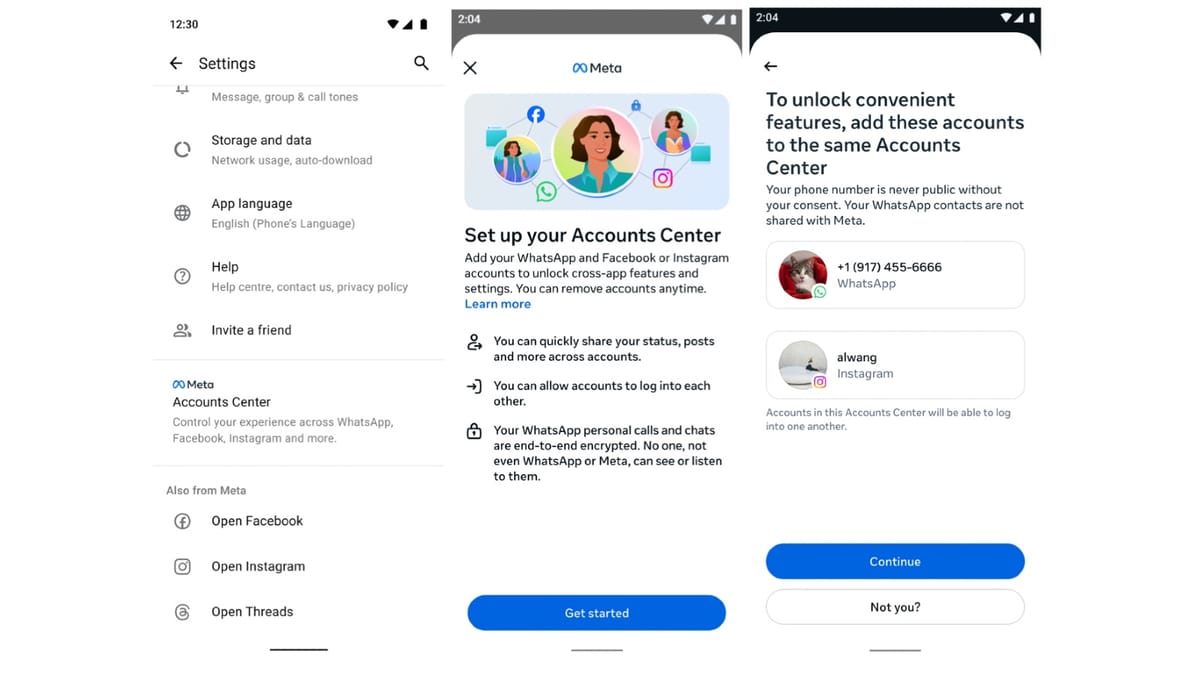
A second major update concerns the integration of WhatsApp into Accounts Center. Until the 2025-2026 compliance period, Accounts Center - Meta's centralised hub for consent over cross-app data combination - covered Facebook and Instagram but not WhatsApp. That has changed. According to the compliance report, Meta now presents EU, EEA, and Swiss users with the choice to add their WhatsApp account to the same Accounts Center as Facebook and Instagram, enabling or withholding consent for data combination across all three services.
The technical implementation follows the same structure as the Facebook-Instagram Accounts Center flow. Users who add WhatsApp to their Accounts Center can benefit from cross-app experiences including shared profile photos, avatars, and cross-posting. Those who decline will not have their WhatsApp data combined with other Meta services. According to the report, "if the user declines to give their consent to the combination and use of their personal data across Facebook, Instagram and/or WhatsApp via Accounts Center, Meta will not combine or use their personal data across those accounts."
This is directly relevant to advertisers. Meta's advertising targeting in the EU now operates on a consent basis across all three major apps. Users who have opted into Accounts Center can be targeted with cross-app signals. Those who have not are served ads based only on single-app data, or with the less personalized option using minimal signals.
Messaging interoperability: BirdyChat, Haiket, and group messaging
Article 7 of the DMA requires Meta to make the basic functionalities of WhatsApp and Facebook Messenger interoperable with third-party messaging services. The 2026 report documents significant progress since the first interoperability launches in 2024.
According to the compliance report, as of November 2025, Meta has partnered with two third-party providers - BirdyChat (fully launched) and Haiket (in advanced beta testing) - to deliver interoperable messaging with WhatsApp in the EU. PPC Land covered this launch in November 2025. Additionally, Meta confirms it launched an interoperable group messaging solution for WhatsApp and Facebook Messenger during the compliance period, fulfilling a requirement under Article 7(2).
The technical architecture for interoperability offers third-party providers two options. The first is a client-to-server-to-client model, in which the third-party client connects directly to the WhatsApp server, bypassing the third-party server entirely. This gives Meta direct user signals to detect spam and abusive accounts, and is WhatsApp's preferred model. The second is a proxy server model, introduced in direct response to third-party feedback, which allows providers to insert a proxy server as an intermediary between their client and the WhatsApp server. The filing notes this reduces Meta's ability to guarantee the same security standards as first-party messaging.
Both solutions require that third-party providers use end-to-end encryption at a standard equivalent to the Signal Protocol. The report describes the Signal Protocol as "the 'gold standard' for encryption" per third-party commentary. Interoperable chats are designed to look materially similar to native chats, while users can opt to keep third-party messages in a separate inbox tab or combine them with their first-party messages.
Meta has also added features going beyond DMA requirements in both solutions: reactions, replies, typing indicators, and read receipts are all included in third-party interoperable chats on both WhatsApp and Facebook Messenger.
The 2026 compliance report documents substantial updates to data portability under Article 6(9). Meta consolidated its two previous tools - Download Your Information and Transfer Your Information - into a single unified tool called Export Your Information (EYI). The tool supports two export modes: device export in JSON or HTML format, and direct transfer to external services.
According to the filing, EYI currently supports fifteen third-party destinations: Google Drive, Weople, Fabric, Datapods, Emerge, Google Photos, Dropbox, WordPress, Koofr, Photobucket, Backblaze B2, Google Docs, Google Calendar, Daybook, and Blogger. Meta also launched a new deeplinking functionality allowing third-party developers to direct users straight into EYI from their own products, bypassing the need to navigate through Meta's apps. A public portal for developer onboarding to EYI was also launched during the compliance period.
For WhatsApp specifically, Meta provides two separate portability tools: Request Account Information (RAI) for account settings and data, and Request Channel Report (RCR) for activity related to WhatsApp Channels. Both support recurring automated transfers.
Ad transparency: over 350 data points in Ads Manager
On advertiser transparency under Articles 5(9), 5(10), and 6(8), the report confirms Meta offers more than 350 different data points through Ads Manager to provide transparency over spend, profitability, and performance. These include budget, amount spent, cost per result, number of impressions, cost per thousand impressions, and many others.
Ads Manager data can be broken down by time period, demographic, geography, delivery type, and action. Exportable in multiple file formats and accessible via API, these tools also extend to third parties authorized by advertisers through Business Manager.
For publishers on Audience Network, Monetization Manager provides equivalent reporting on fill rate, impressions, click-through rates, and estimated revenue. Meta also maintains a DMA-specific report for advertiser pricing data related to Audience Network placements delivering ads to people in the EEA.
The company notes that its measurement has been independently accredited by the Media Rating Council for display impressions, sophisticated invalid traffic detection, viewable ad impressions, and brand safety processes. This accreditation covers Facebook and Instagram Feed across desktop web, mobile web, and mobile app environments.
Ad auction structure and the blind auction requirement
Article 6(5) requires Meta to apply the same ranking criteria to its own cross-product promotions as it does to third-party advertisers. The 2026 report confirms that Meta routes its own promotional activity through its blind ad auction mechanism to ensure equivalent treatment. The auction computes a Total Value score for each ad based on three components: the advertiser bid, the estimated action rate (representing the likelihood of user engagement with a specific outcome), and ad quality (relevance and overall quality score).
According to the report, "there is no separate delivery mechanism for Meta promotions compared with third-party ads - all ads are treated and ranked in the same way." This structure is directly relevant to advertisers competing for placement against Meta's own promoted products on Facebook and Instagram feeds.
Among the updates for Article 5(2) compliance for Facebook Messenger, the 2026 report documents a new Contacts Transfer feature. Users who choose the Messenger without Facebook option - a standalone Messenger account not linked to a Facebook account - can perform a one-time transfer of their Facebook messaging contacts to the new account. This addresses what had been a significant usability gap in the standalone Messenger offering.
The feature works in three stages: kickstart (populating the new inbox with recent Facebook Messenger conversation contacts), discoverability (making transferred contacts findable via search), and reachability (delivering messages to the inbox rather than the message request folder). The report notes this feature was developed "above and beyond the DMA requirements" in response to Commission feedback.
According to the filing, as of March 7, 2024, users accessing Facebook Messenger for the first time are presented with a choice screen asking whether to create a combined Facebook and Messenger account or a standalone Messenger without Facebook account.
Article 6(2) and non-public business user data
On Article 6(2), which prohibits Meta from using non-public data provided by business users in competition with those same business users, the report states that "Meta found no evidence of business user data being used in a way that would be 'in competition with' Meta's business users." As of March 7, 2024, Meta maintains technical safeguards and a mandatory pre-launch product review process to prevent and confirm that advertising data from competing advertisers is not used in competition with those advertisers. The scope covers data from Ads Manager, Meta Business Suite, Business Tools, Facebook Pages, Instagram professional accounts, WhatsApp Business Messaging, and Facebook Gaming Play.
The 2026 DMA compliance filings carry direct implications for advertisers operating in the EU and EEA. PPC Land has tracked the evolution of Meta's DMA compliance since the first compliance report in March 2024, and the 2026 documents represent a meaningful shift in scope and product change.
The January 2026 rollout of non-dismissible LPA choice flows means a segment of the EU user base has now actively selected less personalized advertising. That segment will receive ads based on significantly reduced data signals, which advertisers need to factor into campaign planning, budgeting, and attribution modeling. The 90% data reduction in the LPA option is material; signal loss of that scale affects lookalike audiences, retargeting pools, and conversion optimization.
The imminent arrival of WhatsApp Status and Channels ads in the EU opens a new placement category on a platform that has, until now, been largely closed to paid media placements in Europe. Advertisers will need to adapt creative and compliance workflows to the new consent flows embedded in those placements.
The €200 million DMA fine and Meta's appeal signals that the regulatory environment remains unsettled. The outcome of the appeal - or further Commission enforcement action - will continue to shape what personalized advertising is permissible in the EU.
On interoperability, the launch of WhatsApp third-party messaging with BirdyChat and Haiket creates a fragmented messaging landscape in Europe. Advertisers using click-to-WhatsApp formats or WhatsApp Business messaging should monitor how users across different interoperable platforms respond to ad formats within those environments.
Timeline
- November 2022 - Digital Markets Act enters into force in the EU.
- September 5, 2023 - European Commission designates Meta as a gatekeeper under the DMA. Core Platform Services designated: Facebook, Instagram, Meta Ads, Facebook Messenger, WhatsApp, and Facebook Marketplace.
- March 6, 2024 - Meta submits its first DMA Compliance Report. DMA obligations become legally binding for designated gatekeepers.
- March 7, 2024 - WhatsApp interoperability with third-party services begins.
- April 29, 2024 - Meta rolls out updated DMA Accounts Center choice flows.
- September 7, 2024 - Facebook Messenger interoperability with third-party services launches.
- November 2024 - Meta launches Less Personalized Ads option for EU users, using 90% less data. Subscription for No Ads price reduced from €9.99 to €5.99 per month on desktop.
- March 6, 2025 - Meta submits second annual DMA compliance report.
- April 23, 2025 - European Commission fines Meta €200 million for DMA violations. Commission also de-designates Facebook Marketplace as a core platform service.
- June 16, 2025 - Meta announces WhatsApp Status ads globally, using Instagram and Facebook data.
- July 2, 2025 - Meta formally appeals the Commission's DMA non-compliance decision.
- November 14, 2025 - WhatsApp launches interoperable third-party messaging with BirdyChat (fully launched) and Haiket (advanced beta) in Europe.
- January 2026 - Meta rolls out revised, non-dismissible Less Personalized Ads choice flows to all EEA users.
- March 6, 2026 - Meta submits third DMA Compliance Report. Simultaneously publishes non-confidential public summary and Consumer Profiling Techniques Audit overview. Confirms WhatsApp Channels and Status ads arriving in EU "in the coming weeks."
Summary
Who: Meta Platforms, Inc., acting as a designated gatekeeper under the EU Digital Markets Act, with the filing overseen by DMA Head of Compliance Andre Mintz and Meta's internal Compliance Function. The submission is directed to the European Commission.
What: Meta submitted its third annual DMA Compliance Report, a 79-page document covering compliance with Articles 5, 6, and 7 of the DMA across its five designated core platform services. Simultaneously, it published a non-confidential summary of its Consumer Profiling Techniques Audit, a 11-page document required under Article 15 of the DMA. Key developments include: the WhatsApp integration into Accounts Center, the imminent EU launch of WhatsApp Status and Channels ads, the appeal of a €200 million fine, updated Less Personalized Ads choice flows, messaging interoperability with BirdyChat and Haiket, a new Export Your Information data portability tool, and the Contacts Transfer feature for Messenger without Facebook.
When: Both documents are dated March 6, 2026. This is Meta's third annual filing; the first was submitted on March 6, 2024, and the second on March 6, 2025.
Where: The filing covers Meta's designated core platform services operating in the European Union, European Economic Area, and Switzerland. Meta Platforms, Inc. is incorporated in Delaware, USA, with the relevant European entities being Meta Platforms Ireland Limited and WhatsApp Ireland Limited.
Why: The DMA requires designated gatekeepers to submit annual compliance reports under Article 11 and independently audited consumer profiling descriptions under Article 15. Meta must demonstrate ongoing compliance with obligations governing consent for data combination, advertising transparency, data portability, messaging interoperability, and non-discrimination in platform access. The filings serve both a regulatory disclosure function and a public accountability function for advertisers, publishers, and users across the EU.
Share this article
The link has been copied!