Meta's former top AI scientist publicly endorses Google Gemini
Yann LeCun, who left Meta for his own AI startup, endorses Google Gemini in LinkedIn post with far-reaching implications for AI competition.


Yann LeCun, who left Meta for his own AI startup, endorses Google Gemini in LinkedIn post with far-reaching implications for AI competition.
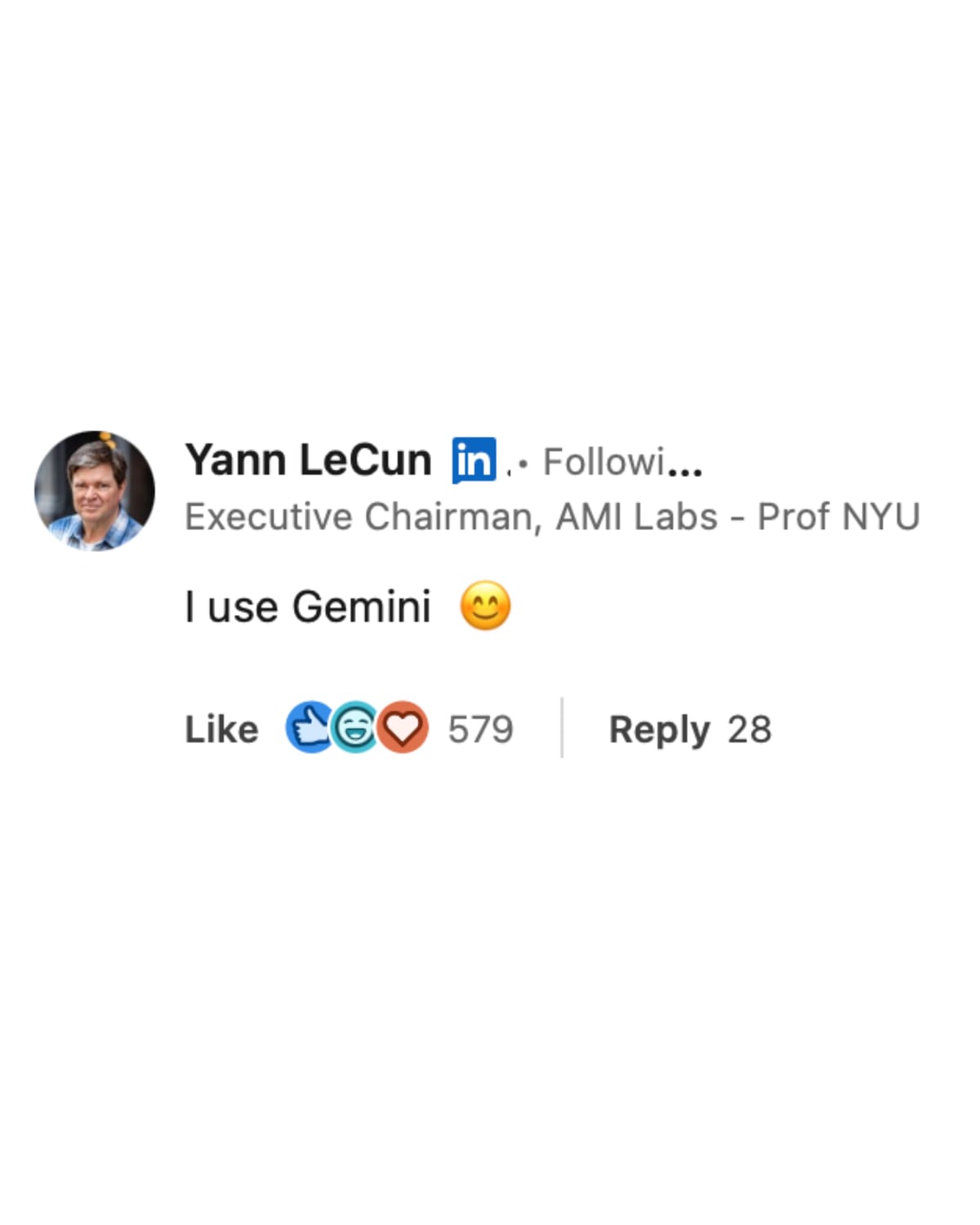
Yann LeCun, the Turing Award-winning researcher who departed Meta in November 2025 after 12 years as Chief AI Scientist, today posted a simple but significant statement on LinkedIn: "I use Gemini 😊". The three-word endorsement from one of artificial intelligence's most influential figures arrives as competitive tensions between major AI platforms reach critical intensity, with Google's Gemini capturing 22% of global AI traffic in recent measurements.
The post, published February 1, 2026, generated immediate attention across the AI community. LeCun's endorsement carries particular weight given his foundational contributions to deep learning and his recent high-profile exit from Meta, where he led the company's fundamental AI research efforts for over a decade before leaving to launch Advanced Machine Intelligence Labs focused on developing alternatives to current large language model approaches.
LeCun's public preference for Gemini over competing platforms - including ChatGPT, Meta AI, and other alternatives - reflects broader competitive dynamics reshaping the AI landscape throughout 2025 and into 2026. According to traffic analysis from Similarweb published in January 2026, ChatGPT's market dominance has eroded significantly over the past year, falling from 86.6% of AI chatbot traffic in January 2025 to 64.6% by mid-January 2026. During the same period, Gemini's share expanded from 5.3% to 22%, representing a 315% increase that coincides with Google's systematic integration of AI capabilities across its product portfolio.
The endorsement gains additional significance when considered alongside LeCun's well-documented skepticism about large language models, the technology underlying most current AI chatbots. During a September 2025 seminar at New York University's Center for Data Science, LeCun declared that "Auto-Regressive LLMs are doomed," presenting Joint Embedding Predictive Architecture as a superior path forward. "They cannot be made factual, non-toxic, etc. They are not controllable," LeCun stated about large language models, pointing to fundamental mathematical limitations that he argued make current AI systems unreliable for critical applications.
His willingness to publicly use Gemini despite these technical reservations suggests the platform may offer capabilities or characteristics that distinguish it from competitors in ways that align with his research philosophy. Google has positioned Gemini as a multimodal system trained from inception to handle text, code, audio, images, and video simultaneously, rather than as a pure language model. According to Google DeepMind, this architectural difference enables reasoning across different data types in ways that text-focused systems cannot replicate.
The LinkedIn post emerged from a larger conversation about AI platform preferences among researchers and industry professionals. Raia Hadsell, Vice President of Research at Google DeepMind, had shared data from Nikkei xTECH analyzing shifts in the AI landscape over the past year. The Japanese publication's report documented Gemini's market share surge and attributed it to what Hadsell described as "velocity" enabled by integrating research teams and launching Gemini 3 Pro. "The numbers tell the story," Hadsell wrote in her February analysis.
LeCun's response appeared in the comment section of Hadsell's post, where multiple AI researchers and industry figures discussed their platform preferences and experiences. Several commenters expressed similar preferences for Gemini over competing options, with some noting specific technical advantages in particular use cases. One commenter mentioned removing a ChatGPT subscription after Gemini 3's release, while others discussed Gemini's integration with Google's broader ecosystem as a practical advantage for workflow continuity.
The timing of LeCun's endorsement coincides with intensifying competitive pressure across the AI industry. OpenAI declared a "code red" on December 2, 2025, delaying advertising implementation and other initiatives to focus resources on improving ChatGPT's core capabilities as Google's AI products gained ground. CEO Sam Altman's internal memo acknowledged mounting competitive threats, particularly from Google's integration of Gemini across search, productivity tools, and consumer applications.
Google's systematic product integration strategy has differentiated Gemini from competitors throughout 2025. The company introduced Gemini directly into Google Ads on January 24, 2024, as a conversational tool helping advertisers create Search campaigns. Beyond advertising applications, Google deployed Gemini 3 in search with model-designed interfaces in December 2025, enabling dynamic interface generation and real-time simulations for complex queries. The platform's user base climbed from 450 million monthly active users in July to 650 million in October 2025.
LeCun's departure from Meta in November 2025 followed tensions over the company's AI strategy and organizational structure. According to interviews with the Financial Times, LeCun expressed frustration with Meta's pivot toward more powerful LLM-based models under new chief AI officer Alexandr Wang, the 28-year-old former Scale AI CEO whom Meta acquired for $14.8 billion in June 2025. The restructuring placed LeCun, 65, reporting to Wang despite LeCun's decades of pioneering AI research. "You don't tell a researcher what to do. You certainly don't tell a researcher like me what to do," LeCun told the Financial Times.
The organizational changes at Meta coincided with disappointing reception of the company's Llama 4 model released in April 2025. Internal documents revealed that Meta data scientists discovered the model's benchmark results had been inflated, leading CEO Mark Zuckerberg to reportedly lose confidence in those responsible and sideline the generative AI department. LeCun stated he had "almost nothing to do with the LLM project since the original Llama shipped," reflecting his longstanding disagreement with Meta's strategic emphasis on language models.
Advanced Machine Intelligence Labs, LeCun's new venture, represents a fundamental departure from the LLM-centric approach dominating Silicon Valley. The company focuses on developing "world models" - AI systems that understand physics, maintain persistent memory, and plan complex actions rather than simply predicting the next word. According to LeCun's November 2025 LinkedIn announcement, the goal involves bringing about "the next big revolution in AI: systems that understand the physical world, have persistent memory, can reason, and can plan complex action sequences."
The startup has reportedly entered fundraising talks targeting a $3.5 billion valuation despite having not yet officially launched. LeCun serves as executive chairman, with Alex LeBrun, founder of health tech startup Nabla, assuming CEO responsibilities. The company plans to establish headquarters in Paris in early 2026, with a partnership arrangement with Nabla providing immediate applications for the technology in FDA-certifiable AI systems for healthcare.
LeCun's research philosophy emphasizes learning from visual and sensory data rather than text alone, arguing that human children grasp the world through thousands of hours of visual experience rather than reading billions of pages of text. This perspective directly challenges the prevailing industry consensus that scaling language models through increased computational resources and training data will lead to artificial general intelligence. "We are not going to get to human-level AI just by scaling LLMs," LeCun stated in a May 2025 podcast interview, calling them "systems with gigantic memory and retrieval ability, not a system that can invent solutions to new problems."
The endorsement occurs as marketing professionals navigate rapidly shifting AI platform dynamics. Research from WordStream published in July 2025 found that 20% of AI responses to PPC-related questions contained inaccurate information across five major platforms. Google Gemini demonstrated the highest accuracy rate with only 6% incorrect responses, while Google AI Overviews showed the poorest performance with 26% incorrect answers. The study tested ChatGPT, Google AI Overviews, Google Gemini, Perplexity, and Meta AI with identical questions about PPC best practices.
Platform-specific biases emerged throughout testing, with Meta AI consistently framing responses through a Facebook Ads perspective even when answering Google Ads questions. The accuracy disparities suggest that marketing professionals must carefully evaluate which AI platforms provide reliable guidance for specific advertising tasks rather than assuming equivalent capabilities across competing services.
Google's multi-year partnership with Apple, announced in January 2026, positions Gemini models as the foundation for Apple Intelligence starting later this year. The collaboration integrates Google's Gemini models with Apple's existing AI framework, including enhanced Siri capabilities. According to the joint statement, Apple conducted a "careful evaluation" before determining that Google's AI technology provides "the most capable foundation" for its artificial intelligence infrastructure.
The partnership raised questions about market consolidation and opportunities for smaller AI companies to establish comparable platform integrations. While OpenAI maintains its existing relationship with Apple for ChatGPT integration announced in June 2024, the selection of Google's Gemini as foundational technology for Apple Intelligence represents deeper integration into Apple's core AI infrastructure. Anthropic's Claude AI assistant has partnerships with various enterprise customers but lacks comparable consumer platform integrations. The structure differs from typical cloud service agreements, with Google's technology forming the foundation for Apple's own models rather than Apple simply purchasing API access.
Competitive dynamics between Google and OpenAI have intensified throughout 2025 and into 2026. Debra Aho Williamson, Chief Analyst at Sonata Insights and the analyst who published one of the first projections for social media advertising spending in 2007, forecasts that 2026 will mark the year when AI media emerges alongside social and retail media as a significant advertising destination. According to Williamson's December 2025 analysis, ChatGPT will reach 1 billion weekly users worldwide by the end of 2025, just three years after its November 2022 launch, while Facebook took more than eight years to reach 1 billion monthly users.
However, the platform power dynamic shifts faster than many marketers realize, according to Williamson's assessment of OpenAI's advertising delay. "If model performance slips, everything built on top of it (including monetization) gets deprioritized," she stated regarding OpenAI's code red declaration. "That creates room for the stable ecosystems - Google, Meta, Amazon - to make headway." The observation suggests that established technology companies with diversified revenue streams maintain strategic advantages over AI-focused startups dependent on continuous fundraising.
Google's position as both a search incumbent and AI innovator creates unique competitive advantages compared to startup competitors. The company can experiment with AI features while maintaining existing advertising revenue streams that totaled $164 billion annually for Meta and substantially more for Google across its various properties. Meta announced hundreds of billions of dollars in AI infrastructure investments in July 2025, including gigawatt-scale data center clusters named Prometheus and Hyperion that will consume energy equivalent to 4-5 million American homes annually.
LeCun's endorsement may influence platform adoption patterns among AI researchers, developers, and enterprise users who respect his technical judgment and track record. His breakthroughs at Bell Labs in the 1980s and 1990s demonstrated that computers could read handwritten checks through convolutional neural networks, technology that became foundational for facial recognition and autonomous vehicles. His willingness to pursue neural network research when much of the scientific community dismissed the approach in the 1980s established credibility for contrarian technical positions that later proved prescient.
The comment generated 579 reactions and 28 replies on LinkedIn as of publication, indicating substantial engagement from the AI research and development community. Several respondents questioned LeCun's reasoning for preferring Gemini, while others shared their own experiences comparing different AI platforms for various use cases. The discussion reflects broader industry debates about the relative strengths and weaknesses of competing AI systems, evaluation methodologies for assessing platform capabilities, and the relationship between benchmark performance and practical utility.
Research tracking has documented substantial variation in how different AI platforms handle specific tasks and domains. A January 2026 analysis examining AI traffic war dynamics found that while ChatGPT still generates substantially more referral traffic to external websites despite its declining share, Gemini's growth trajectory suggests accelerating competitive pressure. Data from SEO platform Conductor showed ChatGPT drove over 1.6 billion visits to external websites between September and November 2025, while Gemini generated 287 million site visits during the same period.
The AI platform landscape continues fragmenting as specialized tools emerge for specific use cases alongside general-purpose chatbots. Claude Code, Anthropic's terminal-based AI coding tool, has demonstrated rapid adoption with estimated $130 million annual revenue potential, though traffic tracking based solely on web usage does not capture local or API-based interactions. A Google principal engineer publicly acknowledged in January 2026 that Claude Code reproduced complex distributed systems architecture in one hour that her team spent a full year building, sparking debate about development productivity and organizational efficiency.
Marketing technology professionals face decisions about which AI platforms to adopt for content creation, campaign optimization, customer research, and other business applications. LeCun's endorsement provides one data point from an authoritative technical source, though marketing teams must evaluate platforms based on their specific requirements, existing technology stacks, budget constraints, and use case priorities. The accuracy research from WordStream suggests that relying exclusively on any single AI platform for critical business decisions carries risks given documented error rates across all tested systems.
Google has systematically expanded AI capabilities throughout its advertising infrastructure during 2025, launching Ads Advisor and Analytics Advisors powered by Gemini models in December, introducing Gemini 3 with generative UI capabilities in November, and releasing capabilities built on Gemini 3 Pro for advanced functionality within Google Ads. The Gemini product line achieved substantial scale since its February 2024 launch when Google rebranded its Bard chatbot, with the platform now operating across Google's ecosystem including Search, Gmail, and Google Workspace.
The announcement demonstrates how personal platform preferences among influential AI researchers can generate substantial visibility and discussion, potentially influencing adoption patterns across the broader technology community. Whether LeCun's endorsement reflects specific technical advantages, workflow integration benefits, or other factors remains unclear based on the brief LinkedIn comment. His willingness to use Gemini despite his documented skepticism about large language models suggests the platform may offer characteristics that distinguish it from pure text-based systems in ways that align with his research philosophy emphasizing multimodal understanding.
Industry observers will monitor whether LeCun's public preference for Gemini influences adoption patterns among AI researchers, enterprise customers, or developers building applications on AI platforms. His departure from Meta and launch of Advanced Machine Intelligence Labs focusing on alternatives to current language model approaches positions him as an independent voice no longer constrained by corporate affiliation with major AI platform providers. The endorsement arrives as competitive dynamics reshape digital advertising and AI capabilities become increasingly integrated into marketing workflows across search, social media, retail media, and emerging channels.
Who: Yann LeCun, Turing Award-winning AI researcher and Meta's former Chief AI Scientist who left the company in November 2025 to launch Advanced Machine Intelligence Labs, posted his endorsement of Google Gemini. The statement generated immediate attention from AI researchers, industry professionals, and technology executives across LinkedIn's network.
What: LeCun published a three-word LinkedIn comment stating "I use Gemini 😊" in response to a post by Google DeepMind Vice President of Research Raia Hadsell discussing Gemini's market share growth. The endorsement represents a public preference for Google's AI platform over competing options including ChatGPT, Meta AI, and other alternatives from a researcher known for his skepticism about large language models.
When: The LinkedIn post was published on February 1, 2026, approximately two and a half months after LeCun announced his departure from Meta and during a period of intensifying competition between major AI platforms. The timing coincides with Google's systematic expansion of Gemini across search, productivity tools, and consumer applications throughout 2025 and into 2026.
Where: The endorsement appeared on LinkedIn's professional networking platform in the comment section of a post discussing AI market dynamics and competitive positioning. LeCun's statement reached a global audience of AI researchers, technology executives, marketing professionals, and developers who follow his commentary on artificial intelligence developments and research directions.
Why: The endorsement matters for the marketing and advertising community because it provides a technical perspective from one of AI's most influential figures during a period when marketing professionals increasingly rely on AI platforms for content creation, campaign optimization, and customer research. LeCun's preference for Gemini despite his documented criticism of large language models suggests the platform may offer capabilities or characteristics that distinguish it from pure text-based systems. The statement arrives as competitive dynamics reshape the AI landscape, with Gemini capturing 22% of global AI traffic while ChatGPT's dominance erodes from 86.6% to 64.6% over a twelve-month period. Marketing technology investments increasingly depend on platform selection decisions that affect workflow efficiency, output quality, and strategic capabilities across digital advertising operations.