


Microsoft continues to override people's choice of web browser across Windows 10 and Windows 11, according to a follow-up study published by Mozilla in May 2026, with new evidence that the pattern now extends into Copilot and the Windows Backup migration tool.
The report, titled Over The Edge 2.0: Do Microsoft's Design Tactics Still Compromise Free Browser Choice?, was written by independent researchers Dr. Harry Brignull of Testimonium Ltd and Cennydd Bowles of NowNext Ltd, and published by Mozilla Research. It updates a January 2024 report from the same two authors, which first documented how Microsoft steered Windows users toward its Edge browser through a range of interface tricks. Two years on, the researchers went looking for the same behaviors again, this time across four regions and two versions of Windows, and largely found them still in place.
If nobody's reading it, did it ever really load? Add PPC Land as your preferred source in Google Search and actually see the stories that matter.
What the researchers tested
Brignull and Bowles built eight virtual machines using Microsoft's Hyper-V software: four running Windows 10 Home and four running Windows 11 Home, one pair for each of the regions under test. Those regions were the United States, the United Kingdom, India, and Germany, the last standing in for the European Economic Area as a whole. A VPN gave each virtual machine a local IP address matching its assigned region, since the researchers wanted to rule out geolocation as a separate variable from the region setting built into Windows itself.
The choice of Windows 10 as well as Windows 11 was deliberate. Although Microsoft ended support for Windows 10 in October 2025, the operating system still runs on a substantial share of machines worldwide. Citing StatCounter data, the report notes that around 32 percent of Windows users globally were still on Windows 10 in the first quarter of 2026, with the figure closer to 43 percent in India, so the researchers judged it essential to test both operating systems rather than assume Windows 11 alone tells the full story.
Three questions anchored the research. Can a person download and install a browser other than Edge without interference? Can they set that browser as their default without interference? And once they have done so, does Windows respect that choice going forward? Answering each question meant walking through the exact screens a typical user would see and judging whether any harmful design patterns were present, using a taxonomy adapted from the work of Arunesh Mathur and colleagues, whose 2019 study of 11,000 shopping websites remains one of the most cited catalogs of manipulative interface design. The taxonomy names patterns including Trick Wording, Obstruction, Visual Interference, Preselection, Nagging, and Forced Action, each describing a distinct way an interface can nudge, mislead, or block a user from acting on their own preference.
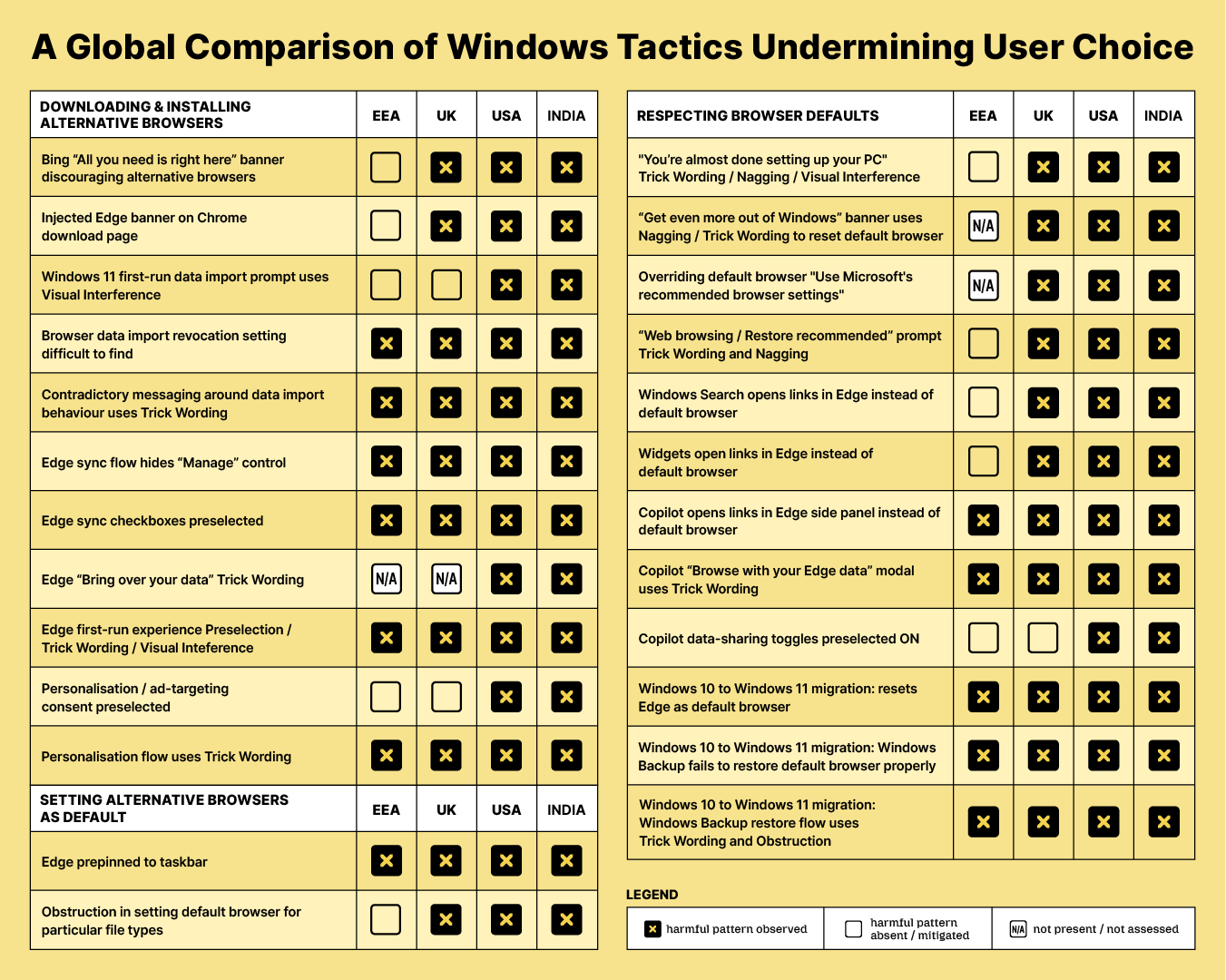
Findings across the browser journey
The answer to all three research questions, across every region tested, was no. Microsoft does not, in the researchers' judgment, let users download an alternative browser, set it as default, or keep it as default, without running into at least one harmful pattern somewhere along the way.
Some of the specific findings echo the original 2024 report almost exactly. Searching Bing for terms like "download chrome" or "download vivaldi" still surfaces a large injected panel titled "All you need is right here," which the report says pushes organic results down the page and compares Edge favorably against a grayed-out rival logo using claims the authors call ambiguous rather than accurate. Completing a Chrome download from google.com still triggers a banner reading "Microsoft Edge runs on the same technology as Chrome, with the added trust of Microsoft," content the researchers say Edge injects directly into the rendering of a competitor's website, a practice they describe as an unprecedented breach of the normal boundary between a browser and the pages it displays.
Newer findings concern how Windows and Edge handle first-run setup. During the Windows 11 first-run experience, a screen headed "Always have access to your recent browsing data" invites the user to let Edge continually import bookmarks, history, and passwords from other browsers. In the US and India test cases, the researchers found the accept option styled as a prominent button while the decline option, "Not now," appeared as a smaller link, a design choice they say runs against Microsoft's own published guidance on when to use a button rather than a link. Locating the control to switch this import off later required navigating to an obscure internal address, edge://settings/profiles/importBrowsingData, that the report says was never surfaced again once the initial consent had been given.
The researchers also describe what they call a potential consent "pipeline": three separate, individually modest-looking requests, covering browsing-data ingestion, cross-device Edge synchronization, and ad personalization, that could combine to give Microsoft a much broader behavioral picture than any single screen discloses. The report is careful to say this connection is a hypothesis rather than a confirmed technical finding, since the authors did not carry out network-level analysis to trace where data actually flows. They call on Microsoft to clarify the point directly and suggest the question deserves independent technical research.
Setting a rival browser as default fared no better in some respects. After making Firefox or Vivaldi the default browser in both Windows 10 and Windows 11, the researchers found that Edge remained the registered handler for the .pdf and .svg file types in the US, UK, and India test cases, a behavior the report labels Obstruction because there was no apparent reason to withhold those file-type associations from a browser the user had just chosen. A separate but related pattern, Preselection, appeared when Edge came pre-pinned to the Windows taskbar on every version and region tested, despite Microsoft's own 2023 blog post pledging that all Microsoft apps would use the same pinning-confirmation flow required of rivals.
New ground: Copilot and the Windows 11 migration
Two findings mark genuine additions to the 2024 report. The first concerns Microsoft's Copilot assistant. When the researchers selected a link returned inside a Copilot answer, the browser had already been set to an alternative default across every region and both operating systems, yet the link opened in a side-panel web view that the report says is built on Edge's own rendering engine, rather than in the browser the user had chosen. The researchers weigh two possible justifications Microsoft might offer, a seamless in-flow experience and improved answer quality from reading the rendered page, and conclude that neither is strong enough to justify overriding an explicit prior instruction; they classify the behavior as Forced Action. A companion consent screen inside Copilot, titled "Browse with your Edge data," carried two data-sharing toggles that defaulted to on in the US and India test cases and to off in the UK and EEA, even though the underlying Copilot build number was identical across all four regions, which the researchers say points to the region setting inside Windows itself, not the Copilot app, as the source of the difference.
The second addition concerns what happens when someone upgrades hardware. Microsoft's Windows Backup tool is marketed, in the company's own support documentation, as making it "easier than ever to move to a new PC." The researchers backed up a Windows 10 machine running an alternative browser as default, restored that backup onto a freshly installed Windows 11 device, and found that the alternative browser was not transferred. Microsoft Edge was silently set as the new default instead. Windows Search results still listed the alternative browser with an "Uninstall" option, suggesting the app was present, but selecting "Open" redirected to the Microsoft Store, where the user needed to reinstall it from scratch and then manually reset it as default. The report attributes the mismatch between what Windows Backup promises and what actually happens to Trick Wording, and treats the poor discoverability of the alternative browser afterward as Obstruction.
This finding lands at a particular moment. Windows 10 support ended in October 2025, which means the population of people carrying out exactly this kind of migration, replacing an unsupported machine with a new Windows 11 device, is unusually large right now. The researchers argue that a silent reset of browser choice during what is effectively a mandatory upgrade cycle carries more weight than it would in an ordinary year.
Regional variation and the EU's Digital Markets Act
The clearest pattern in the new report is regional. Several harmful patterns documented in the US, UK, and India test cases were simply absent when the same journeys were run with the Windows region set to Germany, standing in for the European Economic Area. The Bing "All you need is right here" panel did not appear. The Chrome download banner was missing. The Windows 11 ingestion screen presented accept and decline options with equal visual weight rather than a preselected toggle. A dedicated "Make Firefox the default for .pdf" control appeared where other regions offered no such option. The "You're almost done setting up your PC" journey and its accompanying "Web browsing / Restore recommended" prompt, both criticized at length in the 2024 report, did not appear at all in the EEA test cases on Windows 10.
The researchers attribute this divergence to regulatory pressure rather than a change of philosophy at Microsoft, pointing to the company's own public acknowledgment of updates made to Windows in response to the EU's Digital Markets Act. Even so, the report is explicit that EEA users are not free of harmful patterns altogether. Obstruction around the browser-ingestion setting, Trick Wording in the Copilot consent screen, and Preselection in Edge's taskbar pinning all persisted in the German test cases, which is why the researchers still answer no to all three of their core research questions even within the region subject to the tightest regulation.
That split mirrors a wider theme <cite index="18-1">documented in a University of Antwerp analysis published this month, which found that a Digital Markets Act requirement for gatekeeper browsers like Chrome and Safari to show EU users a choice screen when setting a default browser drove meaningfully higher Firefox use on mobile devices inside the EU than in markets where the rule does not apply, an effect the paper estimated at roughly 6 million additional Firefox users.</cite> The same paper found <cite index="18-1">that among EU users, the browsers gaining most from that contestability were Chrome, Safari, Edge and Firefox in that order, all American products</cite>, a finding PPC Land reported on July 8 alongside the paper's broader argument that regulatory contestability in browsers does not automatically translate into a win for European alternatives. Read together with the Mozilla-backed findings, the two pieces of research point to the same underlying picture: EU rules appear to move real numbers, but only up to the edge of what the rules actually specify.
Why this matters for advertisers and publishers
For people working in paid media, the browser a person actually uses is not a settled fact so much as an input that keeps shifting underneath measurement and targeting systems. A browser default is not simply a stylistic preference. It determines which cookie and storage rules apply to a session, which tracking-prevention defaults are active, and, increasingly, which AI assistant intermediates a click before it ever reaches a landing page. If Windows is nudging or resetting that default at a scale of more than a billion machines, as the new Mozilla-backed report suggests, then attribution assumptions built around "the browser the user chose" deserve a second look, particularly around Windows 10 to Windows 11 migrations happening now that Windows 10 support has lapsed.
PPC Land's coverage of Safari's tracking protections has already documented how browser-level defaults can silently strip identifiers such as GCLID from a meaningful share of sessions, degrading the very click data that automated bidding systems depend on. The Over The Edge 2.0 findings describe a parallel but distinct problem: not a browser vendor tightening its own privacy defaults, but an operating system vendor allegedly working to keep users on its own browser through interface design rather than through open competition. Both dynamics point the same direction for measurement teams, toward less certainty about which browser environment a given click actually occurred in, and therefore less certainty about what any single attribution number really represents.
The report's account of Copilot forcing links open inside an Edge-based view, rather than in whichever browser a person has chosen, also touches a live question in the industry about how AI assistants intermediate web traffic. As AI interfaces take on more of the work that used to belong to a browser directly, opening links, summarizing pages, carrying out multi-step tasks, the same self-preferencing incentives that shaped browser competition over the past three decades appear to be reappearing inside assistant products themselves. <cite index="8-1">OpenAI's own decision to fold its year-old Atlas browser into a new ChatGPT Work agent, announced on July 9, 2026, shows the industry moving in the opposite direction of standalone browsers and toward assistants that embed browsing as one tool among several</cite>, a shift PPC Land reported the same week. Whether that consolidation produces the same self-preferencing pressure the Mozilla-backed researchers describe inside Copilot is precisely the kind of question the report says future researchers and regulators should be watching for.
Regulatory scrutiny of Microsoft's Windows business is not confined to browser defaults. PPC Land's reporting on the Digital Markets Act has tracked Microsoft's designation as a gatekeeper alongside five other large technology firms since 2023, and more recent coverage has followed the European Commission's decision to open market investigations into cloud infrastructure providers, including Microsoft Azure, in November 2025. The Over The Edge 2.0 report adds a specific, screen-by-screen account of what gatekeeper obligations do and do not appear to have changed inside the Windows operating system itself, distinct from the cloud and platform-access questions those separate investigations are examining.
Limitations the researchers acknowledge
The report is explicit about what it does not claim. Software updates itself continuously, and Microsoft can alter Windows, Edge, and Copilot behavior remotely or through staged rollouts to limited user groups, meaning any given screen described in the report could change by the time a reader encounters it. The authors also disclose that Mozilla, as the report's sponsor and a competing browser maker, has a commercial interest in the outcome, while stating that the analysis and conclusions are the authors' own. Claude, an AI system from Anthropic, was used during the research phase for some data retrieval and summarization, including the browser-market-share figures drawn from Cloudflare Radar, work the authors say was independently checked and verified by Mozilla researchers before publication. The determination of which interface patterns count as harmful was made exclusively by Brignull and Bowles.
The researchers stop short of asserting that Microsoft is unique in using these techniques, noting that prior research from bodies including the OECD has documented similar patterns across the technology sector more broadly. Their scope was limited to the specific Microsoft user journeys they tested, not a comparative audit of competing operating systems.
What the researchers recommend
The report closes by repeating a call first made in the 2024 version: that Microsoft abandon the harmful patterns identified worldwide, not only in jurisdictions where regulation currently requires it. The authors frame the EEA's comparatively better showing as evidence that regulatory pressure can change corporate behavior, and they encourage regulators in the United States, United Kingdom, and India, alongside the EU, to treat the findings as a data point in favor of active enforcement rather than reliance on voluntary compliance. They also flag AI assistants as the area most likely to need fresh scrutiny going forward, on the reasoning that as operating systems, browsers, and AI products become harder to separate from one another, the opportunities for one company's assistant to quietly favor its own browser, search engine, or cloud service are likely to multiply rather than shrink.
Timeline
- January 2024 - Mozilla publishes the original Over The Edge report, the first version of this research into Microsoft's browser-choice design practices.
- October 14, 2025 - Microsoft support for Windows 10 officially ends.
- March 31 to May 14, 2026 - Brignull and Bowles capture the screenshots and test journeys underlying the updated report across Windows 10 and Windows 11 in the US, UK, India, and Germany.
- May 5, 2026 - Copilot testing is conducted using build 147.0.3912.98, the version cited throughout the report's Copilot findings.
- May 2026 - Over The Edge 2.0: Do Microsoft's Design Tactics Still Compromise Free Browser Choice? is published by Mozilla Research, authored by Dr. Harry Brignull and Cennydd Bowles.
Related PPC Land coverage
- DMA gains Firefox 6 million EU users but leaves Google 90% dominant examines a University of Antwerp paper finding that EU browser-choice screens shifted millions of users to Firefox while Bing, Edge, and Mozilla, not European rivals, captured most of the resulting gains.
- The 6 Gatekeepers under Digital Markets Act (DMA) explains the original 2023 European Commission designation of Microsoft and five other firms as DMA gatekeepers and the compliance obligations that followed.
- Safari is quietly killing your GCLID - and here is the fix documents how browser-level tracking protections in Safari already strip attribution identifiers from a meaningful share of ad clicks, a related measurement challenge for advertisers.
- OpenAI kills Atlas browser, folds it into new ChatGPT Work agent reports OpenAI's decision to discontinue its standalone browser in favor of an assistant that embeds browsing as one feature among several, a parallel shift in how AI products intermediate the web.
- Google asks appeals court to throw out its entire search monopoly loss covers Google's ongoing appeal of the US antitrust ruling over search-default agreements with Apple and Mozilla, a separate but related dispute over how browser defaults get set in the first place.
Summary
Who: Dr. Harry Brignull of Testimonium Ltd and Cennydd Bowles of NowNext Ltd, commissioned by Mozilla, authored the research examining Microsoft's Windows, Edge, Bing, and Copilot products.
What: A follow-up study to a January 2024 report found that Microsoft continues to use harmful interface design patterns, including Trick Wording, Obstruction, Visual Interference, Preselection, Nagging, and Forced Action, to influence which browser Windows users end up on, with new findings covering Copilot's in-app link handling and the Windows Backup migration tool resetting browser defaults after a Windows 10 to Windows 11 upgrade.
When: Testing was conducted between late March and mid-May 2026, and the report was published in May 2026, two years after the original Over The Edge study.
Where: The research covered Windows 10 Home and Windows 11 Home across four regions: the United States, the United Kingdom, India, and Germany, the latter representing the European Economic Area.
Why: The findings matter for advertisers, publishers, and marketers because browser defaults shape which tracking-prevention rules, cookie policies, and AI intermediaries apply to a given session, and because the report documents measurably fewer harmful patterns only in the region covered by the EU's Digital Markets Act, evidence the authors say supports continued regulatory scrutiny of how operating systems steer user choice.


Discussion