Newsletter monetization shifts toward sponsorships as paid models plateau
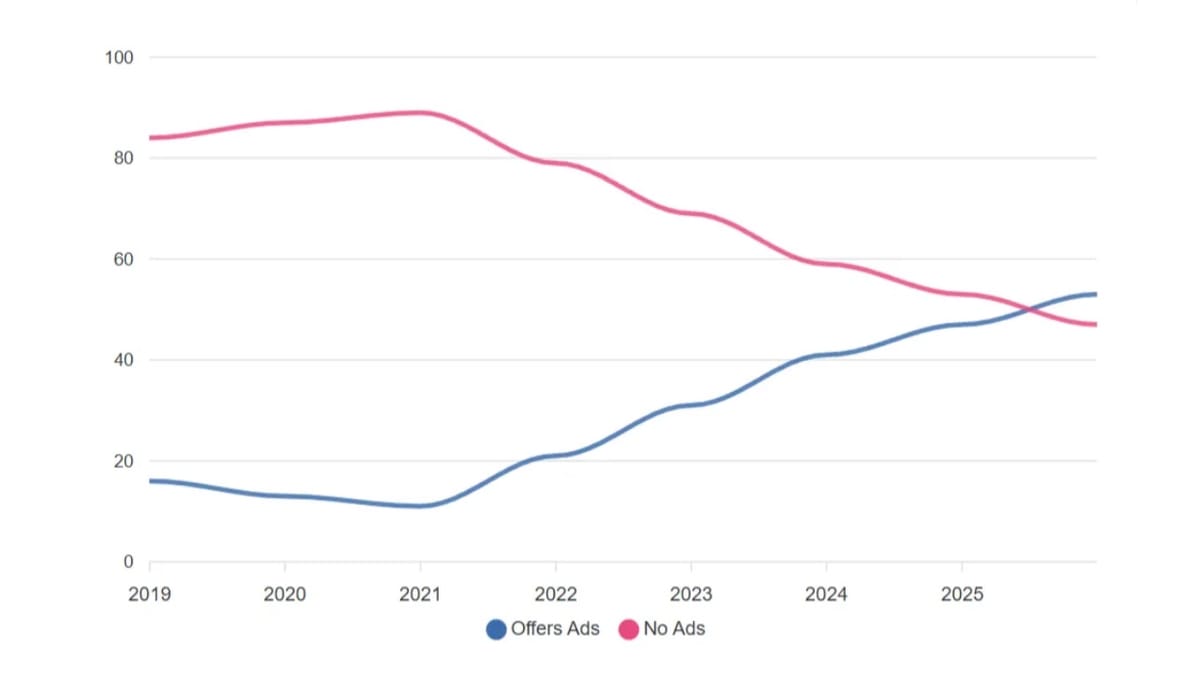
Sponsored content surpassed paid subscriptions as the dominant revenue model for email newsletters in 2025, with 77% of new publications seeking advertising partnerships compared to just 2% operating paywalls.
Newsletter advertising adoption surged from 15% in 2019 to 77% in 2025 as creators shift monetization strategies.
The email newsletter industry experienced a fundamental shift in monetization strategy during 2025, with sponsored content emerging as the preferred revenue model while paid subscription adoption stagnated. According to the sixth annual State of Newsletters report released December 17, 2025, by InboxReads, 77% of newsletters submitted to the platform indicated interest in sponsorships and advertising partnerships, representing an increase from 72% in the previous year. This marked the first year that more newsletter submissions offered sponsorships than those declining advertising revenue.
In contrast, paid newsletter adoption remained flat at just 2% of submissions, identical to 2024 figures. Publications offering paid upgrades alongside free content declined from 12% to 8%, while entirely free newsletters grew from 87% to 91% of submissions. The data suggests paid subscriptions, despite success stories on platforms like Substack, remain difficult for most creators to execute effectively.
"This is the first year where there hasn't been much increase in the percentage of paid and upgradable newsletters," according to the report. The findings indicate that while subscription-based models generate sustainable income for established publications, the barrier to entry remains prohibitively high for emerging newsletters seeking immediate monetization.
The shift toward sponsorship revenue coincided with Substack's decision to enter the advertising space, a significant strategic pivot for a platform that previously positioned itself as champion of direct reader support. Substack's advertising plans represent acknowledgment that most creators struggle to build subscription audiences large enough to generate meaningful income through paywalls alone.
PPC Land Newsletter
Subscribe PPC Land newsletter ✉️ for similar stories like this one
Platform consolidation continues as Substack and beehiiv dominate market
Substack maintained its position as the dominant email service provider in 2025, capturing 41% of newsletter submissions to InboxReads, a marginal increase from 40% the previous year. The platform's brand recognition as effectively synonymous with email newsletters proved difficult for competitors to overcome, despite aggressive feature development elsewhere in the market.
beehiiv, positioned as Substack's primary challenger, held 29% market share in 2025, declining slightly from 33% in 2024. "Last year, I was curious if it'd surpass Substack, but it is tough to beat the brand recognition Substack has built," according to the report. The data demonstrates that while beehiiv maintained significant market presence, its growth trajectory slowed considerably compared to previous years when it appeared positioned to potentially overtake the market leader.
Mailerlite emerged as the third most popular platform with 5% of submissions in 2025, representing substantial growth from previous years when it failed to rank among the top five providers. LinkedIn newsletters, leveraging the professional network's existing user base, tied for third place with 4% of submissions. The platform's investment in newsletter functionality appears to be generating meaningful adoption among creators already embedded in LinkedIn's ecosystem.
Ghost experienced surprising decline, falling from 8% to 4% of submissions despite years of consistent growth. The open-source platform's retreat suggests difficulty competing against well-funded competitors offering more comprehensive feature sets and marketing resources. Kit, formerly ConvertKit, and Mailchimp rounded out the top five providers.
Historical data reveals how platform market dynamics have evolved since 2018. Substack's market share remained relatively flat but significant across the measurement period, while beehiiv demonstrated consistent growth from its launch. "Seems like those two are dominating the space and the others are blips on the radar," according to the report, which noted the difficulty smaller providers face attempting to compete against established platforms with substantial brand recognition and network effects.
Content diversity expands while AI coverage grows modestly
Tech, business, and startup topics continued to dominate newsletter submissions in 2025, maintaining patterns established in previous years. However, AI-focused newsletters grew from 4% of submissions in 2024 to 6% in 2025, reflecting the technology's integration across nearly every industry sector during the year.
Historical trends show software development and programming newsletters declining as percentage of total submissions since 2018, which the report attributes to newsletters evolving "from a niche medium to covering topics for everyone." The democratization of newsletter publishing enabled creators across diverse subject areas to establish audiences, reducing the dominance of technology-focused content that characterized the medium's early growth.
Top newsletter topics stabilized in 2025 after years of shifting preferences, with tech capturing 16% of submissions, business 11%, and startups 10%. Self-improvement, finance, marketing, programming, culture, news, health, education, productivity, politics, and travel all registered between 3% and 7% of submissions. "I only expect to see changes going forward if some new trend in culture emerges the way AI did in the past few years," according to the report.
Reader interests, measured through InboxReads user behavior rather than creator submissions, diverged from submission patterns. Tech newsletters became the most visited category in 2025, dethroning sports which had previously held the top position. Travel newsletters dropped out of the top 10 visited categories entirely, representing a surprising shift given their consistent popularity in previous years. Business, marketing, and news all entered the top 10 most-visited categories.
The disconnect between what creators submit and what readers consume suggests potential opportunities for newsletter creators in underserved categories where audience demand exceeds content supply.
Advertise on ppc land
Buy ads on PPC Land. PPC Land has standard and native ad formats via major DSPs and ad platforms like Google Ads. Via an auction CPM, you can reach industry professionals.
Weekly publishing remains standard despite format experimentation
Weekly newsletter publishing maintained its position as the industry standard in 2025, with 54% of submissions adopting this cadence. Daily newsletters captured second position at 19% of submissions, while monthly publishing remained least popular at just 7%. The distribution closely mirrored 2024 figures, suggesting creators have reached consensus around optimal publishing frequency for audience retention and content sustainability.
Historical data shows weekly publishing declining gradually from its peak, falling from over 70% of newsletters in early measurement years to 54% in 2025. Daily sending consistently held the number two position across the measurement period. Twice-weekly, biweekly, and monthly publishing grew from nearly nonexistent categories to claiming meaningful percentages of the market, with 11% of newsletters publishing twice weekly and 9% adopting biweekly schedules in 2025.
The diversification of publishing schedules reflects creators experimenting with cadences matching their production capabilities and audience expectations. Daily newsletters demand substantial content creation resources but can build deeper audience habits, while weekly publications allow more comprehensive coverage of topics without overwhelming subscriber inboxes. Monthly newsletters, despite their low adoption rate, remain viable for in-depth analysis or specialized professional content.
Newsletter mortality remains consistent at concerning levels
Ten percent of newsletters submitted to InboxReads in 2025 had already become inactive by the time of the report's publication in December, representing a slight increase from 8% in 2024. The relatively stable mortality rate suggests consistent challenges facing newsletter creators attempting to maintain publishing schedules and audience engagement over extended periods.
The attrition rate highlights the difficulty of newsletter sustainability beyond initial launch enthusiasm. Creators face ongoing demands for content creation, audience growth, and revenue generation while competing for attention in increasingly crowded inboxes. The 10% failure rate captures only newsletters that survived long enough to be submitted to a directory, suggesting actual newsletter mortality may be substantially higher when accounting for publications that never reach public launch.
Successful newsletters require not only compelling content but also consistent publishing discipline, effective audience development strategies, and viable monetization models. The relatively high mortality rate among directory-submitted newsletters, which presumably represent more committed creators than those who never formally launch, underscores the medium's challenging economics for creators without existing audiences or revenue sources.
Interest in cross-promotion partnerships declined substantially in 2025, with 61% of newsletter submissions indicating willingness to participate compared to 74% the previous year. The decline continues a multi-year trend as creators reassess the effectiveness of cross-promotion strategies that initially appeared to offer efficient audience growth.
"I do think ineffective automated cross promotions had some part to play here as it diluted the success of the method and maybe turned some creators off," according to the report. Early cross-promotion success stories led to proliferation of automated recommendation platforms that matched newsletters based on category similarity rather than genuine audience alignment. The resulting subscriber acquisition often delivered low engagement rates as readers added through automated recommendations demonstrated limited interest in the recommended publications.
Sophisticated creators increasingly favor selective partnerships with complementary newsletters serving similar audiences rather than broad cross-promotion programs. The shift toward more strategic collaboration reflects maturation of newsletter audience development practices as creators recognize that subscriber quality matters more than raw list size for both engagement metrics and monetization success.
The cross-promotion decline also suggests creators are diversifying their growth strategies beyond newsletter-to-newsletter referrals. Social media promotion, search engine optimization, and paid acquisition campaigns offer alternative audience development channels that may deliver more predictable results than partnership-dependent cross-promotion programs.
Outlook suggests continued platform consolidation and monetization evolution
The 2025 State of Newsletters report reveals an industry reaching maturity in several dimensions while continuing to attract new creators across diverse topics. Substack and beehiiv have established dominant positions that appear difficult for competitors to challenge without substantial differentiation or resource advantages. Smaller platforms face ongoing pressure to either carve out distinctive niches or risk becoming irrelevant in a market characterized by strong network effects and brand recognition advantages.
Sponsorship monetization will likely continue growing as creators recognize the challenges of building subscription audiences. The advertising model offers more predictable revenue for publications with modest but engaged audiences, even as it introduces potential conflicts around editorial independence and audience trust. Platforms are responding to demand for advertising infrastructure, with Substack's entry into sponsored content representing acknowledgment that most creators need monetization paths beyond subscriptions.
"If you're an expert in a niche that's not being catered to it's worth starting a newsletter there," according to the report, suggesting opportunities remain for creators in specialized topics despite overall market maturity. The diversity of newsletter topics continues expanding, though tech, business, and startup content maintains outsized representation among new publications.
The consistent 10% mortality rate among submitted newsletters indicates that sustainability challenges persist for creators entering the medium. Successful newsletters require not only content expertise but also understanding of audience development, platform capabilities, and monetization strategies that align with specific audience characteristics and creator capabilities.
PPC Land Newsletter
Subscribe PPC Land newsletter ✉️ for similar stories like this one
Who: Newsletter creators, email service providers including Substack, beehiiv, Mailerlite, LinkedIn, Ghost, Kit, and Mailchimp, analyzed by InboxReads through its annual industry report.
What: The newsletter industry shifted toward sponsorship monetization in 2025, with 77% of publications seeking advertising partnerships while paid subscription adoption stagnated at 2%. Platform consolidation continued with Substack maintaining 41% market share and beehiiv holding 29%, while cross-promotion interest declined to 61% of submissions.
When: Data covers newsletters submitted to InboxReads during 2025, with the sixth annual State of Newsletters report published December 17, 2025.
Where: The analysis encompasses newsletters submitted to InboxReads globally, with platform distribution and monetization trends reflecting the broader email newsletter industry.
Why: The shift toward sponsorship monetization reflects the difficulty most creators face building subscription audiences large enough to generate sustainable income through paywalls alone. Platform consolidation demonstrates network effects and brand recognition advantages that make competing against established providers increasingly difficult. Cross-promotion decline suggests creators are reassessing effectiveness of automated partnership programs that delivered low-quality subscriber growth.
Share this article
The link has been copied!
Your link has expired. Please request a new one.
Your link has expired. Please request a new one.
Your link has expired. Please request a new one.
Great! You've successfully signed up.
Great! You've successfully signed up.
Welcome back! You've successfully signed in.
Success! You now have access to additional content.