Target and Walmart bring checkout directly into Google's AI assistant
Target and Walmart enable direct purchasing through Google Gemini and AI Mode in Search, powered by Universal Commerce Protocol announced January 11, 2026.


Target and Walmart enable direct purchasing through Google Gemini and AI Mode in Search, powered by Universal Commerce Protocol announced January 11, 2026.
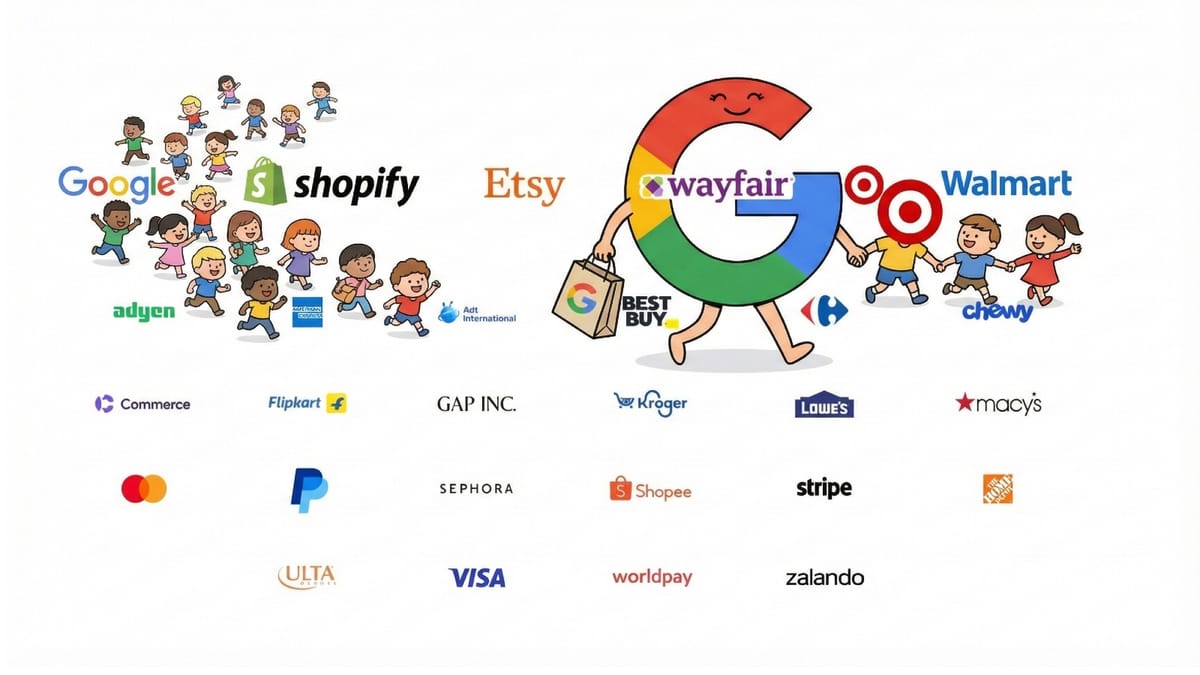
On January 11, 2026, Target and Walmart announced separate integrations that allow consumers to browse inventory and complete purchases without leaving Google's Gemini app or AI Mode in Search. The developments mark the first major retail implementations of the Universal Commerce Protocol, an open standard co-developed by the retailers and Google to enable what the industry calls agentic commerce.
Target's implementation enables consumers to discover and purchase products through conversational queries in Gemini. A shopper asking "I'm getting into working out and want to be both comfortable and stylish at the gym. Help me find cute and affordable floral leggings, in a light color" would receive product options from Target's inventory with the ability to complete checkout without switching applications, according to the retailer's announcement.
Walmart's integration functions similarly. When consumers ask Gemini about camping equipment for spring season, the system automatically includes Walmart and Sam's Club inventory in responses. The experience extends beyond simple product discovery. For customers who link their accounts, Walmart recommends complementary items based on past online and in-store purchases, combines orders with existing cart contents, and applies Walmart+ and Sam's Club membership benefits.
"At Target, we're focused on using technology to make shopping easier and more intuitive wherever our guests are," said Prat Vemana, executive vice president and chief information and product officer at Target. "We're excited to co-develop a new standard for the future of commerce with Google and others."
The Universal Commerce Protocol creates what Google and its retail partners describe as a common language for AI agents and commerce systems. The protocol addresses a fundamental challenge in agentic commerce: enabling transactions across platforms without requiring consumers to navigate between multiple interfaces or repeatedly enter payment credentials.
Target and Walmart both participated as co-developers of UCP alongside Google. The protocol's architecture allows AI agents to access product catalogs, inventory availability, pricing information, and checkout functionality through standardized interfaces. This standardization differs from previous e-commerce integrations that typically required custom implementations for each retailer-platform combination.
The technical implementation handles several complex requirements simultaneously. When a Gemini user asks about products, the system must query multiple retailers' inventories in real-time, apply user-specific personalization (for logged-in customers), maintain shopping cart state across conversation turns, and execute secure payment processing—all while preserving the conversational interface that defines AI assistant interactions.
Walmart's system incorporates both online inventory and products available in physical stores. The retailer offers delivery in under three hours for hundreds of thousands of locally curated products, with some items available in as fast as 30 minutes. This fulfillment capability requires real-time coordination between Gemini's interface, Walmart's inventory management systems, and the retailer's delivery infrastructure.
Target emphasizes that purchases completed through Gemini occur within "the familiar Walmart and Sam's environments they know and love," according to Walmart's announcement. This suggests the checkout process, while initiated in Gemini, redirects to or embeds retailer-controlled interfaces for payment processing and order confirmation.
The January 11 announcements position Target and Walmart as first movers in Google's agentic commerce ecosystem, following similar patterns established by other retailers in alternative AI platforms. Target previously launched conversational shopping capabilities in OpenAI's ChatGPT and developed the Target Gift Finder for personalized recommendations.
Walmart announced an October 2025 partnership with OpenAI enabling customers to shop through ChatGPT. That integration, like the Google implementation, allows users to discover products through conversation and complete purchases without leaving the chat interface. The dual-platform strategy indicates retailers view conversational commerce as requiring presence across multiple AI assistants rather than exclusive partnerships.
"The transition from traditional web or app search to agent-led commerce represents the next great evolution in retail," said John Furner, President and CEO of Walmart U.S. and incoming President and CEO of Walmart Inc. "We aren't just watching the shift, we are driving it."
The implementations differ from traditional retail media advertising, which typically involves sponsored product placements within search results or marketplace interfaces. Instead, these integrations embed entire commerce transactions within AI-generated responses. When Gemini suggests products, those recommendations draw from retailer inventory based on the query's semantic meaning rather than keyword matching or paid placement.
Google's Ashish Gupta, vice president and general manager of Merchant Shopping, framed the development as requiring industry coordination. "Agentic commerce is creating a pivotal moment for retail, which will require the industry working together through standards like the Universal Commerce Protocol to solve retailer and consumer challenges," he said.
Buy ads on PPC Land. PPC Land has standard and native ad formats via major DSPs and ad platforms like Google Ads. Via an auction CPM, you can reach industry professionals.
Both retailers emphasize personalization capabilities enabled by account linking. Walmart's system accesses purchase history from both online transactions and in-store shopping tracked through the retailer's app or membership programs. This unified view of customer behavior allows the system to suggest complementary products based on demonstrated preferences rather than generic recommendations.
Target's announcement highlights that the integration "simplifies the shopping experience and meets guests wherever they are." The retailer did not specify whether its Gemini implementation accesses Target Circle loyalty program data or past purchase history, though such integration would align with capabilities offered in the retailer's ChatGPT partnership.
The personalization architecture raises questions about data sharing between retailers and Google. Neither Target nor Walmart's announcements detail what customer information flows to Google's systems versus what remains within retailer-controlled infrastructure. The Universal Commerce Protocol's design as an open standard suggests it defines data exchange requirements, but the specific privacy and data handling implementations remain unclear from public announcements.
Account linking appears optional in both implementations. Consumers can discover and purchase products without linking accounts, though they would forego personalized recommendations and benefits like Walmart+ membership perks or accumulated rewards points.
Walmart's emphasis on delivery speed—products available in under three hours and as fast as 30 minutes—indicates the Gemini integration connects to the retailer's established local fulfillment network. Walmart has invested heavily in last-mile delivery infrastructure, including automated fulfillment centers and partnerships with delivery services.
The integration of physical store inventory extends the available product catalog beyond centralized warehouse stock. This local inventory access has become increasingly important in retail competition, as consumers expect immediate availability information and fast delivery options regardless of where they initiate purchases.
Target's announcement does not specify delivery timeframes or fulfillment options available through the Gemini integration. The retailer offers same-day delivery through its Shipt subsidiary and drive-up services at most stores, suggesting these capabilities could extend to orders initiated through Google's AI interfaces.
The fulfillment component represents a significant differentiator from pure marketplace models. Amazon's retail operation combines inventory ownership, warehousing, and delivery under single control. Target and Walmart's integrations with external AI platforms must coordinate fulfillment across systems they don't directly control while maintaining delivery speed commitments.
The agentic commerce implementations introduce new competitive dynamics in retail media. Traditional retail media networks monetize through sponsored product listings, display advertising on retailer websites and apps, and off-site advertising that drives traffic to retailer properties. When transactions occur entirely within AI assistant interfaces, these monetization models require adaptation.
Google's existing retail advertising business primarily operates through Shopping ads in Search results and YouTube video advertising. The Gemini integration creates a distinct channel where product discovery occurs through conversational responses rather than search result listings. Whether Google will introduce sponsored placements within Gemini's product recommendations—and how such advertising would function in conversational interfaces—remains unaddressed in current announcements.
Target and Walmart both operate significant retail media networks. Target's Roundel generated over $1 billion in annual revenue as of 2023. Walmart Connect has grown rapidly since its 2021 launch. These networks primarily sell advertising to brands selling products through the retailers' platforms. The shift toward AI-assisted shopping could pressure these businesses if brand visibility becomes determined by AI curation algorithms rather than paid placement.
The Universal Commerce Protocol's open standard nature theoretically allows multiple retailers to participate in single AI assistant responses. A consumer asking about workout clothes might receive options from Target, Walmart, and other participating retailers simultaneously. This multi-retailer comparison within single conversations differs from current e-commerce patterns where consumers typically browse individual retailer websites sequentially.
Implementing commerce within conversational interfaces requires solving several technical challenges that don't exist in traditional e-commerce. Shopping cart persistence across conversation turns, handling product availability changes during extended dialogues, and managing transaction state when users switch topics or pause conversations all require careful architectural consideration.
The natural language interface also introduces ambiguity absent from conventional product search. When a user asks for "affordable" leggings, the system must interpret price sensitivity without explicit dollar amounts. "Cute" styling represents subjective aesthetic judgment that traditional search algorithms don't process. These semantic challenges require both sophisticated natural language understanding and accurate mapping to product attributes in retailer catalogs.
Error handling becomes more complex in conversational commerce. If a selected product goes out of stock between discovery and checkout, the system must gracefully recover while maintaining conversational context. Payment failures, address validation errors, or shipping restrictions need communication in natural language rather than form validation messages.
The integration also must handle multi-step transactions common in retail. Applying discount codes, selecting delivery options, choosing gift wrapping, and other purchase decisions typically involve multiple interface interactions. Compressing these choices into conversational flows without overwhelming users represents a significant design challenge.
The integration of payment processing, personal data, and AI systems intersects with multiple regulatory frameworks. The Universal Commerce Protocol must accommodate varying privacy laws across jurisdictions, payment card industry security standards, and consumer protection regulations that govern online transactions.
Data retention policies become particularly complex when transactions span multiple systems. If a consumer discusses products in Gemini, is that conversation history stored? Do retailers receive transcripts of AI interactions that led to purchases? These questions intersect with regulations like GDPR in Europe and CCPA in California that govern consumer data rights.
The announcements indicate international expansion will follow U.S. launch. Target's fact sheet notes the integration will launch "directly within Gemini in the U.S. and internationally thereafter." This staged rollout likely reflects varying regulatory requirements across markets, particularly in Europe where digital services face stricter oversight.
Payment processing within AI interfaces also raises questions about transaction transparency and consumer protection. Traditional e-commerce checkout flows present explicit order summaries, shipping costs, and total charges before finalizing purchases. Maintaining this transparency within conversational interfaces while preserving user experience requires careful implementation.
The January 11 announcements arrive as retailers accelerate AI investment across operations. Both Target and Walmart have implemented AI in inventory management, dynamic pricing, customer service chatbots, and personalized marketing. The Gemini integration extends AI deeper into the core transaction process.
Consumer adoption of AI assistants for shopping remains relatively limited despite growing usage for information queries. A 2025 survey by retail analytics firm found only 12% of consumers had used AI chatbots for product research, and fewer completed purchases through these interfaces. The low adoption reflects both limited availability of commerce-enabled AI assistants and consumer unfamiliarity with conversational shopping patterns.
The implementations launching in early 2026 will provide market data on whether conversational interfaces actually improve shopping convenience or represent technological capabilities searching for consumer demand. Past retail technology innovations from QR codes to augmented reality shopping apps have struggled to achieve mainstream adoption despite significant investment.
Target and Walmart's participation as UCP co-developers gives them early positioning advantages. If agentic commerce gains traction, their integration timeline means competitors will face catch-up periods. However, if consumer adoption lags, the investments in integration and protocol development may deliver limited returns.
The integration of retail transactions directly into AI assistants could accelerate the broader shift away from traditional search engines. Google's core Search product already faces pressure from AI assistants that provide direct answers rather than links to external websites. Adding commerce capabilities to these assistants further reduces reasons to use conventional search interfaces.
For retailers, the shift creates both opportunities and risks. Direct access to consumers through AI assistants could reduce customer acquisition costs compared to search advertising or marketplace fees. However, retailers also lose control over the customer experience when transactions occur in external platforms. Brand presentation, merchandising, and customer relationship management all become constrained by AI interface capabilities.
The implications extend beyond major retailers. Small and medium-sized e-commerce businesses typically lack resources to develop custom integrations with AI platforms. If agentic commerce becomes standard consumer behavior, these businesses may face structural disadvantages similar to those created by Amazon's marketplace dominance. The Universal Commerce Protocol's open standard design theoretically allows smaller retailers to participate, but practical implementation likely requires technical sophistication many lack.
Product discovery patterns may also shift. Traditional e-commerce favors browsing and comparison shopping. Conversational interfaces emphasize direct recommendation and selection. This pattern could advantage retailers with broad assortments and strong inventory data, as AI systems can suggest alternatives when initial queries don't match available products. Specialty retailers with narrow but deep product lines may face challenges in conversational discovery contexts.
Both Target and Walmart operate complex technology infrastructures supporting e-commerce, inventory management, point-of-sale systems, supply chain coordination, and customer data platforms. The Gemini integration must connect to these existing systems rather than replacing them.
The technical architecture likely involves API layers that expose relevant functionality—product catalogs, inventory status, pricing, customer profiles—to the Universal Commerce Protocol while maintaining security and data isolation. These APIs must handle real-time queries at scale, as popular AI assistants process millions of interactions daily.
Transaction processing requires coordination with payment gateways, fraud detection systems, and order management platforms. Walmart and Target both use sophisticated fraud prevention that analyzes purchase patterns, shipping addresses, and payment methods to identify suspicious transactions. Maintaining these protections when purchases originate from AI assistants rather than retailer-controlled interfaces requires careful implementation.
Customer service integration presents another technical challenge. When problems arise with orders initiated through Gemini—damaged items, delivery failures, incorrect products—support systems must access full transaction context. This requires maintaining transaction records that span the AI interface and retailer systems.
Several questions remain unanswered in current announcements. Whether Google will introduce advertising or sponsored placements within Gemini's product recommendations could significantly impact the economics of agentic commerce. The revenue sharing arrangements between retailers and Google—if any—haven't been publicly disclosed.
The scope of product categories suitable for conversational shopping remains unclear. Complex purchases requiring detailed specifications, size charts, or visual comparison may not translate well to conversation. High-consideration purchases like electronics or furniture typically involve extensive research that conversational interfaces may not accommodate effectively.
Integration with voice interfaces represents a logical extension. Google Assistant voice capabilities could allow entirely voice-driven shopping, though voice commerce has historically struggled to gain adoption beyond simple reordering of familiar products.
The announcements focus on Google's platforms, but the Universal Commerce Protocol's open standard design suggests broader ecosystem possibilities. Whether Apple's Siri, Amazon's Alexa, or other AI assistants will adopt UCP and enable similar retail integrations could determine whether conversational commerce becomes standard or remains a novelty feature.
Target's reference to "just one more example" of AI investments suggests additional implementations may follow. The retailer operates substantial digital infrastructure including mobile apps, in-store technology, and digital payment systems. Further AI integration across these touchpoints could create more comprehensive conversational commerce experiences.
Major retailers not participating in initial UCP implementations face strategic decisions. Adopting the protocol enables access to Google's AI ecosystem but requires integration investment and potentially ceding some customer relationship control. Holding out maintains more direct customer relationships but risks losing visibility if consumers increasingly shop through AI assistants.
Amazon represents the most significant competitive factor absent from announcements. The e-commerce giant operates Alexa, its own AI assistant with voice commerce capabilities. Amazon also launched Rufus, a conversational shopping assistant within its app. Whether Amazon will participate in the Universal Commerce Protocol or maintain proprietary systems could significantly influence the standard's adoption trajectory.
The announcements also pressure smaller retailers to evaluate their AI strategies. Many regional chains and independent retailers lack technical resources for custom AI integrations. If conversational commerce gains traction, these businesses may need to rely on e-commerce platform providers like Shopify or BigCommerce to deliver AI capabilities.
The developments arrive as retailers face broader pressures including inflation concerns, shifting consumer spending patterns, and ongoing digital transformation requirements. AI represents another technology investment competing for capital allocation against store renovations, supply chain improvements, and traditional marketing.
Subscribe PPC Land newsletter ✉️ for similar stories like this one
Subscribe PPC Land newsletter ✉️ for similar stories like this one
Who: Target and Walmart, working as co-developers with Google on the Universal Commerce Protocol. Target's executive vice president and chief information and product officer Prat Vemana and Walmart U.S. President and CEO John Furner (incoming Walmart Inc. CEO) announced the integrations. Google's vice president and general manager of Merchant Shopping Ashish Gupta and CEO Sundar Pichai provided supporting statements.
What: Direct shopping and checkout capabilities integrated into Google's Gemini AI assistant and AI Mode in Search, allowing consumers to browse inventory, receive personalized recommendations, and complete purchases without leaving the conversational interface. The implementations use the Universal Commerce Protocol, an open standard co-developed by the retailers and Google to enable cross-platform agentic commerce. Both retailers offer account linking for personalization, with Walmart providing delivery options including fulfillment in under three hours.
When: Announced January 11, 2026, with U.S. launch followed by international expansion. The implementations follow Walmart's October 14, 2025 partnership with OpenAI for ChatGPT shopping and Google's December 2025 introduction of the Universal Commerce Protocol.
Where: Initially launching in the United States through the Google Gemini app and AI Mode in Google Search, with international expansion planned. The integrations access Target's nationwide inventory and Walmart/Sam's Club products from over 10,750 stores across 19 countries (for Walmart's broader operations).
Why: The retailers position agentic commerce as the next evolution in retail, meeting consumers in AI interfaces where they increasingly seek product information. Target emphasizes using technology "to make shopping easier and more intuitive wherever our guests are," while Walmart describes "the transition from traditional web or app search to agent-led commerce" as a fundamental shift the company is actively driving. The Universal Commerce Protocol creates standardized infrastructure enabling secure, seamless transactions across platforms, addressing technical challenges that have previously limited conversational commerce adoption. The implementations extend AI integration beyond back-office operations into core transaction processes, potentially reducing customer acquisition costs while creating new competitive dynamics in retail media and product discovery.