


Typeface today published its June 2026 Feature Focus, a monthly recap detailing updates rolled out across the AI marketing platform over recent weeks. The post, written by Sr. Product Marketing Manager Arshkrit Chowdhury, covers new capabilities inside Ad Agent, Video Agent, Web Agent, and Image Agent, alongside a preview of two features planned for release later this summer. Typeface describes itself as a marketing orchestration engine backed by Lightspeed, GV, Salesforce Ventures, Madrona, Menlo, and M12.
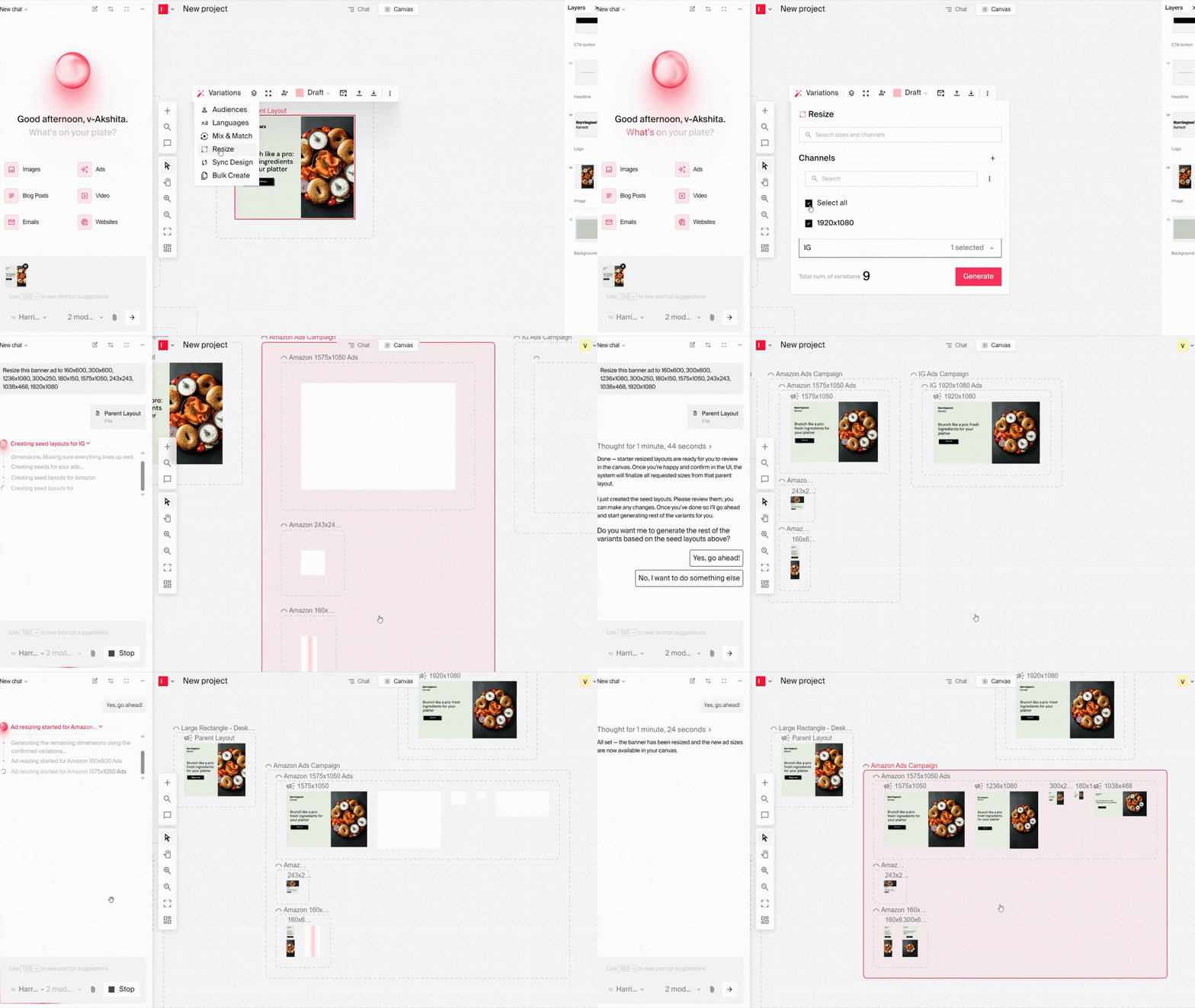
The most consequential update for performance marketers running paid media on retail platforms is a new resizing feature inside Ad Agent, which takes a single approved creative asset and generates compliant ad variants across channels including Walmart and Amazon. That feature is not broadly available. According to the company's own post, "Ads resizing spots are filling fast," and marketers are directed to contact their Engagement Manager to join a waitlist rather than activate the tool immediately. The gating detail matters more than the feature description itself, since it defines who can actually use the update this month and who cannot.
The second major update lands inside Video Agent, where a new capability called Agentic Video Composer allows creative teams to turn a brief or a set of existing assets into a finished video with control over individual scenes, rather than forcing a full rebuild for a single change. According to Typeface, the tool can also generate background music using Google's Lyria model, reading a video's duration and tone before producing a matching track. Unlike the Ad Agent update, Video Agent's new features carry no waitlist language in the source material and read as available now within the existing product.
A third, smaller update adds page-level analytics to Web Agent, letting marketers track page views, visitors, clicks, and engagement on published landing pages without leaving the platform. Image Agent, covered more briefly in the same post, now supports editing a single element of a flat image, such as swapping a logo, without regenerating the entire graphic, and adds version history for images for the first time.
What changed inside Ad Agent
Performance marketers who buy paid media across retail and social channels face a recurring production problem: one approved creative asset has to become a dozen platform-specific variants before a launch deadline, and each platform enforces its own safe zones and placement rules. Typeface's new resizing capability inside Ad Agent is built to remove the manual rebuild step from that process. Marketers upload channel guidelines once, and the system reads platform-specific placement rules, including those for Walmart and Amazon, before generating variants automatically.
The workflow includes a control point before scaling begins. According to the company, marketers first review and approve a set of seed layouts before full generation runs across every required variant, which keeps a human decision inside the loop rather than letting the system publish unreviewed creative directly. When performance data calls for a change mid-flight, marketers can edit copy or creative directly on the canvas, and that single edit propagates across every banner variant tied to the asset. Typeface's post also states that font and color rules travel with the asset automatically, so edited variants remain on-brand without a separate compliance pass.
None of that changes the access question, though. The company's own language, that resizing spots are "filling fast," combined with the instruction to contact an Engagement Manager, indicates a capacity-limited or invitation-based rollout rather than a feature available to every Ad Agent customer on the day of publication. Marketers who want early access will need a direct conversation with Typeface's account team, not a self-serve toggle inside the product.
Agentic Video Composer and the scene-level editing shift
Creative teams leading video production have historically faced a binary choice: recreate scenes from an existing video by hand, or rebuild an entire project from a blank timeline. Video Agent's new Agentic Video Composer is designed to collapse that choice. Because the tool builds video at the scene level, with each moment functioning as its own editable slot, a team can swap, replace, reorder, or retime one scene without touching the rest of the finished cut.
Two separate entry points exist for the feature. In the first, a team starts from a prompt or a set of its own assets, and the agent produces an outline, a storyboard, and a video, dropping existing assets into designated scenes and generating content to fill any gaps. Typeface states there is no length cap on videos generated this way, which opens the door to long-form output rather than restricting teams to short promotional cuts. In the second mode, a team uploads long-form footage directly, and the agent edits that raw material into a highlight reel intended to be ready for publishing, a task the post describes as one creative teams previously handled manually.
Music generation is folded into the same editor. According to the company, teams can now generate a soundtrack using Google's Lyria model without leaving Video Agent, and the system reads the video's duration and overall tone before producing a track intended to match. This is not the first point of contact between Typeface and Google's advertising infrastructure. Google previously partnered with Typeface to let Typeface users import creative assets directly into Google Ads, alongside existing integrations with Canva, Smartly, and Pencil, giving the two companies an existing technical relationship well before this month's music-generation addition.
Brand compliance for generated video content is designed to run during creation rather than after it. According to the post, generated scenes, text overlays, motion, and transitions follow brand standards as they are produced, rather than being flagged for correction in a later review pass. A single outline can also be exported into three aspect ratios required across different platforms: 9:16 for Reels, TikTok, and Shorts; 16:9 for YouTube; and 1:1 for LinkedIn and Meta. That multi-format export addresses a well-documented pain point for teams managing video across placements with conflicting specifications. Meta alone maintains 25 distinct ad placements, each carrying its own aspect ratio guidance, a level of format fragmentation that has pushed several platforms toward automated resizing tools over the past two years.
Web Agent adds analytics, framed as a step toward a larger optimization system
Marketers running landing pages tied to paid campaigns have typically needed a separate analytics tool, or a request to another team, to understand how a page performs after launch. Web Agent's update removes that extra step for pages published through Typeface. Marketers add an analytics script once, and the system applies it automatically to every subsequent page, surfacing page views, visitor counts, clicks, and engagement over time inside the same platform used to publish the page.
Because publishing through Web Agent runs independently of a marketer's content management system, Typeface states that teams can spin up landing page variations to pair with different ad or email campaigns, then test and retire those variants on their own schedule rather than one dictated by a CMS release cycle. The company frames this update explicitly as preparation for a larger system, describing it as "an early step toward the bigger optimization loop" the company is building toward with a feature called Arc Loop, which had not shipped as of publication.
Two features teased, not yet released
Typeface's post includes an early look at two capabilities the company says are coming later this summer, and both remain unreleased as of today. The first, Arc Loop, is described as an effort to close what the company calls an "open loop" problem in AI marketing tools: campaigns publish content, but performance data typically lives in a separate system, so each new campaign effectively starts from zero rather than learning from what worked previously. According to the company, Arc Loop is designed to feed performance signals directly back into a brand's context, so each subsequent campaign builds on prior results rather than repeating the same starting point.
The second, called Chat Cowork, is described as a system that lets a team hand off a complex, multi-step task and return later to completed work. According to the post, Typeface's chat function will plan a job, break it into steps, and work through those steps independently, while holding context across the full task so information is not lost partway through. Neither feature carries a specific release date beyond the company's general reference to later this summer, and neither should be treated as available inside the platform today.
Smaller updates across email, chat, and custom agents
Alongside the three headline updates, Typeface's post lists several narrower additions. On the email side, the platform can now insert citations and footnotes automatically: a marketer supplies a file of approved claims, and the system places matching superscripts in the body text while building a corresponding reference section. Responsive previews now show how a given email will render on both mobile and desktop before it sends, and marketers can generate matching SMS copy from the same workflow used to draft an email.
Inside chat, users can now submit a full set of tasks upfront and let the system work through all of them sequentially, with any input problems flagged before generation begins rather than discovered partway through. Document editing through chat can now update a single section without regenerating an entire document, inside what the company describes as a redesigned, searchable chat interface. A separate update allows teams to define how a specific named individual, such as a chief executive or another persona, sounds in writing, kept distinct from a company's broader brand guidelines, while existing brand safety and compliance rules continue to apply underneath that individual voice profile.
Custom agents built inside the platform are described as now following their configured instructions consistently through an entire task, and can additionally run on a set schedule or trigger automatically when a linked document's status changes. A final update allows external systems connected to Typeface to trigger the next step in a workflow automatically when an event occurs elsewhere, removing the need for a person to start that step manually.
Context: Typeface's research already published this month
The same post closes by pointing readers to a research report the company published earlier in June, a detail worth separating clearly from this month's product updates because it was released as its own item, not as part of this Feature Focus. Typeface's Signal Report, titled "The AI Speed Paradox," found that a large majority of surveyed marketing leaders feel new pressure to move faster because AI tools are more available, even as measured campaign timelines have lengthened rather than shortened. PPC Land covered that report in detail on publication, noting the study drew on more than 200 marketing leaders at the VP level or above, surveyed in May 2026, with comparative data from a prior September 2025 fielding.
According to that earlier PPC Land reporting, the report found that 93 percent of marketing leaders said AI had increased pressure to move faster, while only 16 percent described their organization as fully prepared to operate at that pace, and 34 percent said a single campaign now requires between one and two months to ship, up from just 5 percent the year before. The figures give this month's product announcements a specific backdrop. Features designed to compress creative production time, such as Agentic Video Composer's scene-level editing or Ad Agent's automated resizing, arrive at a moment when Typeface's own survey data suggests the bottleneck limiting campaign speed has shifted away from content generation itself and toward the review, approval, and coordination steps that surround it.
Why the details matter for marketers
A monthly feature recap rarely carries the drama of a funding round, a lawsuit, or a platform shutting down a product line, and this one is no exception. What it does offer is a specific, verifiable account of where an AI marketing platform is investing engineering effort, and where it is choosing to gate access rather than open a feature broadly. The waitlist attached to Ad Agent's resizing tool is the clearest signal in this update: demand for automated cross-channel resizing appears to have outpaced whatever capacity Typeface has allocated to support it this month, at least for the two named retail platforms, Walmart and Amazon.
Video Agent's changes carry a different kind of significance for creative teams specifically. Removing a length cap on generated video, combined with scene-level editing that avoids full rebuilds for single changes, addresses two separate frustrations that have historically pushed video production back toward manual editing tools even after a team adopts an AI platform. Whether those changes measurably shorten production timelines, and whether they interact with the review-and-approval bottleneck Typeface's own Signal Report documented, is not something this month's post answers. That would require a follow-up disclosure, likely months out, showing adoption data or customer-reported time savings, neither of which appears in this release.
The framing of Web Agent's analytics update as a step toward Arc Loop is also worth tracking rather than dismissing as marketing language. If Arc Loop ships as described, feeding performance data back into brand context so each campaign builds on the last, it would represent a structural change to how the platform operates rather than an incremental feature, closing a specific gap the company itself has identified in "open loop" AI marketing tools. Until that feature actually ships, the analytics update inside Web Agent functions as a standalone capability: useful for a marketer checking how a page is performing today, but not yet connected to any automated optimization system.
Timeline
- June 2026 - Typeface rolls out an ads resizing feature inside Ad Agent, gated by waitlist, supporting channel-specific variant generation for platforms including Walmart and Amazon.
- June 2026 - Video Agent gains Agentic Video Composer, adding scene-level editing, Google Lyria-based music generation, and removal of any length cap on generated video.
- June 2026 - Web Agent adds built-in page analytics, tracking views, visitors, clicks, and engagement without a separate tool.
- June 2026 - Image Agent adds single-element editing and version history for images.
- June 22, 2026 - Typeface publishes its Signal Report, "The AI Speed Paradox," separately from this Feature Focus post.
- July 8, 2026 - Typeface publishes its "Feature Focus: June 2026" recap, summarizing the month's updates and previewing Arc Loop and Chat Cowork, both still unreleased.
Related PPC Land coverage
- AI made campaigns slower, not faster, new Typeface data shows - covers Typeface's June 22, 2026 Signal Report, the same research the company references at the close of this Feature Focus post.
- Typeface AEO Analyzer scores content for AI search as Firstsource deal lands - background on Typeface's investor backing and its Marketing Orchestration Engine platform, referenced for company context in this article.
- Google Ads expands AI Tools and Reporting Features across campaign types - documents Typeface's earlier integration allowing asset imports directly into Google Ads, relevant background for this month's Google Lyria music-generation addition.
- Meta's complex aspect ratio requirements span 25 ad placements - explains the platform-fragmentation problem that Video Agent's multi-format export is designed to address.
Summary
Who: Typeface, an AI marketing orchestration platform backed by Lightspeed, GV, Salesforce Ventures, Madrona, Menlo, and M12, along with its Ad Agent, Video Agent, Web Agent, and Image Agent product lines.
What: Typeface published its June 2026 Feature Focus, detailing a waitlisted ad-resizing capability inside Ad Agent for channels including Walmart and Amazon, a new Agentic Video Composer inside Video Agent with scene-level editing and Google Lyria music generation, built-in page analytics inside Web Agent, single-element editing inside Image Agent, and a preview of two unreleased features, Arc Loop and Chat Cowork, planned for later in the summer.
When: The recap was published today, July 8, 2026, covering feature updates rolled out across June 2026.
Where: The updates apply within Typeface's cloud-based marketing platform, used by enterprise marketing and creative teams; the company itself is backed by US-based venture investors.
Why: The update matters because it shows where an AI marketing vendor is choosing to gate access, through the Ad Agent waitlist, versus where it is removing technical constraints outright, such as the video length cap, at a moment when Typeface's own research has documented that campaign timelines are lengthening industry-wide despite wider AI adoption.


Discussion