Visa builds payment infrastructure for AI agents to shop on your behalf
Visa's Rubail Birwadker reveals how the company is building tokenized payment systems for agentic commerce, addressing fraud concerns as AI agents begin making purchases.


Visa's Rubail Birwadker reveals how the company is building tokenized payment systems for agentic commerce, addressing fraud concerns as AI agents begin making purchases.
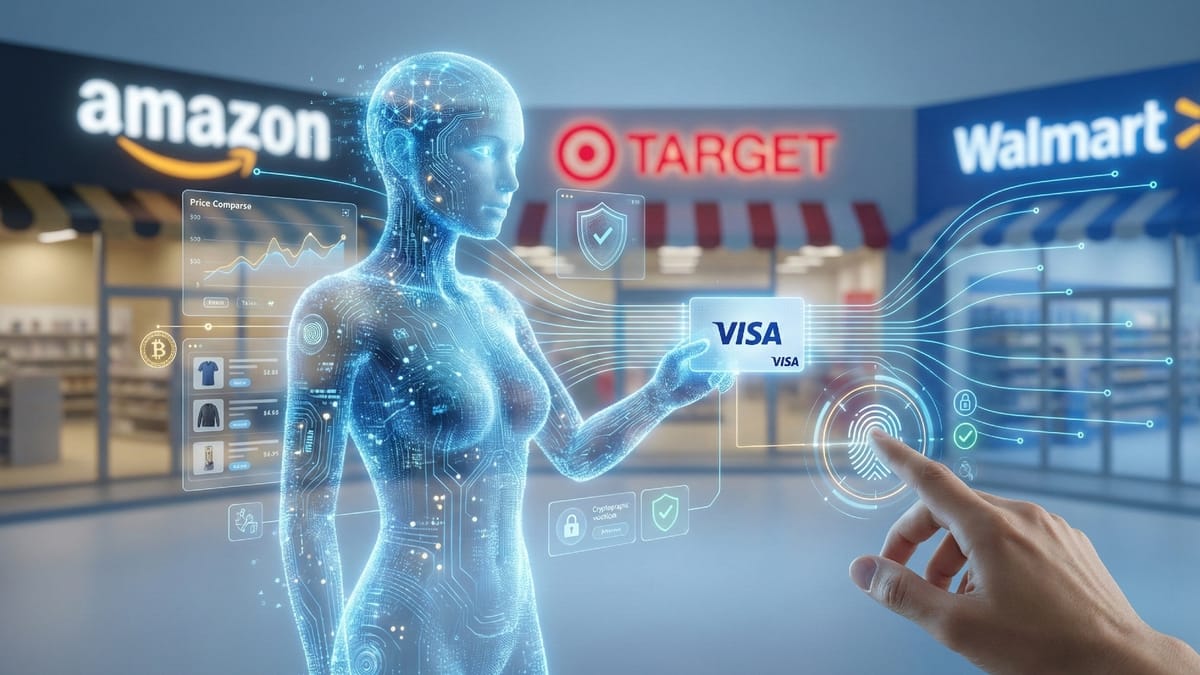
Visa has positioned itself at the forefront of agentic commerce infrastructure, developing payment protocols that allow AI agents to make purchases on behalf of consumers while maintaining security standards comparable to traditional eCommerce transactions. The company joined Google's Universal Commerce Protocol initiative announced January 11, 2026, aligning with Mastercard, Shopify, Etsy, Wayfair, Target, and Walmart to establish open-source technical standards for AI agents executing purchases across retail platforms.
Rubail Birwadker, Visa's Senior Vice President and Global Head of Growth Products and Strategic Partnerships, detailed the company's approach during a September 2025 podcast appearance on The Intelligent Marketer. His role encompasses AI and agentic commerce products, crypto and stablecoins, and global business development for the payment network that connects 10,000 to 15,000 banks with 150 to 200 million merchants serving 4.5 billion credentials worldwide.
The company announced its Model Context Protocol (MCP) integration in late 2024, establishing technical standards for how AI agents can access and utilize payment credentials within conversational interfaces like ChatGPT. Visa's participation in the Universal Commerce Protocol extends these capabilities into broader industry standards enabling any compliant AI agent to transact with any compliant merchant globally. Birwadker emphasized that Visa cannot afford a wait-and-see approach given its network responsibilities. "We almost have to define how we believe the compatibility would work," he stated, noting the imperative to maintain consistent consumer experiences whether transactions occur in Tel Aviv, Mumbai, San Francisco, or Bogota.
Birwadker provided a precise definition distinguishing agentic commerce from traditional eCommerce: the threshold crosses when consumers operate in an environment that is not a merchant environment but ask software to execute purchases at merchants on their behalf. "You have all these new intermediaries that are adding an enormous amount of value that sit in the middle," he explained, pointing to AI platforms that curate, contextualize, compare, and personalize before converting intent to actual purchases.
This differs fundamentally from delegated purchases or subscription services. A consumer browsing Macys.com or standing in an AMC theater knowingly interacts directly with merchants through traditional interfaces. Agentic commerce introduces intermediary software layers that take identity, credentials, and data payloads to merchants after the consumer expresses intent through natural language prompts or automated triggers.
The transactions can execute immediately or conditionally. An AI agent might present four types of red socks from different retailers, purchase the selected option instantly, or wait until a price threshold is met days later. In both scenarios, the agent automates actions consumers would ordinarily perform manually, operating from contextual understanding rather than explicit button clicks.
Visa designed its agentic commerce infrastructure around authenticated tokens rather than exposing Primary Account Numbers (PANs) and Personally Identifiable Information (PII) to AI agents. The approach mirrors Google Pay and Apple Pay implementations, binding tokens representing cards to specific devices and applications.
Birwadker outlined the three-layer security model. First, tokenization prevents sensitive data from circulating with agents, eliminating scenarios where compromised systems leak payment credentials to dark web marketplaces. Second, authentication during initial card provisioning involves bank verification—a trusted source for consumer validation. This step up process identifies whether specific consumers are legitimate before allowing token creation.
Once provisioning completes, the system drastically reduces fraud vectors. "Anything else that happens is not going to be allowed on the token," Birwadker explained. The authentication binds tokens to precise configurations: specific consumers on specific bank cards within specific applications on specific devices. Deviation from these parameters blocks transaction attempts.
Third, Visa implemented biometric authentication at purchase time when human-in-the-loop verification is chosen, further narrowing fraud exposure. The company developed payment instruction data payloads that match agent purchase attempts against consumer natural language prompts before issuing cryptograms. Agents cannot execute purchases without these cryptograms, which are only generated after confirming alignment between intended and actual purchases.
"We have no idea how and what the types of frauds we'll see," Birwadker acknowledged, noting the infrastructure launched in very early stages. He suggested reassessment after accumulating millions of transactions, admitting potential over-correction but emphasizing that fraud prevention warrants conservative approaches. "You want to make sure that that level of precision is not lost when it comes to your money."
Buy ads on PPC Land. PPC Land has standard and native ad formats via major DSPs and ad platforms like Google Ads. Via an auction CPM, you can reach industry professionals.
Scale considerations extend beyond United States implementation. According to Birwadker, 70 to 80 percent of users for major language models and AI platforms operate outside the United States, necessitating payment systems that function across diverse regulatory environments.
European markets present Payment Services Directive 2 (PSD2) requirements including 3D Secure authentication standards and merchant-level step-up verification. Australia imposes local routing requirements. Canada involves Interac integration. Mexico maintains distinct market characteristics. "Every market is different, and it's very hard for payment methods that are designed for a relatively narrow use case to actually scale," Birwadker noted.
The technology must accommodate commercial cards, small business credentials, and consumer cards across varied use cases and geographies. Visa's expertise in global scaling differentiates its approach from payment methods restricted to specific regions or transaction types. This compatibility requirement drove the company's focus on standardized infrastructure adaptable to local regulations rather than geography-specific implementations.
Beyond agent-side infrastructure, Visa addresses concerns from both merchants and issuing banks. Banks worry about call center traffic from consumers disputing purchases where intent may be lost in natural language translation. A consumer might claim they asked for one product while the agent interpreted the request differently. Unlike button clicks that provide clear action records, conversational prompts introduce ambiguity.
Visa is developing dispute, chargeback, and fraud rules specifically for agentic contexts to provide clarity and actionability while preventing issues before they escalate to formal disputes. Banks in markets outside the United States often involve fewer partners than the United States market's longer tail of financial institutions, potentially accelerating adoption in regions where six to eight banking partnerships provide near-universal coverage.
Merchants face different challenges. They must decide how to expose inventory pages, pricing details, and order information to agents without exposing systems to malicious bots. Content Delivery Network (CDN) providers already implement protocols distinguishing good bots from bad bots and controlling access levels. Visa's role involves integrating with this infrastructure so merchants recognize authenticated Visa credentials as signals of legitimate purchase intent.
"Merchant websites are not designed for AI," Birwadker observed. "They're designed for human beings, just like font color, sizes, buttons, interstitials, an agent doesn't care about any of that." Merchants must create architectural forks servicing agents differently than human visitors, enabling rapid navigation and transaction completion. Most merchant-side work currently focuses on CDN-level recognition of authenticated credentials rather than payment processing, which occurs further downstream.
Shopify exemplifies merchant adaptation by making Model Context Protocol servers available for agents navigating Shopify websites and accessing order details. Birwadker characterized this as "as tech-forward as any other company you could look at from a merchant perspective," anticipating broader architectural refactoring to accommodate agent traffic.
Visa's definition process deliberately included startup participation rather than limiting collaboration to established banking partners. Birwadker credited executive leadership for maintaining tech-forward orientation and leveraging geographic proximity to Silicon Valley companies. Visa invested early in Square (2010-2011), Stripe, and Marqeta, staying close to innovation communities.
"We know what we don't know," he stated, acknowledging that expertise for solving hard problems concentrates among entrepreneurs raising capital to address specific challenges. The company hosted dinners inviting agentic commerce startups to participate in standards discussions, recognizing that effective innovation requires both startup ingenuity and established infrastructure compatibility.
This dual approach balances startup innovation with ecosystem scalability. New payment innovations must work for thousands of banks, millions of merchants, and billions of credentials. "Without working with the ecosystem, we don't want to do things subscale, they have to work at scale," Birwadker explained, noting that Visa's brand power manifests in universal compatibility rather than narrow implementations.

Visa conducts regular consumer research revealing consistent themes: safety, security, and money protection remain fundamental building blocks. Early adoption concentrates where purchase inefficiencies create friction. Birwadker shared a colleague's example of family vacation planning with four children—previously a four-hour comparison shopping project across hotels, airlines, locations, weather, and activities, now compressed to 30 minutes through prompt-based recommendations.
The discovery funnel's first 80 percent collapses rapidly as AI handles research traditionally requiring manual effort: restaurant reviews, menu details, venue atmosphere, location weather. "The individual work that went in to do that is going to just collapse," Birwadker predicted, identifying this as an immediate category for agentic adoption.
Another category encompasses purchases consumers must complete but prefer not to spend time executing: bill payments, rent, tuition. These recurring obligations become early automation targets once trust solidifies. However, Birwadker emphasized that physical commerce didn't disappear when eCommerce emerged, and agentic commerce won't replace existing channels. Consumers still walk into AMC theaters to purchase tickets or browse Ray-Ban stores despite online alternatives.
"If I was to make a prediction, I think you'd see a percentage of the world of commerce move to agentic, but the other channels are going to exist and they're just going to evolve," he stated, envisioning physical commerce, eCommerce, mobile commerce, app commerce, and agentic commerce coexisting.
Birwadker observed particularly interesting developments from mega wallets based in Asia—super apps with hundreds of millions or billions of users providing comprehensive services. These platforms never replicated successfully in the United States despite multiple attempts, but they position themselves at the forefront of agentic commerce innovation.
"They already have a captive audience of hundreds of millions if not over a billion users," he noted, describing how these companies design experiences that keep users within native environments rather than redirecting to external merchants. The captive user bases enable aggressive experimentation with agentic features for audiences already conducting significant portions of daily life through these applications.
Asian, Middle Eastern, and African markets show strong overlap between agentic commerce evolution and stablecoin adoption. Stablecoins address product-market fit gaps where cards don't meet consumer needs, particularly in markets with high currency volatility or limited digital infrastructure. Consumers in these environments prefer holding money in stablecoins tied to stable currencies. "In most of the countries where we're seeing a lot of stablecoin adoption in emerging markets, typically we don't really have a lot of people domestically using cards," Birwadker observed.
Fewer banking partners in many international markets compared to the United States accelerates potential adoption. Achieving country-wide coverage might require only six to eight banking partnerships, simplifying coordination compared to the United States market's extensive tail of financial institutions.
Birwadker acknowledged uncertainty about how brand dynamics will evolve for merchants. Small merchants currently rely on advertising—word of mouth, influencer marketing, social media platforms—to attract consumers. Agentic commerce will transform advertising mechanisms, though specific evolution paths remain unclear.
The optimistic scenario suggests intelligent technology might democratize discovery. "If truly, maybe quality shines over anything else, and maybe they have an easier way to get discovered because agents will figure out like, oh, this is the best product because I did all this algorithmic math in the middle," Birwadker posited, imagining an obscure artisan in a Japanese village surfacing to San Francisco buyers through agent evaluation rather than advertising spend.
However, the inverse concern persists: established brands with captive audiences and resources might build proprietary agents maintaining consumer relationships. A loyal Nike customer might prefer interacting with Nike's agent for personalized recommendations rather than consulting neutral intermediaries. Cost-consciousness varies by consumer and purchase category, adding complexity to prediction.
"I actually really truly think those are fundamental questions that really, really need to get answered," Birwadker stated, noting very early signals without clear directional trends. From Visa's perspective, the principle remains that credentials should work identically for enterprise merchants and individual widget sellers, with consistent processing, disputes, chargebacks, and brand guarantees regardless of merchant size.
Birwadker expressed personal excitement about potential loyalty program transformation. He recalled predictions from 10 to 15 years ago about location-based offers—walking past Starbucks and receiving promotional notifications—that never materialized. "Closing the loop on attribution, data, personalization, never really came to pass," he reflected, describing current loyalty systems outside airlines as "kind of janky."
Agentic commerce might finally solve these problems by combining context, data, and personalization while maintaining privacy. "I really, really hope people go build awesome things in agentic that make me a more loyal customer, but also gives me a much more enriched experience," he stated, characterizing enjoyable buying experiences as valuable consumer outcomes.
From Visa's institutional perspective, success means rolling out agentic commerce standards to as many global markets as possible during the coming year and achieving functionality. Birwadker identified a specific accomplishment metric: "Tens of millions, if not hundreds of millions of users using the Visa cards to buy things in an agentic environment at better or lower fraud than they do today in an eCommerce environment."
Visa endorsed Google's Universal Commerce Protocol launched January 11, 2026, positioning the company alongside Mastercard's Agent Pay infrastructure as open-standard infrastructure providers rather than proprietary platform operators. The UCP establishes REST and JSON-RPC transport layers defining how AI agents discover products, negotiate checkout parameters, link customer identities, and manage post-purchase workflows without custom integrations for each merchant.
More than 20 companies endorsed the protocol including payment networks Visa and Mastercard, payment processors Adyen and Stripe, and merchants Best Buy, Flipkart, Macy's Inc., The Home Depot, and Zalando. Google co-developed UCP with Shopify, Etsy, Wayfair, Target, and Walmart, releasing technical specifications and enabling native checkout directly within Google's AI Mode and Gemini app.
The protocol incorporates three complementary standards: Agent Payments Protocol providing cryptographic transaction authorization, Agent2Agent enabling multi-agent collaboration, and Model Context Protocol for tool calling from AI assistants. Visa's authenticated token approach integrates with these specifications, extending tokenization and biometric verification mechanisms across the broader ecosystem.
This open protocol strategy contrasts with Amazon's approach of blocking third-party AI agents to protect $56 billion in annual advertising revenue. Universal Commerce Protocol aims to make checkout buttons obsolete by enabling agents to complete purchases through standardized APIs rather than simulating human interactions with merchant websites. Visa's endorsement signals commitment to infrastructure enabling any agent to transact with any merchant rather than walled gardens where platforms control both agents and transactions.
Birwadker's September 2025 commentary anticipated this industry direction when discussing startup ecosystem involvement. The company's decision to include startups in standards definition reflected recognition that payment infrastructure requires both established network compatibility and innovative approaches from entrepreneurs addressing specific challenges. "We know what we don't know," he stated, acknowledging that solving hard problems requires collaboration beyond traditional banking partnerships.
The company's fundamental mission remains digitizing the world and enabling consumers to pay and get paid anywhere with Visa credentials. Agentic commerce represents a new channel requiring the same security, fraud prevention, and global accessibility that characterizes existing commerce methods. "Everything else is bells and whistles," Birwadker concluded. "The bread and butter is how do we make consumers to purchase in a safe, secure, fraud-free environment as broadly around the world as possible?"
Subscribe PPC Land newsletter ✉️ for similar stories like this one
Subscribe PPC Land newsletter ✉️ for similar stories like this one
Who: Rubail Birwadker, Senior Vice President and Global Head of Growth Products and Strategic Partnerships at Visa, leading the company's initiatives in AI and agentic commerce products, cryptocurrency and stablecoins, consumer and non-card products, and global business development. Visa operates a network connecting 10,000 to 15,000 banks with 150 to 200 million merchants serving 4.5 billion credentials globally.
What: Visa developed payment infrastructure specifically designed for agentic commerce—transactions where AI agents make purchases on behalf of consumers rather than consumers directly interacting with merchant interfaces. The system uses authenticated tokens bound to specific devices and applications, layered security including biometric verification, and cryptogram generation that validates purchase intent before execution. The company announced Model Context Protocol integration enabling this functionality within conversational AI platforms.
When: Visa's investments in payment technology startups began in 2010-2011 with Square, establishing patterns of innovation engagement. Birwadker assumed his current leadership role overseeing growth products and strategic partnerships in November 2024, the same period when Visa announced its MCP integration. The September 23, 2025 podcast interview provided detailed technical disclosure about the company's agentic commerce approach and security architecture.
Where: Visa's agentic commerce infrastructure must function globally across diverse regulatory environments including European PSD2 requirements, Australian local routing mandates, Canadian Interac integration, and Mexican market characteristics. The company emphasized that 70 to 80 percent of major language model users operate outside the United States, necessitating international compatibility. Particularly strong innovation signals emerge from Asian mega wallet platforms with captive audiences exceeding hundreds of millions or billions of users.
Why: The payment network's core responsibility requires maintaining compatibility with emerging technologies rather than adopting wait-and-see approaches. Visa must ensure consistent consumer experiences across 190 countries regardless of transaction context—physical retail, eCommerce, mobile, or agentic environments. The company prioritizes security concerns given unknown fraud vectors that may emerge when consumers entrust software with purchasing authority, designing layered protections that likely over-correct initially. Visa endorsed Google's Universal Commerce Protocol on January 11, 2026, joining more than 20 companies establishing open-source technical standards for AI-mediated commerce. This positioning reflects strategic choice between open interoperable protocols versus proprietary platform-controlled ecosystems, with Visa favoring infrastructure enabling any agent to transact with any merchant rather than walled gardens limiting competition. Success metrics focus on enabling tens or hundreds of millions of users to complete agentic purchases at fraud rates better than or comparable to current eCommerce transactions while scaling globally across banks, merchants, and payment credentials.