AI facial recognition locked up the wrong woman for 5 months
A Tennessee grandmother spent five months in jail after Clearview AI misidentified her as a North Dakota bank fraud suspect. What the case reveals about AI oversight gaps.


A Tennessee grandmother spent five months in jail after Clearview AI misidentified her as a North Dakota bank fraud suspect. What the case reveals about AI oversight gaps.
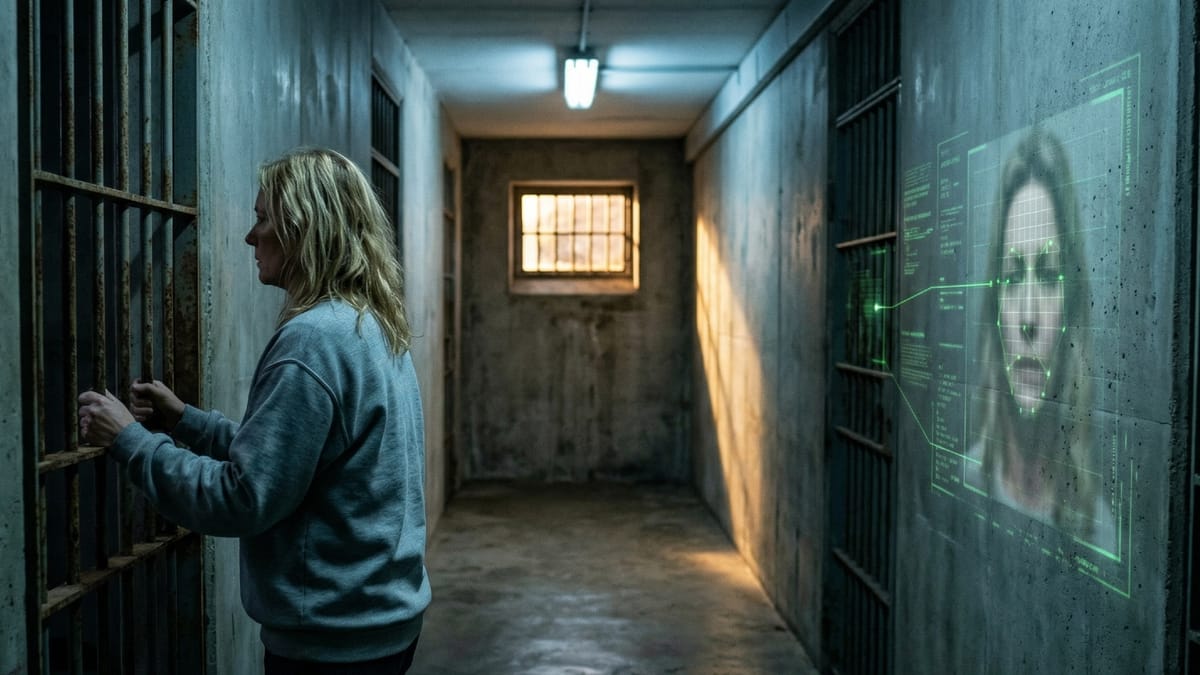
Angela Lipps had never set foot in North Dakota. She had never been on an airplane. She had never committed bank fraud. None of that prevented her from spending five months in custody - first in Tennessee, then in Fargo - after an AI facial recognition system flagged her face as matching a suspect caught on surveillance video more than 1,000 miles from her home.
The case, which surfaced publicly in late March 2026, is the latest in a growing line of documented failures tied to automated identification technology deployed in law enforcement. It raises pointed questions about what happens when a machine's probabilistic output is treated as sufficient grounds for arrest, extradition, and prolonged detention.
Lipps, 50, a mother of three and grandmother of five who has lived most of her life in north-central Tennessee, was arrested at her rental home in July 2025 while babysitting four children. According to The Guardian, US marshals arrived at gunpoint and booked her into a county jail as a fugitive from justice from North Dakota. She had been charged with four counts of unauthorized use of personal identifying information and four counts of theft - all connected to bank fraud incidents in Fargo that occurred in April and May 2025.
Investigators in Fargo had reviewed surveillance footage of a woman using a fake US Army military ID to withdraw tens of thousands of dollars from bank accounts. According to Fargo police records obtained by WDAY News, detectives used facial recognition software to identify Lipps as the suspect. A detective reportedly wrote in court documents that Lipps appeared to match the suspect based on facial features, body type, and hairstyle.
No one from the Fargo police department contacted Lipps before the arrest.
The technology at the center of this case was Clearview AI. According to a press conference statement from Dave Zibolski, chief of the Fargo Police Department, the West Fargo Police Department - a separate agency - used Clearview AI, which "identified a potential suspect with similar features to Angela Lipps." From that match, Fargo's own department then took what Zibolski described as "additional investigative steps independent of AI to assist in identification."
Clearview AI operates a facial recognition system containing more than 60 billion images scraped from websites and social media platforms globally, and has faced substantial regulatory enforcement across Europe. As of October 28, 2025, the privacy advocacy group noyb had filed a criminal complaint against Clearview AI executives in Austria after the company ignored over 100 million euros in European fines. The company's database includes biometric data from millions of Europeans, despite multiple regulatory orders to cease processing and delete that information.
In the United States, however, Clearview AI has continued operating largely without formal restrictions. The Lipps case illustrates how tools subject to significant legal challenge abroad can still be deployed domestically in ways that carry serious consequences for individuals.
Lipps was arrested on July 14, 2025, according to Assistant Chief Travis Stefonowicz of the Fargo Police Department. She remained in Tennessee custody until October 20, 2025, when Tennessee authorities notified the Cass County Sheriff's Office that she had waived extradition and was ready for transport. The duration of her Tennessee detention - roughly 98 days - remains unclear in terms of whether it reflected time served for a probation violation or delays in the extradition process.
She was transported to North Dakota at the end of October - 108 days after her initial arrest, according to InForum. Her first court appearance in North Dakota took place on October 31, 2025.
What followed stretched the case into December through a series of procedural gaps. The detective assigned to her case was not aware she was in custody in North Dakota until December 5, 2025 - more than a month after her arrival. Because Lipps had legal representation, investigators needed her attorney's approval before conducting an interview. That approval came on December 19. Four days later, on December 23, the Fargo Police Department, Cass County State's Attorney, and a presiding judge mutually agreed to dismiss the charges without prejudice. Lipps was released from the Cass County Jail on December 24.
The exculpatory evidence, once reviewed, took five minutes to process. According to her attorney Jay Greenwood, bank records showed that Lipps was more than 1,200 miles away in Tennessee at the time the fraud was occurring in Fargo. "If the only thing you have is facial recognition, I might want to dig a little deeper," Greenwood told InForum.
Her attorney Eric Rice, who spoke to FOX Television Stations, put it plainly: "She did have exculpatory evidence available, such as records showing she was in Tennessee at the time. I don't know why it took multiple months for that information to reach the state, but once it did, the charges were dismissed relatively quickly."
Lipps wrote on a GoFundMe campaign that going to North Dakota was "the first time I had ever been on an airplane." By the time she arrived in Fargo, she was, in her own words, "terrified and exhausted and humiliated." That fundraiser had cleared $68,000 as of the weekend before the story gained wider attention.
Fargo police did not pay for her trip home. Local defense attorneys and a non-profit organization called the F5 Project helped cover a hotel room, food on Christmas Eve and Christmas Day, and her return to Tennessee. No one from the department had apologized, Lipps told WDAY News.
The Fargo Police Department's internal review, completed after Lipps' release, acknowledged that the initial investigation could have been more thorough. Stefonowicz stated that the department does not own or directly operate facial recognition tools. Investigators, he explained, may occasionally request assistance from external state or national intelligence centers that use such systems to generate investigative leads. The department's reliance on West Fargo's Clearview AI output illustrates how the technology can enter a case without the receiving agency having direct accountability or oversight over how it functions.
In response, the Fargo Police Department adopted a formal policy governing facial recognition use on March 25, 2026 - a date that fell just days before the story reached national media. Before that date, no such policy existed because the department did not directly operate the tools. Zibolski also announced the department would no longer send or utilize information from West Fargo's Clearview AI system, citing uncertainty about how it is run or overseen. Going forward, all facial recognition identifications are to be shared monthly with the department's Investigation Division commander.
The case is part of a broader documented pattern. According to The Guardian, in October 2025 an AI system apparently mistook a Baltimore high school student's bag of Doritos for a firearm and called local police, resulting in officers approaching the pupil with guns drawn. Separately, police in the UK arrested a man for a burglary in a city he had never visited after face-scanning software confused him with another person of south Asian heritage.
For the marketing and technology communities, the Lipps case offers a concrete illustration of what happens when algorithmic confidence outpaces human verification. The same logic that produces biometric misidentification in law enforcement - a system assigns a probability, a human treats it as a conclusion - applies across many domains where AI-generated outputs influence real decisions.
Public skepticism toward AI is already measurable and rising. Research released December 1, 2025, showed that majorities of US adults view AI's impact negatively on creative thinking and interpersonal relationships. A survey from Shift Browser found that 81% of consumers expressed concern about AI data access, while 48% ranked privacy as their top AI-related worry - ahead of accuracy at 36%.
Those concerns are grounded in cases like Lipps'. When a system containing over 60 billion scraped images - many collected without the knowledge of the people pictured - produces a false match that results in five months of detention, the downstream effects extend well beyond a single wrongful arrest. They shape how communities perceive AI-assisted decision-making and, ultimately, how much trust institutions can claim when deploying these tools.
The data governance questions at the heart of AI deployment remain largely unresolved across industries. Research published by Publicis Sapient in November 2025 identified a critical gap: organizations claim AI readiness while lacking the data governance foundations needed for autonomous systems to operate responsibly. "AI won't fail for lack of models. It will fail for lack of data discipline," the report concluded.
The Clearview AI controversy in Europe demonstrates how enforcement can escalate when companies treat fines as an operating cost rather than a deterrent. As of October 2025, noyb's criminal complaint against Clearview executives in Austria represented a direct escalation beyond financial penalties - targeting individual managers rather than the corporate entity. Whether similar accountability mechanisms develop in the United States will depend partly on cases like Lipps' gaining traction in civil litigation.
Her GoFundMe describes the lasting costs plainly: during the five months she was in custody, Lipps lost her rental home, her car, and her dog. Her belongings were seized when a storage unit bill went unpaid. "I am not the same woman I was. I don't think I ever will be," she wrote.
Who: Angela Lipps, 50, a grandmother from north-central Tennessee, along with the Fargo Police Department, the West Fargo Police Department, and Clearview AI.
What: Lipps spent five months in custody - first in Tennessee and then in North Dakota - after AI facial recognition technology incorrectly matched her to surveillance footage from a bank fraud investigation. Bank records proving she was in Tennessee at the time of the fraud took months to reach investigators. Charges were dismissed on December 23, 2025, after a 15-minute review of the evidence.
When: Lipps was arrested on July 14, 2025. She was released on December 24, 2025. The Fargo Police Department adopted a formal facial recognition policy on March 25, 2026, and the case gained national media attention on March 29-30, 2026.
Where: The fraud occurred in Fargo, North Dakota. Lipps was arrested at her rental home in Tennessee. She was held in Tennessee for approximately 98 days before being transported over 1,000 miles to Fargo, where she remained in the Cass County Jail until Christmas Eve.
Why: The Fargo Police Department, relying on a facial recognition match from West Fargo's Clearview AI system, pursued Lipps as a suspect without first verifying the identification through independent evidence. The department had no formal policy governing the use of such technology at the time, and the detective assigned to the case was unaware Lipps was in custody until more than a month after her arrival in North Dakota. The case highlights structural gaps in how AI-generated investigative leads are reviewed, verified, and acted upon in law enforcement contexts.