Amazon tightens view attribution as ROAS reporting splits
Amazon implemented shopping-signal enhanced attribution methodology on January 1 affecting view-based campaign measurement across Sponsored Brands, Sponsored Display, and Amazon DSP formats while introducing dual reporting through "all views" metrics.
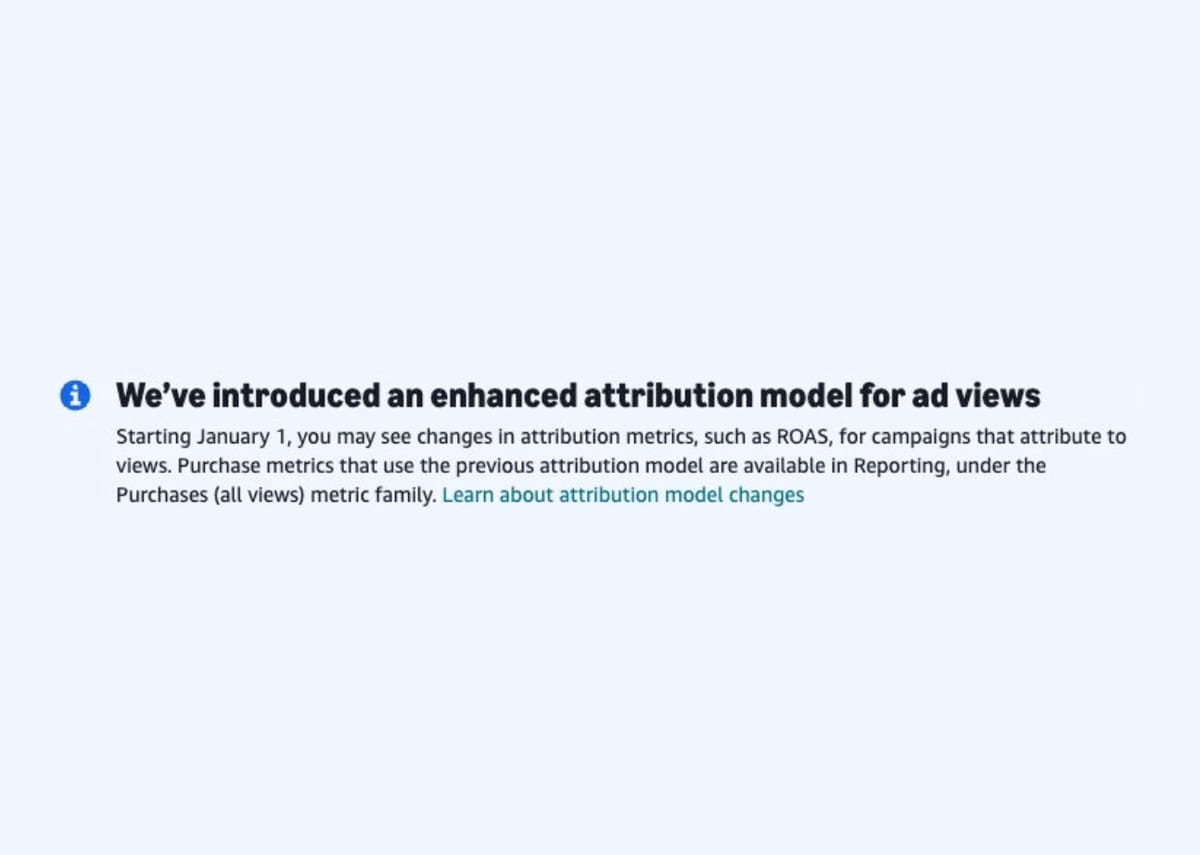
Amazon attribution notification showing enhanced model for view-based campaigns starting January 1
Amazon announced attribution model changes on January 1 affecting how advertisers measure return on ad spend for campaigns relying on view-based conversions. The modifications apply shopping-signal enhanced last-touch attribution to view-tracked campaigns starting January 1, according to documentation published on the platform's Advanced Tools Center. Conversion metrics including purchases, sales, and ROAS now report through the updated methodology, while legacy measurement remains accessible through distinct "all views" metric families.
The adjustment affects Sponsored Brands campaigns and Sponsored Display campaigns billed on viewable cost per thousand impressions basis. Amazon DSP campaigns serving advertisements within the Store also receive the modified attribution framework. Click-based attribution remains unchanged across all campaign formats, limiting measurement modifications exclusively to view-through conversion tracking, the company stated in launch materials.
"Starting January 1, you may see changes in attribution metrics, such as ROAS, for campaigns that attribute to views," Amazon stated in the announcement notification. Purchase metrics calculated using previous attribution models remain available in reporting interfaces under the Purchases (all views) metric family.
PPC Land Newsletter
Subscribe PPC Land newsletter ✉️ for similar stories like this one
The shopping-signal enhanced attribution model concentrates on brand discovery moments within customer journeys. The methodology credits ad views reaching shoppers during exploratory browsing or general category searches rather than distributed attribution across all view exposures. Amazon applies shorter attribution windows compared to the previous 14-day standard, though exact durations were not specified in announcement documentation.
Attribution methodology directly influences reported campaign performance and budget allocation decisions. Tighter attribution windows typically reduce credited conversions by excluding purchases occurring days after ad exposure, while the shopping-signal enhancement introduces algorithmic filtering of view exposures considered less influential in driving purchases.
The dual reporting structure maintains continuity for advertisers requiring historical performance comparison. "Purchases (all views)" encompasses the original attribution model including all ad views for eligible campaigns within 14-day windows, according to API field documentation in the Advanced Tools Center. The separation enables advertisers to evaluate performance shifts resulting from methodology changes rather than actual campaign effectiveness variations.
Reporting access spans multiple interfaces including the Amazon Ads console, reporting APIs, and report builder accessible through the Reporting (beta) tab. The Amazon Ads API field names for Purchases (all views) metrics appear in technical specifications published on the Advanced Tools Center platform.
Amazon launched unified reporting on November 11, 2025, consolidating data analysis across sponsored ads and DSP campaigns through a single report builder interface. The centralized infrastructure enables advertisers to analyze conversion metrics alongside impressions, clicks, and engagement indicators within unified dashboards.
The company introduced conversion path reporting in January 2025, tracking customer interactions across 30-day windows prior to purchase. That measurement system incorporates data from Sponsored Products, Sponsored Brands, Sponsored Display, Sponsored TV, and Amazon DSP advertising formats.
View-based attribution has generated debate within advertising communities regarding methodology validity. The approach credits conversions to advertisements users saw without clicking, operating on assumptions that exposure influenced purchase decisions. Critics question whether this overstates advertising impact by attributing conversions that would have occurred regardless of ad exposure.
The attribution changes affect multiple Sponsored Display campaign objectives that previously operated on distinct optimization strategies. Amazon enhanced optimization for Sponsored Display campaigns on April 4, 2025, aligning Reach and Page Visit campaigns with conversion-focused objectives. That update modified machine learning algorithms evaluating potential ad placements, assigning greater weight to factors correlating with conversion probability rather than maximizing impressions or traffic.
Geographic availability spans 28 markets across six global regions. North American access includes the United States, Canada, and Mexico. South American availability extends to Brazil. European markets encompass the United Kingdom, Germany, Spain, Italy, France, Belgium, Poland, Turkey, Netherlands, Sweden, and Ireland. Middle Eastern implementation covers United Arab Emirates, Saudi Arabia, and Egypt. Asia Pacific territories include Australia, India, Japan, and Singapore. African availability reaches South Africa.
All registered vendors, sellers, and advertisers with Sponsored Brands, Sponsored Display viewable CPM campaigns, or Amazon DSP campaigns serving Store inventory can access the updated attribution methodology. Managed-service and self-service Amazon DSP accounts receive equal access to the measurement framework.
The attribution adjustment occurs as advertisers face mounting pressure demonstrating clear returns on investment. Economic conditions have forced marketing departments to justify spending through direct attribution to sales results rather than proxy engagement metrics like impressions or clicks, according to industry analysts tracking advertising platform developments.
Amazon's advertising business generated $17.7 billion in the third quarter of 2025, representing 22% year-over-year growth according to financial disclosures. That expansion occurred as the company reduced technical barriers to platform adoption while enhancing measurement capabilities across its advertising portfolio.
The shopping-signal enhancement introduces machine learning components analyzing multiple factors determining which view exposures receive conversion credit. The system evaluates placement context, user behavior patterns, and shopping journey stage when attributing purchases to view-based ad exposure, though specific algorithmic details remain undisclosed in public documentation.
Attribution window compression addresses industry criticism regarding extended view-through windows potentially overcrediting advertisement influence. Meta eliminated 7-day and 28-day view-through attribution windows effective January 12, 2026, reflecting broader platform movement toward conservative attribution methodologies limiting claimed advertising effectiveness.
The implementation affects campaign optimization workflows relying on ROAS targets. Advertisers using automated bidding strategies optimized for specific ROAS thresholds may observe performance fluctuations as the attribution model attributes fewer conversions to view-based exposures, potentially triggering bid adjustments or campaign pausing depending on threshold configurations.
Historical data comparison requires careful methodology consideration. Performance evaluation comparing metrics before and after January 1 must account for attribution model changes rather than interpreting variations as campaign effectiveness shifts. The "all views" metric family enables apples-to-apples historical comparison by maintaining consistent attribution methodology across reporting periods.
API integration requires minimal implementation changes. Advertisers utilizing the Amazon Ads API for programmatic reporting access updated metrics through existing field structures, with "all views" metrics available through specific field identifiers documented in Advanced Tools Center specifications. The reporting infrastructure delivers both standard and "all views" metrics through identical API calls, eliminating need for separate endpoint integration.
The modification demonstrates continued platform evolution toward measurement approaches emphasizing demonstrated advertising influence rather than credited conversions potentially occurring independent of advertisement exposure. This philosophical shift mirrors broader advertising industry trends favoring conservative attribution over expansive credit claiming.
Amazon introduced the Reporting (Beta) landing page providing report templates with prepopulated metrics and reporting dimensions accelerating report building. Advertisers create reports through "Create report" buttons while viewing existing reports from centralized locations. The report builder UI offers filtering workflows enabling segmentation by manager account, advertiser account, campaign, country, and ad product level.
The platform extends date range flexibility significantly. Advertisers access data extending back two weeks for hourly reporting, 15 months for daily or weekly reporting, or up to six years for monthly, yearly, or summary-grain reporting. This represents substantial expansion from previous reporting capabilities offering more limited historical access.
Amazon added Brand Store page views as a trackable metric for Sponsored Brands campaigns on November 3, 2025, with historical data extending to September 15. That metric quantifies advertising-driven traffic to Brand Stores specifically from Sponsored Brands advertisements, creating attribution connections between upper-funnel brand awareness spending and storefront engagement.
Advertise on ppc land
Buy ads on PPC Land. PPC Land has standard and native ad formats via major DSPs and ad platforms like Google Ads. Via an auction CPM, you can reach industry professionals.
The company replaced Brand Store quality ratings with sales-based scoring on December 12, 2025, abandoning engagement-based metrics in favor of revenue attribution. The revised quality rating system assigns High, Medium, or Low classifications based on sales attributed to Brand Store visits rather than visitor dwell time.
Attribution methodology influences broader advertising ecosystem decisions. Advertisers managing campaigns across multiple retail media networks increasingly demand consistent measurement methodologies enabling performance comparison. Platform-specific attribution approaches complicate cross-network analysis when different systems credit conversions through varying methodologies and attribution windows.
The measurement infrastructure supports Amazon's AI agent capabilities announced at the November 2025 unBoxed conference. Ads Agent processes natural language instructions to execute complex advertising workflows, including optimization commands like "pause all campaigns with return on ad spend less than 2." The agent relies on accurate attribution data for automated decision-making.
View-based campaign formats serve distinct functions within advertising portfolios compared to click-based alternatives. Sponsored Brands campaigns prioritize brand awareness and consideration rather than immediate product conversions, appearing in prominent positions including top-of-search placements featuring brand logos, custom headlines, and multiple products. That positioning makes Sponsored Brands particularly relevant for new product launches, seasonal campaigns, and brand-building initiatives where immediate conversion attribution proves challenging.
Sponsored Display viewable CPM campaigns similarly emphasize awareness objectives over direct response goals. The billing methodology charges advertisers per thousand viewable impressions meeting Media Rating Council standards requiring 50% of pixels visible for at least one continuous second. Attribution methodology determines how subsequent conversions connect to those viewable exposures.
The technical documentation specifies that metrics labeled "all views" are provided for comparison with the updated attribution model. "For ongoing performance assessment, we recommend using the standard purchase metrics," the Advanced Tools Center documentation stated regarding the Purchases (all views) metric family.
Amazon DSP campaigns accessing third-party inventory beyond Amazon-owned properties receive identical attribution treatment to campaigns serving exclusively within the Store. The shopping-signal enhancement applies algorithmic filtering regardless of inventory source, focusing credit on discovery moments rather than exposure frequency or recency alone.
The attribution adjustment does not affect Amazon Attribution, the company's cross-publisher measurement tool enabling advertisers to track off-Amazon marketing impact on Amazon sales. That measurement solution operates through distinct methodology connecting external advertising exposure to subsequent Amazon purchases through Conversions API integration.
Industry observers note the timing coincides with significant retail media market growth. European retail media spending surged 22.1% while overall advertising grew 6.1% in 2024, according to IAB Europe data. Advertisers increasingly demand sophisticated measurement spanning awareness, consideration, and conversion stages as budget allocation depends on accurate performance attribution.
The measurement infrastructure enables offline sales measurement capabilities Amazon expanded to five product categories on November 4, 2025. Omnichannel Metrics connects Amazon advertising exposure data with offline purchase records collected through the Amazon Shopper Panel, enabling attribution beyond digital conversion tracking.
Attribution methodology impacts campaign budget allocation decisions across advertising portfolios. Advertisers distributing investments between brand awareness initiatives and direct response tactics rely on attribution data determining which channels drive incremental sales versus claiming credit for conversions occurring regardless of advertisement exposure.
The shopping-signal enhancement introduces additional complexity for agencies managing multiple advertiser accounts across Amazon's platform. Campaign optimization strategies must account for attribution methodology variations affecting how different campaign types report performance, requiring sophisticated understanding of measurement infrastructure rather than surface-level metric interpretation.
Advertisers utilizing third-party campaign management platforms require vendor updates incorporating "all views" metric families into reporting dashboards. Platform providers accessing Amazon Ads API must modify data extraction logic capturing both standard and "all views" metrics for historical comparison analysis and performance trend evaluation.
The attribution changes affect approximately 54 distinct metric fields within the Purchases (all views) family according to Advanced Tools Center documentation. Each metric serves specific analytical purposes within comprehensive measurement frameworks advertisers employ for performance evaluation and optimization decision-making.
PPC Land Newsletter
Subscribe PPC Land newsletter ✉️ for similar stories like this one
Who: Amazon Ads announced attribution model changes affecting vendors, sellers, and advertisers running Sponsored Brands, Sponsored Display viewable CPM campaigns, and Amazon DSP campaigns serving Store inventory across 28 global markets.
What: The platform implemented shopping-signal enhanced last-touch attribution methodology for view-based campaign measurement while introducing dual reporting through standard metrics and "all views" metric families. The modification applies algorithmic filtering crediting ad views during brand discovery moments and implements shorter attribution windows compared to the previous 14-day standard.
When: Amazon announced the attribution model changes on January 1, 2026, with the methodology becoming effective immediately. The modifications affect conversion metrics including purchases, sales, and return on ad spend reported through Amazon's advertising interfaces, APIs, and unified reporting system.
Where: The implementation spans North America (United States, Canada, Mexico), South America (Brazil), Europe (United Kingdom, Germany, Spain, Italy, France, Belgium, Poland, Turkey, Netherlands, Sweden, Ireland), Middle East (United Arab Emirates, Saudi Arabia, Egypt), Asia Pacific (Australia, India, Japan, Singapore), and Africa (South Africa).
Why: The attribution methodology update focuses measurement on demonstrated advertising influence during brand discovery moments rather than distributing credit across all view exposures, addressing industry criticism regarding extended view-through windows potentially overcrediting advertisement impact while maintaining historical comparison capability through "all views" metrics.
Share this article
The link has been copied!
Your link has expired. Please request a new one.
Your link has expired. Please request a new one.
Your link has expired. Please request a new one.
Great! You've successfully signed up.
Great! You've successfully signed up.
Welcome back! You've successfully signed in.
Success! You now have access to additional content.