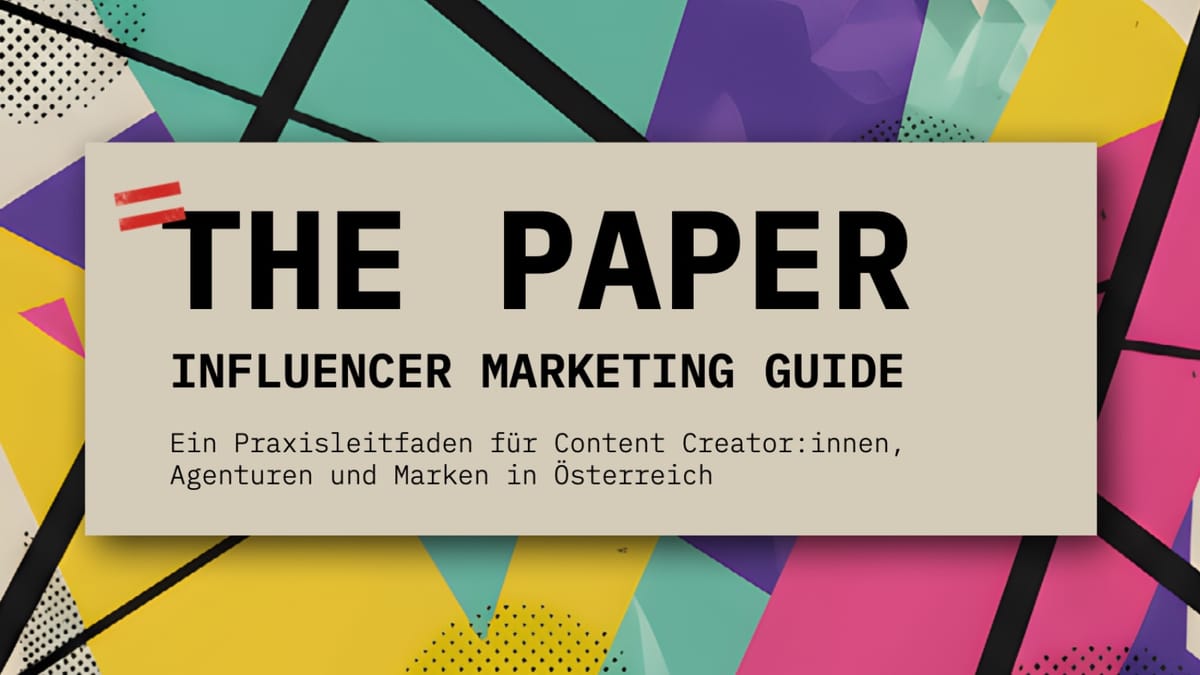
On March 3, 2026, the IAA Creator Hub Austria released "The Paper - Influencer Marketing Guide for Content Creators, Agencies, and Brands," a 40-page practical guide that consolidates legal obligations, disclosure rules, tax requirements, and ethical standards for influencer marketing in Austria. It is the first document of its kind for the Austrian market, and its backers say its significance may reach beyond national borders.
The guide was published with the date stamp "Stand 03.03.26" - meaning it reflects the state of Austrian law and industry practice as of March 3, 2026. The initiative was led by the IAA Creator Hub Austria and supported by a coalition of nine institutions: the Österreichischer Werberat (Austrian Advertising Council), the Wirtschaftskammer Fachverband Werbung (WKO), RTR, IAB Austria, BDO, WPP Media Austria, MATABI.Agency, connective studio, and PRVA. This breadth of institutional backing is unusual for a voluntary industry document, and it signals that the guide carries weight across the entire Austrian communications ecosystem.
According to the document, the publication was motivated by a straightforward gap: thousands of content creators work professionally in Austria, yet no single, accessible reference existed to explain what legal obligations apply, what constitutes advertising under Austrian law, or how disclosure must work across different platforms. The guide aims to be that reference.
The timing matters. IAB Croatia released its own influencer disclosure guidelines on November 3, 2025, and BVDW published Germany's first influencer marketing market landscape on November 13, 2025. Austria's guide arrives four months later, but goes considerably further than either: it addresses not just disclosure mechanics, but also trade registration, income tax brackets, VAT obligations, social insurance contributions, GDPR compliance, copyright law, and a full certification programme.
Across Europe, regulators have intensified scrutiny of commercial content. PPC Land has documented how Italian influencer advertising reached €350 million across Instagram and TikTok in 2024, a scale that naturally attracts enforcement attention. The Austrian data protection authority itself has faced budget cuts that limit enforcement capacity, which makes self-regulatory frameworks like The Paper more consequential as a practical matter: when state enforcement is constrained, industry standards fill the gap.
For agencies and brands operating in Austria - or working with Austrian creators - the document sets a baseline for what professional partnerships should include. Its practical checklists and compliance tables give legal and marketing teams a common vocabulary and a shared audit framework.
The institutional architecture behind the guide
The IAA Creator Hub Austria sits within the International Advertising Association. Martin Distl from WPP Media chairs the Hub and initiated the project. According to the document, Distl described the guide as "a genuine coming-together - a milestone that can have signal effect beyond Austria." Peter Hrubi, from Google, serves as co-chair of the Creator Hub and contributed to the editorial framing. The board includes seven members: Niklas Baume, Andrea Stoidl, Martin Distl, IAB vice-president Rut Morawetz, Peter Hrubi, Sandra Rindler, and Goran Drinic.
IAB Austria itself is the largest representative body for digital communications in Austria and part of the global IAB network, which has been active in setting transparency standards across Europe. The involvement of RTR - the Rundfunk und Telekom Regulierungs-GmbH, Austria's broadcast and telecommunications regulatory body - lends regulatory authority to the document without making it legally binding.
What the guide actually covers
The document runs to 40 pages plus an appendix of checklists. Its structure is methodical, moving from definitions through legal obligations to ethics and certification. Several sections are particularly detailed.
The guide draws a precise distinction between influencers and content creators, noting that the roles increasingly overlap but are conceptually distinct. Influencers are defined by their impact on community opinion; content creators are defined by the craft of producing digital content. According to the document, "all influencers are also content creators, but not all content creators are influencers." For legal purposes, the guide uses "content creator" throughout to cover both.
Platform data cited in the document, sourced from mScience mQuest research conducted in calendar weeks 32 to 34 of 2025, shows that 75% of Austrians aged 15 to 29 follow at least one influencer. Of that group, 36% follow ten or more. Instagram is cited as the dominant platform with 84% penetration. These figures establish the commercial and social scale of the ecosystem that the guide addresses.
Legal obligations: trade registration, tax, and social insurance
One of the guide's most detailed sections addresses commercial registration. There is no specific trade category for "influencer" or "content creator" in Austria. Instead, the guide maps the most likely applicable trade categories, including advertising agency (the most common), announcement business, film production, and photography. Each is classified as either a free trade (freies Gewerbe) or a regulated trade (reglementiertes Gewerbe). Regulated trades, such as business consulting or financial advisory, require additional qualifications.
Creators who do not fit the standard trade categories may register as "neue Selbstständige" - new self-employed - a category that covers literary, artistic, and educational activities.
Tax treatment follows commercial registration. According to the guide, income from content creation constitutes commercial business income in Austria and is subject to income tax on a progressive scale. The 2025 tax brackets run from 0% on income up to €13,308 to 55% on income above €1,000,000. A creator earning €30,000 would face a total tax burden of approximately €4,176.70, representing an effective rate of 13.92%. The guide works through this example explicitly to make the calculation concrete.
VAT obligations apply at the standard 20% rate. Creators below the small business threshold of €55,000 in annual turnover can use the simplified Kleinunternehmerregelung, which eliminates the need to charge VAT but also removes the right to deduct input VAT on business purchases. Quarterly VAT returns are required for turnover under €100,000 annually; monthly returns apply above that level.
Social insurance is mandatory for self-employed Austrians once annual income exceeds €6,613.20 (the 2025 threshold). Combined contributions total approximately 26.8% of income, comprising pension insurance at 18.5%, health insurance at 6.8%, self-employment provision at 1.53%, and a flat accident insurance premium of €12.07 per month. Newly registered businesses pay a provisional minimum monthly contribution of €159.92 during the first three years.
The document notes that VAT returns, receipts, and business records must be retained for seven years under Austrian law.
Austrian media law is fragmented across multiple statutes, and the guide brings them together in one place. The relevant framework comprises the Mediengesetz (MedienG), the Audiovisuelle Mediendienste-Gesetz (AMD-G), the Medienkooperations- und -förderungstransparenzgesetz (MedKF-TG), the E-Commerce-Gesetz (ECG), the Gesetz gegen den unlauteren Wettbewerb (UWG), and the DSGVO alongside Austria's national Datenschutzgesetz (DSG).
Each statute imposes different obligations. Under §24 MedienG, professionally operated channels require an imprint (Impressum) with full name, address, and contact details. Under §25 MedienG, channels publishing content permanently accessible to the public must disclose their ownership structure. Under §26 MedienG, paid or sponsored content must be labeled as "Anzeige," "Werbung," or "entgeltliche Einschaltung."
The AMD-G - governing audiovisual media services - applies to YouTubers, TikTokers, and other video creators who earn income or achieve relevant reach. These creators must notify KommAustria within two months of starting operations. The notification is free of charge but triggers additional obligations, including retention of all published videos for at least ten weeks, accessibility requirements such as subtitles where technically feasible, and a formal disclosure obligation for the identity and contact details of the channel operator.
Creators working with public sector clients face additional requirements under the MedKF-TG, which mandates that public bodies publish their spending on advertising and cooperation agreements.
Disclosure: the practical tables
The guide's disclosure framework distinguishes five types of commercial communication, each requiring a specific label. Standard advertising - where payment or consideration is received for actively promoting a product - requires "Werbung," "Anzeige," or "entgeltliche Einschaltung." Product placement - where a product appears visibly but is not actively endorsed - requires the label "Enthält Produktplatzierung," positioned at the beginning, during interruptions, and at the end of any video. Sponsoring - financial support for content production without active product promotion - requires "Mit freundlicher Unterstützung von..." Own advertising, such as promoting a creator's own products, shop, or affiliate links, requires "Werbung" or "Eigenwerbung." Content that appears commercial in style even without payment received - the "objective advertising character" category - also requires the "Werbung" label.
The document addresses platform tools explicitly. Instagram's "Bezahlte Werbepartnerschaft" (Paid Partnership) label, TikTok's commercial content disclosure toggle, YouTube's "Bezahlte Werbung" setting, and Twitch's sponsored content overlay are all documented with step-by-step activation instructions. Critically, the guide states plainly that platform labels do not replace Austrian legal obligations. Both sets of requirements must be met simultaneously.
For AI-generated content, the guide notes that additional disclosure obligations may arise from platform policies, referencing Instagram, YouTube, TikTok, and Twitch's policies on synthetic media and deepfakes. It stops short of mandating specific labels, acknowledging that platform rules vary and continue to evolve.
Absolute prohibitions and restricted categories
The guide lists content categories where commercial communication to Austrian consumers is legally prohibited altogether. These include tobacco, nicotine products, and e-cigarettes, which face a near-total advertising and sponsorship ban. Prescription medicines cannot be advertised to the general public. Gambling operations without an Austrian licence are prohibited. Claims that foods or non-approved health products can cure diseases are illegal. Advertising for sexual services is forbidden, as is any content that endangers minors.
Categories requiring elevated care but not absolute prohibition include alcohol advertising, which must not target minors or associate consumption with social or sexual success; high-risk financial products such as CFDs and crypto-assets, where mandatory risk disclosures apply; health and nutrition claims under EU Regulation, which require scientific substantiation; and non-prescription medicines, which face strict labelling requirements.
The guide categorises hidden advertising - Schleichwerbung - as "the biggest no-go," noting it violates §26 MedienG and §31 AMD-G simultaneously.
Shared liability
The document addresses liability in terms that agencies and brands will find significant. According to the guide, if a post is incorrectly or incompletely labelled, both the creator and the commissioning party may face consequences regardless of which party caused the error. The stronger the brand's influence over content - through briefings, text templates, or approval processes - the clearer its co-responsibility. The guide recommends that cooperation agreements specify labelling obligations, approval processes, responsibility for product claims, and complaint handling procedures.
Certification
The guide concludes by describing the #ethicalAD certification programme, developed in cooperation with the Österreichischer Werberat and the Jugendmedienschutzverein. Certified creators complete e-learning modules covering legal requirements, disclosure obligations, and ethical standards. Passing results in an official #trusted Partner seal. Annual renewal is required. Certification can be obtained through the #ethicalAD platform or through IAB Content Creator Hub membership.
Timeline
- August - September 2025 - mScience mQuest research (calendar weeks 32-34) documents that 75% of Austrian 15-to-29-year-olds follow at least one influencer and that Instagram reaches 84% of the group, providing the empirical baseline for The Paper
- November 3, 2025 - IAB Croatia releases influencer marketing disclosure guidelines, a parallel European self-regulation initiative
- November 13, 2025 - BVDW publishes Germany's first influencer marketing market landscape, categorising the ecosystem into five segments
- January 16, 2026 - IAB releases its AI Transparency and Disclosure Framework in the United States, establishing disclosure standards for AI-generated ad content
- March 3, 2026 - IAA Creator Hub Austria publishes "The Paper - Influencer Marketing Guide for Content Creators, Agencies, and Brands," the first comprehensive influencer marketing guide for the Austrian market, with nine institutional partners and a 40-page text covering legal, tax, disclosure, ethics, and certification requirements
Summary
Who: The IAA Creator Hub Austria, led by chairman Martin Distl (WPP Media) and co-chairman Peter Hrubi (Google), with nine supporting institutions including IAB Austria, the Österreichischer Werberat, RTR, WKO, BDO, WPP Media Austria, MATABI.Agency, connective studio, and PRVA.
What: "The Paper - Influencer Marketing Guide for Content Creators, Agencies, and Brands," a 40-page practical guide to influencer marketing law, disclosure obligations, tax rules, GDPR compliance, copyright, ethics, self-regulation, and an industry certification programme in Austria. It is the first document of its kind for the Austrian market.
When: Published March 3, 2026, with a version date stamp of "Stand 03.03.26," reflecting current Austrian law and industry practice as of that date.
Where: Austria, with ambitions stated explicitly for signal effect beyond national borders. The guide is available through the IAA Creator Hub Austria at creatorhubaustria.at, influencermarketingguide.at, and thepaper.at.
Why: Austrian influencer marketing has developed rapidly - research shows 75% of Austrians aged 15 to 29 follow at least one influencer - but no single accessible reference existed covering the legal, fiscal, and ethical framework that applies to commercial content. The guide addresses this gap, with particular relevance for the growing number of content creators operating as small businesses and for brands and agencies that share legal responsibility for the content they commission.
Share this article
The link has been copied!