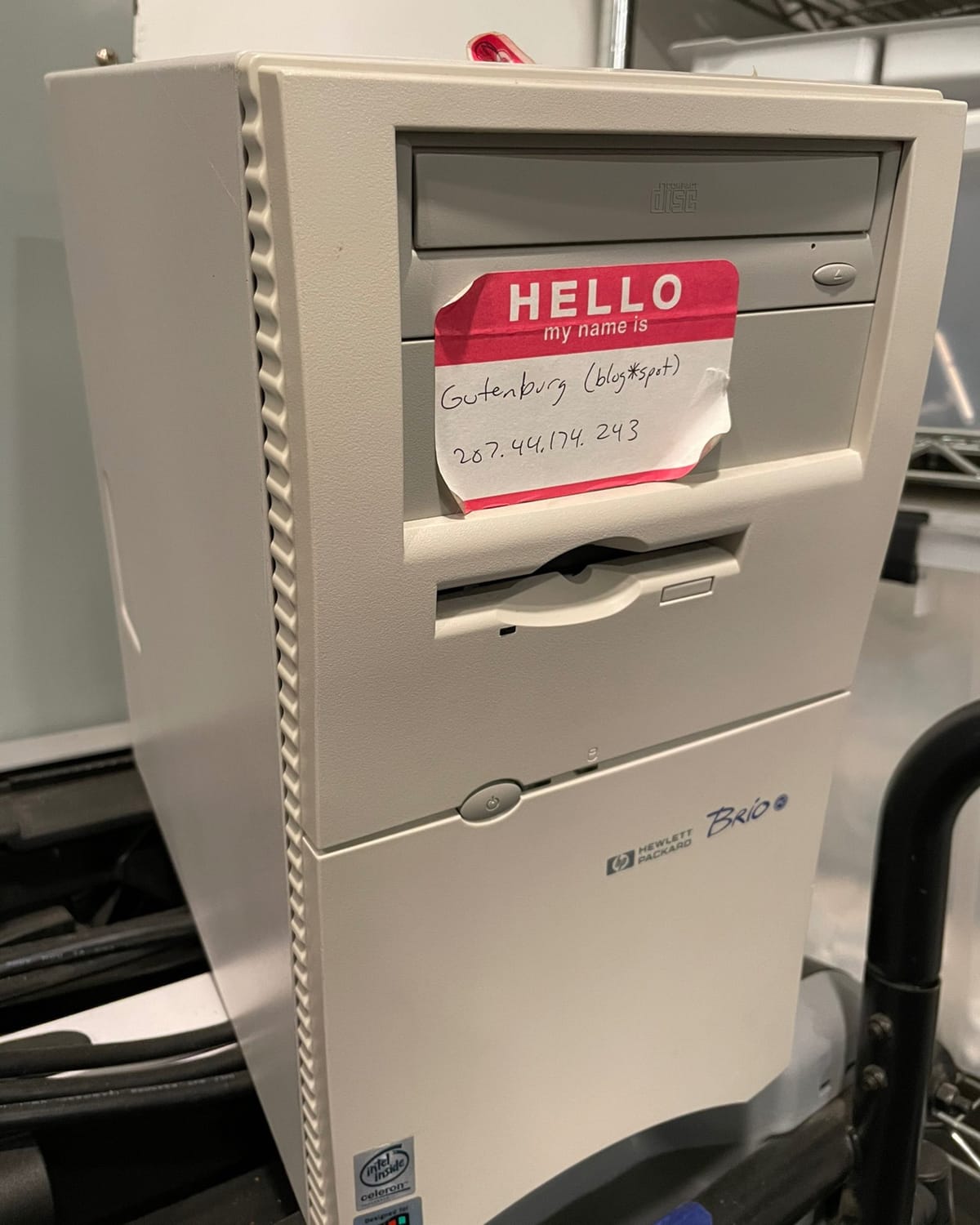
The machine that helped launch blogging as a mass medium is sitting in a garage in California. On February 24, 2021, Evan Williams, the co-founder of Blogger, posted a photograph on X (then Twitter) showing a beige HP tower computer with a "Hello" name tag attached, labeled "Gutenberg." According to Williams, that single desktop server once hosted tens of thousands of blogs - the entire early infrastructure of what would become one of the most consequential content platforms in internet history. The post generated 273 likes and 36 reposts. Five years later, on February 18, 2026, WordPress co-founder Matt Mullenweg drew fresh attention to it, noting: "apparently one of the first servers for Blogger was named Gutenberg and Ev's still got it in his garage."
Mullenweg added a follow-up of his own: "I did not know about this when we chose 'Gutenberg' for WordPress!" The coincidence - that both pioneering blog publishing platforms named central infrastructure after Johannes Gutenberg, the fifteenth-century inventor of the printing press - was apparently entirely accidental. The disclosure attracted 1,300 impressions in replies and renewed attention to a piece of hardware most of the technology industry had long forgotten.
Blogger's technical origins
Blogger launched on August 23, 1999, developed by Pyra Labs, a San Francisco startup co-founded by Williams and Meg Hourihan. The platform was originally conceived as a side feature of project management software - a note-taking tool that spun off into something far larger. According to Wikipedia's entry on Blogger, it is credited with popularizing the blog format as one of the first dedicated blog-publishing tools. Williams himself coined the term "blogger" and is widely credited with contributing to the popularisation of the word "blog."
The platform that would eventually serve hundreds of millions of users began on hardware modest enough to fit under a desk. The Gutenberg server - the HP tower now photographed in Williams' garage - ran what was, by any modern standard, an extraordinary load for a single consumer-grade machine. According to Williams' 2021 post, "I think we served 10k's of blogs off that sucker. Good times." The photograph shows the machine in its current state: dusty, bearing its original name tag, parked between what appears to be standard garage equipment. Commenters on the original 2021 thread questioned the operating system - "WinNT? 2000? Red Hat?" asked one - and the contrast with present-day cloud infrastructure was not lost on observers. "Such a shift from this to AWS running everything these days," wrote one reply.
The server's name, Gutenberg, was chosen as an obvious tribute to the democratizing power of movable type. What the Pyra Labs team almost certainly did not anticipate was that a decade and a half later, the WordPress project would independently assign the same name to its own flagship content editor - a block-based interface that became the default editing experience for WordPress installations globally. Mullenweg's February 18, 2026 acknowledgement that the naming was coincidental has a certain elegance: two of the most significant open and hosted publishing platforms in web history, named their core infrastructure after the same historical figure without coordination.
Pyra Labs and the Google acquisition
Pyra Labs operated Blogger for roughly three and a half years before selling to Google. According to Wikipedia, Google acquired Pyra on February 13, 2003, for an undisclosed sum. The acquisition had immediate consequences for the product: premium features that Pyra had charged for were made available free of charge, and the platform began its transition onto Google's server infrastructure. By May 2007 - eight years after that first HP server handled the platform's initial load - Blogger had completed its full migration to Google-operated servers. The single machine in Williams' garage had by then been replaced by a global data center network.
Williams himself left Google on October 8, 2004, according to Wikipedia's profile of his career. He co-founded Odeo, a podcast company, shortly after departing. Late 2006 saw him co-found Obvious Corporation with Biz Stone and other former colleagues, a vehicle that among other projects incubated Twitter. Williams became CEO of Twitter in October 2008, stepping down in October 2010. He created Medium on September 25, 2012. As of May 2025, according to Forbes, his net worth was estimated at $2 billion.
The trajectory from a single HP server in a San Francisco office to a $2 billion net worth is not a straight line. But Blogger sits at the beginning of it, and the Gutenberg machine represents a specific, physical artifact of that starting point.
Blogger's post-acquisition evolution
After the Google acquisition, Blogger underwent significant technical and design changes. A major redesign on May 9, 2004 introduced web standards-compliant templates, individual archive pages for posts, comments, and email posting capabilities. The "Invader" beta version was released August 14, 2006, moving users to Google servers and adding multilingual support in French, Italian, German, and Spanish. The beta came out of testing in December 2006.
By 2007 the platform ranked 16th among top 50 domains by unique visitors, according to Compete data cited in the Blogger Wikipedia entry. In September 2009, Google added features including geotagging for posts, improved image handling, and raw HTML conversion as part of a tenth-anniversary celebration. Dynamic Views - templates built with AJAX, HTML5, and CSS3 - were introduced on August 31, 2011, promising loading times 40 percent shorter than traditional templates and seven different layout modes.
As of late 2016, Blogger supported 60 languages, from Afrikaans to Zulu. In 2020, Google completed a full interface overhaul making Blogger responsive on mobile devices. The platform remains active today, hosted at blogger.com, with users able to maintain up to 100 blogs per account. Country-specific URL redirects, introduced in February 2013, were discontinued in May 2018, when Blogger stopped routing users to ccTLDs and consolidated on the default blogspot.com addresses.
The platform has also been used for coordinated influence operations. Google's Threat Analysis Group removed 1,177 Blogger blogs in the second quarter of 2024 as part of a wider takedown that also included 1,438 YouTube channels.
What the Gutenberg server moment means for marketing
The reappearance of the Gutenberg server photograph in 2026 has a context that goes beyond nostalgia. The blogging infrastructure Williams helped build in 1999 is the direct ancestor of the publishing ecosystem that digital marketers now depend on - and that ecosystem is, at present, under significant strain.
Independent publishers have experienced traffic declines of up to 95% since Google's September 2023 Helpful Content Update reshaped search rankings. The platform that once directed audiences to blogs - Google Search - has, according to analysis tracked by PPC Land, declined from providing 51% of news publisher traffic in 2023 to just 27% by the fourth quarter of 2025. Google Discover now accounts for approximately 67% of Google-sourced traffic to news publishers, creating a new dependency on an algorithmic feed rather than a search query.
The irony is not minor. Williams built a tool that made it possible for anyone with a desktop machine to publish to the world. The Gutenberg server, according to his own account, handled tens of thousands of blogs from what appears to be a single commercial desktop PC from the late 1990s. The infrastructure was minimal; the ambition was not. What followed was a content ecosystem now measured in the hundreds of millions of websites - and publishers who built businesses on that ecosystem now face traffic losses that industry observers describe as existential.
A travel blogger documented a 40% traffic decline over one year, with advertising revenue dropping 34% year-over-year in 2024. Media executives surveyed in early 2026 expected an additional 43% decline in search traffic over the next three years. The publishing model that Blogger helped make possible - create content, attract an audience through search, generate advertising revenue - is under structural pressure from the same company that acquired the platform in 2003.
For marketing professionals, the Gutenberg server is a useful reminder that publishing infrastructure is never neutral. In 1999, the constraints were physical - one HP tower, one rack, one office in San Francisco. Today the constraints are algorithmic: a set of ranking systems operated by a company whose incentives do not necessarily align with the publishers who built their businesses on the resulting traffic. The hardware has changed. The dependency has not.
What Mullenweg's observation adds
The WordPress connection is technically incidental but culturally significant. WordPress powers roughly 43% of websites globally - a figure that includes a substantial portion of the independent publishers now navigating Google's algorithm changes. That both WordPress and Blogger named central infrastructure after Gutenberg is an artifact of two separate founding teams drawing on the same historical metaphor for democratized publishing. That the connection only became public in February 2026, through a casual post on X, suggests there are other threads in the early history of web publishing that have not yet surfaced.
Mullenweg's post on February 18, 2026, generated 10 likes and 1,300 impressions in replies - modest engagement by platform standards, but the kind of technical history note that tends to circulate slowly through developer and publishing communities. The original 2021 Williams post, which showed the machine and generated 273 likes, sits at the root of the thread.
The Gutenberg server has not been powered on in decades. But it remains, according to Williams, in working physical condition in a California garage - a piece of early web history that most infrastructure archaeology would have assumed was discarded long ago.
Timeline
- August 23, 1999 - Blogger launches, developed by Pyra Labs, with early infrastructure running on minimal hardware including a server named Gutenberg
- February 13, 2003 - Google acquires Pyra Labs for an undisclosed amount; premium Blogger features made free
- May 9, 2004 - Blogger undergoes major redesign introducing web standards-compliant templates and individual archive pages
- October 8, 2004 - Evan Williams officially leaves Google
- August 14, 2006 - Blogger "Invader" beta released, beginning migration to Google servers; multilingual support added
- December 2006 - Blogger beta exits testing
- May 2007 - Full migration to Google-operated servers complete
- 2007 - Blogger ranked 16th among top 50 domains by unique visitors
- September 2009 - Google adds geotagging, improved image handling, and HTML conversion tools for Blogger's tenth anniversary
- August 31, 2011 - Blogger introduces Dynamic Views templates built with AJAX, HTML5, and CSS3
- September 25, 2012 - Evan Williams creates Medium
- February 2013 - Blogger begins country-specific URL redirects
- October 2013 - Twitter IPO values company at between $14 billion and $20 billion
- May 2018 - Blogger discontinues ccTLD redirects, consolidating on blogspot.com
- 2020 - Google completes Blogger interface overhaul for mobile responsiveness
- February 24, 2021 - Evan Williams posts photograph of the Gutenberg server on X, noting it served "10k's of blogs"
- September 2023 - Google's Helpful Content Update begins sustained traffic declines for independent publishers; some sites lose up to 95% of traffic
- June 2024 - Google's Threat Analysis Group removes 1,177 Blogger blogs tied to disinformation operations
- January 15, 2025 - Travel blogger Amanda Williams documents 40% traffic decline and 34% revenue drop attributed to Google algorithm changes
- October 2025 - Raptive reduces pageview requirement for publishers from 100,000 to 25,000 monthly visits
- December 11-29, 2025 - Google's December 2025 core update causes traffic losses of 70-85% for some publishers
- January 17, 2026 - Media executives surveyed expect 43% further decline in search traffic over three years
- February 18, 2026 - Matt Mullenweg posts on X noting the coincidence that both Blogger and WordPress named infrastructure "Gutenberg," independently
Summary
Who: Evan Williams, co-founder of Blogger and Pyra Labs, and Matt Mullenweg, co-founder of WordPress, are the central figures. Blogger was developed by Pyra Labs and later acquired by Google in 2003. The Gutenberg server is a physical artifact of Blogger's founding infrastructure.
What: Williams photographed and shared the original Blogger server - a single HP desktop tower named Gutenberg - still stored in his garage. Mullenweg drew renewed attention to the post in February 2026, noting the coincidence that WordPress independently named its block editor "Gutenberg" without knowledge of the earlier Pyra Labs naming. The server, according to Williams, once hosted tens of thousands of blogs.
When: The original server photograph was posted by Williams on February 24, 2021. Mullenweg's follow-up post appeared on February 18, 2026. Blogger itself launched on August 23, 1999.
Where: Pyra Labs was based in San Francisco. Google acquired the company and migrated Blogger to its own servers by May 2007. The Gutenberg server remains in Williams' garage in California.
Why: The story matters to the marketing and publishing community because Blogger's founding infrastructure represents the physical origin point of modern content publishing - a platform whose audience-building model, dependent on search traffic, now faces structural challenges from the same company that acquired it. The hardware origins of blogging stand in contrast to the algorithmic complexity that now governs whether publishers survive.
Share this article
The link has been copied!