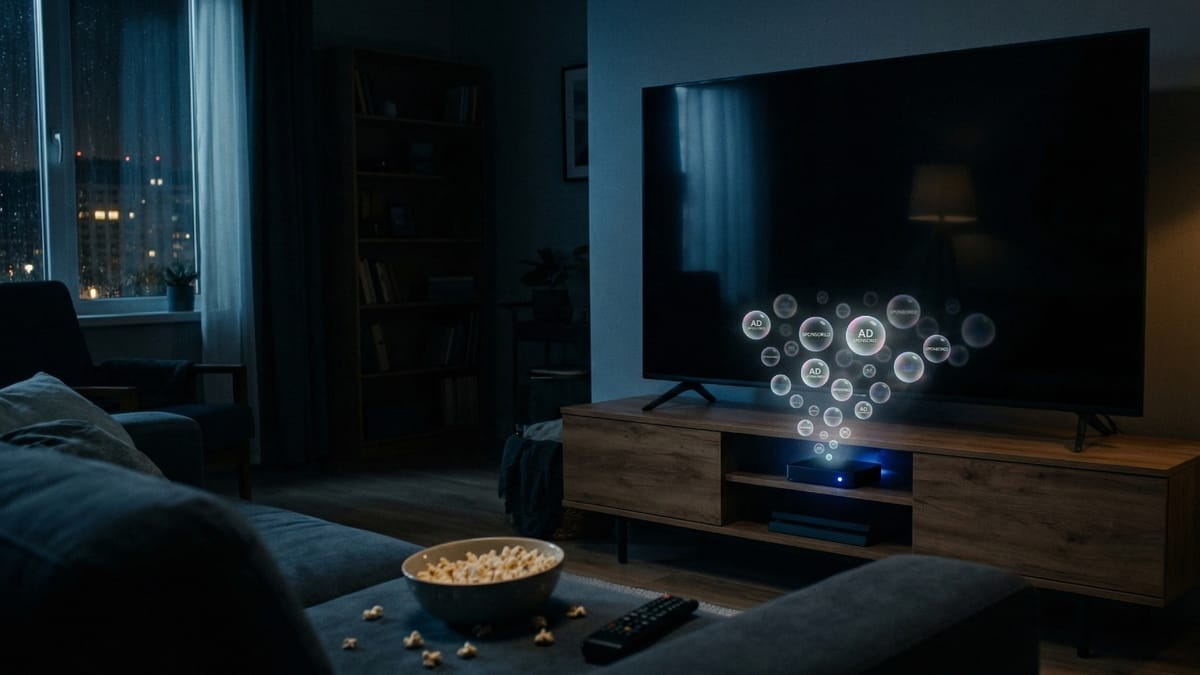
A LinkedIn post circulating this week from Michael M. Maurantonio, described as an ad-fraud investigator and media expert and member of the Digital Forensic Research community, has crystallised an inconvenient truth about connected television advertising that industry researchers have been quantifying for years: ads keep running after viewers switch their televisions off, and measurement systems largely do not notice.
The post cuts through the language used to sell CTV inventory. "Premium inventory. Full-screen. 100% completion rates. Sounds perfect," Maurantonio wrote, before arriving at the problem. According to the post, "the TV is off. The box is still running. Ads are still being counted as 'viewed.'" The mechanism is straightforward: in many CTV setups, the set-top box or streaming device is the measured unit. The physical television screen - and the human sitting in front of it - is not.
This is not a fringe concern. It sits at the centre of the industry's most significant measurement debate in 2026, one with a price tag that DoubleVerify has put at approximately $1 billion in annual wasted advertising spending.
The technical explanation: what HDMI-CEC can and cannot do
The post raises HDMI-CEC by name. "In theory, HDMI-CEC can signal whether a TV is on," Maurantonio wrote. "But in reality? Rarely implemented. Almost never used in measurement logic."
That assessment is technically accurate. Consumer Electronics Control (CEC) is a feature built into the HDMI standard that allows connected devices to communicate with each other using a single bidirectional wire - specifically, pin 13 on the HDMI connector. According to Wikipedia's documentation on the standard, CEC is defined in HDMI Specification 1.0 and was updated across subsequent versions including HDMI 1.2, 1.2a, and 1.3a, the last of which added timer and audio commands. The standard supports up to 15 devices communicating on a shared bus.
CEC wiring is, according to the specification, mandatory across all HDMI devices. Implementation in software is optional. That distinction matters. A manufacturer must include the physical connection but is not required to act on the signals it carries. The result is an industry where the infrastructure to detect whether a screen is on exists inside virtually every television sold today - yet the software layer needed to use that information in ad measurement has not been standardised.
The protocol itself operates at a low speed: 417 bits per second, far below the data rates of other HDMI signals. Each CEC frame begins with a start bit held low for 3.7 milliseconds, followed by up to 16 bytes. The bus is an open-collector line, passively pulled up to 3.3 volts, driven low to transmit. Because CEC is a separate electrical signal from the rest of HDMI's high-speed data, a device can disable its high-speed circuitry in sleep mode and still respond to CEC commands. The bus passes through devices even when they are completely powered off.
Among the commands the standard supports are One Touch Play (which allows a device to wake and switch the television to its input), System Standby (which puts all connected devices into sleep mode simultaneously), and Device OSD Name Transfer (which tells the television what label to display for an attached device). The standard also supports status queries - meaning a device can ask another whether it is active. That capability is precisely what ad-measurement systems would need to verify screen state.
According to How-To Geek's technical documentation of the standard, HDMI-CEC was first defined with the release of HDMI 1.0 and formalised for active use in 2005 with HDMI 1.2a. Despite nearly two decades in the specification, the standard is systematically obscured by proprietary branding. Samsung calls it Anynet+. Sony uses Bravia Sync or Bravia Link. LG markets it as SimpLink. Panasonic goes by VIERA Link, HDAVI Control, or EZ-Sync depending on the product. Philips uses EasyLink. Pioneer uses Kuro Link. Roku TV calls it 1-Touch Play.
This fragmentation of branding is not accidental. According to the How-To Geek analysis, manufacturers use proprietary trade names because it pushes consumers toward purchasing items that appear to work together through shared branding, when the underlying protocol is simply the HDMI standard all manufacturers are obliged to support. Hitachi and Vizio are the notable exceptions, both using the generic "HDMI-CEC" and "CEC" labels respectively.
Android's approach: a system service that few activate
Google addressed the implementation problem on the Android TV platform by building a standardised CEC service into Android itself. According to the Android Open Source Project documentation, updated as of December 2025, the HdmiControlService was introduced as part of the Android TV Input Framework to bring together connected devices and minimise compatibility issues.
Before HdmiControlService existed, manufacturers had to develop their own CEC implementations or license third-party solutions. The service is designed to allow a single implementation to work across multiple logical device types. It connects with the TV Input Manager service, the Audio service, and the Power service, creating the infrastructure for a device to respond correctly to screen-state changes.
Access to the HDMI-CEC service on Android is restricted to system components or applications placed in the privileged application directory - protected by the SignatureOrSystem protection level to prevent abuse by applications with malicious intent.
The documentation notes that Android 12 specifically aligned power control of HDMI-connected displays with internal display power control. When an HDMI playback device wakes, it attempts to wake the connected TV and become the active source via HDMI CEC One Touch Play. If the device goes to sleep while it is the active source, it attempts to turn the connected TV off.
HDMI-CEC 2.0 support was added to improve interoperability. According to the documentation, HDMI-CEC 2.0 offers better interoperability between HDMI devices, improvements to Remote Control Passthrough, and more extensive certification testing, with interactions that are generally more efficient and result in less CEC traffic and faster responses. For a device to support HDMI-CEC 2.0, both hardware and user configuration must be set to use it, and the HAL implementation must report support via the IHdmiCec#getCecVersion call.
The HAL (hardware abstraction layer) definition is available for device manufacturers to implement. In practice, however, manufacturers have adopted CEC in different ways, and devices do not always understand each other. The documentation acknowledges this directly: because of this variance, "consumers can't safely assume that two products that claim CEC support are completely compatible."
That variance is the crack through which ad impressions fall.
The measurement gap, quantified
Maurantonio's post describes the outcome in forensic terms: campaigns that flag as "extreme session durations" or "near-perfect completion rates" in audit data. According to the post, these surface as "high-performing" campaigns that nobody actually watched. The mechanism is not classic ad fraud, he notes - there are no bots, no fake traffic. Instead, it represents what he calls "technically valid delivery with zero attention."
That framing aligns closely with what DoubleVerify documented in its December 2025 call to action, in which the company stated that over one-third of CTV advertising impressions are delivered in TV-off environments. The company has attributed an estimated $1 billion in annual wasted advertising spending to this phenomenon.
DoubleVerify launched its Fully On-Screen verification capability in 2021 specifically to address this issue, and received Media Rating Council accreditation for CTV viewability in April 2024. Yet according to the December 2025 statement from Todd Randak, General Manager of CTV at DoubleVerify, industry-wide adoption of those standards remains significantly lower than in other digital advertising environments. The accreditation exists. The adoption does not.
A DoubleVerify 2025 Global Insights report on North America, released in July 2025, noted that CTV video viewability rates improved 16% during the period studied - in part because publishers began properly pausing ad delivery when television screens were turned off. The report cited "extensive industry-wide efforts to improve Fully On-Screen certification by publishers that were not previously pausing ad delivery when TV screens were turned off." That improvement demonstrates the mechanism works. It also confirms that the default behaviour, before the effort was made, was to keep serving.
A market that has scaled faster than its infrastructure
The financial stakes explain why this problem has persisted. CTV advertising spending reached $33.35 billion in 2025, according to DoubleVerify's data. A January 2026 report from Proximic by Comscore found that 45% of marketers increasing CTV budgets are reallocating money from linear television, with CTV expected to capture 26% of media budgets on average in 2026. More than half of respondents to that survey expected over 60% of their CTV buying to occur programmatically in 2026.
That volume of money entering a channel still operating with incomplete screen-state measurement creates a structural quality problem. The advertising community has repeatedly been warned that completion rates of 99.99% on CTV are not a signal of campaign quality - they are a consequence of how the environment is built. A streaming device running in standby mode, with the television off, will complete an ad impression from start to finish. The completion rate is technically accurate. Its meaning is not.
IAB Europe's CTV Working Group noted in March 2026 that over one-third of CTV ad impressions are delivered in TV-off environments, citing the same $1 billion figure. The group's broader finding was that CTV remains constrained by fragmented identifiers, shared-device attribution gaps, inconsistent platform standards, and the absence of a universal cross-screen measurement framework.
OpenX and TVision in March 2026 moved attention data from post-campaign reporting into the pre-bid layer of CTV transactions, enabling buyers to avoid low-attention environments before placing a bid rather than discovering the problem afterward. Index Exchange embedded a similar signal in February 2026, through a partnership with xpln.ai. These approaches address the symptom - buying away from poor inventory - without resolving the underlying screen-state detection gap.
AdRoll integrated HUMAN Security in October 2025 for fraud defense and viewability tracking, with the system detecting invalid traffic in under 12 milliseconds. That speed matters for pre-bid filtering, but does not resolve the fundamental question of whether the television receiving the ad is on.
Why the industry has not fixed it
Several structural factors explain the persistence of the gap. First, HDMI-CEC is optional at the software level. A streaming device manufacturer is under no obligation to implement it, query television state, or report that information upstream to an ad server. Second, even where CEC is implemented, the information is typically not passed through to the measurement stack. The ad-serving layer, the SSP, the DSP, and the verification vendor each operate on data from the measured device - the box - not the screen.
Third, near-perfect completion rates are commercially convenient. As Maurantonio's post observes, they allow CTV to be sold as premium inventory with premium pricing, while the actual delivery environment may involve no viewer at all. That convenience is shared across the supply chain in ways that create weak incentives for unilateral transparency.
The Android Open Source Project's HdmiControlService documentation points toward a path. The service connects power state information directly to the platform's power management layer. A device running Android TV can, in principle, know whether the connected television is on and use that information to pause ad delivery. The question is whether that capability is activated in production deployments, passed to verification systems, and reflected in impression counting.
According to the AOSP documentation, HDMI-CEC behaviour can be configured at both build time - by original equipment manufacturers using Resource Runtime Overlays - and at runtime via HdmiControlManager system API calls. The scope of power control messages can be set to target the TV only, the TV and audio system, broadcast, or none. For each setting, apps can query allowed options at runtime. That granularity is available. Whether it is used to protect advertiser spend is a separate question.
The LinkedIn post received a reply from Dr. Augustine Fou of FouAnalytics, a researcher whose work on ad fraud measurement has been cited across the industry for several years. His response was brief and pointed: "SO many want to believe this, sometimes they just close their eyes and make believe." The comment captures the dynamic at the centre of the problem. The data on TV-off delivery is not new. The incentives to act on it have not yet overcome the commercial convenience of ignoring it.
What this means for marketing professionals
For buyers running programmatic CTV campaigns, the implication is direct. Completion rate, by itself, measures nothing about viewer attention. A 100% completion rate on a CTV impression can mean a human watched an ad from start to finish. It can equally mean a set-top box executed a delivery log entry for a file nobody saw.
DoubleVerify's data suggests that more than one in three CTV impressions fall into the second category. Until screen-state detection is systematically integrated into the measurement stack - through HDMI-CEC, through platform-level power management, or through panel-based attention measurement - that ratio is unlikely to change.
The Q4 2023 global CTV invalid traffic benchmark from Pixalate placed the overall CTV invalid traffic rate at 17%, down from 18% in Q4 2022. The EMEA region reported the highest rate at 42%. The UK registered the highest country-level rate worldwide at 49%. These figures cover traditional IVT, not the TV-off phenomenon that HDMI-CEC could theoretically address. The two problems are distinct but compound each other.
The measurement community has made progress. Publishers implementing proper pause functionality when televisions power down contributed to the 16% CTV viewability improvement noted in the DoubleVerify North America report. The infrastructure exists to do more. HDMI-CEC pin 13 has been in every HDMI cable since the standard launched. The question is whether the industry will use it.
Timeline
- 1999 - HDMI Specification 1.0 defines Consumer Electronics Control (CEC) for the first time
- 2005 - HDMI 1.2a formalises CEC for active use; physical wiring on pin 13 becomes mandatory across all HDMI devices
- 2006 - HDMI 1.3a updates the standard, adding timer and audio commands to the CEC bus
- 2021 - DoubleVerify launches Fully On-Screen CEC-related verification capability for CTV
- March 2024 - Pixalate reports global CTV IVT rate at 17% in Q4 2023, with $1.1 billion in open programmatic spend lost to invalid traffic
- April 2024 - DoubleVerify earns MRC accreditation for CTV viewability, citing that over one-third of CTV ad impressions deliver in TV-off environments
- June 2024 - DoubleVerify's 2024 Global Insights Report previewed, showing 20% year-over-year increase in new ad fraud schemes with 269% rise in streaming platform variants
- June 2025 - DoubleVerify unveils DV Authentic AdVantage, an AI-powered tool combining verification and campaign optimisation for video platforms
- July 2025 - DoubleVerify 2025 North America report notes 16% improvement in CTV viewability, partly attributed to publishers pausing ads when screens power off
- October 2025 - AdRoll integrates HUMAN Security for fraud defense and viewability tracking across CTV and other environments
- October 2025 - Teads launches deterministic CTV measurement for streaming campaigns outside the United States
- November 2025 - Industry expert warns advertisers against treating CTV like display campaigns, identifying completion rate as a misleading KPI
- December 2, 2025 - Android Open Source Project documentation for HDMI-CEC control service last updated, covering HDMI-CEC 2.0 and CEC configuration options
- December 4, 2025 - DoubleVerify issues public call to action for industry-wide transparency standards, stating over one-third of CTV impressions deliver in TV-off environments and quantifying the annual cost at $1 billion
- January 2026 - Proximic by Comscore report finds CTV expected to capture 26% of media budgets in 2026, with $33.35 billion spent on CTV advertising in 2025
- February 2026 - Index Exchange embeds AI attention signals into its supply-side platform for pre-bid targeting
- March 11, 2026 - IAB Europe's CTV Working Group reiterates that over one-third of CTV impressions deliver in TV-off environments; $1 billion annual waste estimate cited
- March 11, 2026 - OpenX and TVision launch pre-bid CTV attention targeting, moving attention measurement from post-campaign diagnostic to real-time buying signal
- Late March 2026 - Michael M. Maurantonio publishes LinkedIn post raising HDMI-CEC screen-state detection as a measurement problem in CTV advertising; Dr. Augustine Fou of FouAnalytics responds
Summary
Who - Michael M. Maurantonio, an ad-fraud investigator and member of the Digital Forensic Research community, posted the central observation that prompted this analysis. DoubleVerify, IAB Europe's CTV Working Group, the Android Open Source Project, and the HDMI standards body each contribute technical context. Dr. Augustine Fou of FouAnalytics provided a public comment on the post.
What - The article examines the gap between CTV ad delivery and actual screen-state verification. HDMI-CEC, a protocol built into every HDMI-connected device since 1999, is technically capable of signalling whether a television is on. In practice, it is almost never used in ad measurement logic. The result is that impressions continue to be counted - and billed - when the screen is off. Over one-third of CTV ad impressions are estimated to fall into this category, contributing to approximately $1 billion in annual wasted advertising spending.
When - The LinkedIn post was published in late March 2026. The underlying measurement gap has been documented since at least 2021, when DoubleVerify launched Fully On-Screen verification. The $1 billion waste estimate has been cited across multiple industry reports since April 2024.
Where - The problem is global, affecting CTV advertising across all markets. The EMEA region reported the highest CTV invalid traffic rate at 42% in Q4 2023, and the UK reported the highest country-level rate at 49%. North America saw a 16% improvement in CTV viewability in 2024, partly because publishers began pausing ads when screens powered off.
Why - The gap persists because HDMI-CEC software implementation is optional under the HDMI standard, measurement systems track the streaming device rather than the screen, and near-perfect completion rates are commercially convenient throughout the supply chain. The incentives to deploy screen-state detection have not yet outweighed the cost and complexity of doing so at scale.
Share this article
The link has been copied!