
EDO launches AI agent that reads TV ad performance in seconds
Measurement company introduces conversational interface for TV outcomes data as agencies face leaner teams and fragmented buying workflows.

Measurement company introduces conversational interface for TV outcomes data as agencies face leaner teams and fragmented buying workflows.
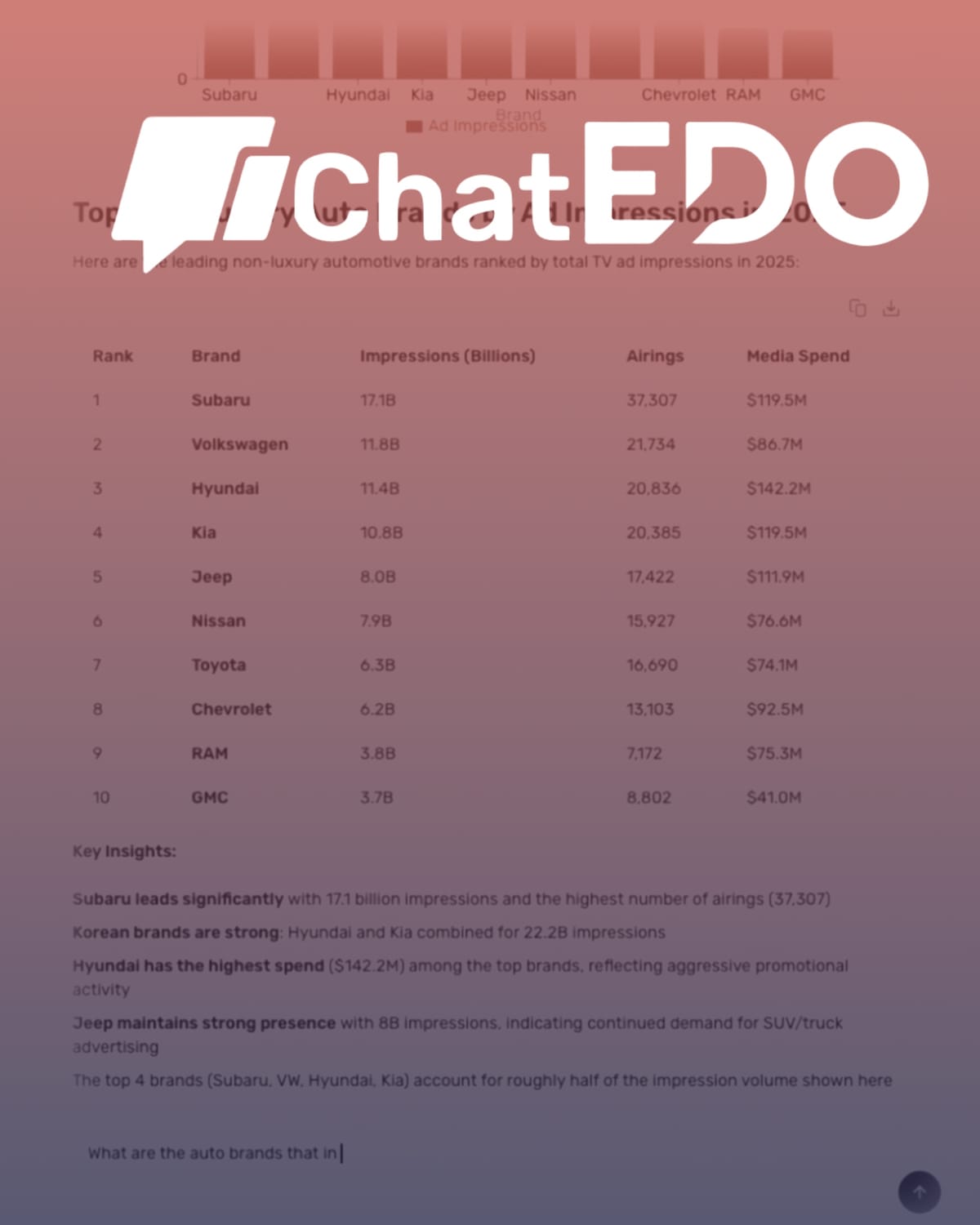
EDO today announced ChatEDO, an agentic artificial intelligence application designed to make television advertising outcomes measurement faster and more accessible across linear and streaming environments. The TV outcomes company positioned the product as its first conversational agent, allowing advertisers, agencies, and publishers to query investment-grade data using natural language rather than dashboards or analysts.
ChatEDO enables users to ask plain-English questions about which creatives, placements, or competitors drive consumer action across convergent television, receiving answers within seconds. The system replaces traditional dashboard navigation and data export workflows with immediate responses delivered through conversational interfaces. EDO President and CEO Kevin Krim stated that "Research & Insights teams are under more pressure than ever and EDO's industry-leading scale and granularity of data across Convergent TV breaks old dashboard and spreadsheet-based workflows."
The application addresses operational pressures facing modern agency and brand teams. As organizations become leaner while TV buying fragments across platforms and programmatic channels, ChatEDO lowers barriers to advanced outcomes analysis. The system enables users beyond research specialists to answer questions about creative performance, media weight, competitors, and category trends without technical expertise traditionally required for complex data analysis.
EDO designed ChatEDO specifically for agency partners through invite-only early access. The limited rollout reflects how frequently agencies require real-time answers during client conversations and in-flight campaign optimization. Agencies can explore competitor media plans and performance during active client calls, eliminating delays associated with pulling additional data and scheduling follow-up meetings days later.
ChatEDO operates as EDO's custom-built agentic interface for AdEngage, the company's Vertical AI-powered Convergent TV measurement platform. The architecture differs from single-provider AI systems by functioning as a model-agnostic orchestrator designed to leverage multiple foundation models via Amazon Web Services Bedrock. This includes OpenAI's GPT-5, Anthropic's Claude Opus, and other artificial intelligence models that can switch seamlessly as new capabilities emerge without disrupting user experience or compromising accuracy.
The proprietary intelligence powering ChatEDO resides in its MCP-based tools. EDO invested years engineering the execution logic and guardrails required to reliably interpret, contextualize, and analyze its syndicated television data at scale. Rather than relying on generic AI platforms, ChatEDO leverages EDO's decade of experience in Vertical AI, combining more than 10 years of cross-platform outcomes data, trillions of impressions, hundreds of millions of airings, and syndicated benchmarks across industries.
The system grounds agentic capabilities in real, predictive consumer behavior rather than generic responses. By combining immediate signals with historical benchmarks, ChatEDO transforms raw data into actionable guidance. EDO Chief Technical Officer and Head of Product Joshua Lee emphasized that "Our focus wasn't just on building a chat interface - it was building the right intelligence behind it. We've spent years structuring Convergent TV outcomes data so it can be reliably consumed by AI agents."
The technical foundation required substantial engineering effort before introducing conversational interfaces. EDO structured its massive database of television advertising activity and outcomes to ensure reliable AI agent consumption. This preparation enables ChatEDO to dramatically reduce time and effort required to understand and optimize campaign performance.
Internal testing demonstrated ChatEDO's effectiveness at answering common but time-consuming questions about creative impact, competitive intelligence, share shifts, media weights, and category trends. Queries that previously required manual filtering across multiple dashboard views, often downloaded into spreadsheets, now receive answers within seconds using plain language and data visualizations.
Less technical team members who might have waited four to six hours for creative performance data can receive instant analysis without SQL expertise or analyst availability. ChatEDO empowers broader organizational access to outcomes intelligence beyond small groups of power users. This democratization supports speed, efficiency, and return on investment at a time when doing more with less has become a business mandate.
The speed improvements address mounting pressure toward measurable business outcomes rather than vanity metrics. Marketing professionals face demands to prove campaigns deliver tangible results including sales uplift and customer acquisition instead of simply generating impressions. ChatEDO's immediate insights enable faster decision-making cycles compared to traditional measurement approaches that often lag by weeks.
By simplifying access to complex data, ChatEDO helps teams at agencies, brands, and publishers move faster, respond to stakeholder needs more quickly, and extend outcomes intelligence throughout organizations. The conversational interface eliminates friction points that historically limited TV outcomes measurement to specialists with technical skills and platform familiarity.
The ChatEDO launch positions EDO within accelerating adoption of agentic artificial intelligence across marketing operations. McKinsey analysis published in July 2025 identified agentic AI as the most significant emerging trend for marketing organizations, with $1.1 billion in equity investment flowing into the technology during 2024. Job postings related to agentic AI increased 985% from 2023 to 2024.
Multiple advertising technology companies launched agentic capabilities throughout 2025. Newton Research integrated specialized marketing measurement agents with Snowflake Cortex AI on November 4, enabling brands to run media mix modeling and incrementality analysis directly within secure data environments. LiveRamp introduced agentic orchestration on October 1, enabling autonomous AI agents to access its identity resolution and audience activation platform.
Amazon launched agentic capabilities across its seller platform on September 17, transforming Seller Assistant from a question-answering tool into an autonomous agent that monitors accounts, optimizes inventory, and manages advertising campaigns around the clock. Google rolled out Ads Advisor and Analytics Advisor in December 2025, implementing agentic conversational experiences powered by Gemini models to accelerate data analysis and campaign management.
The advertising industry also launched multiple standards for agentic communication. The Ad Context Protocol surfacedon October 15, 2025, built on Anthropic's Model Context Protocol to provide a unified communication layer for managing campaigns across different advertising technology systems. However, industry debate emerged about whether new protocols adequately address fundamental transparency concerns before enabling widespread automation.
ChatEDO's implementation differs from platform-native agents by focusing specifically on measurement and insights rather than campaign execution. The application provides intelligence that informs human decision-making rather than autonomous campaign management. This positions the tool as a complement to existing workflows rather than a replacement for strategic oversight.
The ChatEDO announcement arrives as television advertising faces a measurement crisis. Marketing industry debates over linear television versus streaming advertising intensified throughout 2025, with Mixed Media Models failing to capture effectiveness accurately across platforms. Traditional measurement approaches struggle to provide the speed and granularity that modern campaign workflows demand.
The advertising industry is shifting from impression-based measurement to outcomes-focused evaluation that demands proof of real business impact. Industry experts predicted 2026 will prioritize measurable business results over vanity metrics as artificial intelligence reshapes campaign evaluation. This transition creates urgency for measurement solutions that connect television exposure to actual consumer behavior and business outcomes.
Connected TV advertising has experienced rapid growth, with budget share doubling from 14% in 2023 to 28% in 2025. Yet measurement capabilities have not kept pace with spending growth. Publishers and platforms face challenges demonstrating performance that matches the accountability standards of search and social channels.
The Interactive Advertising Bureau pushed for standardized Conversion APIs in October 2025 to close Connected TV's outcome measurement gap, urging industrywide implementation of server-to-server data frameworks. Survey data revealed that two-thirds of advertisers reported improved return on advertising spend after implementing Conversion APIs, demonstrating market demand for better outcome tracking.
Multiple measurement providers launched attribution solutions aimed at connecting advertising exposure to business outcomes throughout 2025. iSpot unveiled Outcomes at Scale in March 2025, promising to transform how brands assess television and streaming campaign performance by connecting verified ad delivery to business outcomes in near real-time. Roku became the first streaming platform to optimize advertisements using iSpot outcomes in January 2026.
Comscore unveiled daily television program tracking powered by AWS artificial intelligence on January 6, 2025, addressing fragmentation that historically separated audience intelligence across platforms. The enhancement provided visibility into audience engagement down to series and episode levels on a daily basis, enabling faster decision-making cycles compared to traditional measurement approaches that often lag by weeks.
EDO itself previously automated TV outcomes delivery directly into publisher platforms. The company has established a reputation for speedy service within the television advertising ecosystem, providing real-time insights into how advertising drives consumer engagement.
ChatEDO's model-agnostic architecture reflects broader industry adoption of standardized frameworks for artificial intelligence agent communication. The Model Context Protocol, launched by Anthropic in November 2024, established a standardized framework for AI-data source connections that multiple advertising technology companies have since implemented.
Amazon opened its advertising APIs to AI agents through Model Context Protocol in November 2025, launching a closed beta for its MCP Server enabling natural language interactions with advertising APIs. The implementation provided programmatic access to Amazon Ads API, Amazon DSP API, and Amazon Marketing Cloud API through conversational interfaces.
The protocol enables artificial intelligence systems to securely interact with enterprise data and tools through standardized interfaces. For ChatEDO, this architecture means the system can leverage the most advanced foundation models as they become available without requiring complete system rebuilds. The orchestration layer manages communication between user queries, AI models, and EDO's proprietary data infrastructure.
This technical approach addresses concerns about vendor lock-in that have emerged as major platforms rolled out competing artificial intelligence agent implementations. By maintaining flexibility to switch between foundation models, EDO ensures ChatEDO remains at the cutting edge of AI capabilities while preserving the proprietary intelligence embedded in its measurement tools and data structures.
ChatEDO's introduction signals a fundamental shift in how marketing teams interact with measurement data. The transition from dashboard-based analysis to conversational interfaces reflects changing expectations about data accessibility and speed. As teams become leaner and television buying more fragmented, tools that reduce complexity and accelerate insight generation become increasingly valuable.
The focus on agency access for early rollout recognizes agencies' unique position in the advertising ecosystem. Agencies manage multiple client relationships simultaneously while navigating complex media landscapes across platforms. Real-time access to competitive intelligence and performance data during active client conversations provides operational advantages that can differentiate agency value propositions.
For brands, ChatEDO promises to democratize access to sophisticated measurement intelligence. Marketing professionals without specialized technical skills can engage directly with outcomes data, asking questions in natural language rather than learning complex dashboard interfaces. This democratization supports broader organizational understanding of what drives advertising effectiveness across television environments.
Publishers and platforms gain tools to demonstrate performance more transparently. As outcome-based thinking becomes standard practice across the advertising industry, measurement capabilities that clearly connect exposure to consumer action become competitive differentiators. ChatEDO provides publishers with immediate access to performance benchmarks and competitive context.
The invite-only early access approach allows EDO to carefully manage capacity during initial rollout. This controlled expansion ensures performance, accuracy, and high-quality user experience while the system handles production workloads. Interested users can request invites at edo.com/chatedo.
EDO positions itself as the TV outcomes company, operating a leading measurement platform that connects convergent television airings to ad-driven consumer behaviors most predictive of future sales. The company's approach combines immediate engagement signals with decision science and vertical artificial intelligence to equip industry leaders with syndicated, investment-grade data that aligns media to business results.
The platform provides detailed competitive, category, and historical insights across linear and streaming television. Leading brands, agencies, networks, streamers, and studios use EDO's intelligence to understand what works in their television advertising investments. The measurement methodology tracks consumer engagement within minutes of ad exposure, controlling for factors including impressions, duration, and seasonality to ensure fair comparisons.
ChatEDO builds on this foundation by making the extensive database accessible through conversational queries. The system processes natural language questions, interprets intent, queries appropriate data sources, and returns visualizations and insights formatted for immediate understanding. This workflow operates continuously, providing always-on access to outcomes intelligence without waiting for analyst availability or manual data processing.
The architecture scales to handle hundreds of thousands of queries as adoption expands beyond early access participants. EDO emphasized that while less technical team members can now receive instant analysis, the system maintains data quality and accuracy standards required for investment-grade measurement. Guardrails ensure queries receive reliable, contextualized responses grounded in EDO's proprietary outcomes database.
Capacity will be carefully managed during initial rollout to ensure performance and user experience quality. The phased expansion allows EDO to refine the system based on real-world usage patterns and feedback from agency partners before broader market availability.
The television advertising measurement market faces significant transformation as viewing fragments across platforms and devices. Research examining the financial viability of competing measurement companies found the U.S. market worth $1.5-2 billion annually, with Nielsen capturing 85-90% of revenue. Competitors including Comscore and VideoAmp split the remaining 10-15%.
The total market for national television measurement services could potentially support multiple companies if each reaches approximately $250 million in annual revenue. However, achieving this requires overcoming coordination challenges across hundreds of companies that currently use compatible systems based on one measurement standard. The economic fundamentals allow for competition if the industry chooses to support it through adoption of alternative measurement currencies.
EDO operates somewhat differently from traditional audience measurement companies by focusing specifically on outcomes measurement rather than audience counting. The company tracks ad-driven consumer behaviors including site visits and search activity that predict future sales, providing a complementary lens to traditional reach and frequency metrics.
This outcomes focus positions EDO to benefit from the industry shift toward accountability and business results. As advertisers demand proof that campaigns deliver tangible impact, measurement solutions connecting exposure to action gain strategic importance. ChatEDO makes this outcomes intelligence more accessible precisely when market pressures intensify demands for measurable performance.
The competitive landscape includes multiple players addressing different aspects of television measurement challenges. Some focus on deduplicated audience reach across platforms. Others emphasize attribution connecting exposure to conversions. Still others concentrate on attention measurement quantifying actual viewer engagement rather than opportunity to see.
EDO's approach combines elements of attribution and outcomes measurement, tracking immediate behavioral signals that correlate with business results. The addition of conversational access through ChatEDO differentiates the offering by reducing friction in how organizations extract insights from outcomes data.
While EDO announced ChatEDO exclusively for agency teams via invite-only early access, the technology platform suggests potential expansion into additional use cases and user groups. Brand marketers managing television investments directly could benefit from similar conversational access to outcomes intelligence. Publishers optimizing inventory could use natural language queries to understand performance patterns across content types and dayparts.
The model-agnostic architecture positions ChatEDO to incorporate new artificial intelligence capabilities as they emerge. Foundation models continue advancing rapidly, with improvements in reasoning, context handling, and multimodal understanding. EDO's orchestration layer can leverage these advances without requiring users to learn new interfaces or workflows.
Integration with planning and buying systems represents another potential evolution. If ChatEDO can answer questions about what worked historically, the same conversational interface could theoretically guide forward-looking decisions about where to invest budgets. This would require additional data integrations and forecasting capabilities beyond pure measurement, but the infrastructure establishes a foundation for such expansion.
The television advertising ecosystem continues evolving toward greater automation and artificial intelligence integration. Major platforms consolidated behind AI agents throughout fall 2025, with Amazon, Google, and multiple advertising technology companies introducing agentic capabilities. ChatEDO positions EDO within this broader transformation while maintaining focus on its core measurement competency.
As agentic artificial intelligence systems become more prevalent, organizations require measurement intelligence that keeps pace with automated campaign execution. The combination of autonomous optimization with conversational measurement access could create feedback loops that continuously improve performance based on outcomes signals.
For now, ChatEDO addresses immediate needs: making EDO's extensive outcomes database more accessible, reducing time to insight, and democratizing advanced analysis capabilities across organizations. The controlled rollout through agency partners provides a testing ground for refining the system before broader deployment. Success with early adopters will determine the pace and scope of future expansion beyond the initial invite-only access.
Who: EDO, the TV outcomes company, developed ChatEDO in collaboration with agency partners who will receive invite-only early access. The system leverages AWS Bedrock infrastructure with multiple foundation models including OpenAI's GPT-5 and Anthropic's Claude Opus. Kevin Krim serves as President and CEO of EDO, while Joshua Lee holds the position of Chief Technical Officer and Head of Product.
What: ChatEDO is an agentic artificial intelligence application functioning as EDO's first conversational interface for its AdEngage measurement platform. The system enables advertisers, agencies, and publishers to query investment-grade television outcomes data using natural language rather than dashboards or spreadsheet exports. ChatEDO answers questions about creative performance, media weight, competitors, and category trends within seconds using plain-English questions, dramatically reducing time to insight from hours to seconds. The application operates as a model-agnostic orchestrator leveraging MCP-based tools built on EDO's decade of Vertical AI experience, combining 10+ years of cross-platform outcomes data, trillions of impressions, and hundreds of millions of airings.
When: EDO announced ChatEDO on February 4, 2026. The company positioned the launch within the context of accelerating agentic AI adoption across marketing operations, with $1.1 billion in equity investment flowing into the technology during 2024 and job postings increasing 985% from 2023 to 2024. The timing reflects mounting pressure on marketing teams to demonstrate measurable business outcomes as television buying fragments across platforms and programmatic channels.
Where: ChatEDO provides access to EDO's Convergent TV measurement platform covering both linear and streaming television environments. The system operates through conversational interfaces accessible to agency partners during the initial invite-only rollout period. Interested users can request invites at edo.com/chatedo. EDO maintains its position as a TV outcomes company serving leading brands, agencies, networks, streamers, and studios across the advertising ecosystem.
Why: The application addresses operational pressures facing modern agency and brand teams as organizations become leaner while television buying grows more fragmented and programmatic. ChatEDO lowers barriers to advanced outcomes analysis, enabling users beyond research specialists to access sophisticated measurement intelligence without technical expertise. The system meets agencies' frequent need for real-time answers during client conversations and in-flight optimization, eliminating delays associated with manual data processing that can require four to six hours for creative performance analysis. The launch positions EDO within the broader industry shift from impression-based measurement to outcomes-focused evaluation demanding proof of real business impact, as Connected TV budget share doubled from 14% in 2023 to 28% in 2025 while measurement capabilities struggled to demonstrate accountability matching search and social channels.