


Google today said the campaign-level language targeting setting will disappear from Search and Performance Max campaigns starting in September 2026, closing out a removal the company first scheduled for the end of 2025. A second, less publicised change ships alongside it: the system will begin favouring the ad and landing page whose language matches the search term itself.
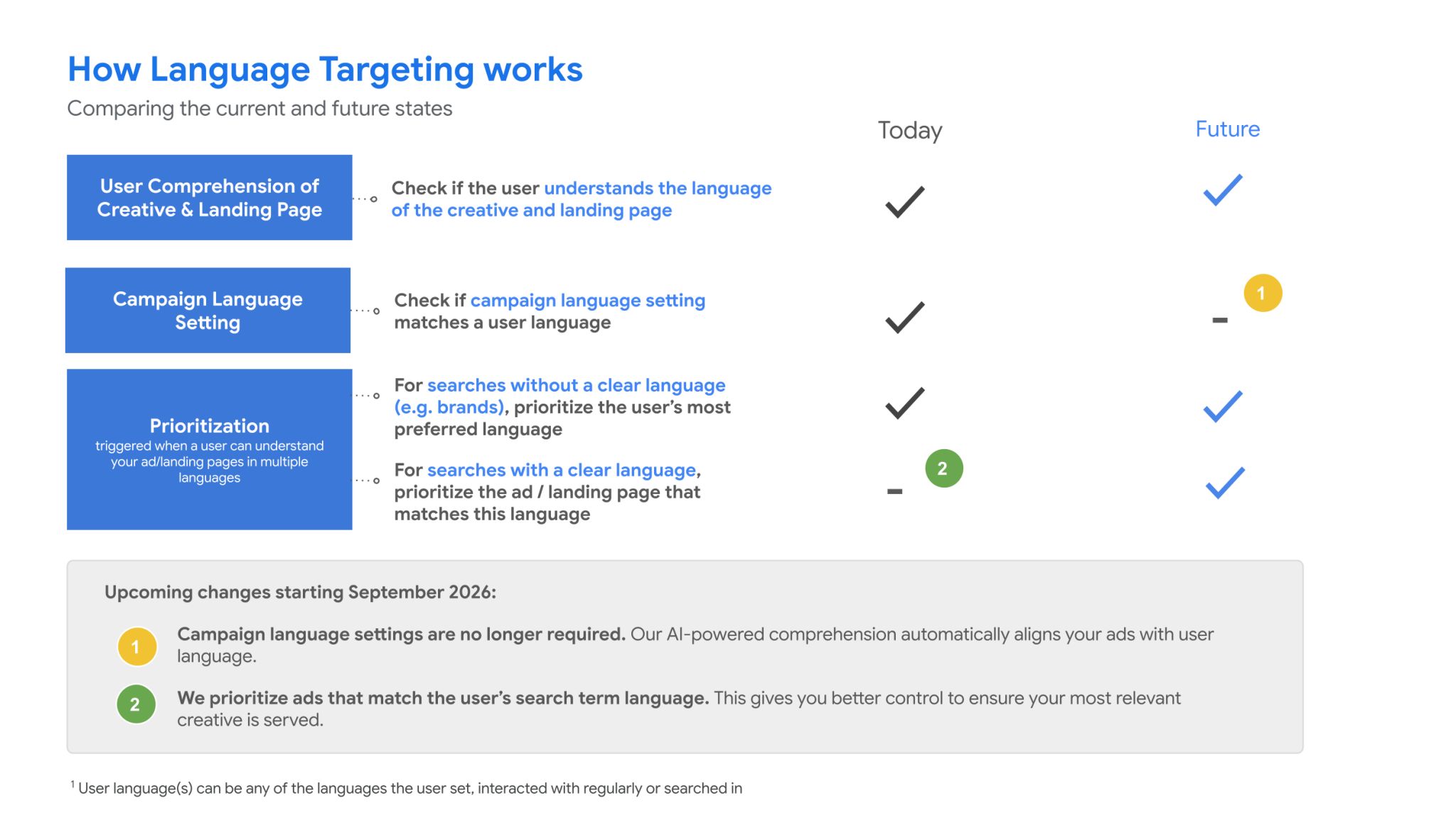
The announcement came from Ginny Marvin, Ads Product Liaison at Google, in a post published on LinkedIn on August 14, 2026. It carried a single explanatory graphic titled "How Language Targeting works", setting out what the platform checks today against what it will check once the setting is gone.
"Starting in September, Google Ads will be removing the language targeting setting for Google search ads in Search and PMax campaigns," Marvin wrote. She added an immediate qualifier: "I know it sounds like a big shift, but it really isn't."
That framing will be tested against a specific detail. The 2025 version of this plan applied to Search campaigns only. This one names Performance Max as well.
What the setting did, and what replaces it
Language targeting has been a campaign-level control in Google Ads for most of the platform's history, sitting alongside location targeting in the campaign settings panel. Advertisers selected one or more languages, and the campaign was understood to serve to users the system judged capable of reading them.
According to Marvin, the control has lost its function. "As language targeting has evolved, the campaign-level setting has become redundant," she wrote. "The system already understands and handles language automatically, looking at an array of signals including the language of the ad creative and landing page, search term language and the user's language settings and preferences."
Think you know ad tech? Prove it. PPC Land now runs a daily word game built entirely from the language of programmatic - sixteen terms, four hidden groups of four, one fresh grid every morning. Some tiles look like they belong somewhere they don't, and that misdirection is the whole puzzle. There's a weekly crossword too, drawn from the terminology that fills briefs, DSP dashboards, and measurement decks. Free to play, no account needed. Find out whether you really know your bid shading from your supply path optimization.
She also cited operational friction as a reason. "And we heard a lot of confusion about how the manual setting works which has led to set up issues," Marvin wrote.
That confusion has a documented shape. The most common misreading, and one Google addresses directly in the post, is the assumption that leaving a language unselected excludes it. It does not, and never did.
The three checks, before and after
The accompanying graphic breaks the serving logic into three components and marks each as active or inactive in the current and future states.
The first is user comprehension of the creative and landing page. According to the graphic, the system checks whether a user understands the language of the ad and the page it points to. This check is active now and stays active.
The second is the campaign language setting, described as a check on whether the campaign's configured language matches a user language. Active now. Marked inactive in the future state. This is the component being removed.
The third is prioritization, which the graphic describes as triggered when a user can understand an advertiser's ads and landing pages in more than one language. It splits into two cases, and the split is where the substantive change sits.
For searches without a clear language, brand names being the example the graphic gives, the system prioritises the user's most preferred language. That behaviour is active now and continues.
For searches with a clear language, the system will prioritise the ad or landing page matching that language. The graphic marks this as inactive today and active in the future.
A footnote defines the term doing the work. According to the graphic, user languages can be any of the languages the user has set, interacted with regularly, or searched in.
A change that arrives dressed as a removal
The second component of the update is not a deletion. It is new serving behaviour, and Google frames it as a gain rather than a loss.
According to the graphic, "We prioritize ads that match the user's search term language. This gives you better control to ensure your most relevant creative is served."
The mechanics deserve unpacking. Under current behaviour, an advertiser running creative in two languages that a bilingual user understands can see either version served, with the user's inferred preference acting as the tiebreaker. Under the September behaviour, the query itself becomes the stronger signal when it carries an unambiguous language. A Spanish-language query should draw the Spanish creative, even where the user reads English fluently and Google's models know it.
For advertisers operating parallel language campaigns in bilingual markets, that is a meaningful shift in which asset wins the auction slot. It is also, in principle, a tightening rather than a loosening: the query language now steers the creative choice more firmly than an inferred user profile does.
The first component is framed differently. According to the graphic, "Campaign language settings are no longer required. Our AI-powered comprehension automatically aligns your ads with user language."
Four things Google says are unaffected
Marvin listed the areas the update does not touch, and the list is more informative than it first appears.
Language exclusions are the first item, and the phrasing is notable because it corrects a persistent misconception rather than describing a change. According to Marvin, exclusions "are already not supported (e.g. leaving a language unselected doesn't mean it's excluded). That's not changing."
Second, ad creative. "Your ad creatives or text customization in AI Max. Google does not translate ad creatives," Marvin wrote. That statement draws a hard line around a capability advertisers have periodically speculated about as automated creative generation has widened. Text customization inside AI Max generates headlines and descriptions from landing page content and existing assets; it does not render them into another language.
Third, reporting. Campaign performance data is not restructured by the change.
Fourth, cross-language matching. Ads will continue to serve against queries in languages other than the ad's own, provided the system judges the user capable of understanding the ad and landing page language.
On existing account architecture, Marvin was direct. Advertisers running single-language campaign structures, separate English and Spanish campaigns being the example given, will find those campaigns continue to function as they do now.
The deadline that slipped
Google first documented this removal a year ago. PPC Land reported in August 2025 that the company's own help documentation stated the language targeting setting would be removed from Search campaigns by the end of 2025, with language detected automatically through Google AI instead.
That documentation contained a second sentence which the current announcement quietly supersedes. It said non-Search campaign functionality would not change.
Performance Max is a non-Search campaign type. It is now explicitly named in scope.
The delay itself runs to roughly nine months, measured from a December 2025 target to a September 2026 start. Delays of that length are not unusual in Google Ads deprecations, and the platform has been visibly recalibrating its 2026 migration calendar. In June, Google pushed the automatic upgrade of Dynamic Search Ads to AI Max from September 2026 to February 2027, restoring DSA creation and editing in the interim.
What did not move was the schedule for automatically created assets and the campaign-level broad match setting. Those remain set for automatic conversion to AI Max on September 1, 2026, confirmed in an email sent to advertisers on August 5, 2026 and signed by the Google Ads Team rather than a named executive. Google subsequently stopped accepting new broad match campaign-level configurations ahead of that date.
September 2026 is therefore carrying a considerable load. Legacy targeting settings convert to AI Max. The language setting disappears from two campaign types. Both land in the same four-week window.
The signal stack behind automatic detection
The signals Marvin lists in the post are consistent with what Google published a year ago, though stated more compactly.
According to the 2025 documentation covered by PPC Land, the detection system drew on historic searches, search term language, user language settings, the language of ads, the language of landing pages, and AI-based keyword prioritisation for ad serving. Marvin's post names the language of the ad creative and landing page, search term language, and the user's language settings and preferences.
The graphic's footnote broadens the definition further, counting languages the user has merely interacted with regularly or searched in as user languages. That is a wider net than an explicitly declared interface preference, and it is the mechanism by which a user who reads two languages becomes eligible for creative in both.
Detection quality depends on data volume. Users with sparse Google search histories, or those accessing services through restricted networks, generate fewer signals for the models to work with. That limitation was flagged in PPC Land's 2025 coverage and is not addressed in the current announcement.
Where this sits in the wider pattern
The removal of a manual targeting control in favour of model inference is not an isolated event on this platform. It is the shape of most Google Ads product change over the past three years.
In September 2025, Google restructured the campaign creation interface to lead with channel selection and default to Performance Max when advertisers selected all available channels. In February 2026, Lookalike segments in Demand Gen ceased to operate as strict targeting boundaries and became audience suggestions that the system could expand beyond. Keyword matching has drifted in the same direction, with exact match behaviour documented matching semantically unrelated terms in November 2025.
Controls have been added back in other places, usually after practitioner pressure. Text guidelines arrived in September 2025 with term exclusions and messaging restrictions for AI-generated copy, then went global in February 2026 with full language and vertical support. Branded search controls reached AI Max in June 2026. AI Brief, announced on April 30, 2026, allows advertisers to steer AI Max through natural-language instructions rather than settings.
The language change fits the first pattern more than the second. A binary campaign setting is being retired, and the replacement is not a different control but the absence of one.
There is a counterweight worth noting. The prioritisation change moving to active status does hand advertisers something concrete: greater confidence that a query in a given language draws the creative written in that language. Google describes this in the graphic as better control. Whether it functions that way in bilingual markets is an empirical question that will only be answerable after September.
Why it matters for the marketing community
Three practical consequences follow from the announcement as written.
The first concerns account audits. Campaigns configured years ago with a specific language selection have been operating under a control that Google now describes as redundant. Once the setting is gone, any performance variance in multilingual markets cannot be attributed to it, which removes a diagnostic variable that media teams have used when investigating irrelevant impressions.
The second concerns the Performance Max expansion. Advertisers who read the 2025 documentation and concluded that their Performance Max campaigns were outside the scope of this change now have a different picture. Performance Max already operates with fewer manual levers than Search; the removal of one more is incremental in isolation and cumulative in aggregate. PPC Land has tracked the same trajectory through the retirement of Dynamic Search Ads, the pushback that followed it, and the extension of AI Max into Shopping campaigns on April 30, 2026.
The third concerns timing. Accounts running automatically created assets or campaign-level broad match are already scheduled for structural conversion on September 1. Adding a targeting setting removal to the same month means that any performance movement observed in September will have at least two plausible causes inside the platform, and separating them will be difficult. Independent measurement has already found divergence between Google's internal figures and third-party results in this period: a Lunio study published on August 12, 2026 reported 72% more invalid traffic on retail AI Max campaigns.
Regulated advertisers face a narrower version of the same question. Compliance language is frequently drafted per market and per language, and the assurance that Google does not translate ad creatives matters more to those advertisers than the removal of the setting itself. That assurance is now on the record.
Marvin's own summary, that this sounds like a big shift but is not one, is defensible on the mechanics. The campaign setting was one input among several, and the others remain. The scope change to Performance Max, and the elevation of search term language in the prioritisation logic, are the parts of the announcement that will show up in September reporting.
Timeline
- August 18, 2025 - Google's help documentation states the language targeting setting will be removed from Search campaigns by the end of 2025, with non-Search functionality unchanged
- September 10, 2025 - Text guidelines introduced for Performance Max and AI Max, adding term exclusions and messaging restrictions
- September 26, 2025 - Campaign creation interface restructured to lead with channel selection and default to Performance Max
- November 2025 - Exact match keyword behaviour documented matching semantically unrelated search terms
- End of 2025 - Original deadline for the language targeting removal passes without the setting being removed
- February 17, 2026 - Lookalike segments in Demand Gen converted from strict targeting constraints to audience suggestions
- February 26, 2026 - Text guidelines beta goes global with full language and vertical support
- April 15, 2026 - AI Max exits beta and Dynamic Search Ads are scheduled for retirement
- April 30, 2026 - AI Max extended to standard Shopping campaigns, and AI Brief announced for natural-language campaign steering
- May 20, 2026 - Advertisers publicly push back on the DSA sunset
- June 1, 2026 - Branded search controls roll out inside AI Max
- June 13, 2026 - DSA automatic migration to AI Max delayed from September 2026 to February 2027
- August 5, 2026 - Google emails advertisers confirming automatically created assets and campaign-level broad match convert to AI Max on September 1
- August 12, 2026 - Lunio publishes a retail study reporting 72% more invalid traffic on AI Max campaigns
- August 13, 2026 - Creation of new campaign-level broad match configurations blocked ahead of the September migration
- August 14, 2026 - Ginny Marvin announces the removal of the language targeting setting from Search and Performance Max campaigns, effective September 2026
- September 1, 2026 - Automatically created assets and campaign-level broad match campaigns convert to AI Max
- September 2026 - Campaign language targeting setting removed; search term language prioritisation becomes active
Related PPC Land coverage
- Google removes language targeting from search campaigns by 2025 - The original August 2025 documentation change, including the full signal list Google published for automatic language detection and the statement that non-Search campaigns would be unaffected.
- Google Ads broad match campaigns face AI Max auto-upgrade on September 1 - Details of the August 5, 2026 email confirming which legacy settings convert and what each affected cohort inherits by default.
- Google blocks new broad match settings before September 1 AI Max migration - Coverage of the closure of legacy setup paths ahead of the September conversion, including API version support timelines.
- Google delays DSA-to-AI Max automigration to February 2027 - The June 2026 decision that moved the Dynamic Search Ads deadline while leaving other legacy settings on the original schedule.
- Google ends Dynamic Search Ads: DSA upgrades to AI Max in September - The April 15, 2026 announcement that took AI Max out of beta and set the retirement path for three legacy configurations.
- Advertisers push back as Google sunsets DSA for AI Max - Practitioner reaction to the migration plan and the documentation language Google used to describe it.
- Google quietly strips Lookalike's hard targeting control in Demand Gen - A parallel case of a manual targeting boundary being converted into a model input.
- Google modifies campaign setup flow to prioritize Performance Max - The September 2025 interface restructure, which referenced the language targeting removal as part of the same automation programme.
- Google's text guidelines beta goes global for AI Max and Performance Max - The February 2026 expansion of creative controls to advertisers running campaigns in any interface language.
- Google introduces text guidelines for AI-powered advertising campaigns - The original term exclusion and messaging restriction controls governing AI-generated ad text.
- Google Ads gets branded search controls inside AI Max - The June 2026 addition of brand inclusion and exclusion options to AI Max targeting.
- AI Brief: Google lets advertisers steer AI Max in plain language - Natural-language instructions as a replacement for structured campaign settings.
- Google brings AI Max to Shopping campaigns, targeting conversational queries - The April 30, 2026 extension of AI Max mechanics into standard Shopping campaigns.
- Google exact match degradation expands to semantically unrelated terms - Documented drift in keyword matching behaviour that preceded the wider targeting changes.
- Retailers on AI Max face 72% more invalid traffic, Lunio finds - Independent measurement published two days before the language targeting announcement.
Summary
Who: Google, through Ginny Marvin, Ads Product Liaison at Google, announcing on LinkedIn. The change affects every advertiser running Search or Performance Max campaigns in Google Ads, with the sharpest relevance for those operating in bilingual or multilingual markets and those running separate campaigns per language.
What: Removal of the campaign-level language targeting setting from Search and Performance Max campaigns, replaced by automatic language detection using ad creative and landing page language, search term language, and the user's language settings and preferences. A second change activates prioritisation of the ad and landing page matching the language of the search term when that query carries a clear language. Language exclusions, ad creative translation, reporting, and cross-language ad matching are unaffected, and single-language campaign structures continue to operate as before.
When: Announced on August 14, 2026. The changes take effect starting September 2026, roughly nine months after the end-of-2025 deadline Google set in its own help documentation in August 2025.
Where: Google Ads globally, across Search and Performance Max campaign types. Non-Search campaign types beyond Performance Max are not named in the announcement.
Why: According to Google, the campaign-level setting has become redundant because the system already determines language automatically from multiple signals, and the manual control generated confusion that led to campaign setup errors. The prioritisation change is presented as giving advertisers greater confidence that the creative matching a query's language is the one served.


Discussion