
Google AdSense Offerwall is generally available - what it means
Google AdSense today made Offerwall generally available, adding email collection in beta, rewarded ads, and unconsented traffic monetization for publishers.

Google AdSense today made Offerwall generally available, adding email collection in beta, rewarded ads, and unconsented traffic monetization for publishers.
Google today announced that Offerwall is now generally available on AdSense, marking a formal transition out of limited availability and into full deployment for all publishers on the platform. The announcement, dated April 13, 2026, was published through the AdSense Help Center and confirms that the Offerwall system - which lets site visitors choose alternative ways to access content - is open to the broader publisher base without restrictions.
The move follows a long development arc. Google first introduced Offerwall as a beta feature in AdSense in early 2024, before launching it for Google Ad Manager on June 26, 2025, following testing with more than 1,000 publishers. The AdSense general availability announcement today closes the gap between the two products and brings the full feature set to AdSense publishers at large.
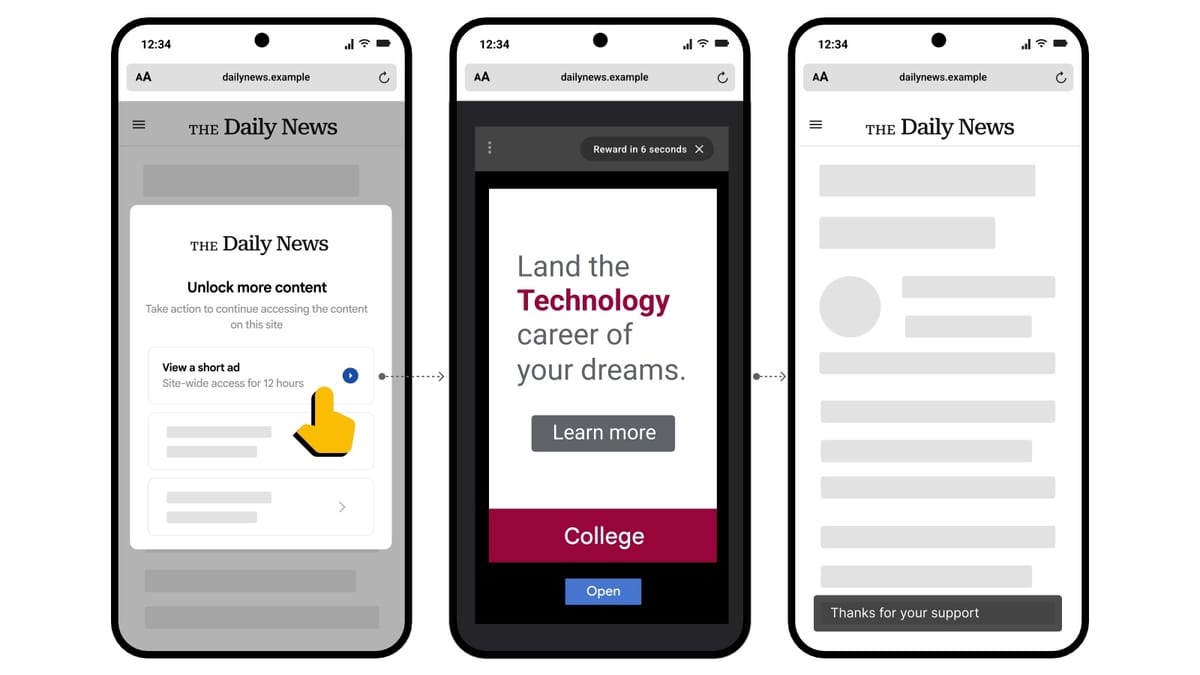
At its core, the Offerwall is a monetization gate. Rather than blocking content outright, it presents site visitors with a menu of choices for how to access what they came to read. According to Google's AdSense Help Center documentation, "Offerwall messages allow your site visitors to choose alternative ways to support your site and gain access to your content, such as viewing a rewarded ad."
The system is configured through the Privacy & messaging message builder inside the AdSense interface. Publishers see a preview of three structural layers: the main Offerwall screen, which displays a summary of choices and instructs the visitor to make a selection; customizable body text; and a list of user choices that the publisher has activated. When a visitor selects one of those choices, a second screen loads where the action is completed - watching a short ad, for example - before access is granted.
Two user choices are currently available for AdSense publishers. The first is rewarded ad, which is turned on by default and invites visitors to watch a short advertisement in exchange for access. The second is email collection, currently in beta, which asks visitors to submit an email address to receive access. According to the documentation, "the Email collection user choice on your Offerwall message gives site visitors the option to provide their email address and, after successfully completing this task, earn access to your site content."
The email collection feature is notable because it operates without requiring any code changes from the publisher. According to the documentation, "Offerwall implements the email collection choice on your behalf, so that no code changes are needed on your site." Publishers enable it by navigating to the User choices section of the Offerwall message builder and toggling on the Email collection option.
Publishers can edit the prompt text that visitors see. The documentation provides the example "Subscribe to our newsletter with your email address" as a possible phrasing, while noting that publishers must disclose all purposes for which they are collecting end-user email addresses. After enabling email collection, publishers must also configure an entitlement - a parameter that determines how long a user receives site access after providing their address.
Collected email addresses are not stored indefinitely. According to Google's documentation, "the email addresses collected from your end users are available for up to 45 days for download." Download is available via a CSV file, which contains three fields: the date on which the email was provided, the domain, and the email address itself. Publishers access this by navigating to Privacy & messaging, clicking Manage on the Offerwall card, and selecting Download collected emails.
There is a technical constraint on repeat prompting. Once a user submits an address, the email collection choice will not be visible to that same user for one year. The documentation specifies that "this is subject to browser implementation as this state is stored in the browser's 1P cookie space." A visitor who clears their cookies, uses a different browser, or switches devices could see the prompt again before that 12-month period expires.
Enabling email collection also carries a compliance step. According to the documentation, activating the feature acknowledges that the publisher has reviewed and accepted Google's Ads Data Processing Terms.
The rewarded ad choice - the longer-established of the two options - works by presenting visitors with a short video advertisement. The Offerwall only shows when rewarded ad inventory is actually available; if no suitable advertisement exists during a given page view, the system defers the Offerwall to the next qualifying page view. That behavior means the actual frequency of display can fall below whatever threshold the publisher has configured.
Publishers have precise control over where and when the Offerwall appears. URL inclusions and exclusions allow targeting down to specific page paths. According to the documentation, exclusions override inclusions - so a publisher who activates the Offerwall across all article paths can exclude individual pages by adding a specific page exclusion.
Metering is the primary frequency control. Publishers set a threshold expressed as a number of page views, and visitors who have reached or exceeded that threshold within a rolling window begin seeing the Offerwall. The documentation specifies that "each visitor's threshold count resets 30 days after their first page view." Pages excluded from the Offerwall do not count toward a visitor's page view tally, and page views where the user has already gained access through a previous Offerwall choice also do not count.
The dismiss option gives publishers an additional lever. If enabled, visitors can close the Offerwall without completing a choice for a configured number of times - up to a maximum of 100 - before the message becomes fully blocking. Setting the dismiss value to 100 effectively makes every Offerwall appearance dismissible.
One documented constraint: the Offerwall does not support Accelerated Mobile Pages (AMP).
One of the more technically significant aspects of the current Offerwall documentation is its explicit support for unconsented traffic. According to the documentation, "Offerwall monetization is now supported on unconsented traffic. Google Ad Manager has expanded Offerwall support, now enabling publishers to monetize traffic where user consent has not been obtained."
For visitors who have not consented, the rewarded ad choice serves either limited ads for European Economic Area traffic or non-personalized ads for US states where users have opted out. The email collection choice, along with any other available options, remains accessible on unconsented traffic and provides an alternative revenue path beyond limited or non-personalized ad serving. This is particularly relevant for publishers operating under the GDPR or US state privacy laws, where a significant share of traffic may arrive without valid consent signals.
PPC Land has documented the Offerwall's unconsented traffic support as part of a broader expansion of Google's publisher monetization tools into privacy-restricted environments.
The Offerwall supports messages in 48 languages. According to the documentation, the language in which a message displays is determined at serving time based on the language setting on the user's device. The supported languages include Arabic, Bangla, Bulgarian, Chinese (Simplified), Chinese (Traditional), Croatian, Czech, Danish, Dutch, English (UK), English (US), Estonian, Filipino, Finnish, French, German, Greek, Hebrew, Hindi, Hungarian, Icelandic, Indonesian, Italian, Japanese, Korean, Latvian, Lithuanian, Marathi, Norwegian, Persian, Polish, Portuguese (Brazil), Portuguese (Portugal), Romanian, Russian, Sinhala, Slovak, Slovenian, Spanish, Spanish (Latin America), Swedish, Tamil, Telugu, Thai, Turkish, Ukrainian, Urdu, and Vietnamese. Google notes that publishers are responsible for verifying the accuracy of wording in any language they deploy.
Testing is available without waiting for a real visitor session. According to the documentation, publishers can test an Offerwall by appending ?fc=alwaysshow&fctype=monetization to a page URL after publishing the message. An example URL from the documentation reads: http://www.example.com/sports.html?fc=alwaysshow&fctype=monetization. Google recommends testing in a browser that clears cookies - such as Chrome in incognito mode - since the Offerwall state is stored in first-party cookie space and will not display again to the same browser session once a choice is completed.
Performance data is accessible through a metrics card at the top of the Offerwall Messages page. Additional metrics and dimensions are available for download as a CSV file.
The general availability announcement arrives at a difficult moment for many independent publishers. PPC Land reported in December 2025 that Google AdSense was automatically enrolling active Offerwall publishers in a machine learning optimization system beginning January 10, 2026, claiming performance improvements of 8.15% in total ad revenue and 10.2% in Offerwall conversion rates compared to manual metering configurations. That enrollment followed a pattern of automated feature activation that has been applied to several AdSense tools in recent product cycles.
The Green Card News case study referenced in the Offerwall documentation serves as the platform's primary public evidence of commercial impact. According to the AdSense Help Center, the publisher "drove a 74% revenue uplift with Offerwall while maintaining user experience." The case study is available for download through the documentation. No other publisher performance figures appear in the announcement material reviewed.
For the marketing and publishing community, the general availability of Offerwall represents a formal signal that Google considers the product mature enough for universal AdSense deployment. The email collection feature in beta is a meaningful addition: it extends the Offerwall beyond ad-based exchanges into first-party data collection, a capability that has become increasingly important as third-party cookies diminish in reach and reliability. Publishers who activate email collection gain a direct channel to users who would otherwise remain anonymous, and the 45-day download window places the data management responsibility squarely with the publisher.
The consent and privacy regulatory environment surrounding these features is also in active motion. Google sent mandatory service emails to AdSense publishers on April 7, 2026, announcing automatic enrollment in consent message optimization for European regulations messages, with an activation date of May 7, 2026. That rollout affects publishers reaching users in the EEA, the United Kingdom, and Switzerland, and introduces further automation of publisher-facing consent tooling.
Who: Google AdSense, the display advertising monetization platform, addressing publishers using the AdSense product.
What: Offerwall is now generally available on AdSense, giving all publishers access to a content-gating mechanism that offers site visitors a choice of how to access content - by watching a rewarded ad or, in a beta feature, by submitting an email address. Collected emails are available for download for up to 45 days in CSV format. The system also supports monetization of unconsented traffic.
When: The general availability announcement was published on April 13, 2026.
Where: The feature is accessible through the Privacy & messaging section of the Google AdSense interface, available to publishers globally.
Why: Google frames Offerwall as a tool for publishers to generate revenue from highly engaged users who visit the site frequently, while offering visitors a degree of choice over how they access content. The addition of email collection extends the product beyond ad-only exchanges into first-party data capture, relevant in a market where consent-based data is increasingly scarce and valuable.