
Google finally adds Gemini API spend caps - after billing chaos hit devs
Google launches Gemini API Project Spend Caps and revamped Usage Tiers in AI Studio after a 2025 billing bug charged developers thousands for unused services.

Google launches Gemini API Project Spend Caps and revamped Usage Tiers in AI Studio after a 2025 billing bug charged developers thousands for unused services.
Google today introduced Project Spend Caps in Google AI Studio, allowing developers to set monthly dollar limits on their Gemini API expenses for the first time. The company also announced a complete overhaul of its Usage Tiers system and a suite of new billing dashboards designed to improve cost visibility. The announcement, authored by Jason Stephen and Nabila Babar and published on Google's Keyword blog on March 16, 2026, arrives seven months after a billing system bug resulted in erroneous charges that left some developers facing bills exceeding $70,000 for services they never used.
The timing is difficult to ignore. For years, developers working with Google Cloud and its AI APIs have operated without hard spending limits - a structural gap that competitors like OpenAI addressed long ago. When a pricing configuration error in August 2025 caused the Gemini 2.5 Flash billing system to charge developers for "Native Image Generation" output tokens they never generated, the absence of spend controls turned a software bug into a financial crisis for an unknown number of users.
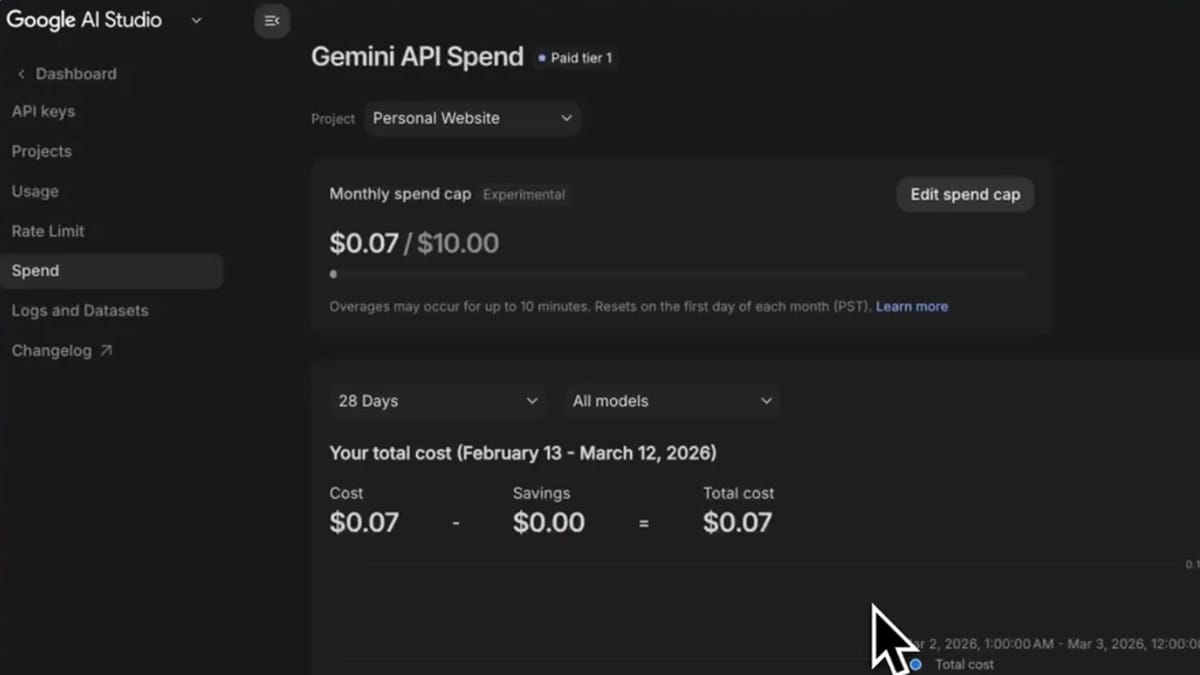
The centerpiece of today's update is a feature called Project Spend Caps. According to Google's announcement, developers can now "easily establish a monthly dollar limit for Gemini API spend" on individual projects within Google AI Studio. Once configured, the limit persists until the developer modifies or disables it. Google noted this is "particularly useful for accounts with multiple projects where you'd want granular control over project-level spend."
There is a caveat. Spend caps carry an approximate 10-minute delay, and Google stated that "users are responsible for overages incurred during that period." In a system where billing errors have historically escalated rapidly - one developer reported charges growing by $200 in just 20 minutes even after deleting all API keys - a 10-minute enforcement gap is not insignificant.
Project owners can configure these caps per project through the Spend tab in AI Studio, under a section labeled "Monthly spend cap."
The second major change involves Google's Usage Tiers, which govern rate limits and quotas for API access. According to the announcement, the company has "completely revamped" the tier system with three specific changes. First, lower spend qualifications mean developers with a strong payment history reach higher quotas more easily. Second, tier upgrades are now automatic and immediate once criteria are met, eliminating manual processes. Third, each usage tier now carries a maximum monthly spend limit enforced across the entire billing account - what Google described as a "system-defined cap" that "automatically increases as you graduate to higher tiers."
Google compared this billing account tier cap to practices at "other platforms in the industry," a tacit acknowledgement that the company's previous approach lagged behind competitors.
Beyond spend caps and tier changes, Google detailed a broader set of billing improvements rolled out over "the past few months." These include a new billing setup directly within AI Studio that eliminates the need to navigate between multiple windows and tabs, a rate limit dashboard showing Requests Per Minute (RPM), Tokens Per Minute (TPM), and Requests Per Day (RPD) metrics for every project, a daily cost breakdown graph within a new billing dashboard, and an expanded usage dashboard that tracks error metrics, token usage, and generation statistics for specific services including Imagen and Veo.
The new cost dashboard allows developers to track expenses per project across different time frames - from the last seven days to the full month - with filters by model. The usage dashboard adds dedicated graphs for image and video generation requests per day, along with tools like Grounding with Google Search and Maps.
These features address specific technical shortcomings that became painfully visible during the August 2025 billing incident. Multiple developers reported at the time that Google's billing dashboard took up to 48 hours to display accurate usage data - a delay that made it nearly impossible to diagnose runaway charges in real time.
To understand why today's announcement matters, the events of August 2025 require examination.
On or around August 23, 2025, developers using the Gemini API began reporting sudden, massive spikes in their Google Cloud bills. The charges appeared under a specific SKU: "Generate_content image output token count for Gemini 2.5 Flash Native Image Generation." The problem was that many of these developers had never generated any images through the API. Their workflows involved text translation, cached content storage, or other non-visual tasks.
One developer, posting on Reddit's r/GeminiAI community, described discovering over $1,000 in charges for image generation after using the API solely to translate product descriptions. "I NEVER GENERATED ANY IMAGES with API," the developer wrote. "My workflow only translated text, and it wasn't even running overnight." The developer reported deleting all API keys, only to watch the debt increase by another $200 within 20 minutes. Even after disabling the billing account entirely, an additional $500 charge appeared on the developer's card.
The situation was not isolated. On the Google AI Developers Forum, a thread titled "Gemini API cost suddenly skyrocketed" accumulated reports from numerous affected users. One developer identified as Ryan_L described over $70,000 in charges in a post tagged "[CRITICAL-BUG]." Another forum user reported $300 per day in unexplained charges that continued to grow even with no active caches, no running applications, and billing screenshots that changed retroactively from one day to the next.
According to one affected user, Google's billing reports showed inconsistent data across consecutive days - charges that appeared on one day's report vanished the next, while forecasts bore no relationship to actual bills. "Someone tell me that this is normal and something I can trust?" the developer wrote after documenting billing screenshots that showed a forecast of $11.48 alongside an actual bill of $963.18 for the same period.
Analysis shared by developers on the forum pointed to a specific technical failure. According to one detailed investigation posted on Reddit, "the billing anomaly is not an isolated incident but a widespread, systemic issue affecting multiple developers as of August 23, 2025." The analysis concluded that "a significant bug within Google's billing and metering system" was "miscategorizing internal, multimodal 'thinking' tokens as high-cost 'image output' tokens."
Google eventually acknowledged the problem. Logan Kilpatrick, who at the time managed community relations for Google's AI developer products, posted a status update confirming: "A bug in the billing system is causing erroneous charges on 'Gemini 2.5 Flash Native Image Generation' for some users. All such charges will be refunded." The message appeared on AI Studio's status page and was shared on social media.
Individual developers received emails from Google Cloud Support confirming the error. According to one email shared publicly, Google's team identified "an incorrect pricing configuration for our '2.5 Flash Native Image Generation' service" and stated that "this error caused usage to be calculated incorrectly, resulting in the charges you observed." The email promised that once the issue was corrected, Google would "automatically apply a credit to your account for the full amount of the discrepancy."
The word "credit" proved contentious. Several developers noted that a billing credit - money applied to their Google Cloud balance - was not the same as a refund to their payment method. For developers who did not regularly spend large amounts on Google Cloud services, a credit of $1,000 or more sitting in their account had limited practical value. "I am not a 'heavy api user,' and I don't need $1,237 on the balance," one developer wrote. "Very sad that a lot of people who can't send a dispute will not receive a refund to the payment method."
The resolution process was uneven. Some developers reported receiving adjustments within weeks. Others waited considerably longer. On the Google AI Developers Forum, one user wrote in September 2025 - weeks after the initial incident - that "the support team told me that this issue was resolved and the incorrect charges were updated on my account. But when I check my billing report and transaction history, nothing has changed."
Multiple developers took matters into their own hands by filing disputes with their banks or credit card companies. This action triggered a secondary problem. According to one developer, Google responded to the bank dispute by disabling the developer's payment profile across all Google services - not just Cloud, but also Google Play Store and YouTube Premium. To reinstate the payment profile, Google required the developer to upload copies of both sides of their government identification and their most recently used payment card. The developer noted that the bank had already cancelled and asked them to destroy the disputed card, making compliance impossible.
"Not only did I NOT get the refund or credit I was told I would get," the developer wrote in a forum post directed at Logan Kilpatrick, "I have now had payments disabled on my account in what I can only describe as what appears to be retaliatory action from Google for the disputing the charges that were confirmed mistakes by your own support."
Another affected developer described a similar pattern: "It's been almost 2 weeks with no support from Google - no billing updates, no cancel incorrect transaction, nothing like they promised. I've had to file a dispute with my bank to cancel these incorrect charges. Now, I'm also getting emails saying I need to update my payment info and submit ID, or my account will be locked."
Reports of billing problems related to the Gemini API continued appearing for months after the initial August incident. As late as four months after the initial reports, developers were still posting about unexplained charges with no resolution.
The lack of hard spending limits on Google's AI APIs has been a persistent frustration for developers. While Google's announcement today frames spend caps as a new feature designed for "better cost management," the underlying need has existed for years. Google's Maps API pricing overhaul in 2018 triggered similar developer anxiety about uncapped billing, with developers expressing fear that usage surges could generate massive unexpected bills.
Other API providers have offered hard spending limits for some time. OpenAI, for instance, allows developers to set monthly budget caps that halt API access once reached. Anthropic provides similar controls. The Gemini API's absence of such a feature was noted by developers even before the August 2025 billing crisis. "All other API providers (that I know of) have the possibility to establish a hard limit," one developer wrote on Reddit. "Only Google just keeps billing you without any limit."
The structural absence of spend controls amplified the damage from the August 2025 bug. Had developers been able to cap their monthly spend at, say, $100, the miscategorized tokens would have triggered a billing halt rather than an escalating financial catastrophe. A developer who set up a simple text translation workflow would not have discovered $1,000 in image generation charges days later.
Google's announcement today does not reference the August 2025 billing incident directly. The blog post makes no mention of the bug, the forum complaints, or the months of developer frustration that preceded these changes. Whether the incident served as a direct catalyst for the spend cap feature or merely accelerated existing product plans remains unclear.
For marketing professionals who rely on AI APIs to power advertising workflows, content generation, and data analysis, these billing controls address a real operational risk. The Gemini API is increasingly integrated into marketing technology stacks through tools like Google AI Studio's vibe coding features, which allow rapid prototyping of AI-powered marketing applications. Image generation capabilities built on Gemini 2.5 Flash technology have expanded across Google's product ecosystem, creating more entry points for API consumption and, consequently, more potential exposure to billing surprises.
The broader pattern of API cost volatility is familiar to the digital marketing industry. Google's elimination of the n=100 SERP parameter in September 2025 increased data collection costs tenfold for SEO platforms overnight. Amazon's introduction of SP-API fees for third-party developers created new financial pressures for e-commerce tool providers. These cost shifts reshape the economics of marketing technology businesses and ultimately flow through to the advertisers and agencies that depend on them.
The 48-hour billing data delay that Google's system exhibited during the August 2025 crisis is particularly problematic for marketing operations that need real-time cost monitoring across multiple API services. The new rate limit and cost dashboards announced today represent a partial solution - though whether the underlying billing infrastructure now processes data faster remains unaddressed in the announcement.
Google's framing of the revamped Usage Tiers as offering "less friction and more transparency" aligns with what developer tool improvements across its API ecosystem have emphasized throughout 2025 and 2026 - simplified workflows, consolidated interfaces, and automated processes. But the substance of today's announcement is fundamentally about risk mitigation rather than developer experience optimization. Spend caps exist because their absence caused quantifiable financial harm.
Today's announcement leaves several questions open. The 10-minute delay on spend cap enforcement creates a window during which charges can exceed the configured limit. Google stated that developers bear responsibility for overages during this period. For high-throughput applications processing thousands of API calls per minute, 10 minutes of uncapped billing could represent substantial exposure depending on the models and features in use.
The billing account tier cap - the system-defined maximum spend enforced across all projects - adds a secondary layer of protection. But Google did not publish the specific dollar amounts for each tier in the blog post, directing developers instead to documentation. The practical value of these caps depends entirely on where the limits are set relative to typical developer budgets.
Questions also remain about whether Google has fundamentally resolved the billing infrastructure issues that caused the August 2025 incident. The announcement mentions improved observability and dashboards, but does not discuss changes to the metering and pricing configuration systems that produced the erroneous charges. A spend cap prevents financial damage from exceeding a set threshold, but it does not prevent the underlying billing errors from occurring.
For developers who were affected by the August 2025 billing bug and have not yet received full refunds or experienced account-level consequences from bank disputes, today's announcement offers no specific remediation. The improvements are forward-looking, designed to prevent future incidents rather than resolve past ones.
Google concluded its announcement by stating: "We hope these updates help you build more confidently with the Gemini API, and we will continue to make improvements to provide a more reliable and transparent service." Whether the new controls prove sufficient to restore developer confidence - particularly among those who watched their bills climb into the thousands for services they never used - will depend on execution rather than promises.
Who: Google, through its Google AI Studio team (Jason Stephen and Nabila Babar authored the announcement), introduced the changes. The updates affect all developers using the Gemini API through Google AI Studio. Developers who experienced billing errors in August 2025 - some reporting charges exceeding $70,000 - represent the most directly affected group.
What: Google launched Project Spend Caps allowing per-project monthly dollar limits on Gemini API expenses, revamped its Usage Tiers system with lower qualification thresholds, automatic upgrades, and billing account-level spend limits, and released new dashboards for rate limits, costs, and usage monitoring. The announcement follows a billing system bug in August 2025 that charged developers for image generation they never performed.
When: The announcement was published on March 16, 2026 - approximately seven months after the August 2025 billing bug that triggered widespread developer complaints across Google's forums and Reddit communities.
Where: The features are available within Google AI Studio, Google's development platform for the Gemini API. The billing errors and developer complaints surfaced on the Build with Google AI Forum and Reddit's r/GeminiAI community, with affected developers spanning multiple countries.
Why: The spend caps and billing improvements address a long-standing gap in Google's API billing infrastructure that was dramatically exposed by the August 2025 pricing configuration error. The absence of spending limits meant developers had no mechanism to prevent runaway charges, whether caused by their own usage, compromised API keys, or - as occurred in August 2025 - bugs in Google's own billing system. Competing API providers including OpenAI and Anthropic already offered hard spending limits, making Google's lack of such controls an increasingly untenable competitive disadvantage.