Google launches protocol for AI agents to shop across platforms
Google launches Universal Commerce Protocol with major retailers on January 11, 2026, introducing checkout APIs and payment standards for autonomous AI agents.


Google launches Universal Commerce Protocol with major retailers on January 11, 2026, introducing checkout APIs and payment standards for autonomous AI agents.
Google today launched the Universal Commerce Protocol, establishing open-source technical standards for AI agents to execute purchases across different retail platforms without requiring custom integrations for each merchant. The company simultaneously introduced three related protocols—Model Context Protocol, Agent2Agent, and Agent Payments Protocol—along with new advertising features designed to capture high-intent shoppers during research phases.
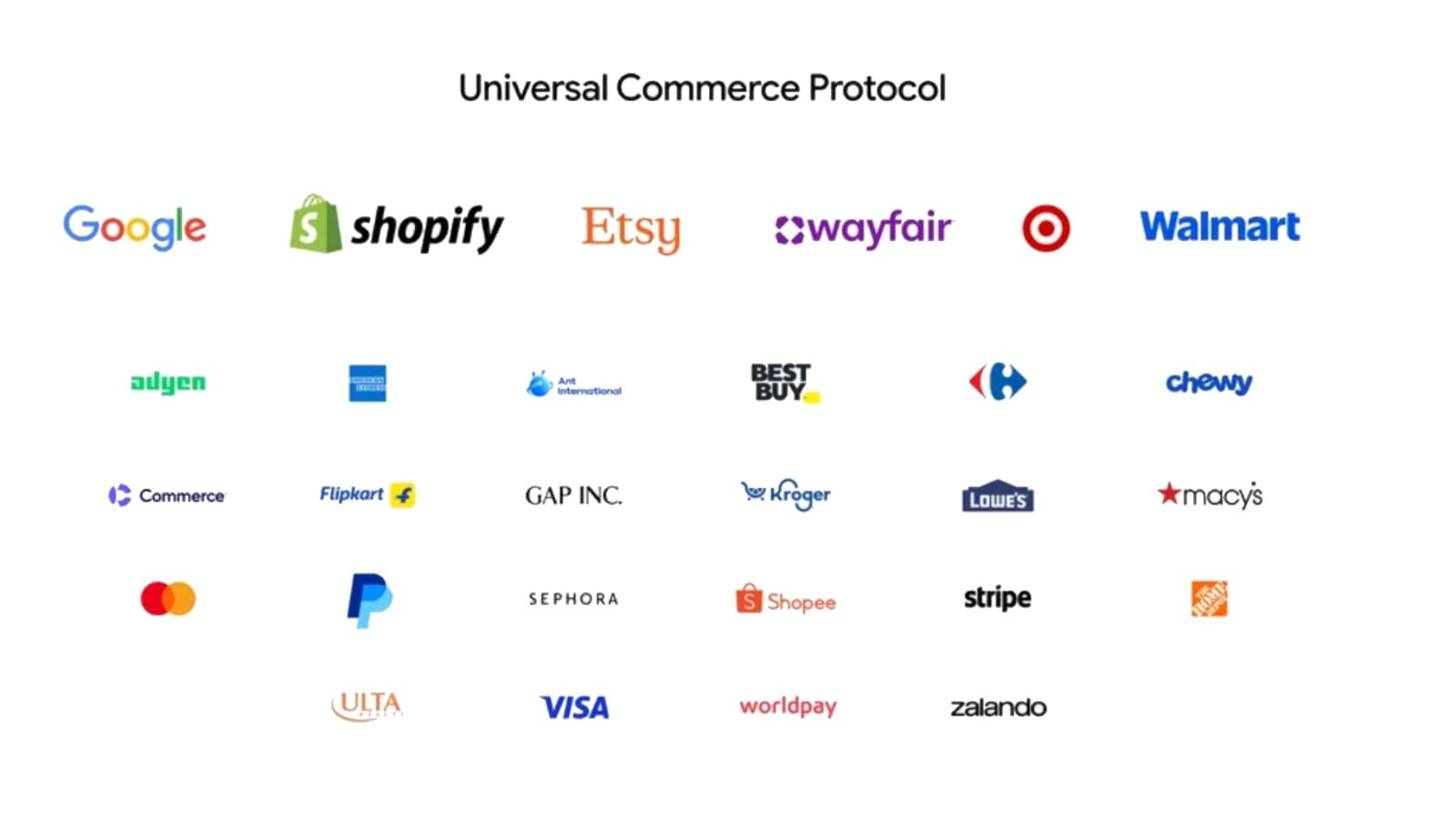
"AI agents will be a big part of how we shop in the not-so-distant future," according to Sundar Pichai, CEO of Google and Alphabet, in a post published on X on January 11. "To help lay the groundwork, we partnered with Shopify, Etsy, Wayfair, Target and Walmart to create the Universal Commerce Protocol, a new open standard for agents and systems to talk to each other across every step of the shopping journey."
The protocols arrive as major merchants adopt divergent strategies toward AI shopping agents. While Amazon blocks third-party AI agents to protect its advertising business, Google positions itself as the infrastructure provider enabling open commerce across competing platforms. The company co-developed UCP with Shopify, Etsy, Wayfair, Target, and Walmart, with endorsements from more than 20 additional companies including Adyen, American Express, Best Buy, Flipkart, Macy's Inc., Mastercard, Stripe, The Home Depot, Visa, and Zalando.
The Universal Commerce Protocol defines technical specifications for AI agents to discover products, negotiate checkout parameters, link customer identities, and manage post-purchase workflows, according to documentation published January 11. The protocol establishes REST and JSON-RPC transport layers with built-in support for three complementary standards: Agent Payments Protocol for cryptographic transaction authorization, Agent2Agent for multi-agent collaboration, and Model Context Protocol for tool calling from AI assistants.
The Model Context Protocol operates as the foundational layer connecting AI applications to external systems. Originally developed by Anthropic and donated to the Linux Foundation, MCP provides what Google describes as "a USB-C port for AI applications." The protocol enables AI systems like Claude or ChatGPT to access data sources including local files and databases, tools such as search engines and calculators, and specialized workflows through standardized interfaces.
"MCP (Model Context Protocol) is an open-source standard for connecting AI applications to external systems," according to official documentation published by the Linux Foundation. "Using MCP, AI applications like Claude or ChatGPT can connect to data sources (e.g. local files, databases), tools (e.g. search engines, calculators) and workflows (e.g. specialized prompts)—enabling them to access key information and perform tasks."
Agent2Agent Protocol establishes communication standards for AI agents built using different frameworks to collaborate on complex workflows. Originally developed by Google and donated to the Linux Foundation, A2A enables agents constructed with LangGraph, CrewAI, Semantic Kernel, or custom solutions to delegate sub-tasks, exchange information, and coordinate actions. IBM's Agent Communication Protocol has been incorporated into A2A specifications, while Cisco's agntcy framework provides components for agent discovery, group communication, identity management, and observability using A2A and MCP standards.
The Agent Payments Protocol addresses what Google characterizes as a "crisis of trust" in autonomous commerce. Current payment systems assume direct human authorization through clicking "buy" buttons on trusted websites. When AI agents initiate purchases, fundamental questions arise about authorization verification, authenticity confirmation, and accountability determination if fraudulent transactions occur.
"Today's payment systems assume a human is directly clicking 'buy' on a trusted website," according to AP2 documentation published January 11. "When an autonomous agent initiates a payment, this core assumption is broken, leading to critical questions that current systems cannot answer."
The protocol introduces three types of verifiable digital credentials using cryptographic signatures: Intent Mandates capturing conditions under which agents can make purchases, Cart Mandates providing non-repudiable proof of user authorization for specific purchases, and Payment Mandates signaling AI agent involvement to payment networks. These credentials operate within defined role-based architectures handling both human-present and human-not-present transaction scenarios.
UCP's initial implementation focuses on three core capabilities: native checkout integration, embedded checkout rendering, and identity linking. The native checkout capability enables AI agents to integrate directly with seller checkout APIs, negotiating complex cart logic including dynamic pricing, tax calculations, and shipping options across millions of businesses through unified sessions.
Buy directly from eligible retailers on Google’s AI surfaces.
Google demonstrated embedded checkout through mockup screens showing a Monos Carry-On Pro suitcase priced at $265.50 with buyer details including email, name, and shipping destination. The specification supports bidirectional communication between checkout interfaces and AI systems, along with payment and shipping address delegation for complex flows requiring business-specific logic.
"Checkout: Support complex cart logic, dynamic pricing, tax calculations, and more across millions of businesses through unified checkout sessions," according to UCP documentation. The specification defines parameters including checkout session identifiers, currency codes, buyer information, line item details with product identifiers and quantities, total calculations, payment methods, and fulfillment destinations.
Identity linking establishes OAuth 2.0-based connections between customer accounts and AI systems. This enables agents to access order history, apply loyalty rewards, and retrieve saved payment methods while maintaining business control over customer relationships. Order management capabilities, currently under development, will provide standardized interfaces for tracking shipments, processing returns, and handling post-purchase support.
The protocol's design principles emphasize business sovereignty. Retailers remain the Merchant of Record with full ownership of customer relationships and business rule control. The specification's modular architecture supports vertical-specific extensions beyond core retail transactions.
Buy ads on PPC Land. PPC Land has standard and native ad formats via major DSPs and ad platforms like Google Ads. Via an auction CPM, you can reach industry professionals.
Google announced that UCP will power a new checkout feature on eligible product listings in AI Mode within Search and the Gemini app. "And coming soon, UCP will power native checkout so you can buy directly on AI Mode and the Gemini app," Pichai stated in his X post. Shoppers can complete purchases from eligible United States retailers using Google Pay with payment methods and shipping information already saved in Google Wallet. PayPal support is planned for future releases.
The feature builds on Google's expanding AI shopping capabilities introduced November 13, 2025. That deployment included agentic checkout enabling autonomous purchases of price-tracked items when prices reach target budgets, Duplex-powered phone calls verifying local store inventory, and conversational shopping powered by the Shopping Graph containing 50 billion product listings with 2 billion receiving hourly updates.
Retailers maintain control over checkout customization while avoiding abandoned cart scenarios through direct integration. The implementation contrasts with ChatGPT's instant checkout feature launched October 17, 2025, which encountered structural challenges including retailer incentives against AI intermediation and consumer preferences for seeing options before purchasing decisions.
"The feature is built with security at its core: shoppers can buy confidently with Google Pay using payment methods and shipping info already saved in Google Wallet and soon, will be able to make a purchase with PayPal," according to Vidhya Srinivasan, Vice President and General Manager of Ads and Commerce at Google. "Retailers remain the seller of record, with the ability to customize the integration to their specific needs, all while helping to capture sales and avoid abandoned carts."
Google introduced Business Agent on January 11, enabling retailers to deploy branded AI assistants directly in Search results. The feature operates as what Google describes as "a virtual sales associate" capable of answering product questions in brand voices, helping retailers connect with consumers during critical shopping moments.
Shoppers can chat with eligible retailers directly on Search.
Business Agent launches with retailers including Lowe's, Michael's, Poshmark, and Reebok. Eligible United States retailers can activate and customize the agent through Merchant Center settings. Future capabilities will include training based on retailer data, customer insights access, related product offers, and agentic checkout enabling direct purchases within the conversation interface.
The deployment addresses discovery challenges as conversational commerce gains adoption. Traditional keyword-based product discovery struggles when shoppers use natural language descriptions requiring contextual understanding of attributes like "modern, stylish rug for high-traffic dining room" or "easy to clean" materials suitable for frequent entertaining scenarios.
Google announced dozens of new data attributes in Merchant Center designed for discovery through conversational interfaces including AI Mode, Gemini, and Business Agent. The attributes complement existing product feeds by extending beyond traditional keywords to include answers to common product questions, compatible accessories, and substitute recommendations.
The expansion follows Google's ongoing Merchant Center infrastructure modernization. Changes implemented throughout 2025 included modifications to shipping attributes, installment pricing handling, and EU energy efficiency standards. Additional updates required separate product IDs for multi-channel items when attributes differ between online and in-store versions.
"The way people shop is changing, but our goal remains the same: to help retailers get discovered," according to Google's announcement. "That's why we're announcing dozens of new data atributes in Merchant Center designed for easy discovery in the conversational commerce era, on surfaces like AI Mode, Gemini and Business Agent."
Google plans to roll out the new attributes with a small retailer group before expanding availability in coming months. The conversational focus reflects broader shifts in how consumers research purchases, with natural language queries replacing traditional category navigation and filter refinement workflows.
Google introduced Direct Offers on January 11, creating a new advertising format allowing retailers to present exclusive discounts directly within AI Mode when shoppers demonstrate purchase intent. The pilot enables advertisers to configure relevant offers in campaign settings, with Google's AI determining when displaying specific promotions would be contextually appropriate.
User flow of Direct Offers pilot in AI Mode, labeled “Sponsored deal.”
The feature operates through scenario-based triggering. When shoppers search for products with specific requirements—such as "modern, stylish rug for high-traffic dining room that's easy to clean"—Google elevates relevant products meeting search criteria. Direct Offers allows participating retailers to feature special discounts alongside standard product listings, helping close sales when value considerations influence purchase decisions.
"Imagine you search 'I'm looking for a modern, stylish rug for a high-trafc dining room. I host a lot of dinner parties, so I want something that is easy to clean,'" according to Google's announcement. "Google already elevates the most relevant products to meet your search criteria. But ofen, you are only ready to buy if you're geting a great deal. Now relevant retailers have an opportunity to also feature a special discount."
Retailers configure discount offers within campaign settings rather than creating promotional materials for every potential search scenario. The AI system evaluates search context, product relevance, and competitive dynamics to determine appropriate discount displays. Google initially focuses on percentage-based discounts before expanding to bundles, free shipping, and other value attributes beyond price reductions.
The company collaborates with Petco, e.l.f. Cosmetics, Samsonite, Rugs USA, and Shopify merchants during the pilot phase. Direct Offers appears labeled as "Sponsored deal" within AI Mode interfaces, distinguishing paid placements from organic product recommendations generated by the Shopping Graph.
The protocol announcements position Google as the neutral infrastructure provider in emerging commerce wars between platform-controlled ecosystems and open agent-mediated shopping. Amazon blocks AI agents through robots.txt configurations while developing proprietary alternatives including Rufus and "Buy For Me" features protecting $56 billion in annual advertising revenue.
Industry analysis published in August 2025 argued that blocking AI agents serves Amazon's business interests because agentic commerce "violates the motivations of retail outlets to control the customer relationship and monetize their first-party data with advertising." The characterization suggests platforms lack commercial motivation allowing unrestricted third-party agent access to their marketplaces.
Google's open protocol approach contrasts with this platform control strategy. By establishing standards enabling any compliant agent to transact with any compliant merchant globally, UCP creates infrastructure where Google provides enabling technology without mandating exclusive relationships. This reflects Google's historical positioning as advertising infrastructure provider rather than merchant or retailer.
Shopify adopted different approaches compared with Amazon's restrictions. The platform introduced warning language to merchants' robots.txt files rather than implementing comprehensive blocking. Shopify's "Robot & agent policy" requires "buy-for-me" agents to include human review steps and directs developers to integrate Shopify checkout technology into their tools.
Payment authentication infrastructure continues developing separately from commerce protocols. Cloudflare partnered with Visa and Mastercard in October 2025 developing the Trusted Agent Protocol and Agent Pay using Web Bot Auth foundations. These protocols help merchants distinguish legitimate AI shopping agents from malicious bots through cryptographic verification while addressing authorization and accountability challenges in autonomous transactions.
Skepticism about AI shopping agent commercial viability persists despite technology launches and protocol standardization efforts. Analysis published October 2025 identified eight structural challenges including retailer incentives against AI intermediation, consumer preferences for option comparison before decisions, and AI agents lacking contextual purchase knowledge about household needs.
The infrastructure investments by Google, Anthropic, Linux Foundation, and participating retailers suggest belief that autonomous commerce represents significant market opportunity despite structural obstacles. Market projections showing agentic AI reaching $1 trillion valuation by 2035-2040 drive technology development even as practical implementation encounters friction from platform control dynamics and consumer behavior patterns.
Google's strategy differs from platform aggregators attempting to own customer relationships. By providing open protocols enabling interoperability, Google positions its advertising and payments infrastructure as essential middleware capturing value without requiring exclusive merchant or consumer relationships. This approach reflects lessons from programmatic advertising where open standards created larger markets than proprietary systems despite individual platforms losing some control.
The protocol availability creates technical capability for autonomous commerce. Whether consumers, merchants, and AI agent developers adopt these standards at scale remains dependent on resolving fundamental tensions between platform control economics and open agent-mediated shopping experiences.
Subscribe PPC Land newsletter ✉️ for similar stories like this one
Subscribe PPC Land newsletter ✉️ for similar stories like this one
Who: Google, in collaboration with Shopify, Etsy, Wayfair, Target, Walmart, and more than 20 additional companies including payment networks Visa and Mastercard, advertising technology firms, and major retailers across multiple markets. The Linux Foundation hosts Model Context Protocol and Agent2Agent Protocol as open-source standards.
What: Four interconnected protocol announcements establishing technical infrastructure for AI-mediated commerce: Universal Commerce Protocol defining checkout, identity linking, and order management standards; Model Context Protocol enabling AI applications to connect with external systems; Agent2Agent Protocol facilitating multi-agent collaboration; and Agent Payments Protocol providing cryptographic transaction authorization. Google simultaneously launched Business Agent for branded customer interactions, Direct Offers advertising format for AI Mode, and dozens of new Merchant Center data attributes optimized for conversational discovery.
When: Google announced all protocols and features on January 11, 2026. The company plans phased rollouts with initial United States availability expanding globally in coming months. Business Agent launched immediately with Lowe's, Michael's, Poshmark, and Reebok, while Direct Offers operates as pilot with Petco, e.l.f. Cosmetics, Samsonite, Rugs USA, and Shopify merchants. New Merchant Center attributes will roll out with small retailer groups before broader expansion.
Where: The protocols operate globally as open-source standards available through GitHub repositories managed by the Linux Foundation and individual organizations. Initial commercial implementations focus on United States markets through Google Search, AI Mode, Gemini app, and Merchant Center. Business Agent appears directly in Search results for eligible retailers, while Direct Offers displays within AI Mode interfaces. UCP supports vertical-specific extensions beyond core retail scenarios, enabling adoption across different commerce categories and geographic markets.
Why: The protocols address fragmentation preventing AI agents from executing purchases across different merchant platforms without custom integration work for each retailer. Current commerce infrastructure assumes human shoppers clicking buy buttons on trusted websites, creating authorization, authenticity, and accountability challenges when autonomous agents initiate transactions. Google positions open standards as enabling broader markets compared with proprietary platform-controlled approaches, reflecting competitive dynamics where Amazon blocks third-party agents to protect $56 billion in annual advertising revenue while Google provides infrastructure capturing value through payments and advertising middleware rather than exclusive merchant relationships. The announcements coincide with industry projections showing agentic AI reaching $1 trillion valuation by 2035-2040 despite persistent questions about commercial viability given retailer incentives against intermediation and consumer preferences for option comparison before purchase decisions.