Google NewFront 2026: Gemini takes over Google Marketing Platform
Google yesterday introduced the Gemini advantage in Google Marketing Platform at NewFront 2026, launching live sports bidding, Confidential Publisher Match with Roku, and Ads Advisor for all users.
Google Marketing Platform logo, as presented at Google NewFront 2026 in New York City.
Google Marketing Platform logo, as presented at Google NewFront 2026 in New York City.
Google yesterday formally introduced a set of product changes to Google Marketing Platform at its NewFront 2026 event, held on March 23 at Pier 57 in New York City. The livestream, which began at 11:30 AM ET and ran for 64 minutes, marked one of the most comprehensive presentations Google has staged at the annual industry showcase, touching on inventory, performance, and campaign management across Display & Video 360, Search Ads 360, Campaign Manager, and Google Analytics.
The event was anchored by three major announcements: the launch of a live sports biddable suite for Display & Video 360; the introduction of Confidential Publisher Match, a new identity framework built on Trusted Execution Environments; and the general availability of Ads Advisor, the Gemini-powered campaign assistant that Google first began rolling out to English-language accounts in November 2025. Alongside these, Google announced Kroger as a new Commerce Media Suite partner with SKU-level sales reporting, and moved YouTube Mastheads and Pause Ads into DV360 for the first time.
Gemini 3 as the underlying engine
Kristen O'Hara opened the session by setting a deliberate scale of ambition. She cited Demis Hassabis, CEO of Google DeepMind, who she said describes AI as "10 times the industrial revolution happening at 10 times the speed, making it 100 times the change." The framing positioned Gemini 3 - which Google launched in November 2025 - not as an incremental update but as a structural shift in what the platform can do.
"At Google, we've gone from Sundar pivoting the company a couple of years ago to be AI-first, to truly becoming the full-stack AI company from the Silicon to the Search bar," O'Hara said. The point she was making is architectural: when the underlying Gemini model advances, it advances every Google product that runs on it simultaneously. "The beauty of our full-stack approach is that when the Gemini model advances, it advances Google products across our many surfaces that billions of people use around the world every single day," she continued. That includes Search, YouTube, and Google Marketing Platform.
O'Hara also identified the core problem Google says it is solving for marketers. "We've reached a point where manual planning, siloed tools and a fragmented data strategy can no longer keep pace with the speed of culture," she said. The consumer journey, in her framing, has collapsed from a linear path into something simultaneous - people searching, streaming, scrolling, and shopping at the same time, often about the same thing. "The modern media behaviors of searching, streaming, scrolling and shopping, well, they've collapsed that time line from discovery to decision," she said.
Marta Martinez, Managing Director for the Americas at Google Marketing Platform, picked up the thread. "No human can predict these billions of moments in real-time," she said, explaining why AI-powered inventory and bidding are now central to the platform's proposition rather than optional add-ons. "To solve this complexity, we have supercharged our Marketplace with the intelligence and processing power of our latest Gemini models."
How the Gemini model is built for advertising
Zach Gleicher, described as one of DeepMind's first product managers and the longest-standing PM working on Gemini - having joined the team in 2017 - joined the stage to explain how the model is constructed and why it matters for advertising performance.
According to Gleicher, training happens in two stages. Pre-training collects information from across the internet and encodes it into the model's weights. Post-training is use-case specific, fine-tuning the model to perform well for defined tasks. He used an analogy: pre-training is like a university student absorbing general knowledge across a liberal arts degree, while post-training is like that graduate joining the workforce and being trained in specific skills - how to format a slide deck, how to read a strategy document. "We work hand in hand with teams like Google Marketing Platform to make sure that our models are tuned specifically well to work well for these use cases," Gleicher said.
The capability that matters most for advertising is reasoning - what Gleicher described as "thinking, reasoning, train of thought." He explained that models trained to reason write out their steps before acting, which is how more complex agents capable of handling multiple tasks are built. "As we're developing these real-time agents, but also collaborating with teams like Waymo to help with self-driving cars and integrating Gemini into those systems, these reasoning capabilities are becoming especially important," he said.
Martinez made the connection explicit. "The same technology that is used for self-driving cars and for the Gemini app is now powering the Google Marketing Platform," she said. The real-time reaction capability embedded in the live sports biddable suite - which must respond to bid requests within fractions of a second during live broadcasts - draws directly on those reasoning architectures.
Gleicher also highlighted multimodal understanding as a second key capability. Gemini can now process images, video, and text simultaneously, which he said is "super important for something like bid optimization, where you really want to understand the content within the creative." The model can read the context of an ad - not just its targeting parameters - and factor that into bidding decisions.
Martinez added an important distinction between what Google's platform can do versus other commerce data providers. "Others simply know what a consumer purchased. Google can infer why the consumer purchased something and what they might be doing, and what they might be looking for next," she said. The implication is that the Gemini model's reasoning capabilities allow GMP to engage with consumers at what she called "the moment of the mental spark, not just when they're ready to put the product in the cart."
Live sports: a biddable suite built for volume spikes
The live sports biddable suite is the most technically specific announcement of the day. Martinez explained the core engineering challenge plainly: "In a linear broadcast, a commercial break is one message to many. In streaming, that same commercial break triggers millions of individual bid requests in less than a single second." Standard programmatic infrastructure was not built for those spikes.
Google's answer is an AI-powered suite that, according to Martinez, "has mastered these massive spikes, and it can optimize creative delivery so that your ads hit the screens smoothly and you never miss one single shot." The suite was announced today as a full launch. "We're not just entering the arena of programmatic live sports. DV360 is the arena of programmatic live sports," Martinez said.
The inventory available through DV360 for live sports is now substantial. The platform provides access to over 7.8 billion hours of ad-supported watch time every month in the United States alone, according to Martinez. It is also, she said, "the only platform with access to the top three streaming leaders: YouTube, Disney and Netflix, all in one place."
Specific partnership expansions announced today include: a strengthened collaboration with NBCUniversal, which Google extended in January 2026 to cover programmatic Winter Olympics inventory; UFC programmatic inventory via Paramount, made available in DV360 for the first time; MLB rights through Disney's ESPN and FUBO, bringing 3,500 live out-of-market games to DV360; and NFL Sunday Ticket on YouTube and YouTube TV. Google also cited the first-ever exclusive global broadcast of an NFL game on YouTube, which it said drew nearly 20 million global concurrent viewers across 230 countries - "breaking every livestreaming record possible," according to Martinez.
In the United States, Display & Video 360 today reaches 96% of ad-supported connected TV households. That figure follows the 98% figure cited at the IAB NewFronts in May 2025, where Google also reported DV360 provided access to more than 5 billion hours of ad-supported viewing monthly, which it claimed was 40% more than The Trade Desk and 90% more than Amazon DSP.
Beyond scale, the live sports suite also introduces AI-powered creative delivery optimization. Gleicher explained that Gemini's multimodal understanding enables bid optimization based on the actual content of a creative - not just targeting parameters. Martinez gave a concrete example: "Gemini can understand if your ad will resonate better if, for example, the team that you follow wins." That level of contextual inference, applied in real time during a live broadcast, is what differentiates the suite from standard programmatic bidding.
YouTube Shorts, which Martinez said now receives 200 billion daily views, is also now accessible as inventory within DV360. The combination creates a content path for advertisers: reach an audience during a live sports event on CTV, then re-engage the same audience as they scroll for game highlights on Shorts. Martinez noted that 60% of people would rather watch creators break down a major event than watch the event itself - a figure that underlines why Shorts inventory alongside live streaming matters for sports campaigns specifically.
The event also introduced YouTube Creator Takeovers, a creator partnership boost, and Pause Ads to Display & Video 360 - formats previously accessible only through Google Ads. Moving Pause Ads and Mastheads into DV360 is significant because DV360 offers frequency controls and measurement options that are not available in Google Ads, as Martinez noted during the Mastheads announcement.
Confidential Publisher Match and the identity layer
The second major announcement was Confidential Publisher Match, which Martinez described as "the new generation of Google's identity model." The system operates within Trusted Execution Environments - a hardware-level privacy architecture that allows first-party data from multiple parties to be processed together without either party seeing the other's raw records.
In practice, Confidential Publisher Match connects an advertiser's first-party data, which already sits within Google Marketing Platform, with streaming signals from CTV publishers. "Now, you can reach your customers with the most effective targeting options across more streaming content, and know for sure how your consumer interacted with your campaigns. All of that with no extra fees and no hidden costs," Martinez said.
The cross-device conversion tracking it enables is technically notable: an advertiser can connect a publisher CTV impression to a final purchase, tracking the full path without requiring additional integration work. "Now you can connect a publisher CTV imprint inventory all the way to a final purchase while tracking cross-device conversions," Martinez said.
Google announced it is launching Confidential Publisher Match first with Roku, which it described as one of the largest CTV providers in the United States. "You will get the scale and signals of Roku, combined with your first-party data, with all of your signals, measurement and audiences in one place," Martinez said. The Roku launch makes Confidential Publisher Match immediately operational for a significant share of the US CTV audience.
The announcement extends Google's expanding first-party data infrastructure. The Data Manager API, launched in December 2025, consolidated first-party data ingestion across Google Ads, Google Analytics, and Display & Video 360 into a single integration point. Confidential Publisher Match extends that infrastructure outward, into publisher data environments, enabling signal combination at scale without data exposure on either side.
Martinez framed the two-step logic underpinning the whole performance section: first, data unification - bringing first-party data, media signals, and measurement into one trusted place; second, data activation - using that unified intelligence to power AI bidding tools. "There is no human way to manage all of these channels, behaviors, KPIs and audiences manually," she said. "That's where our AI bidding tools come in."
Commerce Media Suite: Kroger joins, SKU-level reporting added
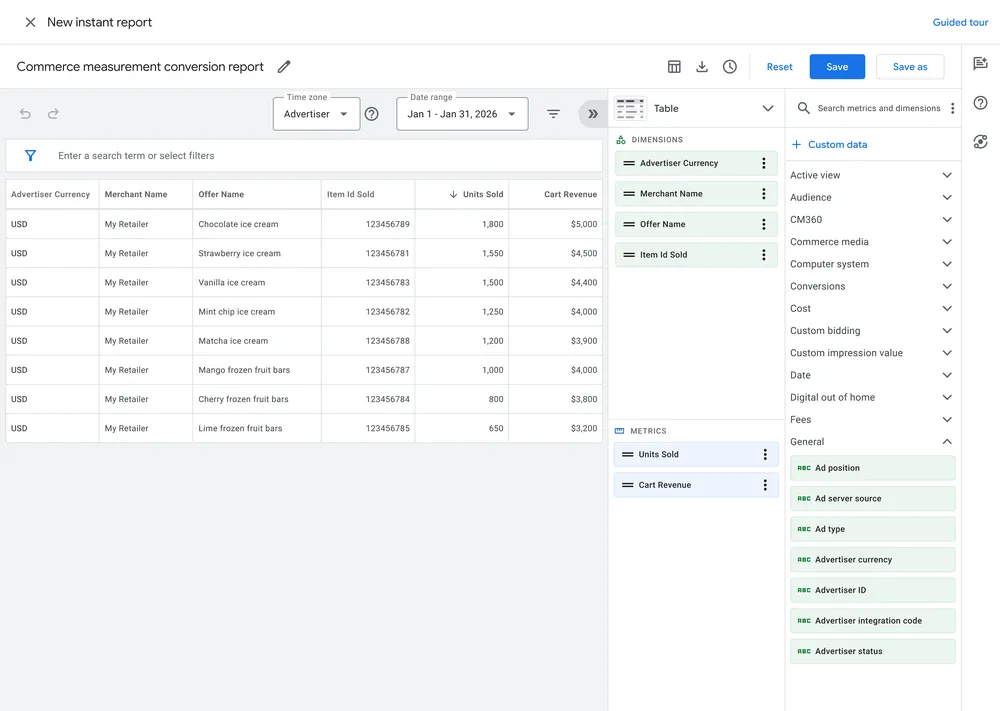
Google today announced that Kroger is collaborating with Display & Video 360 through the Commerce Media Suite. For the first time, brands will be able to reach Kroger audiences - built from retail purchase signals - across YouTube and premium publishers. Google is also introducing SKU-level reporting, tying individual product sales at Kroger directly back to DV360 media spend.
"For the first time, brands will be able to reach Kroger audiences built from retail purchase signals across YouTube and premium publishers," Martinez said. The SKU-level reporting element closes what has been a persistent measurement gap: connecting media investment to specific product sales at the retailer level rather than relying on broader conversion proxies. Martinez demonstrated the capability using a hypothetical CPG snack brand targeting a soccer match watch party - identifying a loyal buyer via Kroger's first-party data in DV360, serving a CTV ad in the living room, re-engaging on YouTube Shorts, and measuring whether those chips ended up in the Kroger.com cart.
The Kroger addition extends a Commerce Media Suite that has been growing quickly since its launch. Martinez said over 30 of the world's leading retailers have now joined. Criteo became Google's first onsite retail media partner for Search Ads 360 in September 2025, and the Kroger collaboration today further broadens the retail data network available within DV360. "That is the power of our Commerce Media Suite, where you can reach Kroger shoppers across YouTube and other streaming players, plus SKU sales level reporting to close the loop on ROI," Martinez said.
Google also noted that 81% of people who discover something on social media platforms such as Meta or TikTok return to Google Search to learn more - a figure Martinez used to illustrate why integrating Search and video campaigns within a single platform produces incremental value that neither channel delivers alone. Adding an extra GMP product to an existing ad stack, she said, delivers a 76% lift in ROAS based on data from advertisers already using the platform.
Ads Advisor: general availability and new agentic capabilities
The DV360 version covers three stages of campaign management. For campaign setup, a Campaign Builder feature - coming soon - allows an advertiser to upload a media plan and have the system automatically generate a complete campaign configuration. Reardon explained that the agent draws not only from the uploaded plan but from data previously held in the platform. "Thanks to our deep reasoning capabilities, our agents collect information, not just from her media plan, but from data previously uploaded. No more siloed tools," he said.
For campaign optimization and monitoring, Ads Advisor can diagnose creative rejections and explain the cause in seconds. Because different publishers maintain different creative policies, identifying why an ad was rejected has historically required escalating to multiple teams. "Without Ads Advisor, you would need to seek help to discover what is wrong with the creative," Reardon noted. With it, the system surfaces the specific policy issue and the fix immediately.
For campaign reporting, Reardon demonstrated a generative AI capability that creates custom dashboards on request. The example he gave: "show me a bar chart of CTR across the top five geos and overlay it with a CPM trend." The interface responds in real time, generating the visualization without requiring the user to navigate through reporting tabs or configure custom charts manually. "Those days are gone," Reardon said. Coming soon, the system will automatically create tailored dashboards with customizable metrics. "It only takes one prompt to elevate your impact," he said.
The agent capabilities Reardon demonstrated go beyond automation as it has traditionally been understood in programmatic advertising. Because Campaign Builder draws on historical campaign data when setting up a new campaign, the system arrives at launch already incorporating prior performance signals. "Our campaigns are optimized from the start," Reardon said. "That way, AI can deliver the most valuable connections."
The Ads Advisor launch in DV360 follows a sequence of agentic capability rollouts that PPC Land tracked through Think Week 2025 in September, when Google introduced AI-powered advisors across Google Ads and Analytics, with Ads Advisor reaching 50% of eligible users globally at the time. Today's announcement extends that to full availability within DV360.
Advertiser case studies: PepsiCo and ESPN
Two brand case studies provided external validation for the platform's capabilities. Amanda Cheung, Lead Media Strategy, Planning and Investment at PepsiCo, described the company's evolving use of DV360 in terms of a five-S framework - streaming, scrolling, searching, shopping, and a fifth S PepsiCo added itself: sense, meaning real-world engagement. "The traditional consumer journey of awareness, consideration, purchase is no longer linear. Instead, it has expanded, fragmented and blurred," Cheung said.
In 2025, PepsiCo shifted certain CTV and audio publishers from direct buys to programmatic within DV360 to gain efficiency. The company now manages YouTube, CTV, and audio together within the platform across both its foods and beverages portfolio. PepsiCo was also an early adopter of Video Reach Campaigns 2.0, an AI-powered bidding strategy that allocates spend automatically across YouTube formats - in-feed, bumpers, in-stream, and Shorts - in real time. "We began with just a few test brands and those tests showed both higher reach and reduced CPM costs," Cheung said, adding that PepsiCo has since scaled VRC 2.0 to all divisions, with nearly 100% adoption in the United States and over 60% in select global markets, reaching up to 90% in some.
PepsiCo also participated in a beta test of YouTube Mastheads and Pause Ads within DV360. For the Lay's Super Bowl campaign in early 2026, the company used high-impact YouTube Masthead placements in early January, generating 46 million impressions on the first day alone. The ad, titled "Last Harvest," subsequently ranked second on USA Today's Super Bowl Ad Meter. Cheung also mentioned use of YouTube AdBlitz to amplify the campaign around the Super Bowl - a placement platform Google offers specifically for the event.
ESPN provided the second case study. Inna Kern, VP of Media Strategy and Planning at ESPN, described using DV360 to manage the launch of a direct-to-consumer service in the fall of 2025. "By unifying our media on Google's Display & Video 360, we could draw in both upper funnel awareness to build relationships with fans and go all the way down to acquisition, converting fans at the right price for the best value," Kern said. Unifying ESPN's media on DV360 produced a 28% increase in reach and saved over one million dollars through frequency capping.
What this means for the marketing community
The NewFront 2026 presentation is the culmination of a sequence of moves that PPC Land has tracked since at least the May 2025 NewFronts, when Google first positioned DV360 as an end-to-end AI-powered platform for CTV. Today's announcements represent specific product launches rather than roadmap previews, which gives marketing teams something concrete to evaluate.
Three dynamics stand out. First, the live sports biddable suite directly addresses a gap that programmatic buyers have encountered when moving budgets from linear television. The volume and latency requirements of live event bidding are structurally different from on-demand inventory, and standard programmatic tools have not handled them reliably. Second, Confidential Publisher Match introduces a technical architecture for combining first-party data with publisher signals that operates within hardware-enforced privacy boundaries - a meaningful distinction as regulatory scrutiny of data matching practices continues across jurisdictions. Third, SKU-level reporting in the Commerce Media Suite narrows the measurement gap between media spend and product sales in a way CPG advertisers have long requested from retail media networks.
The question of whether Google's AI capabilities within GMP translate into measurable performance advantages remains open. The figures cited during the event - 76% ROAS lift, 28% reach increase, 46 million impressions on day one - are presented in the context of brands already using GMP and are not independently verified benchmarks. Martinez summarized the platform's ambition plainly: "The world's best AI will now deliver you the best ROI. And it's only possible in Google Marketing Platform." Marketing teams evaluating whether to consolidate buying activity within GMP will need to weigh that claim against their own data and their current stack configurations.
Timeline
April 2024 - Google presented DV360 updates at NewFront 2024, introducing instant deals and expanded streaming partnerships.
May 5, 2025 - Google presented at IAB NewFronts 2025, announcing DV360 reached 98% of US CTV households and over 5 billion hours of ad-supported viewing monthly; Bill Reardon demonstrated end-to-end generative AI integration in DV360.
September 10, 2025 - Think Week 2025 introduced agentic AI advisors across Google Ads, Analytics, and Marketing Platform, with Ads Advisor reaching 50% of eligible users globally.
March 23, 2026 - Google NewFront 2026 livestream aired at 11:30 AM ET from Pier 57 in New York City, introducing the live sports biddable suite, Confidential Publisher Match with Roku, Kroger Commerce Media collaboration with SKU-level reporting, YouTube Mastheads and Pause Ads in DV360, and general availability of Ads Advisor for DV360 users.
Summary
Who: Google Marketing Platform, presented by Kristen O'Hara (VP, Google), Marta Martinez (Managing Director, Americas, Google Marketing Platform), Bill Reardon (General Manager, Enterprise Platforms), and Zach Gleicher (product manager, Google DeepMind). Brand speakers included Amanda Cheung (Lead Media Strategy, PepsiCo) and Inna Kern (VP Media Strategy, ESPN).
What: Google launched the Gemini advantage in Google Marketing Platform, comprising: a live sports biddable suite for Display & Video 360 designed to handle real-time bid request spikes during live streaming events; Confidential Publisher Match, a Trusted Execution Environment-based identity framework launching first with Roku; Kroger as a new Commerce Media Suite partner with SKU-level conversion reporting; YouTube Mastheads and Pause Ads now accessible within DV360 with additional frequency controls and measurement; and Ads Advisor now generally available for DV360 users, covering campaign setup via Campaign Builder, creative rejection diagnosis, and generative AI reporting dashboards.
When: The event aired on March 23, 2026, beginning at 11:30 AM ET, with the announcement originally confirmed on February 26, 2026 by Bill Reardon. The livestream ran 64 minutes and is available on-demand.
Where: The presentation was held at Pier 57 in New York City as part of Google NewFront 2026, with a global livestream accessible to registered attendees.
Why: Google is embedding the Gemini 3 model across its marketing platform stack to address fragmentation in campaign management, the scale requirements of live sports programmatic buying, and the measurement gap between CTV impressions and retail purchase outcomes. The commercial logic is consolidation: Google is making a case that combining inventory, data, and AI optimization within a single platform produces incremental ROAS that fragmented stacks cannot replicate.
Share this article
The link has been copied!
Your link has expired. Please request a new one.
Your link has expired. Please request a new one.
Your link has expired. Please request a new one.
Great! You've successfully signed up.
Great! You've successfully signed up.
Welcome back! You've successfully signed in.
Success! You now have access to additional content.