Google's Liz Reid on why search won't die when AI answers everything
Google Search VP Liz Reid addresses AI Overviews growth, the ChatGPT rivalry, agents reshaping the web, and why personalization may be Search's strongest card.


Google Search VP Liz Reid addresses AI Overviews growth, the ChatGPT rivalry, agents reshaping the web, and why personalization may be Search's strongest card.
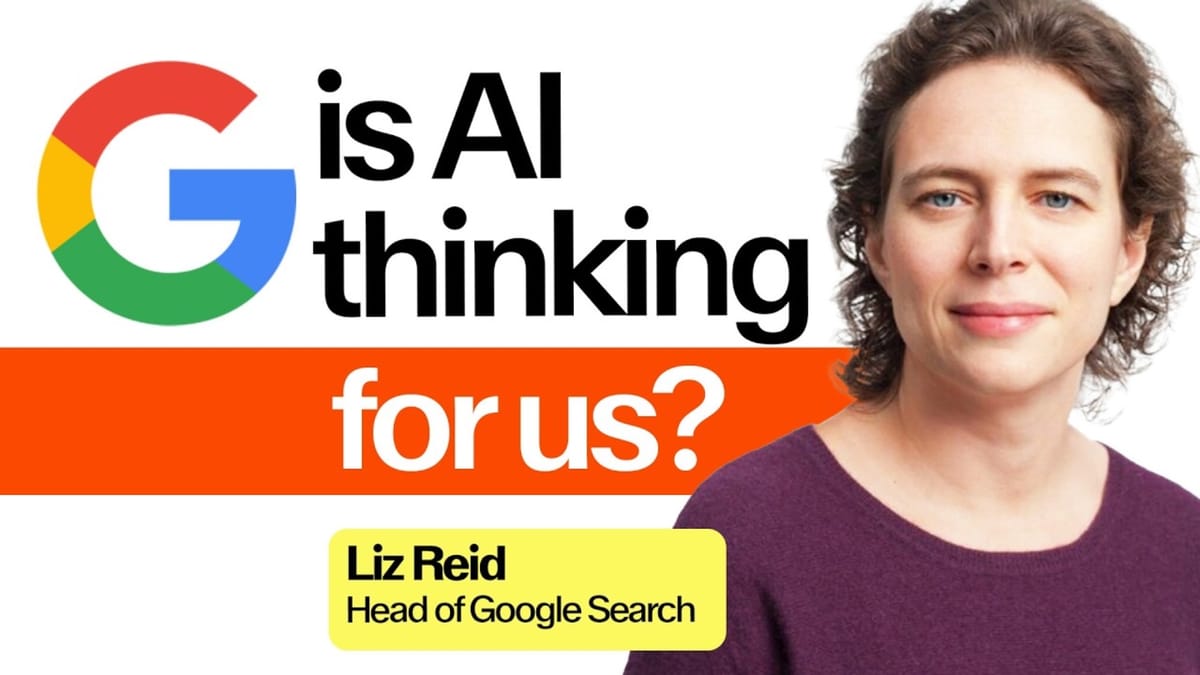
Google's head of search yesterday addressed one of the industry's most debated questions: what happens to the world's most used information product when artificial intelligence can answer almost anything? Liz Reid, VP and head of search at Google, sat down with journalists Alex Heath and Ellis Hamburger on the Access podcast, published March 6, 2026 on YouTube, and spoke with unusual candor about a product she has steered through what she described as the most consequential period in its 25-year history.
The episode, which had gathered 367 views within a day of publication, arrives at a moment of genuine uncertainty for the search industry. AI Overviews are reshaping how billions of people encounter information online, ChatGPT's market share has eroded from 86.6% to 64.6% over the course of 2025, and the question of whether Google Search and Gemini are converging into a single product now has real strategic weight.
Reid, who joined Google roughly 22 years ago as one of the first female engineers in the company's New York office - when fewer than 2,000 people worked at the firm - has become the public face of a team navigating an unusually fast-moving transition. She moved from Google Maps to search during the early period of the pandemic, joining a division that was, in her description, "in a few different pieces." Taking full leadership came later, at a point when competitors and press were speculating openly that ChatGPT might eat search's lunch.
Reid did not shy away from the competitive pressure. She acknowledged that users like one of the podcast hosts were mixing ChatGPT, Claude, and Google in their daily information habits, often reserving search for more habitual tasks. Her response was less a defensive argument and more an empirical one. According to Reid, the overall volume of questions people ask is growing, not shrinking. "People are using the tools collectively much more," she said, "and so there's a lot of growth."
She compared the current period to earlier platform shifts - mobile in particular. When mobile arrived, she noted, it "was a big question for Google. Google was a desktop product." The company ended up stronger through it. The implication was clear: the size of the pie matters more than the distribution of slices.
That argument has some data behind it. Google reported during its third-quarter 2025 earnings call that AI Overviews were driving more than 10% additional queries globally for the types of searches where they appear. Alphabet's consolidated revenue reached $102.3 billion in that quarter, a 16% year-over-year increase. Reid herself pointed to the speed of AI Overviews adoption as a surprise, noting that users picked up the feature faster than Google typically expects when changing familiar interfaces. "I have been surprised by how fast people appreciated AI Overviews, started using AI Overviews, just started searching more," she said.
Still, the picture is complicated for the marketing community. Independent research has documented organic click-through rate declines of up to 54.6% year-over-year for AI Overview queries, a figure that Google has publicly disputed. The company's own position, stated by Reid in August 2025, was that "average click quality has increased" and that Google was "sending slightly more quality clicks to websites than a year ago." The gap between what Google reports and what publishers measure remains one of the central tensions in the search industry today.
One of the more technically revealing exchanges in the episode concerned the history of large language models inside Google Search. Reid confirmed that AI has been embedded in search long before the public phase of the generative AI boom. BERT, the transformer model Google integrated into search results years before ChatGPT existed, was used primarily on the ranking side rather than in the user interface. The reason was not capability but latency.
"People on search are sensitive to 100 millisecond difference," Reid explained. "They will search more or less for 100 milliseconds." That constraint meant that even when early language models showed promise for generating user-facing summaries, Google could not ship them without degrading the experience. The models were fast enough for offline, pre-processed ranking signals but not for live response generation.
MUM, which followed BERT as a more powerful model capable of multi-modal and multi-lingual tasks, faced similar constraints. According to Reid, these tools were "mostly used in limited use cases because the quality wasn't good enough" and the speed wasn't there. The improvement in model efficiency - not just model capability - was what ultimately unlocked AI Overviews as a product. "It was fast enough for people and it was good enough for people to be net better," she said.
This historical context matters for understanding why Google's AI search push, which observers sometimes characterize as a panicked response to OpenAI, is more accurately described as the maturation of a long-running technical roadmap. Google integrated Gemini 3 into search on January 27, 2026, making it the default model for AI Overviews globally and enabling seamless transitions from AI Overview summaries into conversational AI Mode exchanges - a capability that had been in testing since December 1, 2025.
The most strategically significant portion of the interview covered the relationship between Google Search and the Gemini app. From the outside, AI Mode and Gemini increasingly look like the same product. Reid's explanation of the internal distinction was precise, if not entirely settled.
According to Reid, the Gemini app is oriented around productivity and creation - it "tends to lean in more heavily on things like productivity or creation." Search, by contrast, is "more information based" and specifically designed to surface the open web, connecting users with content from other people rather than producing answers in isolation. "How do you bring out the web?" she asked rhetorically. That orientation toward external sources is what distinguishes Search's design philosophy from Gemini's assistant model.
Whether the two products converge over time, Reid said she genuinely did not know. "I think what we see is some areas they're converging more and some areas they're diverging more." She also raised a third possibility: that agents might eventually produce a product that is neither Search nor Gemini but something that subsumes both. Google executives had hinted at a unified AI search interface as recently as November 2025, though technical and strategic differences between the products remain significant.
For advertisers and marketers, the distinction carries real implications. AI Mode queries run two to three times longer than traditional search queries, according to figures Reid shared in a June 2025 interview. Longer queries carry stronger intent signals, which theoretically supports more precise targeting. Adthena detected the first ads inside Google AI Overviews in November 2025, finding 13 instances across 25,000 search engine results pages at a frequency of 0.052%. The scale of monetization across AI search features remains nascent.
One of the more forward-looking exchanges in the episode concerned the possibility that AI agents - not humans - could eventually become the dominant users of Google Search. Reid did not dismiss the scenario. "I certainly think there will be a world in which agents are doing a lot of interaction on the internet, not just people," she said. But she pushed back against a fully agent-mediated future: "I personally don't believe in a world where it's all agents. People sometimes want to hear directly from other people."
The nuance matters for anyone thinking about how advertising and content discovery work in an agentic environment. If agents are the ones issuing queries and fetching results on behalf of users, the relationship between search, clicks, and commercial intent changes fundamentally. Google's December 2025 documentation on how AI search might develop into a full agent system suggests the company is actively thinking through what task completion - rather than information retrieval - means for its core product. Reid's framing was that the impact on Google is "all about how we all navigate the innovation space," and that done well, agents represent an opportunity rather than a threat.
The episode's most commercially significant discussion concerned personal intelligence, Google's feature allowing users to opt in to context-aware search that draws on their Gmail, Calendar, and past search history. Reid described a colleague who, stranded in an airport, asked Google what to do. The response pulled from his profile: a recommendation for a specific store in his terminal, advice on when to leave for the gate, and information about lounge access through a credit card he held. "A bunch of things that he wouldn't have even thought to ask," she said.
The feature requires explicit opt-in. Reid was clear that forced personalization was not the design intent. "If you want your information siloed, you should be able to keep the information separate." The strategic argument, however, is that Google has years of behavioral data across more users than any competitor, and that AI's ability to synthesize that data could become a retention mechanism no rival can easily replicate. When asked directly whether Google has more context on users than any other company, Reid acknowledged: "I do think in a bunch of cases we do know a bunch and AI's ability to parse it together is doing that."
For marketing professionals, the personalization layer has implications for both targeting and measurement. If search increasingly routes queries through user-specific context, the aggregate signals that have underpinned keyword-level campaign optimization become harder to generalize. The industry is already grappling with the structural shift that publishers describe as the "Great Decoupling" - more impressions, fewer clicks - and personalization adds another variable to an already unstable measurement environment.
Reid addressed the proliferation of low-quality AI-generated content with notable directness. Her position was that AI slop is a scaled-up version of a problem Google has always faced. "People would pay people in other countries to create rip-off, essentially surface-level content," she said. "AI slop allows them to create it faster. It's not a new problem. It's just sort of the next level scale of the problem."
She drew a distinction between using AI as a tool to produce better content and using it to produce slop at scale. "Did you use AI as a tool, or did you create slop?" The editorial and commercial implications of that question are significant. Google's spam detection, which Reid described as a "cat and mouse game" that is "never done," has to distinguish between the two. Google's June 2025 core update required 16 days to complete - the most extensive rollout time of any update in recent memory - and the ongoing challenge of AI-generated spam was a factor in the extended processing window.
For publishers, Reid pointed to what she sees as a structural shift toward user-generated content, podcasts, and direct creator relationships. She noted that audiences are increasingly "listening to more podcasts, hearing directly from more creators than influencers." The challenge for search, she acknowledged, is indexing content that increasingly lives behind paywalls, in audio files, or in proprietary platforms. The multimodal capabilities of large language models - their ability to process audio and video - offer a partial answer, enabling Google to index formats it could not previously parse at scale.
One practical outcome Reid flagged was Google's effort to strengthen connections between users and specific publishers they already trust. Personalized search, she suggested, should surface content from sources a user subscribes to or has engaged with repeatedly - not treat all sources equally for all people. "If a user loves Access and they ask a question and you had a great story on it, the question shouldn't rank equivalently for six billion people. It should surface higher for me."
Publishers seeking to exclude their content from AI Overviews without losing standard search visibility currently face what Google itself described as a "huge engineering challenge", according to a February 2026 statement from Sulina Connal, Google's managing director for news and book partnerships in Europe. The UK's Competition and Markets Authority has already proposed binding requirements for granular opt-out controls, with implementation in the first half of 2026 classified as a Category 1 priority.
The interaction between subscriptions and search ranking is an area Reid described as nascent but important. The specific mechanism - how a user's subscription status feeds into result ordering - remains underdeveloped by her own account. But the direction of travel, toward personalized source weighting, has clear implications for how publishers and advertisers think about audience relationship management as an SEO factor.
For practitioners managing paid and organic search programs, the Access interview offers several signals worth tracking. First, Reid's framing of search growth as expansionary rather than redistributive aligns with Google's financial results but conflicts with the traffic data many publishers report. That tension has not resolved, and the first ads in AI Overviews represent the beginning of a monetization experiment whose outcome remains genuinely uncertain.
Second, the personal intelligence framing suggests that contextual relevance - informed by user behavior history across Google's ecosystem - could become a more important ranking signal. Advertisers with strong first-party data strategies and publishers with loyal, engaged audiences may see structural advantages.
Third, the agent question is not theoretical. Reid confirmed that Google is actively designing for a world in which agents are significant users of search infrastructure. What that means for impression volumes, bid strategies, and conversion attribution is an open question, but it is one the industry will need to answer within a timeframe that is closer than most planning cycles assume.
Elizabeth Reid shared the episode on LinkedIn the same day it published, writing: "Such a fun conversation. We covered a lot - from how we're rethinking personalization to where Search is headed, and what it's like leading the team during such a massive shift in tech. I'm so optimistic about the future of the web and the expansionary moment we're in."
Who: Liz Reid, VP and head of Google Search with approximately 22 years at the company, speaking with journalists Alex Heath (author of the Sources newsletter) and Ellis Hamburger (co-founder of Meaning) on the Access podcast, part of the Vox Media Podcast Network.
What: A wide-ranging interview covering how AI Overviews and AI Mode are changing Google Search, the competitive dynamics with ChatGPT and the Gemini app, the possibility of agents becoming the primary users of search infrastructure, Google's personal intelligence personalization feature, the challenge of AI-generated content spam, and the future relationship between search and publishers.
When: The episode was published on March 6, 2026, on YouTube. Elizabeth Reid shared it on LinkedIn the same day. The recording is approximately one hour and six minutes long.
Where: The podcast is distributed across major audio platforms and YouTube under the Access brand. The conversation covered developments affecting Google Search globally, with particular reference to AI Mode rollout, publisher concerns, and competitive dynamics in the United States and European markets.
Why: The interview carries significance for the marketing community because Reid's statements provide direct insight into how Google's search leadership is thinking about AI Overviews monetization, the future structure of search products, personalization as a strategic differentiator, and the handling of content quality in an environment where AI-generated material continues to scale. Her views on the agent-mediated web and the divergence or convergence of Search and Gemini directly affect how paid search practitioners, SEO professionals, and publishers should be planning their strategies over the next two to three years.