
IAB Europe's 383-question guide finally maps who owes what to whom in ad tech
IAB Europe's Programmatic Working Group released an updated supply chain transparency guide on April 9 with 383 questions across 11 nodes and 39 edges.

IAB Europe's Programmatic Working Group released an updated supply chain transparency guide on April 9 with 383 questions across 11 nodes and 39 edges.
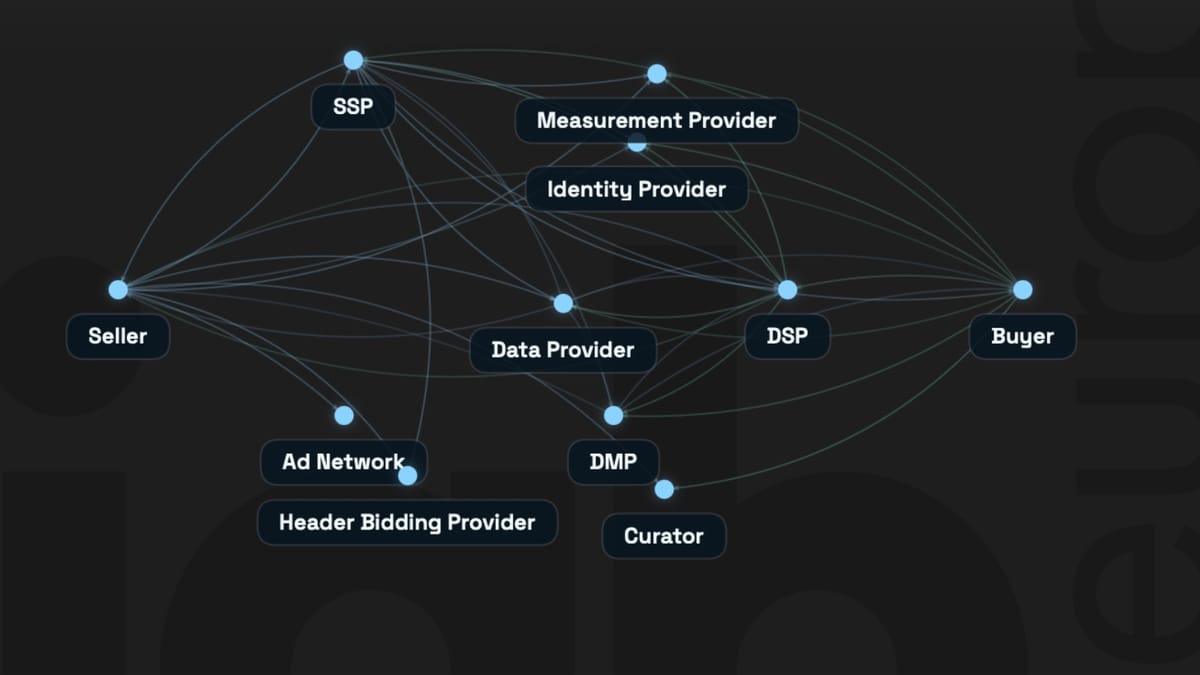
IAB Europe published on April 9, 2026 an updated version of its supply chain transparency guidance, presenting a structured set of 383 questions distributed across 11 stakeholder nodes and 39 relational edges in a new interactive graph format. The release, credited to Lauren Wakefield and the organization's Programmatic Working Group, replaces what had been a static document first introduced in 2018 with an interactive tool designed to surface the right questions for each pair of counterparties in the digital advertising supply chain.
The shift from a downloadable guide to a navigable graph is not cosmetic. The format acknowledges a structural reality: most participants in programmatic advertising occupy a specific position in a network of relationships, and the questions relevant to a DSP talking to an SSP differ substantially from those relevant to a seller talking to an identity provider, or a buyer evaluating a data provider. The old format delivered all of that in a single document. The new one routes users through the specific edges that affect their work.
According to the published guidance, the interactive graph maps 11 distinct node types: Seller, SSP, DSP, Buyer, Data Provider, DMP, Identity Provider, Measurement Provider, Ad Network, Header Bidding Provider, and Curator. Between those nodes, 39 directional edges define the relationships where questions apply. The 383 questions in the dataset are tagged by category - Cost, Data, GDPR, Identity, Inventory, Measurement, Fraud, SPO, Consent, Sustainability, and Ads.txt - and each question is assigned to a specific origin-destination pair.
The question set is technically detailed and operationally specific. In the SSP-to-DSP edge alone, the guidance asks whether the DSP supports ad-podding, whether it supports OMSDK, whether it utilizes bid shading across auctions, whether its video supply supports VAST 2.0 or VAST 4.2 and at what percentage of overall offering, and what method is used for impression counting. Questions on the SSP-to-DSP edge also cover the split between PMPs and open market demand, the proportion of direct demand versus agency demand versus intermediaries, and how the DSP responds to a bid request without GDPR signals.
The data layer of the guide reflects the complexity that has accumulated around first-, second-, and third-party data distinctions. Questions addressed to data providers include whether data can be applied cross-device and whether that cross-device application is deterministic or probabilistic - a distinction that carries real weight in an environment where identity resolution methodologies vary considerably and where regulators have shown interest in how audience profiles are constructed. The guidance asks whether data is collected in a GDPR-compliant way, under which legal basis data is collected and shared, and what the audience match rate is. It also asks whether data is modelled, and if so, what modelling has been applied.
DMPs face a parallel but distinct set of questions. The guidance asks how long data will be retained, how data was collected and the audience profiled, whether data will be matched to other data and if so how, and whether data will be shared with additional parties. For DMPs, the guidance also requests match rates to common activation platforms - a practical operational question for any buyer trying to understand effective reach across connected environments.
The identity provider edge of the graph addresses one of the most technically contested areas in programmatic advertising. According to the guidance, stakeholders should ask whether an identity solution provides addressability in cookie-restricted browsers and what the step-by-step workflow is for propagating the identifier. The guidance requests monthly active addressable user counts specifically for Safari, Firefox, and Edge - browsers that have restricted or eliminated third-party cookies and that together represent a substantial proportion of European web traffic.
The question about publisher integration lists is also present: the guidance asks whether an identity provider can supply a list of publishers integrated with a first-party addressability solution. That question matters because scale claims for identity solutions depend entirely on publisher adoption, and adoption is often described in aggregate rather than surfaced as verifiable inventory.
On inventory questions, the guidance probes several areas that have historically been sources of opacity. The SSP-to-Seller edge asks whether the top level domain or complete page URL is passed, whether the URL is transparent or masked, whether the inventory is owned and operated or exclusive, whether the app ID or bundle ID is passed, and whether third-party verification vendors can track URLs. These questions correspond directly to the mechanisms that enable or obstruct fraud detection: masked URLs prevent verification vendors from assessing page content, and absent bundle IDs make it impossible to validate app inventory against app-ads.txt.
The guidance also addresses header bidding providers, asking whether wrapper fees or integration maintenance fees are charged to SSPs, and what the process is for resolving reporting discrepancies between wrapper-recorded wins and SSP-recorded impressions. Discrepancy resolution is an unglamorous but consequential part of programmatic operations, and formalizing the expectation that partners should have a defined process for it brings that into the transparency framework.
Sustainability as a formal category
The 2026 update includes sustainability as a distinct question category. The SSP-to-Measurement Provider edge asks whether carbon emissions reporting is provided, and whether the measurement provider can help identify and reduce high-carbon supply and demand paths. That framing positions carbon reduction not as a brand statement but as an operational question between counterparties - something measurable and contractually relevant.
European publishers showed 73% adoption of supply chain transparency standards as of August 2025, with IAB Europe's research examining 2,054 European online news publishers on ads.txt, sellers.json, and SupplyChain object implementation. The new interactive guide now extends the transparency conversation upstream into the questions counterparties should be asking each other before and during commercial relationships, rather than examining only the technical signals present in the bid stream.
One question in the SSP-to-Measurement Provider edge asks how attention time is calculated, specifically whether the calculation includes eye-tracking proxies, scroll speed, or hardware signals. That level of specificity reflects where the attention measurement conversation has arrived in 2026. It is no longer sufficient to reference attention as a category; the methodology determines whether metrics from different providers are comparable, and the guidance treats that as a question worth asking at the supply chain level.
DoubleVerify partnered with Impact Plus in June 2025 to provide carbon footprint measurement across digital advertising supply chains - a development that PPC Land covered when the tools were announced. The IAB Europe guidance now operationalizes the expectation that SSPs should be able to ask their measurement partners whether carbon reporting exists and whether high-carbon paths can be identified. That represents a shift from carbon measurement as a voluntary brand initiative to carbon reporting as a supply chain accountability question.
Supply path optimization is explicitly tagged in the guidance. The SSP-to-DSP edge asks how the DSP performs SPO and which factors are taken into account. That question matters because SPO practices differ considerably across buyers, and the degree of transparency DSPs offer into their path selection logic directly affects whether SSPs and sellers can understand why certain inventory is or is not selected. IAS introduced automated supply path optimization tools in January 2026 that connect post-bid transparency with pre-bid optimization - exactly the kind of workflow the IAB Europe guidance is trying to ensure stakeholders can evaluate through direct counterparty questioning.
GDPR appears as a tag on questions across multiple edges. The guidance asks both SSPs and sellers whether they are passing IAB Europe Transparency and Consent Framework signals and managing data according to the consent and purpose given by the user. For DMPs, it asks under which legal basis cookies are being stored in line with GDPR and national legislation. IAB Europe's TCF enforcement procedures surged 118% to 587 in 2025, with 953 vendors and 181 CMPs registered in the framework. Against that enforcement backdrop, the supply chain transparency guidance adds a practical layer: partners should be able to answer these questions, and the inability to do so is itself informative.
The TCF's legal status has also continued to evolve. The Belgian Market Court issued a significant ruling in May 2025 - covered in detail by PPC Land - that confirmed IAB Europe as a joint controller but limited that role to TC String processing within the TCF itself, rather than extending to subsequent OpenRTB processing. The consent-related questions in the supply chain transparency guidance operate within that clarified legal framework.
The supply chain transparency guidance is not the only substantive document IAB Europe's working groups have produced in recent weeks. The organization's CTV Working Group and Programmatic Working Group jointly published the Guide to Programmatic for CTV on April 4, 2026, covering SSAI, OpenRTB, app-ads.txt, sellers.json, TCF consent in CTV, six ad format definitions, fraud - including PARETO and BADBOX 2.0 - and measurement. That guide noted 18 CMPs validated for CTV and 466 vendors registered to the TCF supporting CTV environments.
The supply chain transparency guide published on April 9 complements that CTV output by ensuring that regardless of channel - web, app, or CTV - the structural questions between counterparties are framed consistently. The graph format allows the same framework to absorb future additions, which is relevant given how quickly inventory types and supply chain configurations have been changing.
According to the IAB Europe announcement, the interactive version will continue to be updated to reflect industry developments and priorities. The Programmatic Working Group welcomes collaboration on the project - a framing that positions the graph as a living document rather than an annual publication cycle, which is a notable departure from how the 2018 guide was maintained.
The transparency conversation in digital advertising has often focused on what can be observed in the bid stream - ads.txt entries, sellers.json records, SupplyChain objects. Those signals exist in the technical layer and can be checked programmatically. What the IAB Europe guide addresses is a different layer: the questions that buyers, sellers, and intermediaries should be asking each other directly, in commercial conversations, before and alongside the technical signals.
That distinction matters because not everything relevant to a supply chain relationship is encoded in a bid request. Carbon reporting, modelling disclosures, SPO methodology, identity solution architecture, data collection legal basis, wrapper fee structures, and attention calculation methods are all areas where the guidance creates an expectation that counterparties should have answers. The graph format makes it easier to identify which questions apply to a specific relationship, which reduces the effort required to ask them systematically rather than selectively.
The question set has now grown to 383 items across 39 edges. Whether individual market participants use it selectively or comprehensively depends on their appetite for accountability - but its existence means that a partner who cannot answer these questions has a harder time claiming transparency as a selling point.
Who: IAB Europe's Programmatic Working Group, with the post credited to Lauren Wakefield. The guidance addresses all participants in the digital advertising supply chain - sellers, SSPs, DSPs, buyers, data providers, DMPs, identity providers, measurement providers, ad networks, header bidding providers, and curators.
What: An updated supply chain transparency guidance document, now published in interactive graph format, containing 383 questions organized across 11 stakeholder nodes and 39 relational edges. The guidance covers data, cost, inventory, identity, GDPR compliance, measurement, fraud, supply path optimization, consent, sustainability, and ads.txt. It is designed to help each stakeholder group identify the questions to ask counterparts at different stages of the supply chain.
When: Published April 9, 2026, by IAB Europe. The guidance was first introduced in 2018 as a static document and has been updated periodically since then. The 2026 version introduces the interactive graph format for the first time.
Where: Published on the IAB Europe website. The interactive graph is accessible directly from the announcement. The guidance applies to the European digital advertising market and to global participants operating within European regulatory frameworks.
Why: Transparency across the programmatic supply chain remains contested, with multiple layers of intermediaries between advertiser and publisher creating opacity around costs, data usage, identity methodology, and inventory quality. The guidance provides a structured framework for counterparties to request accountability from each other through specific, documented questions - extending the transparency conversation beyond what technical bid stream signals can reveal.